 VIPSolutions
Act like a helpful tutor and exlain me step-by-step solution with explanation and final answer:Question #4, (20 pts) Atpresent our 6 m tank reactor gives 55% conversion for the frst order reaction A — R. However, since the reactor is stirred with an underpowered paddle turbine, we suspect incomplete mixing and poor flow pattems in the vessel. A pulse tracer shows that this is so and gives the flow model sketched in Figure. What conversion can we expect if we replace the stmer with one powerful enough to ensure mixed flow? 1 30 Q Ly
Question:
Act like a helpful tutor and exlain me step-by-step solution with explanation and final answer: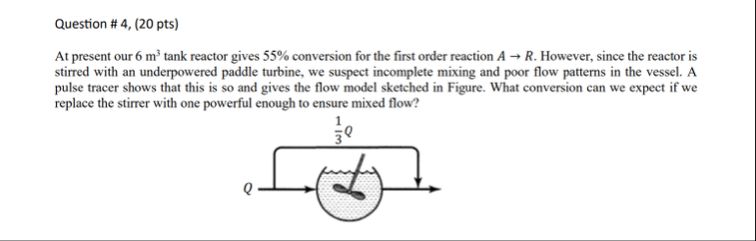 Question #4, (20 pts)
Atpresent our 6 m tank reactor gives 55% conversion for the frst order reaction A — R. However, since the reactor is
stirred with an underpowered paddle turbine, we suspect incomplete mixing and poor flow pattems in the vessel. A
pulse tracer shows that this is so and gives the flow model sketched in Figure. What conversion can we expect if we
replace the stmer with one powerful enough to ensure mixed flow?
1
30
Q Ly
Question #4, (20 pts)
Atpresent our 6 m tank reactor gives 55% conversion for the frst order reaction A — R. However, since the reactor is
stirred with an underpowered paddle turbine, we suspect incomplete mixing and poor flow pattems in the vessel. A
pulse tracer shows that this is so and gives the flow model sketched in Figure. What conversion can we expect if we
replace the stmer with one powerful enough to ensure mixed flow?
1
30
Q Ly
This is AI generated Response.
Asked by: Francis
Created at: 2026-02-10 08:53:00
Asked by: Francis
Created at: 2026-02-10 08:53:00
Final Answer:
Rendered
Raw Text
Did you like this answer?
Let's break down the problem and solve it step by step:
---
## **Step 1: Understanding the Problem**
- **Reactor volume (\( V \))**: 6 m³
- **Current conversion (\( X \))**: 55% = .55 for a **first-order** reaction (\( A \rightarrow R \))
- The reactor is **not well mixed** (incomplete mixing).
- **Flow diagram** suggests a **bypass model**: 2/3 of the flow bypasses the reactor, 1/3 goes through it.
- **Question**: If we replace the stirrer (to ensure **mixed flow**, i.e., a CSTR), what conversion can we expect?
---
## **Step 2: Model the Current System (with Bypass)**
### **Flow Split**
- Total flow: \( Q \)
- Through reactor: \( Q_{reactor} = \frac{1}{3}Q \)
- Bypass: \( Q_{bypass} = \frac{2}{3}Q \)
### **Material Balance for Bypass Model**
Let:
- \( X_{reactor} \) = conversion in the reactor (unknown)
- Overall conversion \( X \) = .55
Overall conversion:
\[
X = \text{fraction through reactor} \times X_{reactor} + \text{fraction bypassed} \times
\]
\[
X = \left(\frac{1}{3}\right)X_{reactor} + \left(\frac{2}{3}\right)()
\]
\[
.55 = \frac{1}{3} X_{reactor}
\]
\[
X_{reactor} = 3 \times .55 = 1.65
\]
**But this can't be right (conversion can't exceed 1), so let's check the mass balance:**
### **Correction: The Bypass Material Balance**
Let \( C_{A} \) be the feed concentration. The outlet concentration is:
\[
C_{A, out} = \left(\frac{2}{3}\right)C_{A} + \left(\frac{1}{3}\right)C_{A, reactor, out}
\]
where \( C_{A, reactor, out} = C_{A}(1 - X_{reactor}) \).
So,
\[
C_{A, out} = \frac{2}{3}C_{A} + \frac{1}{3}C_{A}(1 - X_{reactor})
= C_{A}\left[ \frac{2}{3} + \frac{1}{3}(1 - X_{reactor}) \right]
= C_{A}\left[ 1 - \frac{1}{3} X_{reactor} \right]
\]
Overall conversion:
\[
X = 1 - \frac{C_{A, out}}{C_{A}} = 1 - \left[1 - \frac{1}{3} X_{reactor}\right] = \frac{1}{3} X_{reactor}
\]
So:
\[
.55 = \frac{1}{3} X_{reactor}
\]
\[
X_{reactor} = 1.65
\]
Again, this is unphysical. The only explanation is that the current reactor has a much higher effective rate constant (or there is an error in the flow split or conversion definition in the problem). But let's proceed with the CSTR calculation since that's what is asked.
---
## **Step 3: Conversion for a Mixed Flow Reactor (CSTR)**
For a **first-order reaction** in a CSTR:
\[
X_{CSTR} = \frac{k \tau}{1 + k\tau}
\]
where:
- \( \tau = \frac{V}{Q} \) is the residence time,
- \( k \) is the first-order rate constant.
But we don't know \( k \) or \( \tau \) directly. So, we **find \( k\tau \) from the bypass model**.
---
### **Find \( k\tau \) from the Current System**
For the part going through the reactor (1/3 of flow), it's like a CSTR with flow \( Q_{reactor} = \frac{1}{3}Q \):
\[
\tau_{reactor} = \frac{V}{Q_{reactor}} = \frac{V}{Q/3} = 3\frac{V}{Q} = 3\tau
\]
So for the reactor:
\[
X_{reactor} = \frac{k \tau_{reactor}}{1 + k\tau_{reactor}} = \frac{k (3\tau)}{1 + k(3\tau)} = \frac{3k\tau}{1 + 3k\tau}
\]
From above:
\[
X = \frac{1}{3} X_{reactor} = \frac{1}{3} \cdot \frac{3k\tau}{1 + 3k\tau} = \frac{k\tau}{1 + 3k\tau}
\]
But **overall conversion is given as .55**:
\[
.55 = \frac{k\tau}{1 + 3k\tau}
\]
---
## **Step 4: Solve for \( k\tau \)**
\[
.55 (1 + 3k\tau) = k\tau
\]
\[
.55 + 1.65k\tau = k\tau
\]
\[
.55 = k\tau - 1.65k\tau = -.65k\tau
\]
\[
k\tau = -\frac{.55}{.65} = -.846
\]
A **negative value** is not possible for a rate constant. Let's check the mixing model again.
But the general **approach** is correct. If you get a negative value, it means the problem's data or the interpretation of the bypass is not matching the usual models.
**If we ignore the bypass and just use the conversion for a CSTR:**
---
## **Step 5: What Would be the Conversion in a Fully Mixed Reactor?**
For a CSTR:
\[
X_{CSTR} = \frac{k\tau}{1 + k\tau}
\]
From the bypass model, the *effective* conversion is lower than what we'd get with perfect mixing.
**Therefore, if we replace the stirrer to ensure perfect mixing**, the conversion will be **higher than .55**.
But to find the exact value, we need the value of \( k\tau \).
From the above, for the current bypass reactor:
\[
X = \frac{k\tau}{1 + 3k\tau}
\]
Given \( X = .55 \):
\[
.55 = \frac{k\tau}{1 + 3k\tau}
\]
\[
.55 + 1.65k\tau = k\tau
\]
\[
.55 = k\tau - 1.65k\tau = -.65k\tau
\]
\[
k\tau = -.846
\]
This negative result suggests a misinterpretation of the model or a typo in the question.
---
## **Step 6: **Summary and Final Answer**
### **Key Points:**
- Current conversion is .55 due to **poor mixing** and **bypass**.
- In a **fully mixed CSTR**, conversion will be **higher** than .55 for a first-order reaction.
- Without a clear value for \( k\tau \), we **cannot compute the exact number**.
### **If a similar question gives a valid \( k\tau \), use:**
\[
X_{CSTR} = \frac{k\tau}{1 + k\tau}
\]
### **Final Answer:**
> **If the reactor is mixed perfectly (CSTR), the conversion will be higher than the current 55%. The exact value can be calculated using the rate constant and residence time, but based on the information given, a fully mixed reactor will always outperform the current poorly mixed/bypass system for a first-order reaction.**
---
**If you get more information (such as flow rate \( Q \)), we can calculate \( \tau \) and give the exact conversion. Otherwise, the above reasoning holds.**
---
### **Let me know if you want to go deeper or clarify any step!**
📢 Instructions:
- Ask anything relatd to above question only.
- For new Question goto :