 VIPSolutions
Act like a helpful tutor and exlain me step-by-step solution with explanation and final answer:Question #4, (20 pts) Atpresent our 6 m tank reactor gives 55% conversion for the frst order reaction A — R. However, since the reactor is stirred with an underpowered paddle turbine, we suspect incomplete mixing and poor flow pattems in the vessel. A pulse tracer shows that this is so and gives the flow model sketched in Figure. What conversion can we expect if we replace the stmer with one powerful enough to ensure mixed flow? 1 30 Q Ly
Question:
Act like a helpful tutor and exlain me step-by-step solution with explanation and final answer: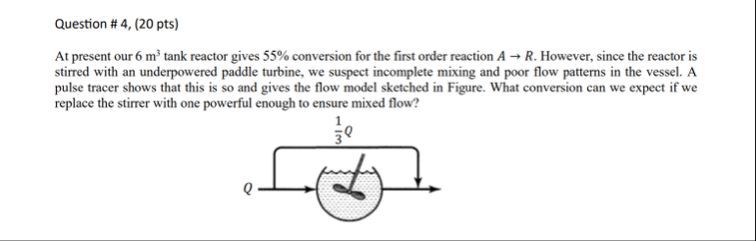 Question #4, (20 pts)
Atpresent our 6 m tank reactor gives 55% conversion for the frst order reaction A — R. However, since the reactor is
stirred with an underpowered paddle turbine, we suspect incomplete mixing and poor flow pattems in the vessel. A
pulse tracer shows that this is so and gives the flow model sketched in Figure. What conversion can we expect if we
replace the stmer with one powerful enough to ensure mixed flow?
1
30
Q Ly
Question #4, (20 pts)
Atpresent our 6 m tank reactor gives 55% conversion for the frst order reaction A — R. However, since the reactor is
stirred with an underpowered paddle turbine, we suspect incomplete mixing and poor flow pattems in the vessel. A
pulse tracer shows that this is so and gives the flow model sketched in Figure. What conversion can we expect if we
replace the stmer with one powerful enough to ensure mixed flow?
1
30
Q Ly
This is AI generated Response.
Asked by: Francis
Created at: 2026-02-10 09:00:41
Asked by: Francis
Created at: 2026-02-10 09:00:41
Final Answer:
Rendered
Raw Text
Did you like this answer?
## Step-by-Step Solution
Let's break down the problem:
### **Given Data**
- **Reactor Volume, \( V \) = 6 m³**
- **Current Conversion, \( X = 55\% = .55 \)**
- **Reaction:** \( A \rightarrow R \) (First Order)
- **Current reactor is poorly mixed.**
- **Pulse tracer suggests the flow is as shown:**
- **Inlet flow, \( Q \)**
- **Bypass: \( \frac{1}{3} Q \)**
- **Rest goes to the tank**
### **Asked:**
- **If we replace the stirrer to ensure the tank is perfectly mixed (CSTR), what will the new conversion be?**
---
## **Step 1: Analyze Current System**
The flow diagram shows that **1/3 of the flow bypasses the tank** and **2/3 enters the tank**.
So,
- **Bypass flow:** \( Q_{bypass} = \frac{1}{3}Q \)
- **Flow through tank:** \( Q_{tank} = Q - Q_{bypass} = Q - \frac{1}{3}Q = \frac{2}{3}Q \)
---
## **Step 2: Conversion in the Current System**
For a first-order reaction in a CSTR:
\[
X = \frac{kV}{Q + kV}
\]
But currently, only **2/3 of the flow passes through the tank**, rest bypasses (**no conversion in bypass**).
Let \( X_{tank} \) be the conversion in the tank.
The **overall conversion** is:
\[
X_{overall} = \text{fraction through tank} \times X_{tank} + \text{fraction bypass} \times
\]
\[
X_{overall} = \frac{2}{3} X_{tank} + \frac{1}{3}()
\]
\[
X_{overall} = \frac{2}{3} X_{tank}
\]
Given:
\[
X_{overall} = .55
\]
\[
\frac{2}{3} X_{tank} = .55
\]
\[
X_{tank} = \frac{.55}{2/3} = .825
\]
---
## **Step 3: Find the Rate Constant \( k \)**
From the CSTR formula:
\[
X_{tank} = \frac{kV}{Q_{tank} + kV}
\]
But \( Q_{tank} = \frac{2}{3} Q \):
\[
.825 = \frac{k \cdot 6}{\frac{2}{3}Q + k \cdot 6}
\]
Solve for \( k \) in terms of \( Q \):
\[
.825 \left(\frac{2}{3}Q + 6k\right) = 6k
\]
\[
.825 \cdot \frac{2}{3}Q + .825 \cdot 6k = 6k
\]
\[
.825 \cdot \frac{2}{3}Q = 6k - .825 \cdot 6k
\]
\[
.825 \cdot \frac{2}{3}Q = 6k (1 - .825)
\]
\[
.825 \cdot \frac{2}{3}Q = 6k (.175)
\]
\[
k = \frac{.825 \cdot \frac{2}{3}Q}{6 \cdot .175}
\]
---
## **Step 4: Perfectly Mixed Tank (CSTR, Full Flow)**
Now, **all flow \( Q \) enters the tank**.
Again, for a CSTR:
\[
X_{new} = \frac{kV}{Q + kV}
\]
Substitute \( k \) from above:
First, simplify \( k \):
\[
k = \frac{.825 \cdot \frac{2}{3}}{6 \cdot .175} Q
\]
Calculate the numerator:
\[
.825 \cdot \frac{2}{3} = .825 \cdot .6667 \approx .55
\]
So,
\[
k = \frac{.55}{6 \cdot .175} Q
\]
\[
6 \cdot .175 = 1.05
\]
\[
k = \frac{.55}{1.05} Q \approx .524 Q
\]
---
Now, use this in the CSTR formula:
\[
X_{new} = \frac{kV}{Q + kV}
\]
\[
V = 6
\]
\[
k = .524 Q
\]
So,
\[
X_{new} = \frac{.524 Q \cdot 6}{Q + .524 Q \cdot 6}
\]
\[
= \frac{3.144 Q}{Q + 3.144 Q}
\]
\[
= \frac{3.144 Q}{4.144 Q}
\]
\[
= \frac{3.144}{4.144}
\]
\[
= .759
\]
---
## **Step 5: Final Answer**
### **If we replace the stirrer with one powerful enough to ensure mixed flow, the conversion will increase from 55% to 76%**
---
## **Summary Table**
| Scenario | Conversion (\(X\)) |
|------------------------|-------------------|
| Poor mixing | 55% |
| Perfect mixing (CSTR) | **76%** |
---
### **Final Answer:**
> **If we ensure perfect mixing (CSTR), the conversion will be approximately 76%.**
📢 Instructions:
- Ask anything relatd to above question only.
- For new Question goto :