 VIPSolutions
Act like a helpful tutor and exlain me step-by-step solution with explanation and final answer:( give me answer without using bullet points)[= —> Product C Cyclones ANT 1 Regenerated Intemal | Erie catalyst cooling coils FES rms | continuous Distributor plate — FREE] 1 | regeneration Ge dT TTT [ow AandB i B Spent catalyst Analyze the governing population balance equation if the catalyst particles, accounting for particle attrition, elutriation, and the continuous feed and withdrawal of solids. © Reduce the general integro-differential equation to a set of moment equations under specific simplifying assumptions regard the attrition rate and the particle size distribution function. © Obtain the expression for the steady-state particle size distribution within the bed. « Analyze the residence time distribution (RTD) of both the gas and solid phases to characterize the macroscopic mixing patterns ‘within the reactor. © Derive the expression for the E-curve from a pulse tracer experiment, considering a combined model of ideal reactors in series and parallel. © Deduce the degree of segregation within the reactor based on the derived RTD functions.
Question:
Act like a helpful tutor and exlain me step-by-step solution with explanation and final answer:( give me answer without using bullet points)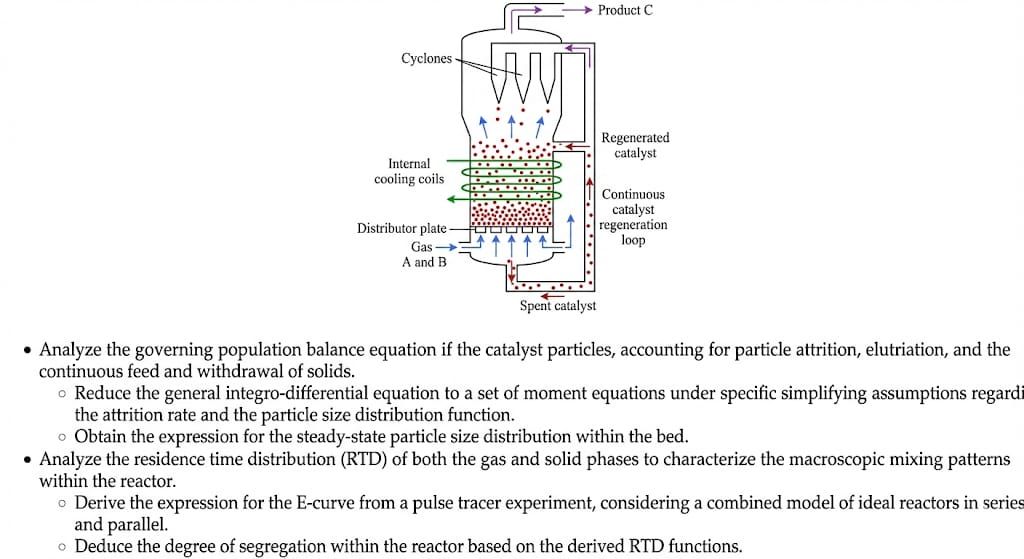 [= —> Product C
Cyclones ANT 1
Regenerated
Intemal | Erie catalyst
cooling coils FES
rms | continuous
Distributor plate — FREE] 1 | regeneration
Ge dT TTT [ow
AandB i B
Spent catalyst
Analyze the governing population balance equation if the catalyst particles, accounting for particle attrition, elutriation, and the
continuous feed and withdrawal of solids.
© Reduce the general integro-differential equation to a set of moment equations under specific simplifying assumptions regard
the attrition rate and the particle size distribution function.
© Obtain the expression for the steady-state particle size distribution within the bed.
« Analyze the residence time distribution (RTD) of both the gas and solid phases to characterize the macroscopic mixing patterns
‘within the reactor.
© Derive the expression for the E-curve from a pulse tracer experiment, considering a combined model of ideal reactors in series
and parallel.
© Deduce the degree of segregation within the reactor based on the derived RTD functions.
[= —> Product C
Cyclones ANT 1
Regenerated
Intemal | Erie catalyst
cooling coils FES
rms | continuous
Distributor plate — FREE] 1 | regeneration
Ge dT TTT [ow
AandB i B
Spent catalyst
Analyze the governing population balance equation if the catalyst particles, accounting for particle attrition, elutriation, and the
continuous feed and withdrawal of solids.
© Reduce the general integro-differential equation to a set of moment equations under specific simplifying assumptions regard
the attrition rate and the particle size distribution function.
© Obtain the expression for the steady-state particle size distribution within the bed.
« Analyze the residence time distribution (RTD) of both the gas and solid phases to characterize the macroscopic mixing patterns
‘within the reactor.
© Derive the expression for the E-curve from a pulse tracer experiment, considering a combined model of ideal reactors in series
and parallel.
© Deduce the degree of segregation within the reactor based on the derived RTD functions.
Asked by: Francis
Created at: 2026-02-10 09:08:52
Final Answer:
📢 Instructions:
- Ask anything relatd to above question only.
- For new Question goto :