 VIPSolutions
Act like a helpful tutor and exlain me : tables in renderd form14.7. Derive the expected mean squares for a balanced three-stage nested design, assuming that A is fixed and that B and C are random. Obtain formulas for estimating the variance components. Assume the restricted form of the mixed model.
Question:
Act like a helpful tutor and exlain me :
tables in renderd form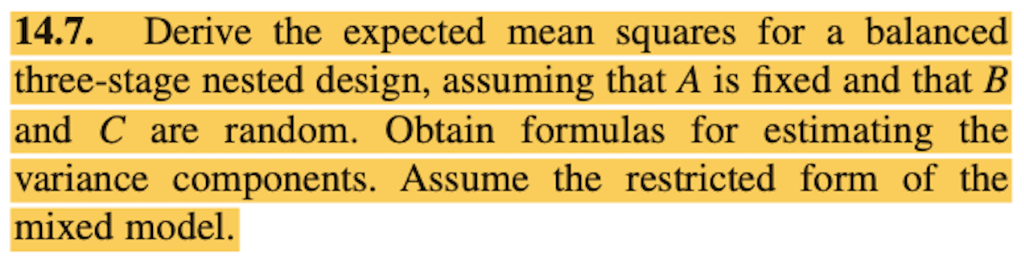 14.7. Derive the expected mean squares for a balanced
three-stage nested design, assuming that A is fixed and that B
and C are random. Obtain formulas for estimating the
variance components. Assume the restricted form of the
mixed model.
14.7. Derive the expected mean squares for a balanced
three-stage nested design, assuming that A is fixed and that B
and C are random. Obtain formulas for estimating the
variance components. Assume the restricted form of the
mixed model.
This is AI generated Response.
Asked by: Umesh
Created at: 2025-08-03 23:32:35
Asked by: Umesh
Created at: 2025-08-03 23:32:35
Final Answer:
Rendered
Raw Text
Did you like this answer?
Absolutely! Let’s break down and **explain step by step** how to answer this question about a **three-stage nested design** in ANOVA, with some rendered tables for clarity.
---
### **1. Understanding the Model**
- **Three-stage nested design**: A ⊃ B ⊃ C (C is nested in B, which is nested in A)
- **A is fixed**: Levels of A are chosen deliberately (not random)
- **B and C are random**
- **Balanced**: Same number of observations in each group
#### **Model Equation**
\[
Y_{ijkl} = \mu + \alpha_i + \beta_{j(i)} + \gamma_{k(ij)} + \epsilon_{l(ijk)}
\]
Where:
- \(i = 1, ..., a\) (levels of A)
- \(j = 1, ..., b\) (levels of B within A)
- \(k = 1, ..., c\) (levels of C within B and A)
- \(l = 1, ..., n\) (replicates within C, B, A)
- \(\alpha_i\) = fixed effect of A
- \(\beta_{j(i)}\) = random effect of B within A, \(\sim N(0, \sigma^2_B)\)
- \(\gamma_{k(ij)}\) = random effect of C within B and A, \(\sim N(0, \sigma^2_C)\)
- \(\epsilon_{l(ijk)}\) = random error, \(\sim N(0, \sigma^2)\)
---
### **2. Expected Mean Squares Table**
| Source | df | Mean Square (MS) | Expected Mean Square (EMS) |
|----------------|----------------------|--------------------------|------------------------------------------------------------|
| A | \(a-1\) | \(MS_A\) | \(\sigma^2 + n\sigma^2_C + nc\sigma^2_B + ncb \text{(fixed effect)}\) |
| B(A) | \(a(b-1)\) | \(MS_{B(A)}\) | \(\sigma^2 + n\sigma^2_C + nc\sigma^2_B\) |
| C(B(A)) | \(ab(c-1)\) | \(MS_{C(B(A))}\) | \(\sigma^2 + n\sigma^2_C\) |
| Error | \(abc(n-1)\) | \(MS_{Error}\) | \(\sigma^2\) |
**Note:** For a fixed effect, the EMS for A does not include a variance component for A.
---
### **3. **Formulas for Estimating Variance Components**
Let’s solve for each variance component in terms of the observed mean squares:
#### **a. Error Variance (\(\sigma^2\)):**
\[
\hat{\sigma}^2 = MS_{Error}
\]
#### **b. Variance due to C (\(\sigma^2_C\)):**
\[
\hat{\sigma}^2_C = \frac{MS_{C(B(A))} - MS_{Error}}{n}
\]
#### **c. Variance due to B (\(\sigma^2_B\)):**
\[
\hat{\sigma}^2_B = \frac{MS_{B(A)} - MS_{C(B(A))}}{nc}
\]
---
### **4. Table with Formulas**
| Component | Formula |
|-------------------|----------------------------------------------------------|
| \(\sigma^2\) | \(MS_{Error}\) |
| \(\sigma^2_C\) | \(\frac{MS_{C(B(A))} - MS_{Error}}{n}\) |
| \(\sigma^2_B\) | \(\frac{MS_{B(A)} - MS_{C(B(A))}}{nc}\) |
---
### **5. Summary Table**
| Source | df | Mean Square | Expected Mean Square (EMS) | Variance Component Estimate |
|----------------|-------------|-----------------|----------------------------------|--------------------------------------------|
| A (fixed) | \(a-1\) | \(MS_A\) | \(\sigma^2 + n\sigma^2_C + nc\sigma^2_B + ncb\;[\text{effect of A}]\) | N/A (Fixed) |
| B(A) (random) | \(a(b-1)\) | \(MS_{B(A)}\) | \(\sigma^2 + n\sigma^2_C + nc\sigma^2_B\) | \(\frac{MS_{B(A)} - MS_{C(B(A))}}{nc}\) |
| C(B(A)) (random) | \(ab(c-1)\)| \(MS_{C(B(A))}\)| \(\sigma^2 + n\sigma^2_C\) | \(\frac{MS_{C(B(A))} - MS_{Error}}{n}\) |
| Error | \(abc(n-1)\)| \(MS_{Error}\) | \(\sigma^2\) | \(MS_{Error}\) |
---
## **Summary**
- **Model**: \(Y_{ijkl} = \mu + \alpha_i + \beta_{j(i)} + \gamma_{k(ij)} + \epsilon_{l(ijk)}\)
- **EMS Table**: Shows how each level’s mean square is built from the variance components.
- **Variance components**: Estimated by equating observed mean squares to their expectations and solving.
---
If you want a **numerical example** or a **diagram**, let me know!
📢 Instructions:
- Ask anything relatd to above question only.
- For new Question goto :