 VIPSolutions
Act like a helpful tutor and exlain me : The clevis shown is connected to a rectangular member ( t , w are 0 . 2 5 ” and 0 . 7 5 ” respectively. Bolt diameter is 5 / 1 6 ” . Force P is 1 2 5 0 lb a . ) Is the connection single or double shear? b . ) Determine the total area in shear, and solve for the shear stress in the bolt. c . ) Determine the axial stress member A ( gross section, not at hole ) . d . ) What theoretical bolt diameter would result in axial stress from part c . ) being equal to the shear stress in part b . ) ?t (IT 1 | [Ee pe— SHINAI] } fier [JE = QD a. | i rr os — i
Question:
Act like a helpful tutor and exlain me :
The clevis shown is connected to a rectangular member
(
t
,
w are
0
.
2
5
”
and
0
.
7
5
”
respectively. Bolt diameter is
5
/
1
6
”
.
Force P is
1
2
5
0
lb a
.
)
Is the connection single or double shear? b
.
)
Determine the total area in shear, and solve for the shear stress in the bolt. c
.
)
Determine the axial stress member A
(
gross section, not at hole
)
.
d
.
)
What theoretical bolt diameter would result in axial stress from part c
.
)
being equal to the shear stress in part b
.
)
?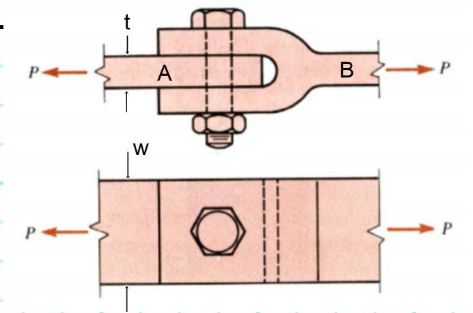 t (IT 1
| [Ee
pe— SHINAI] } fier
[JE =
QD
a.
|
i
rr os —
i
t (IT 1
| [Ee
pe— SHINAI] } fier
[JE =
QD
a.
|
i
rr os —
i
This is AI generated Response.
Asked by: manish kumar
Created at: 2025-09-12 08:49:53
Asked by: manish kumar
Created at: 2025-09-12 08:49:53
Final Answer:
Rendered
Raw Text
Did you like this answer?
Let's break down the problem step by step with clear explanations:
---
# a) Is the connection single or double shear?
**Shear Type:**
- In the clevis connection shown, the bolt passes through both "fork" parts (B) and the middle "tongue" part (A).
- The force \( P \) tries to pull the middle member (A) out, and both fork legs (B) resist.
**Shear Planes:**
- The bolt is sheared along **two planes**: one at each interface between the fork and the tongue.
**Conclusion:**
**This is a double shear connection.**
---
# b) Total Area in Shear and Shear Stress in the Bolt
### **Given:**
- Thickness, \( t = 0.25" \)
- Width, \( w = 0.75" \) (not needed for shear)
- Bolt diameter, \( d = 5/16" = 0.3125" \)
- Force, \( P = 1250 \) lb
### **Shear Area Calculation:**
**Shear occurs on two planes (double shear):**
\[
A_{shear, total} = 2 \times \text{Area of bolt cross section}
\]
\[
A_{bolt} = \frac{\pi}{4} d^2 = \frac{\pi}{4} (0.3125)^2 = 0.0767 \text{ in}^2
\]
\[
A_{shear, total} = 2 \times 0.0767 = 0.153 \text{ in}^2
\]
### **Shear Stress Calculation:**
\[
\tau = \frac{P}{A_{shear, total}} = \frac{1250}{0.153} = 8176 \text{ psi}
\]
---
# c) Axial Stress in Member A (Gross Section)
### **Axial Stress Formula:**
\[
\sigma = \frac{P}{A_{gross}}
\]
Where:
- \( A_{gross} = w \times t = 0.75 \times 0.25 = 0.1875 \text{ in}^2 \)
\[
\sigma = \frac{1250}{0.1875} = 6667 \text{ psi}
\]
---
# d) What bolt diameter would make axial stress = shear stress?
Set \( \sigma = \tau \):
\[
\frac{P}{A_{gross}} = \frac{P}{A_{shear, total}}
\]
\[
A_{gross} = A_{shear, total}
\]
\[
w \times t = 2 \times \frac{\pi}{4} d^2
\]
\[
0.75 \times 0.25 = \frac{\pi}{2} d^2
\]
\[
0.1875 = 1.5708 d^2
\]
\[
d^2 = \frac{0.1875}{1.5708} = 0.1194
\]
\[
d = \sqrt{0.1194} = 0.3456"
\]
---
## **Summary Table**
| Quantity | Value |
|---|---|
| Shear planes | Double shear (2 planes) |
| Total shear area | \( 0.153 \) in² |
| Shear stress, bolt | \( 8176 \) psi |
| Axial stress, member A | \( 6667 \) psi |
| Theoretical bolt diameter (for equal stresses) | \( 0.346 \) in |
---
**Let me know if you'd like to see the math worked out in more detail, or if you need help with a follow-up step!**
📢 Instructions:
- Ask anything relatd to above question only.
- For new Question goto :