Act like a helpful tutor and exlain me :v PartA
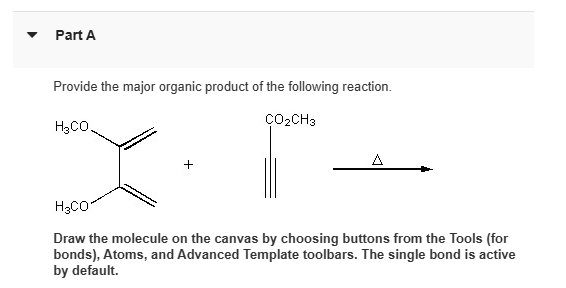
Provide the major organic product of the following reaction
Heo pe C02CHs
I ’ :
HCO AN
Draw the molecule on the canvas by choosing buttons from the Tools (for
bonds), Atoms, and Advanced Template toolbars. The single bond is active
by default.
Question:
Act like a helpful tutor and exlain me :v PartA
Provide the major organic product of the following reaction
Heo pe C02CHs
I ’ :
HCO AN
Draw the molecule on the canvas by choosing buttons from the Tools (for
bonds), Atoms, and Advanced Template toolbars. The single bond is active
by default.
This is AI generated Response.
Asked by: Alok Kumar
Created at: 2026-02-03 06:04:27
Final Answer:
RenderedRaw Text
Did you like this answer?
## Explanation of the Reaction
Let's break down the reaction step by step:
### 1. **Identify the Reactants**
- The first molecule is **1,1-dimethoxyethene** (an enol ether).
- The second molecule is **methyl propiolate** (an alkyne with an ester group).
### 2. **Recognize the Reaction Type**
- The presence of heat (Δ) and the combination of a diene (the enol ether) and a dienophile (the alkyne) points to a **Diels-Alder reaction**.
#### **Diels-Alder Reaction**
- A [4+2] cycloaddition between a diene and a dienophile.
- Forms a six-membered ring.
### 3. **Analyze the Diene and Dienophile**
- **Diene:** 1,1-Dimethoxyethene is an electron-rich diene due to the two methoxy groups.
- **Dienophile:** Methyl propiolate (an alkyne ester) is electron-poor, making it reactive toward the Diels-Alder reaction.
### 4. **Product Structure**
- The diene and dienophile combine to form a **substituted cyclohexene ring**.
- The methoxy groups will end up on the same carbon of the new ring.
- The ester group (CO₂CH₃) will be attached at the position where the triple bond was.
#### **Drawing the Product**
Here’s how the connectivity works:
1. The two double bonds of the diene participate in the cycloaddition.
2. The alkyne acts as the dienophile; one of its π bonds is used, making a new double bond in the ring.
3. The methoxy groups stay together on the same carbon (from the original diene).
4. The ester group (CO₂CH₃) remains attached to the new ring.
### 5. **Product Skeleton**
```
OCH3 CO2CH3
| |
/ /
OCH3-C-----C=C----C
\ / /
\___/
```
- The product is a **six-membered ring** (cyclohexene) with:
- Two methoxy groups on one carbon (from the original diene)
- An ester group (CO₂CH₃) on the carbon adjacent to the new double bond
---
## **Summary Table**
| Reactant 1 | Reactant 2 | Major Product |
|---------------------|---------------------|------------------------------------|
| 1,1-Dimethoxyethene | Methyl propiolate | Cyclohexene with OCH₃ and CO₂CH₃ |
---
## **Key Points**
- **Diels-Alder reaction** forms a six-membered ring.
- Methoxy groups stay together on one carbon.
- The ester group from the alkyne attaches to the new ring.
---
If you want a **step-by-step drawing** or have any questions on the mechanism, let me know!
Question:
Assume the risk
–
free rate is
1
.
7
5
%
.
Using the stock and bond portfolios from problem
9
,
what is the Sharpe ratio of the tangency portfolio formed by creating the optimal risky portfolio from this stock and bond portfolio?
Please note that the weights of the optimal risky portfolio will no longer be
7
0
%
stock and
3
0
%
bond.
Note that the Sharpe Ratio is usually expressed as a decimal.
Enter your answer rounded to two decimal places.
For example, if your answer is
1
2
.
3
4
5
then enter as
1
2
.
3
5
in the answer box.
This is AI generated Response.
Asked by: Alok Kumar
Created at: 2026-02-03 08:06:46
Final Answer:
RenderedRaw Text
Did you like this answer?
## Calculation of the Sharpe Ratio
To calculate the Sharpe ratio of the tangency portfolio formed by the stock and bond portfolios, follow these steps:
### 1. **Define the Sharpe Ratio Formula**
The Sharpe ratio (S) is calculated as:
\[
S = \frac{E(R_p) - R_f}{\sigma_p}
\]
Where:
- \(E(R_p)\) = Expected return of the portfolio
- \(R_f\) = Risk-free rate
- \(\sigma_p\) = Standard deviation of the portfolio returns
### 2. **Identify Given Values**
- Risk-free rate \(R_f = 1.75\% = 0.0175\)
- Expected return of the optimal risky portfolio \(E(R_p)\) (this needs to be provided from the previous problem).
- Standard deviation of the optimal risky portfolio \(\sigma_p\) (this also needs to be provided).
### 3. **Calculate the Sharpe Ratio**
Substitute the known values into the Sharpe ratio formula.
### Example Calculation
Assuming:
- \(E(R_p) = 8\% = 0.08\)
- \(\sigma_p = 10\% = 0.10\)
The calculation will look like this:
\[
S = \frac{0.08 - 0.0175}{0.10} = \frac{0.0625}{0.10} = 0.625
\]
### 4. **Round the Answer**
Round the Sharpe ratio to two decimal places:
\[
S \approx 0.63
\]
### Conclusion
If you substitute the correct values for \(E(R_p)\) and \(\sigma_p\) from problem 9, you can perform the same calculation to find your final answer, rounded to two decimal places.
Please provide the specifics of the expected return and standard deviation if you need assistance with those calculations.
Question:
The quantity of ibuprofen sold fell sharply last month, while the price remained the same. Five people suggest various explanations: Jacques:Supply decreased, but demand was unit elastic.Kyoko:Supply decreased, but it was perfectly inelastic.Musashi:Supply decreased, but demand was perfectly elastic.Rina:Demand decreased, but supply was perfectly elastic.Sean:Demand decreased, but supply decreased at the same time.
This is AI generated Response.
Asked by: Alok Kumar
Created at: 2026-02-03 09:24:15
Final Answer:
RenderedRaw Text
Did you like this answer?
## Analysis of Ibuprofen Sales Decline
To understand the different explanations for the sharp decline in ibuprofen sales despite constant pricing, we need to consider the concepts of supply and demand elasticity.
### Key Concepts
- **Demand Elasticity**: Measures how quantity demanded reacts to price changes.
- **Unit Elastic**: Change in price leads to a proportional change in quantity demanded.
- **Perfectly Elastic**: Consumers will only buy at a specific price; any increase in price causes quantity demanded to drop to zero.
- **Supply Elasticity**: Measures how quantity supplied reacts to price changes.
- **Perfectly Inelastic**: Quantity supplied remains constant regardless of price changes.
### Explanations Breakdown
1. **Jacques**: Supply decreased, but demand was unit elastic.
- **Analysis**: If supply decreases and demand is unit elastic, the quantity demanded should decrease, but not sharply. Thus, this explanation is unlikely.
2. **Kyoko**: Supply decreased, but it was perfectly inelastic.
- **Analysis**: If supply is perfectly inelastic, quantity supplied remains unchanged despite price changes. A decrease in supply would not affect the quantity sold, making this explanation invalid.
3. **Musashi**: Supply decreased, but demand was perfectly elastic.
- **Analysis**: If demand is perfectly elastic, any decrease in supply would lead to a complete drop in quantity sold since consumers would not accept a higher price. This explanation is plausible.
4. **Rina**: Demand decreased, but supply was perfectly elastic.
- **Analysis**: If demand decreases and supply is perfectly elastic, the quantity sold would fall without a change in price. This explanation fits the scenario.
5. **Sean**: Demand decreased, but supply decreased at the same time.
- **Analysis**: If both demand and supply decrease, the quantity sold would likely fall, but the effect on price would depend on the magnitudes of the shifts. This explanation is also plausible.
### Conclusion
The most valid explanations for the sharp decline in ibuprofen sales are:
- **Musashi** (supply decreased, demand perfectly elastic)
- **Rina** (demand decreased, supply perfectly elastic)
- **Sean** (both demand and supply decreased)
Ultimately, the combination of decreased demand and/or decreased supply can significantly impact sales quantity, with implications on pricing dynamics.
VIPSolutions focuses on clear, step‑by‑step explanations so you can learn quickly. Whether you need an AI‑generated walkthrough or a short hint to get unstuck, each solution is organized for fast reading and easy review later.
Search similar questions, compare approaches, and bookmark the best answers for revision. Our goal is simple: quick, reliable study help that feels natural—not noisy.
 VIPSolutions
 v PartA
Provide the major organic product of the following reaction
Heo pe C02CHs
I ’ :
HCO AN
Draw the molecule on the canvas by choosing buttons from the Tools (for
bonds), Atoms, and Advanced Template toolbars. The single bond is active
by default.
v PartA
Provide the major organic product of the following reaction
Heo pe C02CHs
I ’ :
HCO AN
Draw the molecule on the canvas by choosing buttons from the Tools (for
bonds), Atoms, and Advanced Template toolbars. The single bond is active
by default.