 VIPSolutions
Act like a helpful tutor and exlain step-by-step solution with explanation and final answer:1. You are designing a chemical process that involves compressing a stream of acetylene (CzHz) (300K, 1 atm) the highest pressure you can feasibly achieve. The table below lists some. information about acetylene. __ Molar Mass | Density | Melting Point | Description | Other Notes 260g mol" | 1.097 192K Colorless, |= Intrinsically unstable, especially’ gL (at1.27 atm) | odorless gas. | when pressurized. Decomposes Not toxic. | spontaneously at T > 600K. Used asfuel |o ALP >200 kPa, intense heat or for welding | vibrations may result in explosive torches, decomposition . Copper catalyzes the decomposition of acetylene With the budget that you have available, you have options, illustrated in the diagram below. OptionA Opticn8 CH, 300K 1atm OPTION A. one very efficient compressor (COM-1; you may assume ~100%) OPTION B. two lower efficiency compressors (COM-1,2 ~80%) plus a heat exchanger (HX-1) The heat exchanger operates isobarically and uses chilled water (T= 280K) to reject heat. In this problem, you may assume the chilled water temperature is the surrounding temperature (i.e., do not need to consider it as a flowing stream). Heat transfer limitations allow you to cool the acetylene stream exiting COM-2 to temperatures as low as 300K, but this temperature can be controlled by slowing (or stopping) the flow of the chilled water. (a) After analyzing this system, which configuration would you choose and why? Explain your reasoning. If you made any assumptions or approximations, explain how they might affect your analysis. (b) Ifyou had an unlimited budget for equipment and your only objective were to minimize the. enerqy cost associated with the acetylene compression process, how would you design the system? Assume you have unlimited money, space, time, access to utilities, etc. Potentially useful equations: b5_(Gh)s, Tn Pa 52 ST Ry BE Ri iT, a Py RR) A BH = (Cy (T = Ty) + HE — Hf You may assume any reasonable value for (©? Ns (Cs or R. Recall that for ideal gases, Cp = 3.5R and R=8.314 J mol ’K", There are two blank sheets following this page if you would like to use for your work. You may unbind this exam and staple the pages together when completed, if you wish.
Question:
Act like a helpful tutor and exlain step-by-step solution with explanation and final answer: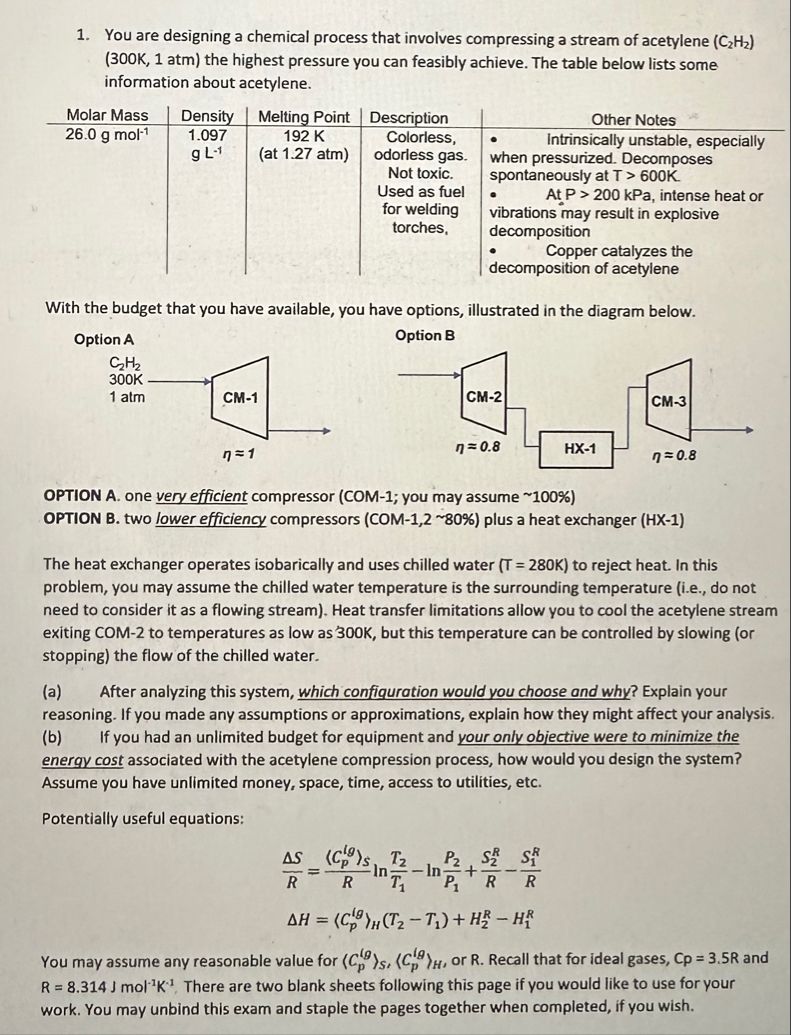 1. You are designing a chemical process that involves compressing a stream of acetylene (CzHz)
(300K, 1 atm) the highest pressure you can feasibly achieve. The table below lists some.
information about acetylene.
__ Molar Mass | Density | Melting Point | Description | Other Notes
260g mol" | 1.097 192K Colorless, |= Intrinsically unstable, especially’
gL (at1.27 atm) | odorless gas. | when pressurized. Decomposes
Not toxic. | spontaneously at T > 600K.
Used asfuel |o ALP >200 kPa, intense heat or
for welding | vibrations may result in explosive
torches, decomposition
. Copper catalyzes the
decomposition of acetylene
With the budget that you have available, you have options, illustrated in the diagram below.
OptionA Opticn8
CH,
300K
1atm
OPTION A. one very efficient compressor (COM-1; you may assume ~100%)
OPTION B. two lower efficiency compressors (COM-1,2 ~80%) plus a heat exchanger (HX-1)
The heat exchanger operates isobarically and uses chilled water (T= 280K) to reject heat. In this
problem, you may assume the chilled water temperature is the surrounding temperature (i.e., do not
need to consider it as a flowing stream). Heat transfer limitations allow you to cool the acetylene stream
exiting COM-2 to temperatures as low as 300K, but this temperature can be controlled by slowing (or
stopping) the flow of the chilled water.
(a) After analyzing this system, which configuration would you choose and why? Explain your
reasoning. If you made any assumptions or approximations, explain how they might affect your analysis.
(b) Ifyou had an unlimited budget for equipment and your only objective were to minimize the.
enerqy cost associated with the acetylene compression process, how would you design the system?
Assume you have unlimited money, space, time, access to utilities, etc.
Potentially useful equations:
b5_(Gh)s, Tn Pa 52 ST
Ry BE Ri iT, a Py RR)
A
BH = (Cy (T = Ty) + HE — Hf
You may assume any reasonable value for (©? Ns (Cs or R. Recall that for ideal gases, Cp = 3.5R and
R=8.314 J mol ’K", There are two blank sheets following this page if you would like to use for your
work. You may unbind this exam and staple the pages together when completed, if you wish.
1. You are designing a chemical process that involves compressing a stream of acetylene (CzHz)
(300K, 1 atm) the highest pressure you can feasibly achieve. The table below lists some.
information about acetylene.
__ Molar Mass | Density | Melting Point | Description | Other Notes
260g mol" | 1.097 192K Colorless, |= Intrinsically unstable, especially’
gL (at1.27 atm) | odorless gas. | when pressurized. Decomposes
Not toxic. | spontaneously at T > 600K.
Used asfuel |o ALP >200 kPa, intense heat or
for welding | vibrations may result in explosive
torches, decomposition
. Copper catalyzes the
decomposition of acetylene
With the budget that you have available, you have options, illustrated in the diagram below.
OptionA Opticn8
CH,
300K
1atm
OPTION A. one very efficient compressor (COM-1; you may assume ~100%)
OPTION B. two lower efficiency compressors (COM-1,2 ~80%) plus a heat exchanger (HX-1)
The heat exchanger operates isobarically and uses chilled water (T= 280K) to reject heat. In this
problem, you may assume the chilled water temperature is the surrounding temperature (i.e., do not
need to consider it as a flowing stream). Heat transfer limitations allow you to cool the acetylene stream
exiting COM-2 to temperatures as low as 300K, but this temperature can be controlled by slowing (or
stopping) the flow of the chilled water.
(a) After analyzing this system, which configuration would you choose and why? Explain your
reasoning. If you made any assumptions or approximations, explain how they might affect your analysis.
(b) Ifyou had an unlimited budget for equipment and your only objective were to minimize the.
enerqy cost associated with the acetylene compression process, how would you design the system?
Assume you have unlimited money, space, time, access to utilities, etc.
Potentially useful equations:
b5_(Gh)s, Tn Pa 52 ST
Ry BE Ri iT, a Py RR)
A
BH = (Cy (T = Ty) + HE — Hf
You may assume any reasonable value for (©? Ns (Cs or R. Recall that for ideal gases, Cp = 3.5R and
R=8.314 J mol ’K", There are two blank sheets following this page if you would like to use for your
work. You may unbind this exam and staple the pages together when completed, if you wish.
Asked by: Francis
Created at: 2026-02-23 07:48:56
Final Answer:
📢 Instructions:
- Ask anything relatd to above question only.
- For new Question goto :