 VIPSolutions
Act like a helpful tutor and exlain step-by-step solution with explanation and final answer:P1 Under conditions of high Reynolds number flow within a baffled Q cylindrical vessel where mechanical agitation is provided by a T;, I Bs rotating impeller and fluid properties are assumed constant, a —> rigorous derivation of the transport equations for turbulent quanti- 5 a) ities becomes necessary. The spatial distribution of turbulent kineti energy and its dissipation rate across the fluid domain requires BE an analytical formulation based on the Reynolds-averaged Navier- Stokes framework. Considering the production of turbulence due 9 to mean shear and buoyancy effects, coupled with the diffusive and 4 dissipative mechanisms represented by specific tensor terms, ag complete closure model must be established. The resulting coupled 1 ve differential equation system must accurately govern the evolution 1 w of these scalar fields, accounting for the anisotropy of the Reynolds stress tensor through an appropriate constitutive relation. -— = G 1. Formulate the governing transport equation for turbulent of @Y neh) Ls You kinetic energy. « Deduce the production term accounting for mean shear. b—s— Establish the form of the dissipative term. 2. Derive the corresponding transport equation for the dissipation rate. « Obtain the structure of the diffusion term. « Determine the source terms related to production and destruction. P2 In the context of turbulent fluid flow through a packed bed reactor characterized by a random arrangement of solid particles, the modeling of momentum transfer and energy dissipation demands a distinct approach. The interplay between the interstitial velocity field and the solid phase boundary layers creates a complex flow structure that cannot be adequately described by simple laminar models. A generalized formulation for the effective viscosity and the additional source terms representing the drag force exerted by the packing materal is required. This formulation must be integrated into the macroscopic conservation equations to yield a predictive model for the pressure drop and the turbulence levels within the porous medium. 3. Formulate the macroscopic momentum balance equation for the packed bed. « Derive the expression for the Ergun equation drag term. « Establish the effective viscosity tensor. 4. Deduce the turbulent kinetic energy balance within the porous medium. « Obtain the production term due to interstitial shear. + Determine the additional dissipation due to solid surfaces. 5. Develop the transport equation for the dissipation rate in the packed bed. P3 For a free shear layer formed by the mixing of two parallel fluid streams with different velocities, the development of the ‘wrbulent field is governed by the Kelvin-Helmholtz instability mechanism and the sub- sequent pairing of coherent structures. An analysis of the self-similar nature of the velocity profiles and the growth rate of the mixing layer thickness is crucial for understanding the overall mixing process. The mod- deling of the Reynolds shear stress term, which is the primary mechanism for momentum transfer in this configuration, requires the application of an appropriate eddy viscosity hypothesis or a higher-order closure scheme. A complete set of equations describing the mean flow field and the turbulence statistics must be deduced from the governing conservation laws. 6. Establish the self-similar velocity profile equations for the mixing layer. 7. Derive the expression for the growth rate of the mixing layer thickness. 8. Formulate the Reynolds shear stress transport equation. 9. Deduce the turbulent kinetic energy balance for the shear flow.
Question:
Act like a helpful tutor and exlain step-by-step solution with explanation and final answer: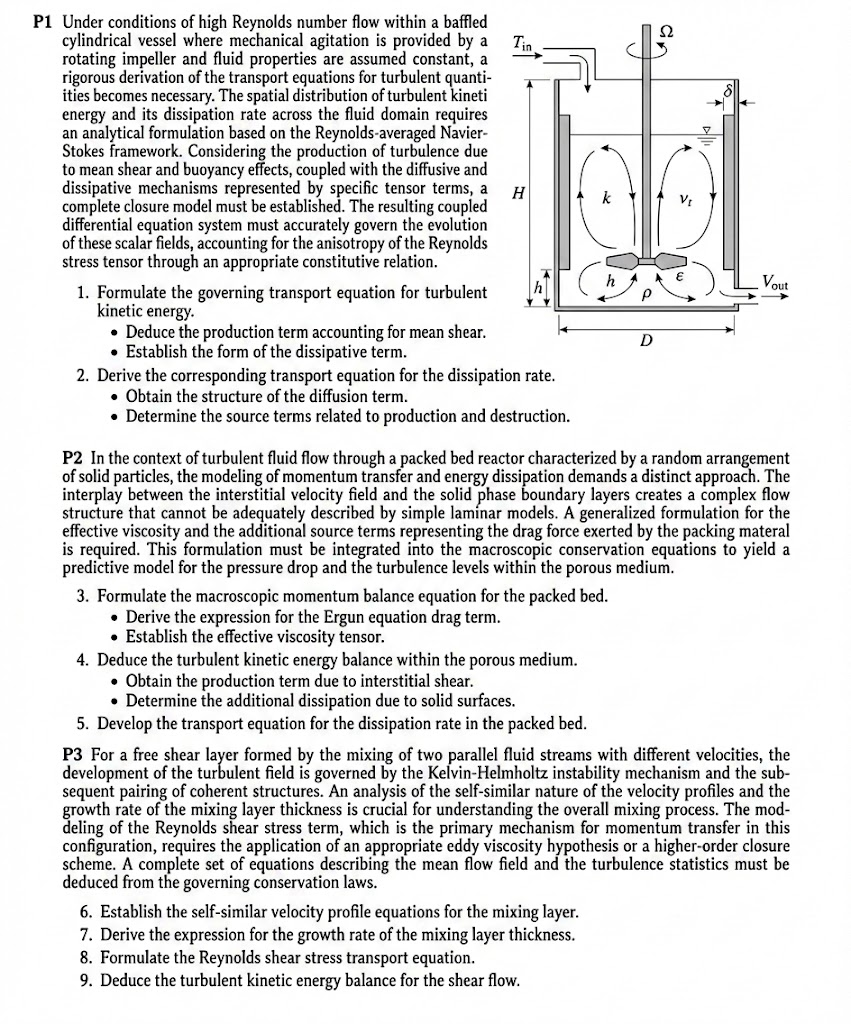 P1 Under conditions of high Reynolds number flow within a baffled Q
cylindrical vessel where mechanical agitation is provided by a T;, I Bs
rotating impeller and fluid properties are assumed constant, a —>
rigorous derivation of the transport equations for turbulent quanti- 5 a)
ities becomes necessary. The spatial distribution of turbulent kineti
energy and its dissipation rate across the fluid domain requires BE
an analytical formulation based on the Reynolds-averaged Navier-
Stokes framework. Considering the production of turbulence due 9
to mean shear and buoyancy effects, coupled with the diffusive and 4
dissipative mechanisms represented by specific tensor terms, ag
complete closure model must be established. The resulting coupled 1 ve
differential equation system must accurately govern the evolution 1 w
of these scalar fields, accounting for the anisotropy of the Reynolds
stress tensor through an appropriate constitutive relation. -— =
G
1. Formulate the governing transport equation for turbulent of @Y neh) Ls You
kinetic energy.
« Deduce the production term accounting for mean shear. b—s—
Establish the form of the dissipative term.
2. Derive the corresponding transport equation for the dissipation rate.
« Obtain the structure of the diffusion term.
« Determine the source terms related to production and destruction.
P2 In the context of turbulent fluid flow through a packed bed reactor characterized by a random arrangement
of solid particles, the modeling of momentum transfer and energy dissipation demands a distinct approach. The
interplay between the interstitial velocity field and the solid phase boundary layers creates a complex flow
structure that cannot be adequately described by simple laminar models. A generalized formulation for the
effective viscosity and the additional source terms representing the drag force exerted by the packing materal
is required. This formulation must be integrated into the macroscopic conservation equations to yield a
predictive model for the pressure drop and the turbulence levels within the porous medium.
3. Formulate the macroscopic momentum balance equation for the packed bed.
« Derive the expression for the Ergun equation drag term.
« Establish the effective viscosity tensor.
4. Deduce the turbulent kinetic energy balance within the porous medium.
« Obtain the production term due to interstitial shear.
+ Determine the additional dissipation due to solid surfaces.
5. Develop the transport equation for the dissipation rate in the packed bed.
P3 For a free shear layer formed by the mixing of two parallel fluid streams with different velocities, the
development of the ‘wrbulent field is governed by the Kelvin-Helmholtz instability mechanism and the sub-
sequent pairing of coherent structures. An analysis of the self-similar nature of the velocity profiles and the
growth rate of the mixing layer thickness is crucial for understanding the overall mixing process. The mod-
deling of the Reynolds shear stress term, which is the primary mechanism for momentum transfer in this
configuration, requires the application of an appropriate eddy viscosity hypothesis or a higher-order closure
scheme. A complete set of equations describing the mean flow field and the turbulence statistics must be
deduced from the governing conservation laws.
6. Establish the self-similar velocity profile equations for the mixing layer.
7. Derive the expression for the growth rate of the mixing layer thickness.
8. Formulate the Reynolds shear stress transport equation.
9. Deduce the turbulent kinetic energy balance for the shear flow.
P1 Under conditions of high Reynolds number flow within a baffled Q
cylindrical vessel where mechanical agitation is provided by a T;, I Bs
rotating impeller and fluid properties are assumed constant, a —>
rigorous derivation of the transport equations for turbulent quanti- 5 a)
ities becomes necessary. The spatial distribution of turbulent kineti
energy and its dissipation rate across the fluid domain requires BE
an analytical formulation based on the Reynolds-averaged Navier-
Stokes framework. Considering the production of turbulence due 9
to mean shear and buoyancy effects, coupled with the diffusive and 4
dissipative mechanisms represented by specific tensor terms, ag
complete closure model must be established. The resulting coupled 1 ve
differential equation system must accurately govern the evolution 1 w
of these scalar fields, accounting for the anisotropy of the Reynolds
stress tensor through an appropriate constitutive relation. -— =
G
1. Formulate the governing transport equation for turbulent of @Y neh) Ls You
kinetic energy.
« Deduce the production term accounting for mean shear. b—s—
Establish the form of the dissipative term.
2. Derive the corresponding transport equation for the dissipation rate.
« Obtain the structure of the diffusion term.
« Determine the source terms related to production and destruction.
P2 In the context of turbulent fluid flow through a packed bed reactor characterized by a random arrangement
of solid particles, the modeling of momentum transfer and energy dissipation demands a distinct approach. The
interplay between the interstitial velocity field and the solid phase boundary layers creates a complex flow
structure that cannot be adequately described by simple laminar models. A generalized formulation for the
effective viscosity and the additional source terms representing the drag force exerted by the packing materal
is required. This formulation must be integrated into the macroscopic conservation equations to yield a
predictive model for the pressure drop and the turbulence levels within the porous medium.
3. Formulate the macroscopic momentum balance equation for the packed bed.
« Derive the expression for the Ergun equation drag term.
« Establish the effective viscosity tensor.
4. Deduce the turbulent kinetic energy balance within the porous medium.
« Obtain the production term due to interstitial shear.
+ Determine the additional dissipation due to solid surfaces.
5. Develop the transport equation for the dissipation rate in the packed bed.
P3 For a free shear layer formed by the mixing of two parallel fluid streams with different velocities, the
development of the ‘wrbulent field is governed by the Kelvin-Helmholtz instability mechanism and the sub-
sequent pairing of coherent structures. An analysis of the self-similar nature of the velocity profiles and the
growth rate of the mixing layer thickness is crucial for understanding the overall mixing process. The mod-
deling of the Reynolds shear stress term, which is the primary mechanism for momentum transfer in this
configuration, requires the application of an appropriate eddy viscosity hypothesis or a higher-order closure
scheme. A complete set of equations describing the mean flow field and the turbulence statistics must be
deduced from the governing conservation laws.
6. Establish the self-similar velocity profile equations for the mixing layer.
7. Derive the expression for the growth rate of the mixing layer thickness.
8. Formulate the Reynolds shear stress transport equation.
9. Deduce the turbulent kinetic energy balance for the shear flow.
Asked by: Francis
Created at: 2026-02-26 18:54:11
Final Answer:
📢 Instructions:
- Ask anything relatd to above question only.
- For new Question goto :