 VIPSolutions
Act like a helpful tutor and exlain step-by-step solution with explanation and final answer:1. Under conditions of thermal stratification within a finite reservoir volume subject to continuous organic loading a complete mathematical description of the biochemical osygen demand dynamics becomes necessary. Assuming a distinct two layer system with an upper well mixed epilimnion and a lower isolated hypolimnion separated by a stable thermocline diffusive transport and kinetic decay processes dictate the temporal evolution of the organic constituent concentration. Qin Cin X 1 — > Epilimnion Ja —> Qout, Cepi Vepi \ [Bm / Hypolimnion X Viypo | 4 vk « Formulate the ordinary differential equation describing the time rate of change of the pollutant concentration within the epilimnion control volume. = Establish the governing mass balance equation accounting for advective inflows and outflows. = Define the reaction terms representing first order kinetic decay and interfacial diffusive transfer. « Deduce the corresponding ordinary differential equation for the pollutant concentration evolution within the isolated hypolimnion layer. = Construct the mass balance formulation considering interfacial diffusion as the primary source term. « Incorporate the first order decay and net settling loss mechanisms into the final expression. » Determine the steady state analytical solutions for the pollutant concentrations in both the epilimnion and hypolimnion. = Apply the condition of vanishing temporal derivatives to the coupled system of differential equations. = Solve the resulting algebraic equations to express the equilibrium concentrations in terms of the given parameters. 2. For a plug flow river reach receiving a point source discharge of oxygen demanding waste the spatial profile of the dissolved oxygen deficit requires fundamental derivation. Considering the simultaneous processes of biochemical oxidation and atmospheric reaeration under steady state conditions a coupled system of equations governs the long- itudinal variation of both the organic matter and the dissolved oxygen. 1. Establish the first order differential equation representing the decay of the ultimate biochemical oxygen dem- nd as a function of downstream distance. 1.1 Define the governing kinetics based on a first order reaction rate constant. 1.2 Express the rate of change with respect to travel time using the average stream velocity. 2 Formulate the corresponding first order differential equation for the rate of change of the dissolved oxygen leficit. 2.1 Construct the mass balance including the deoxygenation sink term derived previously. 2.2 Introduce the reaeration source term based on the deficit and a reaeration rate constant. 3. Derive the integrated analytical solution known as the Streeter Phelps equation for the dissolved oxygen deficit rofile. 5 Solve the coupled linear differential equation using an integrating factor or method of undetermined coefficients. 3.2 Apply the initial boundary conditions at the point of discharge to define the integration constants. 4. Deduce the expressions for the critical travel time and the corresponding maximum dissolved oxygen deficit. 4.1 Differentiate the Streeter Phelps equation with respect to time and set the result to zero. 4.2 Substitute the critical time back into the original equation to find the peak deficit. 5. Evaluate the influence of temperature on the kinetic rate constants and the saturation concentration. 5.1 Apply the Arrhenius relationship to adjust the deoxygenation and reaeration constants for non standard temperatures. 5.2 Determine the saturation concentration of dissolved oxygen as a function of temperature and salinity.
Question:
Act like a helpful tutor and exlain step-by-step solution with explanation and final answer: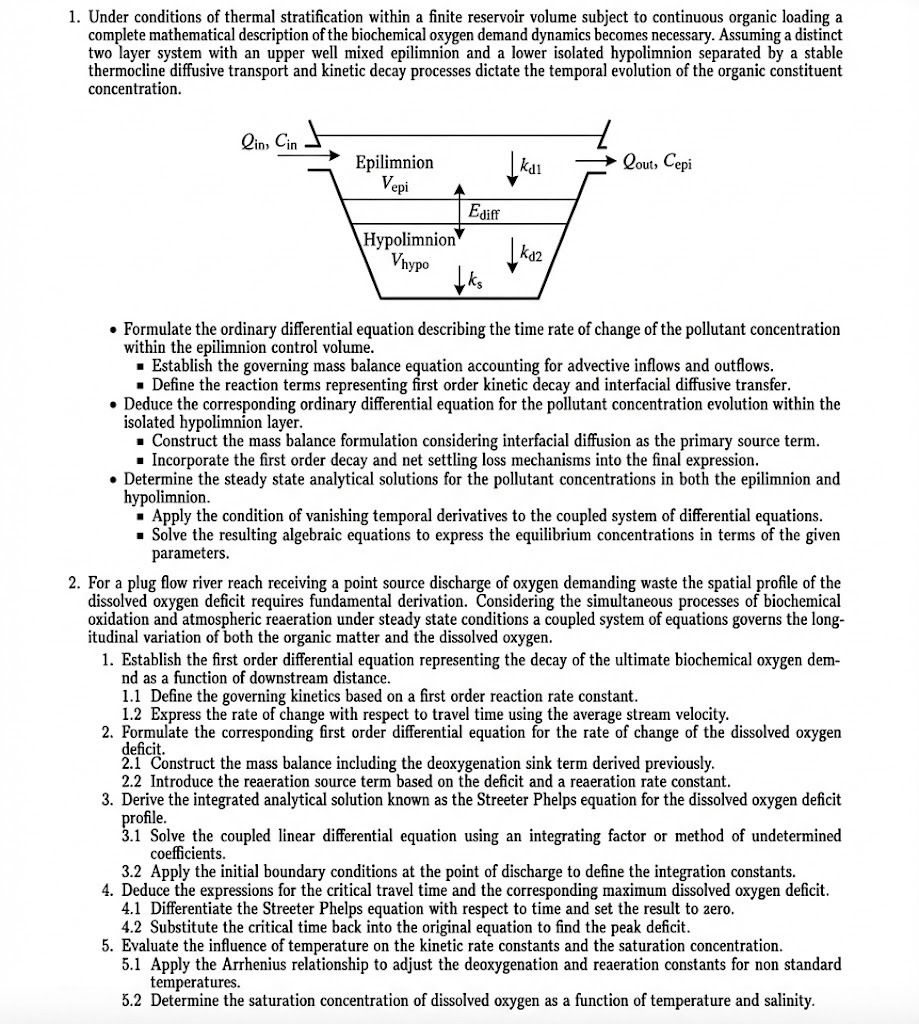 1. Under conditions of thermal stratification within a finite reservoir volume subject to continuous organic loading a
complete mathematical description of the biochemical osygen demand dynamics becomes necessary. Assuming a distinct
two layer system with an upper well mixed epilimnion and a lower isolated hypolimnion separated by a stable
thermocline diffusive transport and kinetic decay processes dictate the temporal evolution of the organic constituent
concentration.
Qin Cin X 1
— > Epilimnion Ja —> Qout, Cepi
Vepi
\ [Bm /
Hypolimnion X
Viypo | 4
vk
« Formulate the ordinary differential equation describing the time rate of change of the pollutant concentration
within the epilimnion control volume.
= Establish the governing mass balance equation accounting for advective inflows and outflows.
= Define the reaction terms representing first order kinetic decay and interfacial diffusive transfer.
« Deduce the corresponding ordinary differential equation for the pollutant concentration evolution within the
isolated hypolimnion layer.
= Construct the mass balance formulation considering interfacial diffusion as the primary source term.
« Incorporate the first order decay and net settling loss mechanisms into the final expression.
» Determine the steady state analytical solutions for the pollutant concentrations in both the epilimnion and
hypolimnion.
= Apply the condition of vanishing temporal derivatives to the coupled system of differential equations.
= Solve the resulting algebraic equations to express the equilibrium concentrations in terms of the given
parameters.
2. For a plug flow river reach receiving a point source discharge of oxygen demanding waste the spatial profile of the
dissolved oxygen deficit requires fundamental derivation. Considering the simultaneous processes of biochemical
oxidation and atmospheric reaeration under steady state conditions a coupled system of equations governs the long-
itudinal variation of both the organic matter and the dissolved oxygen.
1. Establish the first order differential equation representing the decay of the ultimate biochemical oxygen dem-
nd as a function of downstream distance.
1.1 Define the governing kinetics based on a first order reaction rate constant.
1.2 Express the rate of change with respect to travel time using the average stream velocity.
2 Formulate the corresponding first order differential equation for the rate of change of the dissolved oxygen
leficit.
2.1 Construct the mass balance including the deoxygenation sink term derived previously.
2.2 Introduce the reaeration source term based on the deficit and a reaeration rate constant.
3. Derive the integrated analytical solution known as the Streeter Phelps equation for the dissolved oxygen deficit
rofile.
5 Solve the coupled linear differential equation using an integrating factor or method of undetermined
coefficients.
3.2 Apply the initial boundary conditions at the point of discharge to define the integration constants.
4. Deduce the expressions for the critical travel time and the corresponding maximum dissolved oxygen deficit.
4.1 Differentiate the Streeter Phelps equation with respect to time and set the result to zero.
4.2 Substitute the critical time back into the original equation to find the peak deficit.
5. Evaluate the influence of temperature on the kinetic rate constants and the saturation concentration.
5.1 Apply the Arrhenius relationship to adjust the deoxygenation and reaeration constants for non standard
temperatures.
5.2 Determine the saturation concentration of dissolved oxygen as a function of temperature and salinity.
1. Under conditions of thermal stratification within a finite reservoir volume subject to continuous organic loading a
complete mathematical description of the biochemical osygen demand dynamics becomes necessary. Assuming a distinct
two layer system with an upper well mixed epilimnion and a lower isolated hypolimnion separated by a stable
thermocline diffusive transport and kinetic decay processes dictate the temporal evolution of the organic constituent
concentration.
Qin Cin X 1
— > Epilimnion Ja —> Qout, Cepi
Vepi
\ [Bm /
Hypolimnion X
Viypo | 4
vk
« Formulate the ordinary differential equation describing the time rate of change of the pollutant concentration
within the epilimnion control volume.
= Establish the governing mass balance equation accounting for advective inflows and outflows.
= Define the reaction terms representing first order kinetic decay and interfacial diffusive transfer.
« Deduce the corresponding ordinary differential equation for the pollutant concentration evolution within the
isolated hypolimnion layer.
= Construct the mass balance formulation considering interfacial diffusion as the primary source term.
« Incorporate the first order decay and net settling loss mechanisms into the final expression.
» Determine the steady state analytical solutions for the pollutant concentrations in both the epilimnion and
hypolimnion.
= Apply the condition of vanishing temporal derivatives to the coupled system of differential equations.
= Solve the resulting algebraic equations to express the equilibrium concentrations in terms of the given
parameters.
2. For a plug flow river reach receiving a point source discharge of oxygen demanding waste the spatial profile of the
dissolved oxygen deficit requires fundamental derivation. Considering the simultaneous processes of biochemical
oxidation and atmospheric reaeration under steady state conditions a coupled system of equations governs the long-
itudinal variation of both the organic matter and the dissolved oxygen.
1. Establish the first order differential equation representing the decay of the ultimate biochemical oxygen dem-
nd as a function of downstream distance.
1.1 Define the governing kinetics based on a first order reaction rate constant.
1.2 Express the rate of change with respect to travel time using the average stream velocity.
2 Formulate the corresponding first order differential equation for the rate of change of the dissolved oxygen
leficit.
2.1 Construct the mass balance including the deoxygenation sink term derived previously.
2.2 Introduce the reaeration source term based on the deficit and a reaeration rate constant.
3. Derive the integrated analytical solution known as the Streeter Phelps equation for the dissolved oxygen deficit
rofile.
5 Solve the coupled linear differential equation using an integrating factor or method of undetermined
coefficients.
3.2 Apply the initial boundary conditions at the point of discharge to define the integration constants.
4. Deduce the expressions for the critical travel time and the corresponding maximum dissolved oxygen deficit.
4.1 Differentiate the Streeter Phelps equation with respect to time and set the result to zero.
4.2 Substitute the critical time back into the original equation to find the peak deficit.
5. Evaluate the influence of temperature on the kinetic rate constants and the saturation concentration.
5.1 Apply the Arrhenius relationship to adjust the deoxygenation and reaeration constants for non standard
temperatures.
5.2 Determine the saturation concentration of dissolved oxygen as a function of temperature and salinity.
Asked by: Francis
Created at: 2026-03-03 10:06:56
Final Answer:
📢 Instructions:
- Ask anything relatd to above question only.
- For new Question goto :