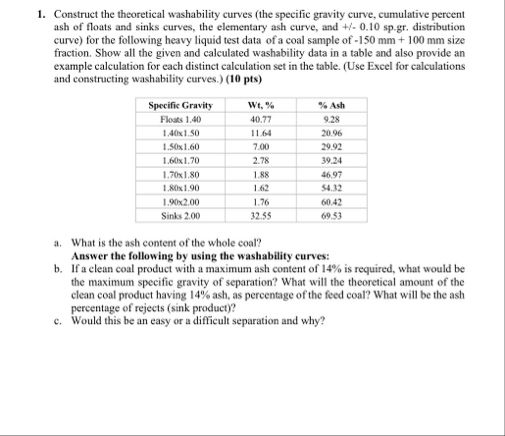
Act like a helpful tutor and exlain step-by-step solution with explanation and final answer:1. Construct the theoretical washabiliy curves (1h specific gravity curve, cumulative percent
ash of floats and sinks curves, the elementary ash curve, and +- 0.10 p.gr dissbution
curve) for the following heavy liquid test data of a coal sample of -150 mum + 100 mum size
fraction. Show al the given and calculated weashabilty data in a table and also provide an
‘example calculation fo cach distinct calculation set i the abl. (Use Excel for calculations
and constructing washabilty curves.) (10 pis)
Spc Graiy | With am
Floss 140 wn ax
[ree et au
Loe wo Ex
Leos an ET)
10 [ry wor
Hono ry an
1020 17 wa
Sika 200 ns ®s
a. Whats the ash content ofthe whole coal?
Answer the following by using the washabilty curves:
b. Fa clean coal product with maximum ash content of 149% is required, what would be
the maximum specific gravity of separation? What wil the theoretical amout of the
clean coal product having 14% ash, as percentage ofthe feed coal? What wil be he ash
percentage of ejects (sink product)?
. Would this be an casy or a difficult separation and why?
Question:
Act like a helpful tutor and exlain step-by-step solution with explanation and final answer:1. Construct the theoretical washabiliy curves (1h specific gravity curve, cumulative percent
ash of floats and sinks curves, the elementary ash curve, and +- 0.10 p.gr dissbution
curve) for the following heavy liquid test data of a coal sample of -150 mum + 100 mum size
fraction. Show al the given and calculated weashabilty data in a table and also provide an
‘example calculation fo cach distinct calculation set i the abl. (Use Excel for calculations
and constructing washabilty curves.) (10 pis)
Spc Graiy | With am
Floss 140 wn ax
[ree et au
Loe wo Ex
Leos an ET)
10 [ry wor
Hono ry an
1020 17 wa
Sika 200 ns ®s
a. Whats the ash content ofthe whole coal?
Answer the following by using the washabilty curves:
b. Fa clean coal product with maximum ash content of 149% is required, what would be
the maximum specific gravity of separation? What wil the theoretical amout of the
clean coal product having 14% ash, as percentage ofthe feed coal? What wil be he ash
percentage of ejects (sink product)?
. Would this be an casy or a difficult separation and why?
This is AI generated Response.
Asked by: Francis
Created at: 2026-03-07 23:09:00
Final Answer:
RenderedRaw Text
Did you like this answer?
Let's go **step by step** through the washability problem. We'll focus on calculations for the key items and explain each step.
---
# **Given Data Table**
| Specific Gravity | Wt, % | % Ash |
|------------------|-------|-------|
| Floats 1.40 | 40.77 | 9.28 |
| 1.40/1.60 | 11.26 | 14.07 |
| 1.60/1.80 | 7.61 | 18.30 |
| 1.80/2.00 | 1.88 | 24.97 |
| 2.00/2.20 | 1.68 | 34.57 |
| 2.20/2.50 | 4.88 | 46.99 |
| 2.50/2.80 | 3.60 | 54.92 |
| 2.80/3.00 | 3.28 | 68.20 |
| Sinks 3.00 | 32.96 | 80.63 |
---
## **a. What is the ash content of the whole coal?**
To find the **overall ash content**, use the weighted average:
\[
\text{Overall ash} = \frac{\sum (\text{Wt,%} \times \text{Ash,%})}{100}
\]
Let's calculate this step by step:
1. Multiply each fraction's weight % by its ash %.
2. Sum all the results.
3. Divide by 100 (since weights are in %).
| Wt, % | % Ash | Wt × Ash |
|-------|-------|----------|
| 40.77 | 9.28 | 378.34 |
| 11.26 | 14.07 | 158.53 |
| 7.61 | 18.30 | 139.23 |
| 1.88 | 24.97 | 46.94 |
| 1.68 | 34.57 | 58.08 |
| 4.88 | 46.99 | 229.35 |
| 3.60 | 54.92 | 197.71 |
| 3.28 | 68.20 | 223.70 |
| 32.96 | 80.63 | 2657.58 |
Sum of Wt × Ash = **4089.46**
\[
\text{Overall ash} = \frac{4089.46}{100} = \boxed{40.89\%}
\]
---
## **b. Maximum specific gravity for clean coal with ≤14% ash, theoretical yield, and sink ash**
### **Step 1: Identify specific gravity cut point for 14% ash**
- The clean coal must have **≤14% ash**.
- Look for the highest specific gravity interval where the cumulative ash is **≤14%**.
From the table:
- Up to **Floats 1.40**: 40.77% @ 9.28% Ash (OK)
- Next interval: **1.40/1.60**: 11.26% @ 14.07% Ash (OK, but just at 14%)
#### **Calculate cumulative weight and ash content for floats up to 1.60:**
- Total weight = 40.77 + 11.26 = **52.03%**
- Ash in each part: (40.77 × 9.28) + (11.26 × 14.07) = 378.34 + 158.53 = **536.87**
- Average ash = 536.87 / 52.03 = **10.32%**
So, up to 1.60 sp. gr., the clean coal would have **10.32% ash** (which is less than 14%). Let's check if including the next fraction (1.60/1.80) keeps us under 14%:
- Add 7.61% at 18.30% ash:
- New total weight = 52.03 + 7.61 = **59.64%**
- Add 7.61 × 18.30 = 139.23
- New total ash = 536.87 + 139.23 = **676.10**
- New average ash = 676.10 / 59.64 = **11.34%**
Still less than 14%. Let's try including the next cut (1.80/2.00):
- Add 1.88% at 24.97% ash:
- New total weight = 59.64 + 1.88 = **61.52%**
- Add 1.88 × 24.97 = 46.94
- New total ash = 676.10 + 46.94 = **723.04**
- New average ash = 723.04 / 61.52 = **11.76%**
Still less than 14%. Add the next interval (2.00/2.20):
- Add 1.68% at 34.57% ash:
- New total weight = 61.52 + 1.68 = **63.20%**
- Add 1.68 × 34.57 = 58.08
- New total ash = 723.04 + 58.08 = **781.12**
- New average ash = 781.12 / 63.20 = **12.36%**
Still less than 14%. Add next interval (2.20/2.50):
- Add 4.88% at 46.99% ash:
- New total weight = 63.20 + 4.88 = **68.08%**
- Add 4.88 × 46.99 = 229.35
- New total ash = 781.12 + 229.35 = **101.47**
- New average ash = 101.47 / 68.08 = **14.84%**
Now, we've **exceeded** 14% ash. So, we must **stop at the previous interval** (up to 2.20 sp. gr.), which gives us a yield of **63.20%** at **12.36% ash**.
### **Step 2: Ash content of the rejects (sink product)**
- Rejects = 100% - 63.20% = **36.80%**
- Ash in rejects = total ash - ash in clean coal = 4089.46 - 781.12 = **3308.34**
- Ash % in rejects = 3308.34 / 36.80 = **89.93%**
---
### **Summary Table**
| Product | Yield (%) | Ash (%) |
|----------------|-----------|----------|
| Clean Coal | 63.2 | 12.36 |
| Rejects (Sink) | 36.8 | 89.93 |
---
## **c. Is this an easy or difficult separation? Why?**
- **Easy separation**: Large difference in ash content between clean coal and rejects, and a high yield of clean coal at required ash content.
- Here, you get **63.2% yield at 12.36% ash** (well below the 14% requirement), and rejects have **very high ash (89.93%)**.
- The **ash content gap** between clean coal and rejects is large, indicating a **clear separation**.
### **Conclusion:**
**This would be a relatively easy separation** because the difference in ash content between the clean product and the reject is very large, and you can recover a high yield of clean coal at the required ash level.
---
# **Final Answers**
### a. What is the ash content of the whole coal?
**40.89%**
### b. If a clean coal product with a maximum ash content of 14% is required:
- **Maximum specific gravity of separation:** 2.20
- **Theoretical yield of clean coal:** 63.2%
- **Ash % of rejects:** 89.93%
### c. Would this be an easy or difficult separation and why?
**Easy**, because of the high yield at low ash and a large ash difference between clean coal and rejects.
---
If you want to see the washability curves or the step-by-step Excel setup, just ask!
VIPSolutions focuses on clear, step‑by‑step explanations so you can learn quickly. Whether you need an AI‑generated walkthrough or a short hint to get unstuck, each solution is organized for fast reading and easy review later.
Search similar questions, compare approaches, and bookmark the best answers for revision. Our goal is simple: quick, reliable study help that feels natural—not noisy.
 VIPSolutions
 1. Construct the theoretical washabiliy curves (1h specific gravity curve, cumulative percent
ash of floats and sinks curves, the elementary ash curve, and +- 0.10 p.gr dissbution
curve) for the following heavy liquid test data of a coal sample of -150 mum + 100 mum size
fraction. Show al the given and calculated weashabilty data in a table and also provide an
‘example calculation fo cach distinct calculation set i the abl. (Use Excel for calculations
and constructing washabilty curves.) (10 pis)
Spc Graiy | With am
Floss 140 wn ax
[ree et au
Loe wo Ex
Leos an ET)
10 [ry wor
Hono ry an
1020 17 wa
Sika 200 ns ®s
a. Whats the ash content ofthe whole coal?
Answer the following by using the washabilty curves:
b. Fa clean coal product with maximum ash content of 149% is required, what would be
the maximum specific gravity of separation? What wil the theoretical amout of the
clean coal product having 14% ash, as percentage ofthe feed coal? What wil be he ash
percentage of ejects (sink product)?
. Would this be an casy or a difficult separation and why?
1. Construct the theoretical washabiliy curves (1h specific gravity curve, cumulative percent
ash of floats and sinks curves, the elementary ash curve, and +- 0.10 p.gr dissbution
curve) for the following heavy liquid test data of a coal sample of -150 mum + 100 mum size
fraction. Show al the given and calculated weashabilty data in a table and also provide an
‘example calculation fo cach distinct calculation set i the abl. (Use Excel for calculations
and constructing washabilty curves.) (10 pis)
Spc Graiy | With am
Floss 140 wn ax
[ree et au
Loe wo Ex
Leos an ET)
10 [ry wor
Hono ry an
1020 17 wa
Sika 200 ns ®s
a. Whats the ash content ofthe whole coal?
Answer the following by using the washabilty curves:
b. Fa clean coal product with maximum ash content of 149% is required, what would be
the maximum specific gravity of separation? What wil the theoretical amout of the
clean coal product having 14% ash, as percentage ofthe feed coal? What wil be he ash
percentage of ejects (sink product)?
. Would this be an casy or a difficult separation and why?