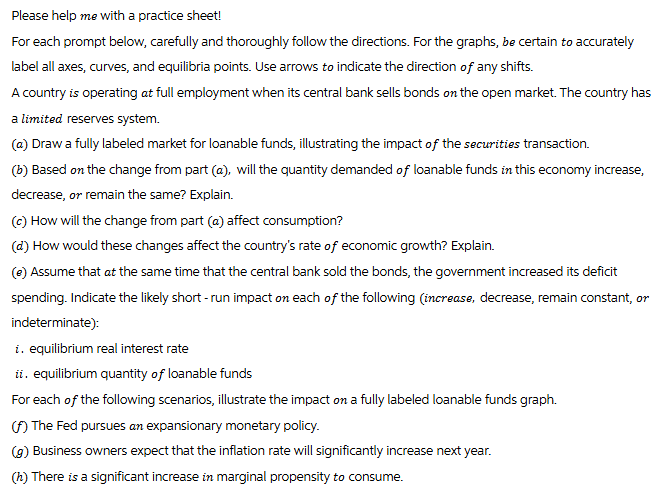
Give step-by-step solution with explanation and final answer:Please help me with a practice sheet!
For each promt below, carefully and thoroughly follow the directions. For the graphs, be certain to accurately
label all axes, curves, and equilibria points. Use arrows to indicate the direction of any shifts.
A country is operating at full employment when its central bank sells bonds on the open market. The country has.
limited reserves system.
(a) Draw a fully labeled market for loanable funds, illustrating the impact of the securities transaction.
(6) Based on the change from part (a). will the quantity demanded of loanable funds in this economy increase,
decrease, or remain the same? Explain.
(&) How will the change from part (a) affect consumption?
(d) How would these changes affect the country’s rate of economic growth? Explain.
(&) Assume that at the same time that the central bank sold the bonds, the government increased its deficit
spending. Indicate the likely short - run impact on each of the following (increase, decrease, remain constant, or
indeterminate):
. equilibrium real interest rate.
ii. equilibrium quantity of loanable funds
For each of the following scenarios, illustrate the impact on a fully labeled loanable funds graph.
(f) The Fed pursues an expansionary monetary policy.
(5) Business owners expect that the inflation rate wil significantly increase next year.
(i) There is a significant increase in marginal propensity to consume.
Question:
Give step-by-step solution with explanation and final answer:Please help me with a practice sheet!
For each promt below, carefully and thoroughly follow the directions. For the graphs, be certain to accurately
label all axes, curves, and equilibria points. Use arrows to indicate the direction of any shifts.
A country is operating at full employment when its central bank sells bonds on the open market. The country has.
limited reserves system.
(a) Draw a fully labeled market for loanable funds, illustrating the impact of the securities transaction.
(6) Based on the change from part (a). will the quantity demanded of loanable funds in this economy increase,
decrease, or remain the same? Explain.
(&) How will the change from part (a) affect consumption?
(d) How would these changes affect the country’s rate of economic growth? Explain.
(&) Assume that at the same time that the central bank sold the bonds, the government increased its deficit
spending. Indicate the likely short - run impact on each of the following (increase, decrease, remain constant, or
indeterminate):
. equilibrium real interest rate.
ii. equilibrium quantity of loanable funds
For each of the following scenarios, illustrate the impact on a fully labeled loanable funds graph.
(f) The Fed pursues an expansionary monetary policy.
(5) Business owners expect that the inflation rate wil significantly increase next year.
(i) There is a significant increase in marginal propensity to consume.
This is AI generated Response.
Asked by: Vikram Kumar
Created at: 2025-10-22 05:31:31
Final Answer:
RenderedRaw Text
Did you like this answer?
Let's analyze and solve each part step-by-step.
---
## **(a) a fully labeled market for loanable illustrating the impact of a securities transaction.**
**Key points:**
- The market for loanable funds includes **supply** (saving) and **demand** (investment).
- The **securities transaction** (issuing bonds) influences the **supply** of loanable funds.
**Impact of securities issuance:**
- When the government or firms issue bonds, they are **demanding** funds (borrowing), which shifts the **demand curve** to the **right**.
- Conversely, a **sale of bonds** by the government **reduces** the supply of loanable funds (since funds are moving from savers to bond buyers), shifting **supply** to the **left**.
**Graph setup:**
- Vertical axis: **Real interest rate (r)**
- Horizontal axis: **Quantity of loanable funds (Q)**
- Initial equilibrium: intersection of demand \( D_ \) and supply \( S_ \)
- After securities transaction:
- **Demand for loanable funds increases** (shift \( D_ \to D_1 \))
- **Supply may decrease** if bonds are sold to the public, but the dominant effect is increased demand.
---
## **(b) How does the change from part (a) affect the quantity demanded of loanable funds?**
- **If demand increases** (due to bonds being issued), **the quantity of loanable funds demanded at the initial interest rate increases**.
- **If supply decreases**, the **equilibrium quantity** could **decrease or stay the same**, but generally, the **demand increase leads to higher equilibrium interest rate and possibly higher quantity**.
**Answer:**
- The **quantity demanded of loanable funds increases** due to increased demand for bonds and borrowing.
---
## **(c) How will the change from part (a) affect consumption?**
- **Higher interest rates** (due to increased demand) **discourage consumption** because borrowing costs are higher and saving becomes relatively more attractive.
- So, **consumption decreases**.
---
## **(d) How would these changes affect the country’s rate of economic growth?**
- **Higher interest rates** **reduce investment** (costly borrowing), which **slows economic growth**.
- **Decreased investment** reduces capital accumulation, leading to **slower growth**.
**Answer:**
- The **rate of economic growth decreases**.
---
## **(e) Impact of the government increasing its deficit spending while the central bank sells bonds.**
- **Government increases deficit spending**, **raising the demand for loanable funds**.
- **Central bank sells bonds**, **reducing the supply of loanable funds** (supply shifts left).
**Likely short-run impact:**
- **Interest rates increase** (demand still high, supply reduced).
- **Loanable funds decrease** (less funds available for private investment).
---
## **(f) Impact of the Fed pursuing expansionary monetary policy.**
- **Expansionary policy** involves **buying bonds**, which **increases the money supply**.
- **Impact**:
- **Increases the supply of loanable funds**.
- **Interest rates decrease**.
- **Loanable funds increase**.
---
## **(g) Impact of expected inflation on loanable funds market.**
- If **business owners expect higher inflation**, they **will demand more funds** now to invest before costs rise.
- **Demand for loanable funds shifts right**, **interest rates increase**.
---
## **(h) Impact of a significant increase in marginal propensity to consume (MPC).**
- **Higher MPC** implies households **prefer to consume more out of additional income**.
- This **increases savings**, shifting **supply** of loanable funds **to the right**.
- **Result**:
- **Interest rates decrease**.
- **Loanable funds increase**.
---
## **Summary of Graphs and Impacts**
| Scenario | Effect on Loanable Funds Graph | Details |
|---|---|---|
| (a) Securities transaction | Demand shifts right | Interest rate rises, quantity increases |
| (b) Quantity demanded | Increases | Due to increased demand |
| (c) Consumption | Decreases | Higher interest rates discourage consumption |
| (d) Economic growth | Decreases | Investment slows down |
| (e) Government deficit + bond sales | Interest rate increases, supply decreases | Less funds for private investment |
| (f) Expansionary monetary policy | Supply increases | Interest rates decrease |
| (g) Expected inflation | Demand shifts right | Interest rates increase |
| (h) Higher MPC | Supply shifts right | Interest rates decrease |
---
If you need the actual diagrams, I can help generate them or guide you through drawing them step-by-step.
Question:
Actual diagrams needed
This is AI generated Response.
Asked by: Vikram Kumar
Created at: 2025-10-22 05:35:23
Final Answer:
RenderedRaw Text
Did you like this answer?
Certainly! Below is a structured guide for creating the necessary diagrams based on the scenarios discussed.
---
# **Diagrams for Loanable Funds Market**
## **1. Securities Transaction Impact**
**Graph Setup:**
- **Axes:**
- Vertical: Real Interest Rate (r)
- Horizontal: Quantity of Loanable Funds (Q)
**Steps to Draw:**
1. Draw the initial demand curve \( D \) and supply curve \( S \) intersecting at equilibrium point \( E_0 \).
2. Draw the new demand curve \( D_1 \) shifted to the right due to increased demand for funds.
3. Optionally, illustrate a leftward shift of supply \( S_1 \) due to bond sales (if significant).
4. Label the new equilibrium point \( E_1 \) where \( D_1 \) intersects with \( S \) or \( S_1 \).
**Alt Text:**
"Graph illustrating the market for loanable funds after a securities transaction, showing the shift in demand."
---
## **2. Effect on Quantity Demanded**
**Graph Setup:**
- Similar to the previous graph, focus on the quantity demanded at the initial interest rate \( r_0 \).
**Steps to Draw:**
1. Highlight the change in quantity from \( Q_0 \) to \( Q_1 \) at the new equilibrium point \( E_1 \) due to the increase in demand.
**Alt Text:**
"Graph showing the increase in quantity demanded of loanable funds due to a securities transaction."
---
## **3. Impact on Consumption**
**Graph Setup:**
- Use a simple supply and demand graph for the consumption goods market.
**Steps to Draw:**
1. Label the axes: Price Level (P) and Real GDP (Y).
2. Draw the initial aggregate demand curve \( AD \) and aggregate supply curve \( AS \).
3. Show a leftward shift in \( AD \) due to decreased consumption, leading to a new equilibrium \( E_2 \) at a lower output level.
**Alt Text:**
"Graph depicting the decrease in aggregate demand in the consumption goods market due to higher interest rates."
---
## **4. Economic Growth Impact**
**Graph Setup:**
- Similar to the previous consumption graph.
**Steps to Draw:**
1. Use the same axes: Price Level (P) and Real GDP (Y).
2. Illustrate a potential decrease in the long-term aggregate supply (if relevant) due to lower investment, shifting the AS curve left.
**Alt Text:**
"Graph demonstrating the potential impact on economic growth with a shift in long-term aggregate supply due to decreased investment."
---
## **5. Government Deficit Spending + Bond Sales**
**Graph Setup:**
- Use the loanable funds market graph.
**Steps to Draw:**
1. Show the shifts: Rightward shift in the demand curve due to increased deficit spending.
2. Leftward shift in the supply curve due to bond sales.
3. Highlight the new equilibrium with higher interest rates \( r_2 \).
**Alt Text:**
"Graph showing the combined effects of government deficit spending and bond sales on the loanable funds market."
---
## **6. Expansionary Monetary Policy**
**Graph Setup:**
- Loanable funds market.
**Steps to Draw:**
1. Illustrate a rightward shift of the supply curve due to increased money supply.
2. Show the resulting decrease in equilibrium interest rates and an increase in quantity of loanable funds.
**Alt Text:**
"Graph illustrating the effects of expansionary monetary policy on the loanable funds market."
---
## **7. Expected Inflation Effect**
**Graph Setup:**
- Loanable funds market.
**Steps to Draw:**
1. Show a rightward shift in the demand curve due to expected inflation.
2. Mark the new equilibrium with a higher interest rate.
**Alt Text:**
"Graph showing the increase in demand for loanable funds due to expected inflation."
---
## **8. Increase in Marginal Propensity to Consume**
**Graph Setup:**
- Loanable funds market.
**Steps to Draw:**
1. Show a rightward shift in the supply curve due to higher savings.
2. Illustrate a decrease in equilibrium interest rates and an increase in the quantity of loanable funds.
**Alt Text:**
"Graph illustrating the impact of an increase in marginal propensity to consume on the loanable funds market."
---
These steps will help you create the necessary diagrams for each scenario. Ensure that all curves are clearly labeled with arrows indicating the direction of shifts. If you need further assistance with the actual drawing or specific values, let me know!
VIPSolutions focuses on clear, step‑by‑step explanations so you can learn quickly. Whether you need an AI‑generated walkthrough or a short hint to get unstuck, each solution is organized for fast reading and easy review later.
Search similar questions, compare approaches, and bookmark the best answers for revision. Our goal is simple: quick, reliable study help that feels natural—not noisy.
 VIPSolutions
 Please help me with a practice sheet!
For each promt below, carefully and thoroughly follow the directions. For the graphs, be certain to accurately
label all axes, curves, and equilibria points. Use arrows to indicate the direction of any shifts.
A country is operating at full employment when its central bank sells bonds on the open market. The country has.
limited reserves system.
(a) Draw a fully labeled market for loanable funds, illustrating the impact of the securities transaction.
(6) Based on the change from part (a). will the quantity demanded of loanable funds in this economy increase,
decrease, or remain the same? Explain.
(&) How will the change from part (a) affect consumption?
(d) How would these changes affect the country’s rate of economic growth? Explain.
(&) Assume that at the same time that the central bank sold the bonds, the government increased its deficit
spending. Indicate the likely short - run impact on each of the following (increase, decrease, remain constant, or
indeterminate):
. equilibrium real interest rate.
ii. equilibrium quantity of loanable funds
For each of the following scenarios, illustrate the impact on a fully labeled loanable funds graph.
(f) The Fed pursues an expansionary monetary policy.
(5) Business owners expect that the inflation rate wil significantly increase next year.
(i) There is a significant increase in marginal propensity to consume.
Please help me with a practice sheet!
For each promt below, carefully and thoroughly follow the directions. For the graphs, be certain to accurately
label all axes, curves, and equilibria points. Use arrows to indicate the direction of any shifts.
A country is operating at full employment when its central bank sells bonds on the open market. The country has.
limited reserves system.
(a) Draw a fully labeled market for loanable funds, illustrating the impact of the securities transaction.
(6) Based on the change from part (a). will the quantity demanded of loanable funds in this economy increase,
decrease, or remain the same? Explain.
(&) How will the change from part (a) affect consumption?
(d) How would these changes affect the country’s rate of economic growth? Explain.
(&) Assume that at the same time that the central bank sold the bonds, the government increased its deficit
spending. Indicate the likely short - run impact on each of the following (increase, decrease, remain constant, or
indeterminate):
. equilibrium real interest rate.
ii. equilibrium quantity of loanable funds
For each of the following scenarios, illustrate the impact on a fully labeled loanable funds graph.
(f) The Fed pursues an expansionary monetary policy.
(5) Business owners expect that the inflation rate wil significantly increase next year.
(i) There is a significant increase in marginal propensity to consume.