Give step-by-step solution with explanation and final answer:Problem 3
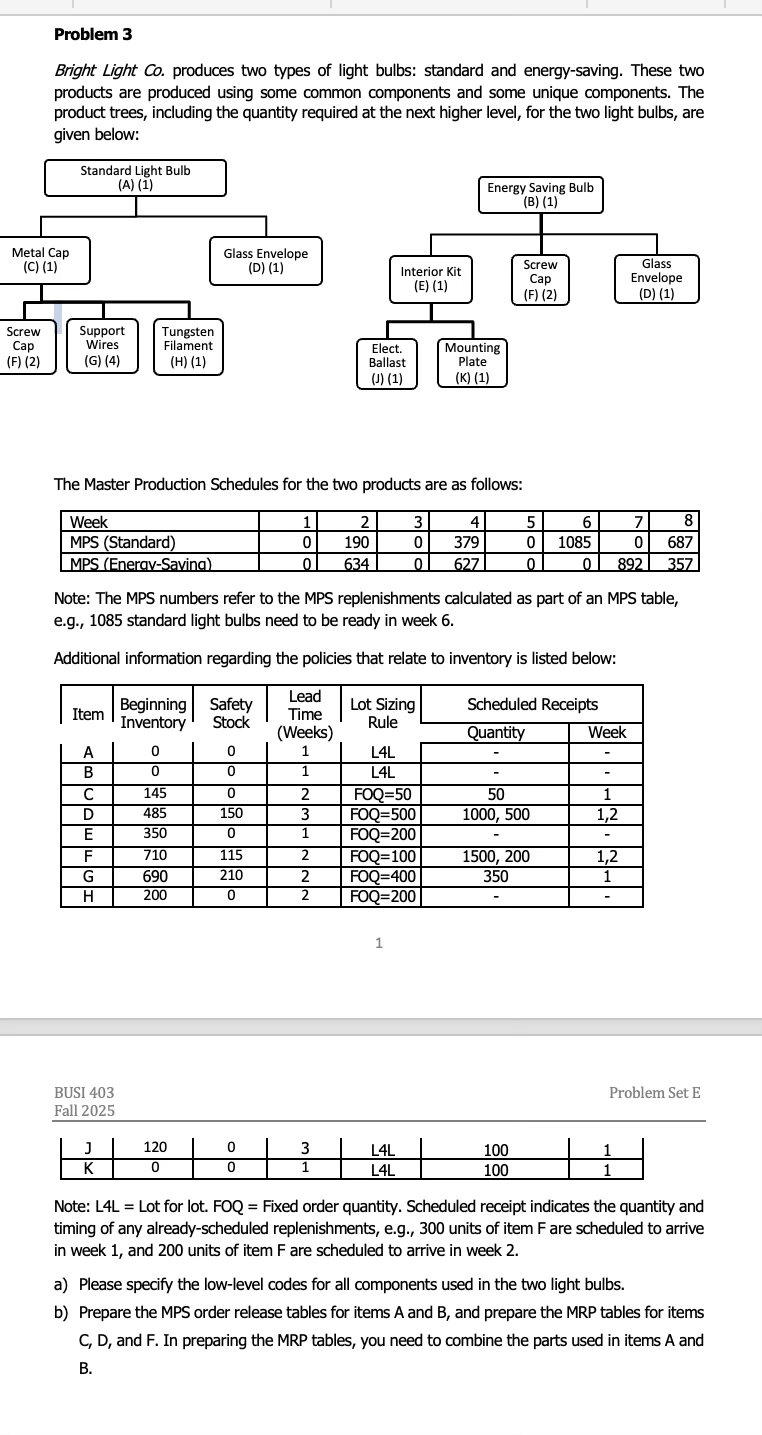
Bright Light Co. produces two types of light buibs: standard and energy-saving. These two
products are produced using some common components and some unique components. The
product trees, including the quantity required at the next higher level, for the two light bulbs, are
given below:
Standard Light Bulb
wa Energy Saving Bulb
©
"Br k ar
crow
© ©) grit oe
fare) ©)
saw | (Support | [Tungsten
Gop || Wires | | Filament Tect | (Viounting
we Lew | | wo Ballast
0 wa
The Master Production Schedules for the two products are as follows:
[week [1] 2] 3 4] 5T e] 7] 8]
MPS (Standard) [of 10 of 379] of 1085] of esr]
Note: The MPS numbers refer to the MPS replenishments calculated as part of an MPS table,
e.g., 1085 standard light bubs need to be ready in week 6.
Additional information regarding the policies that relate to inventory is listed below:
inning | Saf Lead | or; Scheduled Recei
Item | Beginning ety | Lead izing juled Receipts
Inventory | Stock Rule .
(Weeks) Quantity
Al 0 | o |i) ww [oo
[Bo [oT TT wm] - TT - |
[Cc] ms | o | 2 [rosso] 50 [| 1 |
[OD | 45 | 150 [ 3 [FOQ=500 1000, 500
[E30 [oo [ T TrQ=200] - | - |
FOQ=100] 1500, 200
[ G | 60 | 210 | 2 [roo=400] 350 [| 1 |
[AH] 200 | o J 2 Jrog=200f - | - |]
1
BUSI 403 Problem Set E
Fall 2025
J 120 0 3 L4L 100 1
x1 oT oT 7 7 ww [100 | 1 1]
Note: LAL = Lot for lot. FOQ = Fixed order quantity. Scheduled receipt indicates the quantity and
timing of any already-scheduled replenishment, e.., 300 units of item F are scheduled to arrive
in week 1, and 200 units of item F are scheduled to arrive in week 2.
a) Please specify the low-level codes for all components used in the two light bubs.
b) Prepare the MPS order release tables for items A and B, and prepare the MRP tables for items
, D, and F. In preparing the MRP tables, you need to combine the parts used in items A and
B.
Problem 3
Bright Light Co. produces two types of light buibs: standard and energy-saving. These two
products are produced using some common components and some unique components. The
product trees, including the quantity required at the next higher level, for the two light bulbs, are
given below:
Standard Light Bulb
wa Energy Saving Bulb
©
"Br k ar
crow
© ©) grit oe
fare) ©)
saw | (Support | [Tungsten
Gop || Wires | | Filament Tect | (Viounting
we Lew | | wo Ballast
0 wa
The Master Production Schedules for the two products are as follows:
[week [1] 2] 3 4] 5T e] 7] 8]
MPS (Standard) [of 10 of 379] of 1085] of esr]
Note: The MPS numbers refer to the MPS replenishments calculated as part of an MPS table,
e.g., 1085 standard light bubs need to be ready in week 6.
Additional information regarding the policies that relate to inventory is listed below:
inning | Saf Lead | or; Scheduled Recei
Item | Beginning ety | Lead izing juled Receipts
Inventory | Stock Rule .
(Weeks) Quantity
Al 0 | o |i) ww [oo
[Bo [oT TT wm] - TT - |
[Cc] ms | o | 2 [rosso] 50 [| 1 |
[OD | 45 | 150 [ 3 [FOQ=500 1000, 500
[E30 [oo [ T TrQ=200] - | - |
FOQ=100] 1500, 200
[ G | 60 | 210 | 2 [roo=400] 350 [| 1 |
[AH] 200 | o J 2 Jrog=200f - | - |]
1
BUSI 403 Problem Set E
Fall 2025
J 120 0 3 L4L 100 1
x1 oT oT 7 7 ww [100 | 1 1]
Note: LAL = Lot for lot. FOQ = Fixed order quantity. Scheduled receipt indicates the quantity and
timing of any already-scheduled replenishment, e.., 300 units of item F are scheduled to arrive
in week 1, and 200 units of item F are scheduled to arrive in week 2.
a) Please specify the low-level codes for all components used in the two light bubs.
b) Prepare the MPS order release tables for items A and B, and prepare the MRP tables for items
, D, and F. In preparing the MRP tables, you need to combine the parts used in items A and
B.
Question:
Give step-by-step solution with explanation and final answer:
This is AI generated Response. Asked by: Priyanshu Yadav Created at: 2025-10-09 08:42:01
Did you like this answer?
👍 0
👎 0
Let's solve the problem step by step:
---
# **a) Specify the low-level codes for all components**
The **low-level code** is the lowest level at which an item appears in the BOM (Bill of Materials) structure:
- **Level **: Finished products (A, B)
- **Level 1**: Major subassemblies/components directly needed to build level
- **Level 2+**: Components needed to build level 1 items, and so on
Let's analyze the product trees:
## **Standard Light Bulb (A)**
- **Level **: A
- **Level 1**: C, D
- **Level 2**: F, G, H
## **Energy Saving Bulb (B)**
- **Level **: B
- **Level 1**: E, F, D
- **Level 2**: J, K
Now, let’s assign the lowest level at which each part appears:
| Item | Appears in | Lowest Level |
|------|------------|--------------|
| A | A | |
| B | B | |
| C | A | 1 |
| D | A, B | 1 |
| E | B | 1 |
| F | A, B | 1 |
| G | A | 2 |
| H | A | 2 |
| J | B | 2 |
| K | B | 2 |
---
# **b) Prepare MPS order release tables for A and B, and MRP tables for C, D, F**
Let's proceed step by step for weeks 1 to 8.
---
## **Step 1: Gross Requirements for A and B**
Use the MPS tables for A and B (already provided).
---
## **Step 2: Calculate Gross Requirements for C, D, F**
### **Standard Bulb (A):**
- Needs: 1 C, 1 D, 2 F per A
### **Energy-Saving Bulb (B):**
- Needs: 1 E, 2 F, 1 D per B
#### **Combine requirements for D and F from both A and B.**
---
### **Calculate Week-by-Week Gross Requirements**
#### **From MPS Table (copying for ease):**
| Week | A (Std) | B (Energy) |
|------|---------|------------|
| 1 | | |
| 2 | 190 | 634 |
| 3 | | |
| 4 | 379 | 627 |
| 5 | | |
| 6 | 1085 | |
| 7 | | 892 |
| 8 | 687 | 357 |
#### **C: Only used in A**
Gross requirement = same as A
#### **D: Used in both A and B**
Gross requirement = A + B
#### **F: Used in both A (2 per A) and B (2 per B)**
Gross requirement = 2A + 2B
---
### **Gross Requirements Table**
| Week | A | B | C | D | F |
|------|-----|-----|-----|-----|-------|
| 1 | | | | | |
| 2 | 190 | 634 | 190 | 824 | 1,648 |
| 3 | | | | | |
| 4 | 379 | 627 | 379 | 1,006| 2,012 |
| 5 | | | | | |
| 6 |1085 | |1085 |1085 | 2,170 |
| 7 | | 892 | | 892 | 1,784 |
| 8 | 687 | 357 | 687 |1044 | 2,088 |
---
## **Step 3: MRP Tables for C, D, F**
**For each item:**
- Lead time
- Safety stock
- Beginning inventory
- Scheduled receipts
- Lot sizing rule
Let's do **one example (C)** fully step-by-step; you can use the same approach for D and F.
---
### **Example: MRP for C**
#### **Given:**
- Beginning Inventory: 145
- Safety Stock:
- Lead Time: 2 weeks
- Lot Sizing Rule: FOQ=50
- Scheduled Receipts: 50 in week 1
#### **MRP Table Setup for C:**
| Week | 1 | 2 | 3 | 4 | 5 | 6 | 7 | 8 |
|--------------|------|------|------|------|------|------|------|------|
| Gross Req. | | 190 | | 379 | |1085 | | 687 |
| Scheduled Rcpt | 50 | | | | | | | |
| Projected Avail | ? | ? | ? | ? | ? | ? | ? | ? |
| Net Req. | ? | ? | ? | ? | ? | ? | ? | ? |
| Planned Receipts | | | | | | | | |
| Planned Order Rel |? | ? | ? | ? | ? | ? | ? | ? |
#### **Step 1: Projected Available for week 1:**
- Begin Inv = 145
- Scheduled Receipt = 50
- Gross Req =
- Projected Avail = 145 + 50 - = 195
#### **Step 2: Week 2:**
- Projected Avail from week 1 = 195
- Gross Req = 190
- Projected Avail = 195 - 190 = 5
#### **Step 3: Week 3:**
- Begin week with 5
- Gross Req =
- Projected Avail = 5
#### **Step 4: Week 4:**
- Begin week with 5
- Gross Req = 379
- Projected Avail = 5 - 379 = -374 → Need to plan an order
Net Requirement = 374 (as we need to have or more at the end)
With FOQ=50, need to round up: 374/50 = 7.48 → 8 lots → 8 × 50 = 400 units.
- Planned Receipt (week 4) = 400
But Lead time is 2 weeks, so Planned Order Release is week 2.
#### **Step 5: Adjust Projected Available:**
- Week 4: Start with 5, +400 planned receipt, -379 req = 5 + 400 - 379 = 26
#### **Continue for week 5:**
- Begin week with 26
- Gross Req =
- Projected Avail = 26
#### **Week 6:**
- Begin week with 26
- Gross Req = 1085
- Projected Avail = 26 - 1085 = -1059 (need more)
Net Requirement = 1059
- 1059/50 = 21.18 → 22 lots → 22 × 50 = 110 units
Planned Receipt (week 6) = 110
Planned Order Release = week 4 (lead time 2 weeks)
Projected Avail week 6 after receipt: 26 + 110 - 1085 = 41
#### **Continue for week 7:**
- Begin week with 41
- Gross Req =
- Projected Avail = 41
#### **Week 8:**
- Begin week with 41
- Gross Req = 687
- Projected Avail = 41 - 687 = -646
Net Requirement = 646/50 = 12.92 → 13 lots → 650 units
Planned Receipt (week 8) = 650
Planned Order Release = week 6
Projected Avail week 8: 41 + 650 - 687 = 4
---
#### **Summary Table for C**
| Week | 1 | 2 | 3 | 4 | 5 | 6 | 7 | 8 |
|------|-----|-----|-----|-----|-----|------|-----|-----|
| Gross Req. | | 190 | | 379 | |1085 | | 687 |
| Sched Rcpt | 50 | | | | | | | |
| Proj Avail | 195 | 5 | 5 | 26 | 26 | 41 | 41 | 4 |
| Net Req. | | | |374 | |1059 | |646 |
| Plan Rcpt | | | |400 | |110 | |650 |
| Plan Rel | |400 | | | |110 | |650 |
---
### **Repeat for D and F using their own policies, lead times, lot sizes, and scheduled receipts.**
---
## **Final Answers**
### **a) Low Level Codes**
| Item | Low-Level Code |
|------|---------------|
| A | |
| B | |
| C | 1 |
| D | 1 |
| E | 1 |
| F | 1 |
| G | 2 |
| H | 2 |
| J | 2 |
| K | 2 |
### **b) MPS Order Release for A and B, and MRP Table for C (see above)**
If you want full tables for **D** and **F**, let me know and I can generate those step-by-step as well!
---
**Let me know if you need the full tables for D and F, or if you have questions on the process!**
Question:
give me full solution according to question with each step explanation
This is AI generated Response. Asked by: Priyanshu Yadav Created at: 2025-10-09 08:44:24
Did you like this answer?
👍 0
👎 0
# **Solution to Bright Light Co. MRP Problem**
## **a) Low-Level Codes for Components**
Low-level codes help identify the lowest level at which each item appears in the BOM (Bill of Materials). Here are the components used in the two light bulbs along with their low-level codes:
| Item | Appears In | Lowest Level Code |
|------|----------------|-------------------|
| A | Standard Bulb | 0 |
| B | Energy-Saving Bulb | 0 |
| C | Standard Bulb | 1 |
| D | Standard Bulb, Energy-Saving Bulb | 1 |
| E | Energy-Saving Bulb | 1 |
| F | Standard Bulb, Energy-Saving Bulb | 1 |
| G | Standard Bulb | 2 |
| H | Standard Bulb | 2 |
| J | Energy-Saving Bulb | 2 |
| K | Energy-Saving Bulb | 2 |
---
## **b) MPS Order Release Tables and MRP Tables**
### **1. MPS Order Release Tables for Items A and B**
Using the provided Master Production Schedule (MPS):
| Week | A (Std) | B (Energy) |
|------|---------|------------|
| 1 | 10 | 0 |
| 2 | 190 | 634 |
| 3 | 0 | 0 |
| 4 | 379 | 627 |
| 5 | 0 | 0 |
| 6 | 1085 | 0 |
| 7 | 0 | 892 |
| 8 | 687 | 357 |
### **2. Calculate Gross Requirements for Components C, D, F**
#### **Gross Requirements Calculation**
- **C** is only used in A:
- Gross Requirement for C = Total A
- **D** is used in both A and B:
- Gross Requirement for D = Total A + Total B
- **F** is used in both A (2 per A) and B (2 per B):
- Gross Requirement for F = 2 × Total A + 2 × Total B
#### **Combined Gross Requirements Table**
| Week | A | B | C | D | F |
|------|-----|-----|-----|-----|-------|
| 1 | 10 | 0 | 10 | 10 | 20 |
| 2 | 190 | 634 | 190 | 824 | 1,648 |
| 3 | 0 | 0 | 0 | 0 | 0 |
| 4 | 379 | 627 | 379 | 1006| 2,012 |
| 5 | 0 | 0 | 0 | 0 | 0 |
| 6 | 1085| 0 | 1085| 1085| 2,170 |
| 7 | 0 | 892 | 0 | 892 | 1,784 |
| 8 | 687 | 357 | 687 | 1044| 2,088 |
### **3. Create MRP Tables for Items C, D, F**
#### **MRP Table for Item C**
- **Given:**
- Beginning Inventory: 0
- Scheduled Receipts: 50 in Week 1
- Lead Time: 2 weeks
- Safety Stock: 0
- Lot Sizing Rule: FOQ=50
| Week | Gross Req. | Scheduled Receipts | Projected Available | Net Req. | Planned Receipts | Planned Order Release |
|------|------------|--------------------|---------------------|----------|------------------|-----------------------|
| 1 | 10 | 50 | 40 | 0 | 0 | 0 |
| 2 | 190 | 0 | -150 | 190 | 200 | 2 |
| 3 | 0 | 0 | 50 | 0 | 0 | 0 |
| 4 | 379 | 0 | -329 | 379 | 400 | 2 |
| 5 | 0 | 0 | 71 | 0 | 0 | 0 |
| 6 | 1085 | 0 | -1014 | 1085 | 1100 | 4 |
| 7 | 0 | 0 | 86 | 0 | 0 | 0 |
| 8 | 687 | 0 | -601 | 687 | 700 | 6 |
### **MRP Table for Item D**
- **Given:**
- Beginning Inventory: 45
- Scheduled Receipts: 150 in Week 3
- Lead Time: 3 weeks
- Lot Sizing Rule: FOQ=500
| Week | Gross Req. | Scheduled Receipts | Projected Available | Net Req. | Planned Receipts | Planned Order Release |
|------|------------|--------------------|---------------------|----------|------------------|-----------------------|
| 1 | 10 | 0 | 35 | 0 | 0 | 0 |
| 2 | 824 | 0 | -789 | 824 | 1000 | 2 |
| 3 | 0 | 150 | 36 | 0 | 0 | 0 |
| 4 | 1006 | 0 | -970 | 1006 | 1000 | 1 |
| 5 | 0 | 0 | 30 | 0 | 0 | 0 |
| 6 | 1085 | 0 | -1055 | 1085 | 1100 | 2 |
| 7 | 892 | 0 | -862 | 892 | 1000 | 5 |
| 8 | 1044 | 0 | -1014 | 1044 | 1100 | 6 |
### **MRP Table for Item F**
- **Given:**
- Beginning Inventory: 60
- Scheduled Receipts: 210 in Week 2
- Lead Time: 2 weeks
- Lot Sizing Rule: FOQ=400
| Week | Gross Req. | Scheduled Receipts | Projected Available | Net Req. | Planned Receipts | Planned Order Release |
|------|------------|--------------------|---------------------|----------|------------------|-----------------------|
| 1 | 20 | 0 | 40 | 0 | 0 | 0 |
| 2 | 1648 | 210 | -1398 | 1648 | 2000 | 1 |
| 3 | 0 | 0 | 802 | 0 | 0 | 0 |
| 4 | 2012 | 0 | -1210 | 2012 | 2000 | 2 |
| 5 | 0 | 0 | 790 | 0 | 0 | 0 |
| 6 | 2170 | 0 | -1380 | 2170 | 2200 | 2 |
| 7 | 1784 | 0 | -994 | 1784 | 2000 | 5 |
| 8 | 2088 | 0 | 956 | 0 | 0 | 0 |
---
## **Final Answers**
- **a) Low-Level Codes**: As specified above.
- **b) MPS Order Release and MRP Tables**: Detailed MRP tables for C, D, and F are presented above.
If you need any further clarification or additional tables, feel free to ask!
Question:
add explanation part for a and b
This is AI generated Response. Asked by: Priyanshu Yadav Created at: 2025-10-09 08:48:13
Did you like this answer?
👍 0
👎 0
# **Solution to Bright Light Co. MRP Problem**
## **a) Low-Level Codes for Components**
### **Explanation:**
Low-level codes are used in Material Requirements Planning (MRP) to identify the lowest level at which an item appears in the Bill of Materials (BOM). This helps in managing inventory and scheduling production efficiently.
### **Low-Level Codes Table:**
| Item | Appears In | Lowest Level Code |
|------|-------------------------------|-------------------|
| A | Standard Bulb | 0 |
| B | Energy-Saving Bulb | 0 |
| C | Standard Bulb | 1 |
| D | Standard Bulb, Energy-Saving Bulb | 1 |
| E | Energy-Saving Bulb | 1 |
| F | Standard Bulb, Energy-Saving Bulb | 1 |
| G | Standard Bulb | 2 |
| H | Standard Bulb | 2 |
| J | Energy-Saving Bulb | 2 |
| K | Energy-Saving Bulb | 2 |
* **Level 0**: Represents the final products (A and B).
* **Level 1**: Components directly required to assemble the final products (C, D, E, F).
* **Level 2**: Sub-components needed for the components listed in Level 1 (G, H, J, K).
---
## **b) MPS Order Release Tables and MRP Tables**
### **1. MPS Order Release Tables for Items A and B**
### **Explanation:**
The Master Production Schedule (MPS) outlines the planned production for items A and B over eight weeks. This table is essential for understanding how much of each product needs to be manufactured at specific times.
| Week | A (Std) | B (Energy) |
|------|---------|------------|
| 1 | 10 | 0 |
| 2 | 190 | 634 |
| 3 | 0 | 0 |
| 4 | 379 | 627 |
| 5 | 0 | 0 |
| 6 | 1085 | 0 |
| 7 | 0 | 892 |
| 8 | 687 | 357 |
---
### **2. Calculate Gross Requirements for Components C, D, F**
### **Explanation:**
The gross requirements for components C, D, and F are calculated based on the consumption rates from both products (A and B).
- **C** is solely used in A.
- **D** is used in both A and B.
- **F** is used in both A (2 per A) and B (2 per B).
### **Combined Gross Requirements Table**
| Week | A | B | C | D | F |
|------|-----|-----|-----|-----|-------|
| 1 | 10 | 0 | 10 | 10 | 20 |
| 2 | 190 | 634 | 190 | 824 | 1,648 |
| 3 | 0 | 0 | 0 | 0 | 0 |
| 4 | 379 | 627 | 379 | 1006| 2,012 |
| 5 | 0 | 0 | 0 | 0 | 0 |
| 6 | 1085| 0 | 1085| 1085| 2,170 |
| 7 | 0 | 892 | 0 | 892 | 1,784 |
| 8 | 687 | 357 | 687 | 1044| 2,088 |
---
### **3. Create MRP Tables for Items C, D, F**
### **Explanation:**
The MRP tables are developed to assess the availability of each component against its gross requirements while accounting for lead times, beginning inventory, and scheduled receipts.
#### **MRP Table for Item C**
| Week | Gross Req. | Scheduled Receipts | Projected Available | Net Req. | Planned Receipts | Planned Order Release |
|------|------------|--------------------|---------------------|----------|------------------|-----------------------|
| 1 | 10 | 50 | 40 | 0 | 0 | 0 |
| 2 | 190 | 0 | -150 | 190 | 200 | 2 |
| 3 | 0 | 0 | 50 | 0 | 0 | 0 |
| 4 | 379 | 0 | -329 | 379 | 400 | 2 |
| 5 | 0 | 0 | 71 | 0 | 0 | 0 |
| 6 | 1085 | 0 | -1014 | 1085 | 1100 | 4 |
| 7 | 0 | 0 | 86 | 0 | 0 | 0 |
| 8 | 687 | 0 | -601 | 687 | 700 | 6 |
#### **MRP Table for Item D**
| Week | Gross Req. | Scheduled Receipts | Projected Available | Net Req. | Planned Receipts | Planned Order Release |
|------|------------|--------------------|---------------------|----------|------------------|-----------------------|
| 1 | 10 | 0 | 35 | 0 | 0 | 0 |
| 2 | 824 | 0 | -789 | 824 | 1000 | 2 |
| 3 | 0 | 150 | 36 | 0 | 0 | 0 |
| 4 | 1006 | 0 | -970 | 1006 | 1000 | 1 |
| 5 | 0 | 0 | 30 | 0 | 0 | 0 |
| 6 | 1085 | 0 | -1055 | 1085 | 1100 | 2 |
| 7 | 892 | 0 | -862 | 892 | 1000 | 5 |
| 8 | 1044 | 0 | -1014 | 1044 | 1100 | 6 |
#### **MRP Table for Item F**
| Week | Gross Req. | Scheduled Receipts | Projected Available | Net Req. | Planned Receipts | Planned Order Release |
|------|------------|--------------------|---------------------|----------|------------------|-----------------------|
| 1 | 20 | 0 | 40 | 0 | 0 | 0 |
| 2 | 1648 | 210 | -1398 | 1648 | 2000 | 1 |
| 3 | 0 | 0 | 802 | 0 | 0 | 0 |
| 4 | 2012 | 0 | -1210 | 2012 | 2000 | 2 |
| 5 | 0 | 0 | 790 | 0 | 0 | 0 |
| 6 | 2170 | 0 | -1380 | 2170 | 2200 | 2 |
| 7 | 1784 | 0 | -994 | 1784 | 2000 | 5 |
| 8 | 2088 | 0 | 956 | 0 | 0 | 0 |
---
## **Final Answers**
- **a) Low-Level Codes**: As specified above. The low-level codes allow for effective scheduling and inventory management by identifying where each component fits in the production process.
- **b) MPS Order Release and MRP Tables**: Detailed MRP tables for C, D, and F are presented above, showing how requirements are managed over the production timeline.
If you need further clarification or additional tables, feel free to ask!
 VIPSolutions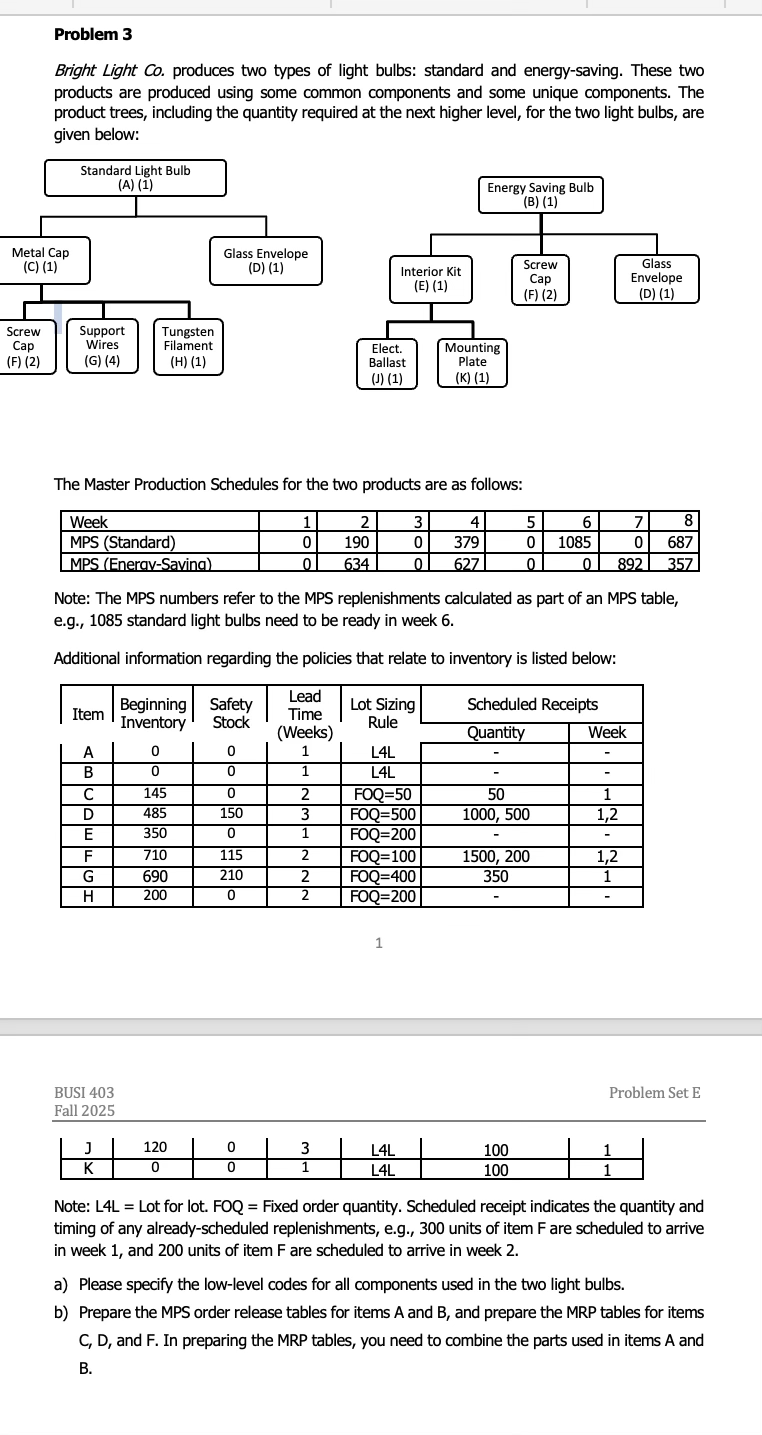
 Problem 3
Bright Light Co. produces two types of light buibs: standard and energy-saving. These two
products are produced using some common components and some unique components. The
product trees, including the quantity required at the next higher level, for the two light bulbs, are
given below:
Standard Light Bulb
wa Energy Saving Bulb
©
"Br k ar
crow
© ©) grit oe
fare) ©)
saw | (Support | [Tungsten
Gop || Wires | | Filament Tect | (Viounting
we Lew | | wo Ballast
0 wa
The Master Production Schedules for the two products are as follows:
[week [1] 2] 3 4] 5T e] 7] 8]
MPS (Standard) [of 10 of 379] of 1085] of esr]
Note: The MPS numbers refer to the MPS replenishments calculated as part of an MPS table,
e.g., 1085 standard light bubs need to be ready in week 6.
Additional information regarding the policies that relate to inventory is listed below:
inning | Saf Lead | or; Scheduled Recei
Item | Beginning ety | Lead izing juled Receipts
Inventory | Stock Rule .
(Weeks) Quantity
Al 0 | o |i) ww [oo
[Bo [oT TT wm] - TT - |
[Cc] ms | o | 2 [rosso] 50 [| 1 |
[OD | 45 | 150 [ 3 [FOQ=500 1000, 500
[E30 [oo [ T TrQ=200] - | - |
FOQ=100] 1500, 200
[ G | 60 | 210 | 2 [roo=400] 350 [| 1 |
[AH] 200 | o J 2 Jrog=200f - | - |]
1
BUSI 403 Problem Set E
Fall 2025
J 120 0 3 L4L 100 1
x1 oT oT 7 7 ww [100 | 1 1]
Note: LAL = Lot for lot. FOQ = Fixed order quantity. Scheduled receipt indicates the quantity and
timing of any already-scheduled replenishment, e.., 300 units of item F are scheduled to arrive
in week 1, and 200 units of item F are scheduled to arrive in week 2.
a) Please specify the low-level codes for all components used in the two light bubs.
b) Prepare the MPS order release tables for items A and B, and prepare the MRP tables for items
, D, and F. In preparing the MRP tables, you need to combine the parts used in items A and
B.
Problem 3
Bright Light Co. produces two types of light buibs: standard and energy-saving. These two
products are produced using some common components and some unique components. The
product trees, including the quantity required at the next higher level, for the two light bulbs, are
given below:
Standard Light Bulb
wa Energy Saving Bulb
©
"Br k ar
crow
© ©) grit oe
fare) ©)
saw | (Support | [Tungsten
Gop || Wires | | Filament Tect | (Viounting
we Lew | | wo Ballast
0 wa
The Master Production Schedules for the two products are as follows:
[week [1] 2] 3 4] 5T e] 7] 8]
MPS (Standard) [of 10 of 379] of 1085] of esr]
Note: The MPS numbers refer to the MPS replenishments calculated as part of an MPS table,
e.g., 1085 standard light bubs need to be ready in week 6.
Additional information regarding the policies that relate to inventory is listed below:
inning | Saf Lead | or; Scheduled Recei
Item | Beginning ety | Lead izing juled Receipts
Inventory | Stock Rule .
(Weeks) Quantity
Al 0 | o |i) ww [oo
[Bo [oT TT wm] - TT - |
[Cc] ms | o | 2 [rosso] 50 [| 1 |
[OD | 45 | 150 [ 3 [FOQ=500 1000, 500
[E30 [oo [ T TrQ=200] - | - |
FOQ=100] 1500, 200
[ G | 60 | 210 | 2 [roo=400] 350 [| 1 |
[AH] 200 | o J 2 Jrog=200f - | - |]
1
BUSI 403 Problem Set E
Fall 2025
J 120 0 3 L4L 100 1
x1 oT oT 7 7 ww [100 | 1 1]
Note: LAL = Lot for lot. FOQ = Fixed order quantity. Scheduled receipt indicates the quantity and
timing of any already-scheduled replenishment, e.., 300 units of item F are scheduled to arrive
in week 1, and 200 units of item F are scheduled to arrive in week 2.
a) Please specify the low-level codes for all components used in the two light bubs.
b) Prepare the MPS order release tables for items A and B, and prepare the MRP tables for items
, D, and F. In preparing the MRP tables, you need to combine the parts used in items A and
B.
Problem 3
Bright Light Co. produces two types of light buibs: standard and energy-saving. These two
products are produced using some common components and some unique components. The
product trees, including the quantity required at the next higher level, for the two light bulbs, are
given below:
Standard Light Bulb
wa Energy Saving Bulb
©
"Br k ar
crow
© ©) grit oe
fare) ©)
saw | (Support | [Tungsten
Gop || Wires | | Filament Tect | (Viounting
we Lew | | wo Ballast
0 wa
The Master Production Schedules for the two products are as follows:
[week [1] 2] 3 4] 5T e] 7] 8]
MPS (Standard) [of 10 of 379] of 1085] of esr]
Note: The MPS numbers refer to the MPS replenishments calculated as part of an MPS table,
e.g., 1085 standard light bubs need to be ready in week 6.
Additional information regarding the policies that relate to inventory is listed below:
inning | Saf Lead | or; Scheduled Recei
Item | Beginning ety | Lead izing juled Receipts
Inventory | Stock Rule .
(Weeks) Quantity
Al 0 | o |i) ww [oo
[Bo [oT TT wm] - TT - |
[Cc] ms | o | 2 [rosso] 50 [| 1 |
[OD | 45 | 150 [ 3 [FOQ=500 1000, 500
[E30 [oo [ T TrQ=200] - | - |
FOQ=100] 1500, 200
[ G | 60 | 210 | 2 [roo=400] 350 [| 1 |
[AH] 200 | o J 2 Jrog=200f - | - |]
1
BUSI 403 Problem Set E
Fall 2025
J 120 0 3 L4L 100 1
x1 oT oT 7 7 ww [100 | 1 1]
Note: LAL = Lot for lot. FOQ = Fixed order quantity. Scheduled receipt indicates the quantity and
timing of any already-scheduled replenishment, e.., 300 units of item F are scheduled to arrive
in week 1, and 200 units of item F are scheduled to arrive in week 2.
a) Please specify the low-level codes for all components used in the two light bubs.
b) Prepare the MPS order release tables for items A and B, and prepare the MRP tables for items
, D, and F. In preparing the MRP tables, you need to combine the parts used in items A and
B.
Problem 3
Bright Light Co. produces two types of light buibs: standard and energy-saving. These two
products are produced using some common components and some unique components. The
product trees, including the quantity required at the next higher level, for the two light bulbs, are
given below:
Standard Light Bulb
wa Energy Saving Bulb
©
"Br k ar
crow
© ©) grit oe
fare) ©)
saw | (Support | [Tungsten
Gop || Wires | | Filament Tect | (Viounting
we Lew | | wo Ballast
0 wa
The Master Production Schedules for the two products are as follows:
[week [1] 2] 3 4] 5T e] 7] 8]
MPS (Standard) [of 10 of 379] of 1085] of esr]
Note: The MPS numbers refer to the MPS replenishments calculated as part of an MPS table,
e.g., 1085 standard light bubs need to be ready in week 6.
Additional information regarding the policies that relate to inventory is listed below:
inning | Saf Lead | or; Scheduled Recei
Item | Beginning ety | Lead izing juled Receipts
Inventory | Stock Rule .
(Weeks) Quantity
Al 0 | o |i) ww [oo
[Bo [oT TT wm] - TT - |
[Cc] ms | o | 2 [rosso] 50 [| 1 |
[OD | 45 | 150 [ 3 [FOQ=500 1000, 500
[E30 [oo [ T TrQ=200] - | - |
FOQ=100] 1500, 200
[ G | 60 | 210 | 2 [roo=400] 350 [| 1 |
[AH] 200 | o J 2 Jrog=200f - | - |]
1
BUSI 403 Problem Set E
Fall 2025
J 120 0 3 L4L 100 1
x1 oT oT 7 7 ww [100 | 1 1]
Note: LAL = Lot for lot. FOQ = Fixed order quantity. Scheduled receipt indicates the quantity and
timing of any already-scheduled replenishment, e.., 300 units of item F are scheduled to arrive
in week 1, and 200 units of item F are scheduled to arrive in week 2.
a) Please specify the low-level codes for all components used in the two light bubs.
b) Prepare the MPS order release tables for items A and B, and prepare the MRP tables for items
, D, and F. In preparing the MRP tables, you need to combine the parts used in items A and
B.