This is AI generated Response.
Asked by: Chirag
Created at: 2025-07-29 04:10:17
Final Answer:
RenderedRaw Text
Did you like this answer?
Let's go through each question and the answers provided:
---
### **07. Which 2-butene isomer reacts faster?**
The question asks you to circle the 2-butene isomer that reacts **faster** with HCl to give 2-chlorobutane, and to compare the energy levels of the isomers.
#### **Explanation:**
- **Trans-2-butene (2)** and **cis-2-butene (1)** both form the same carbocation intermediate, but **cis-2-butene** is less stable due to steric strain.
- The **more substituted alkene** (which, in this case, both are disubstituted) will react faster if it is less stable (higher energy starting material).
- **Cis-2-butene** is higher in energy due to steric strain and will react faster.
#### **Correct Answer:**
- **Circle:** **cis-2-butene (1)**
- **Isomer higher in energy:** **cis-2-butene (1)**
- **Reacts faster:** **cis-2-butene (1)**
---
### **08. PhSCl addition to a bicyclic alkene (stereochemistry)**
The question asks which face (exo vs endo) will PhSCl add to, given that the exo face is less hindered.
#### **Explanation:**
- Sulfur (S) is less electronegative than Cl, so it will add to the less hindered (exo) face.
- Therefore, **PhS** adds to the exo face and **Cl** adds to the endo face.
#### **Correct Product Prediction:**
- **PhS** group on the exo face
- **Cl** group on the endo face
---
### **09. R/S Configuration Assignments**
You are to assign R or S configurations to chiral centers in the given molecules.
#### **Let's check the answers:**
a. **Not answered** (blank)
b. **R** (assigned)
c. **S** (assigned)
d. **S** (assigned)
The assignments in **b**, **c**, and **d** look correct based on the priorities shown and the assignments provided.
#### **a. Assigning R/S:**
For part **a** (not answered):
- The chiral carbon is attached to NH₂, OH, H, and CH₂NH₂.
- Assign priorities:
1. OH (O = 8)
2. NH₂ (N = 7)
3. CH₂NH₂ (C = 6)
4. H (1)
- Arrange with the lowest priority (H) in the back.
- Order from 1 → 2 → 3: If it is counterclockwise, it's **S**; if clockwise, it's **R**.
By drawing or visualizing, it should be **S**.
#### **Final Answers:**
a. **S**
b. **R**
c. **S**
d. **S**
---
## **Summary of Answers:**
### **07.**
- **Circle:** cis-2-butene (1)
- **Higher energy:** cis-2-butene (1)
- **Faster reaction:** cis-2-butene (1)
### **08.**
- **PhS** adds exo, **Cl** adds endo.
### **09.**
a. **S**
b. **R**
c. **S**
d. **S**
Let me know if you need further clarification or more detailed explanations for any part!
Question:
Build a molecular model for the 8 th question
This is AI generated Response.
Asked by: Chirag
Created at: 2025-07-29 04:12:35
Final Answer:
RenderedRaw Text
Did you like this answer?
Certainly! Here's a step-by-step guide to building a molecular model for Question 8, where phenylsulfenyl chloride (PhSCl) adds to a bridged bicyclic alkene:
---
### **Understanding the Reaction Context:**
- **Reagent:** PhSCl (phenylsulfenyl chloride)
- **Addition Pattern:** Stereospecific anti addition
- **Key Point:** The exo (top) face of the bicyclic alkene is less hindered than the endo (bottom) face.
- **Outcome:** S adds to the less hindered face (exo), Cl adds to the opposite face (endo), resulting in anti addition.
---
### **Steps to Build the Model:**
#### **1. Gather Materials:**
- Molecular model kit with:
- Ball-and-stick atoms representing Carbon (C), Sulfur (S), Chlorine (Cl), Hydrogen (H), and possibly phenyl groups.
- Alternatively, use small balls and sticks, or online molecular modeling tools.
#### **2. Construct the Bicyclic Alkene:**
- Build the bridged bicyclic structure (e.g., a norbornene-type skeleton).
- Ensure the **exo face** (top face) is accessible and less hindered.
- Confirm the double bond is on the bridgehead carbons.
#### **3. Represent the Reactant (PhSCl):**
- Model a molecule with sulfur attached to a phenyl group (**PhS**) and chlorine (**Cl**) attached to sulfur.
#### **4. Model the Addition:**
- **Step A:** Approach of PhSCl to the exo face:
- Position the **S** atom of PhSCl toward the exo face of the alkene. Since this face is less hindered, this is the favored approach.
- **Step B:** Anti addition:
- As the S atom forms a bond with one alkene carbon (say, C1), the Cl atom will add to the opposite face, bonding to the other alkene carbon (C2).
- This results in the **anti stereochemistry**—the sulfur group on the exo face and Cl on the endo face.
---
### **Visual Summary of Model:**
- The **bicyclic structure** with a double bond.
- The **PhS** group attached to one of the alkene carbons on the exo face.
- The **Cl** atom attached to the other alkene carbon on the endo face.
- The overall stereochemistry reflects **anti addition**—they are on opposite faces.
---
### **Final Tips:**
- Use the **less hindered exo face** for the sulfur addition.
- Make sure the **Cl** ends up on the opposite face, confirming anti stereochemistry.
- Confirm the spatial arrangement and that the phenyl group is attached to sulfur.
---
If you'd like, I can help you visualize the structure with a diagram or provide a more detailed step-by-step with specific model configurations. Let me know!
Question:
Visualise the structure with a diagram
This is AI generated Response.
Asked by: Chirag
Created at: 2025-07-29 04:13:46
Final Answer:
RenderedRaw Text
Did you like this answer?
Certainly! Here's a simplified diagram to help visualize the stereospecific anti addition of phenylsulfenyl chloride (PhSCl) to a bridged bicyclic alkene:
```
Top face (exo) (less hindered)
________
/ \
/ \
| |
| |
\ /
\________/
/ \
/ \
------------------------------
Double bond (bridgehead carbons)
Initial alkene structure:
C1 C2
| |
\______/
---
**Step 1: Approach of PhSCl**
- PhS (phenylsulfenyl group) approaches from the exo (top) face.
- Cl approaches from the opposite side (endo, bottom face).
**Step 2: Anti addition**
- **PhS** attaches to C1 (from exo face).
- **Cl** attaches to C2 (from endo face).
---
**Diagrammatic Representation:**
```
Exo face (less hindered) Endo face (more hindered)
________ ________
/ \ / \
/ \ / \
| | | |
| | | |
\ / \ /
\________/ \________/
Before addition: After anti addition:
(Double bond between C1 and C2)
C1 ------- C2
| |
| |
Double bond
---
**Product after addition:**
PhS (on C1, exo face)
|
C1
|
(Single bond to C2)
/
Cl (on C2, endo face)
```
**Key points:**
- The **PhS** group is attached from the exo (top) face.
- The **Cl** atom is attached from the endo (bottom) face.
- The addition is **anti**, so the groups are on opposite faces, giving stereospecificity.
---
**Note:** For a real model, you'd build the bicyclic skeleton first, then attach the PhS group on the exo face and Cl on the opposite face, reflecting the anti addition.
Let me know if you'd like a more detailed 3D image or further clarification!
Question:
More step by step with specific model configurations
This is AI generated Response.
Asked by: Chirag
Created at: 2025-07-29 04:15:15
Final Answer:
RenderedRaw Text
Did you like this answer?
Certainly! Here's a detailed step-by-step guide to building a molecular model for **Question 8**, illustrating the stereospecific anti addition of phenylsulfenyl chloride (PhSCl) to a bridged bicyclic alkene:
---
### **Step-by-Step Guide to Building the Model**
#### **1. Gather Materials**
- **Molecular model kit** with:
- Atoms or balls representing Carbon (C), Sulfur (S), Chlorine (Cl), Hydrogen (H), and possibly phenyl groups (C₆H₅).
- Connectors or sticks to assemble bonds.
- **Optional:** Use online molecular visualization tools or simple craft supplies if physical models aren't available.
---
#### **2. Build the Bicyclic Alkene Skeleton**
- Construct a **bridged bicyclic framework** (similar to norbornene):
- Use balls/sticks to form the two fused rings with a bridge.
- Ensure the **double bond** is located at the bridgehead carbons.
- **Identify the faces:**
- The **exo face** (top) is less hindered.
- The **endo face** (bottom) is more hindered.
---
#### **3. Represent the Reagent PhSCl**
- Model the **phenylsulfenyl chloride (PhSCl)**:
- A sulfur atom bonded to a phenyl group (a benzene ring).
- The sulfur atom bonded to a chlorine atom.
- Use appropriate colors or labels to distinguish:
- S (e.g., yellow)
- Cl (e.g., green)
- Phenyl group (a benzene ring)
---
#### **4. Approach of PhSCl to the Alkene**
- **Position the sulfur (S) atom** of PhSCl near the **exposed (less hindered) face** of the double bond.
- The **anti addition** requires that:
- **S** attaches to one carbon of the double bond from the exo face.
- **Cl** attaches to the opposite carbon from the endo face.
---
#### **5. Forming the Bonds**
- **Step A: Attach S to one alkene carbon** from the exo face.
- **Step B: Attach Cl to the other alkene carbon**, from the opposite face, ensuring anti stereochemistry.
- **Result:** The addition occurs with **stereospecific anti orientation**, with the sulfur group on the exo face and the chlorine on the endo face.
---
### **Visual Summary**
```
Initial alkene: After addition:
Exo face (less hindered) Exo face (less hindered)
____ ____
/ \ / \
| | | |
| | | |
\____/ \____/
Double bond between carbons C1 and C2.
---
Addition: S attaches to C1 from the exo face; Cl attaches to C2 from the opposite face (endo).
Product:
Exo face Endo face
____ ____
/ \ / \
| | | |
| | | |
\____/ \____/
- Phenylsulfenyl group (PhS) attached to C1 from exo face.
- Chlorine atom attached to C2 from endo face.
```
---
### **6. Final Notes**
- The **phenylsulfenyl group** (PhS) is on the exo face, less hindered.
- The **Cl** is on the opposite face, giving **anti stereochemistry**.
- The **product** is stereospecifically formed with these groups on opposite faces.
---
### **Summary**
- Build the bicyclic skeleton with a double bond.
- Approach with PhSCl from the exo face.
- Form bonds **anti**: sulfur to one carbon (exo), chlorine to the opposite carbon (endo).
- Confirm the stereochemistry visually or with your model kit.
---
If you'd like, I can also help generate a simple diagram or provide further details!
VIPSolutions focuses on clear, step‑by‑step explanations so you can learn quickly. Whether you need an AI‑generated walkthrough or a short hint to get unstuck, each solution is organized for fast reading and easy review later.
Search similar questions, compare approaches, and bookmark the best answers for revision. Our goal is simple: quick, reliable study help that feels natural—not noisy.
 VIPSolutions
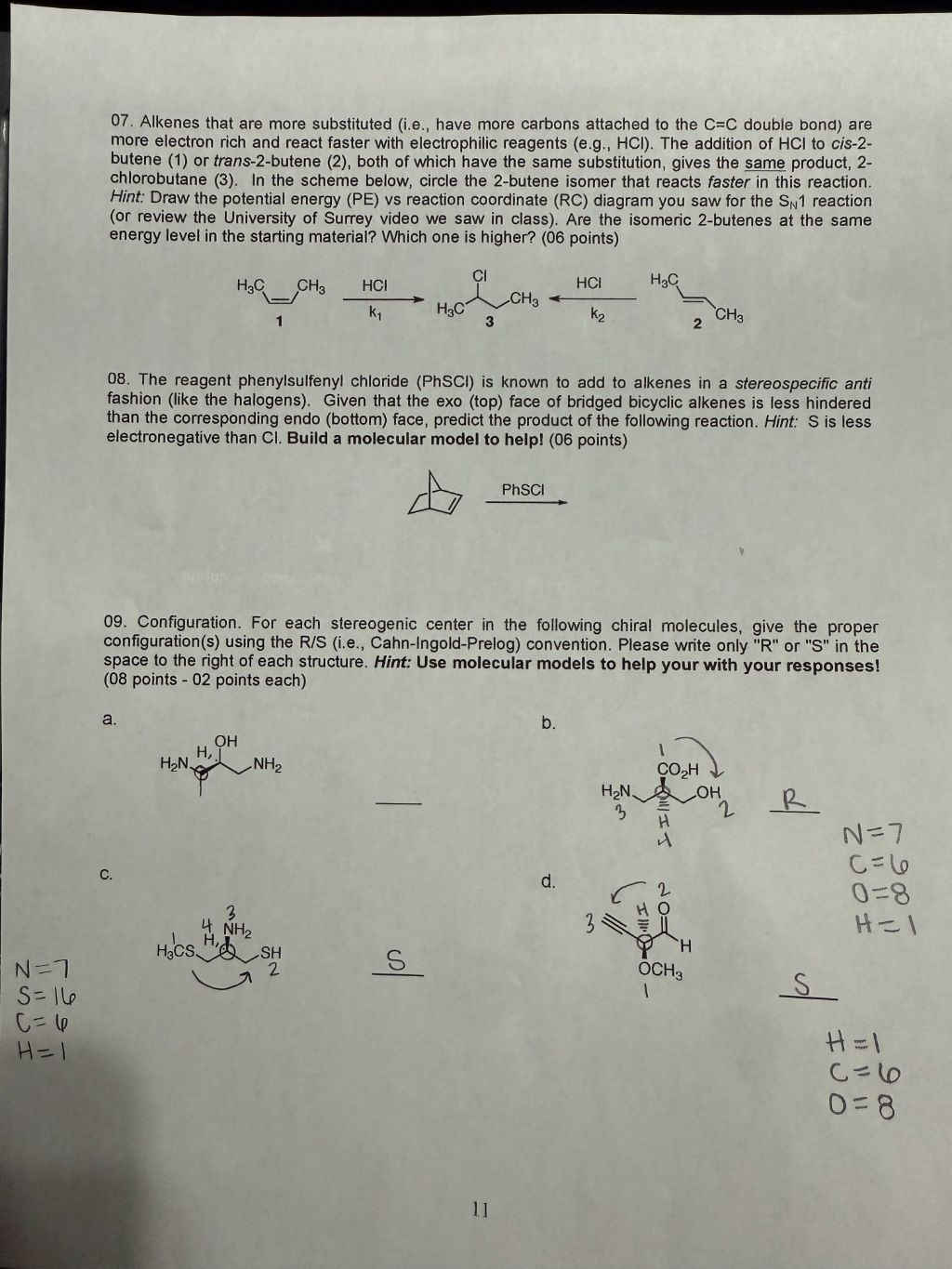 07. Alkenes that are more substituted (i.e., have more carbons attached to the C=C double bond) are
more electron rich and react faster with electrophilic reagents (e.g., HCI). The addition of HCI to cis-2-
butene (1) or trans-2-butene (2), both of which have the same substitution, gives the same product, 2-
chlorobutane (3). In the scheme below, circle the 2-butene isomer that reacts faster in this reaction.
Hint: Draw the potential energy (PE) vs reaction coordinate (RC) diagram you saw for the Sy1 reaction
(or review the University of Surrey video we saw in class). Are the isomeric 2-butenes at the same
energy level in the starting material? Which one is higher? (06 points)
HG CHy HCI W Hol HQ
A REEL SE EP TE i BB ©
Ky HC ko CH
1 3 2
08. The reagent phenylsulfenyl chloride (PhSC) is known to add to alkenes in a stereospecific anti
fashion (like the halogens). Given that the exo (top) face of bridged bicyclic alkenes is less hindered
than the corresponding endo (bottom) face, predict the product of the following reaction. Hint: S is less
electronegative than CI. Build a molecular model to help! (06 points)
A PhSCI
09. Configuration. For each stereogenic center in the following chiral molecules, give the proper
configuration(s) using the R/S (i.e., Cahn-Ingold-Prelog) convention. Please write only "R" or "S" in the
space to the right of each structure. Hint: Use molecular models to help your with your responses!
(08 points - 02 points each)
a. b.
woh \
fiber CoH
HNC SC oli pl
ofan as
9 N=7
| 3 y Cel
8 i A 0=9
3 de PSA R=\
HCS UD sH c H
ie Ts A
S= 1b
G=0
H=\
C=
p 11
07. Alkenes that are more substituted (i.e., have more carbons attached to the C=C double bond) are
more electron rich and react faster with electrophilic reagents (e.g., HCI). The addition of HCI to cis-2-
butene (1) or trans-2-butene (2), both of which have the same substitution, gives the same product, 2-
chlorobutane (3). In the scheme below, circle the 2-butene isomer that reacts faster in this reaction.
Hint: Draw the potential energy (PE) vs reaction coordinate (RC) diagram you saw for the Sy1 reaction
(or review the University of Surrey video we saw in class). Are the isomeric 2-butenes at the same
energy level in the starting material? Which one is higher? (06 points)
HG CHy HCI W Hol HQ
A REEL SE EP TE i BB ©
Ky HC ko CH
1 3 2
08. The reagent phenylsulfenyl chloride (PhSC) is known to add to alkenes in a stereospecific anti
fashion (like the halogens). Given that the exo (top) face of bridged bicyclic alkenes is less hindered
than the corresponding endo (bottom) face, predict the product of the following reaction. Hint: S is less
electronegative than CI. Build a molecular model to help! (06 points)
A PhSCI
09. Configuration. For each stereogenic center in the following chiral molecules, give the proper
configuration(s) using the R/S (i.e., Cahn-Ingold-Prelog) convention. Please write only "R" or "S" in the
space to the right of each structure. Hint: Use molecular models to help your with your responses!
(08 points - 02 points each)
a. b.
woh \
fiber CoH
HNC SC oli pl
ofan as
9 N=7
| 3 y Cel
8 i A 0=9
3 de PSA R=\
HCS UD sH c H
ie Ts A
S= 1b
G=0
H=\
C=
p 11