 VIPSolutions
As depicted in the image on the right, material B, characterized by a dielectric constant of 4, is applied as a coating on substrate A, which possesses a dielectric constant of 9. In this scenario, an electromagnetic wave with a photon energy of 2 eV is vertically incident from the external environment(air).(a)9
Question:
As depicted in the image on the right, material B, characterized by a dielectric constant of 4, is applied as a coating on substrate A, which possesses a dielectric constant of 9. In this scenario, an electromagnetic wave with a photon energy of 2 eV is vertically incident from the external environment(air).(a)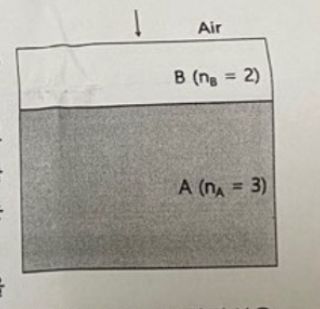 9
9
This is AI generated Response.
Asked by: Mallikarjun
Created at: 2025-12-15 01:54:27
Asked by: Mallikarjun
Created at: 2025-12-15 01:54:27
Final Answer:
Rendered
Raw Text
Did you like this answer?
# Problem Setup- **Incident Wave**: energy \(E = 2 \) eV, from **air** (dielectric constant \( \epsilon = 1 \), \( n_{\text{air}} \approx 1 \))
- **Coating (B)**: Dielectric constant \( \epsilon_B = 4 \) (\( n_B = 2 \))
- **Substrate (A)**: Dielectric constant \( \epsilon_A = 9 \) (\( n_A = 3 \))
## Diagram Summary
```
Air (n ≈ 1)
|
v
-------------------
| Coating B (n=2) |
-------------------
| Substrate A (n=3)|
-------------------
```
# (a) Reflection and Transmission at Interfaces
Let’s analyze the **reflection and transmission** of an electromagnetic wave at **normal incidence** through these layers.
## 1. **Reflection at Air–B Interface**
The **reflection coefficient** at normal incidence is:
\[
r_{12} = \frac{n_1 - n_2}{n_1 + n_2}
\]
where:
- \( n_1 = n_{\text{air}} = 1 \)
- \( n_2 = n_B = 2 \)
So,
\[
r_{AB} = \frac{1 - 2}{1 + 2} = \frac{-1}{3} = -.333
\]
And the **transmission coefficient**:
\[
t_{12} = \frac{2 n_1}{n_1 + n_2}
\]
\[
t_{AB} = \frac{2 \times 1}{1 + 2} = \frac{2}{3} \approx .667
\]
## 2. **Reflection at B–A Interface**
Now, for the wave that passes through B and reaches the B–A interface:
\[
r_{BA} = \frac{n_B - n_A}{n_B + n_A} = \frac{2 - 3}{2 + 3} = \frac{-1}{5} = -.2
\]
\[
t_{BA} = \frac{2 n_B}{n_B + n_A} = \frac{2 \times 2}{2 + 3} = \frac{4}{5} = .8
\]
## 3. **Physical Interpretation**
- **At each interface, some light is reflected and some is transmitted.**
- **Multiple reflections** can occur inside layer B (if the thickness is non-negligible).
- If the thickness is **not specified**, typically only the **first interface reflection** is considered.
# Summary Table
| Interface | Reflection (\( r \)) | Transmission (\( t \)) |
|:--------------:|:-------------------:|:----------------------:|
| Air–B | \( -.333 \) | \( .667 \) |
| B–A | \( -.2 \) | \( .8 \) |
# Next Steps
- **If the thickness of B is given** (or specified as a quarter-wavelength, etc.), you can analyze **interference effects**.
- For **energy reflectance** (fraction of intensity reflected), use \( R = |r|^2 \).
- For **photon energy**, the refractive index is not directly dependent on photon energy unless dispersion is considered (here, we use the given \( n \)).
---
**Let me know if you need to consider the effect of thickness or want to calculate the total reflectance including multiple reflections!**
📢 Instructions:
- Ask anything relatd to above question only.
- For new Question goto :