 VIPSolutions
At what debt percentage to fund $ 1 5 millions for the project WACC will be lowestIn March 2023, the management team of Londonderry Air (LA) met to discuss a proposal to purchase five shorthaul aircraft ata total cost of $25 million. There was general enthusiasm for the investment, and the new aircraft were expected to generate an annual cash flow of $4 million for 20 years. ‘The focus of the meeting was on how to finance the purchase. LA had $20 million in cash and marketable securities (se table). but Ed Johnson, the chief financial officer, pointed out that the company needed at least $10 million in cash to meet normal outflow and as a contingency reserve. This meant that there would be a cash deficiency of $15. million, which the firm would need to cover either by the sale of common stock or by additional borrowing. While admitting that the arguments were finely balanced, Mr. Johnson recommended an issue of stock. He pointed out that the airline industry was subject to wide swings in profits and the firm should be careful to avoid the risk of excessive borrowing. He estimated that in market value terms, the long-term debt ratio was about 59% and that a further debt issue would raise the ratio to 62%. Mr. Johnson's only doubt about making a stock issue was that investors might jump to the conclusion that management believed the stock was overpriced, in which case the announcement might prompt an unjustified selloff by investors. He stressed. therefore, that the company needed to explain carefully the reasons for the issue. Also, he suggested that demand for the issue would be enhanced if at the same time LA increased its dividend payment. This would provide a tangible indication of management's confidence in the future. Summary financial statements for Londot (Figures are book values, in millions of dc BALANCE SHEET Bank debt $50 Cash Other current 20 Other cu liabilities assets 10% bond, due 2037" 100 Fixed asc Stockholders’ equity’ 120 Total liabilities $290 Total ass: INCOME STATEMENT Comer matt = Mr. Johnson's only doubt about making a stock issue was that investors might jump to the conclusion that management believed the stock was overpriced, in which case the announcement might prompt an unjustified selloff by investors. He stressed. therefore, that the company needed to explain carefully the reasons for the issue. Also, he suggested that demand for the issue would be enhanced if at the same time LA increased its dividend payment. This would provide a tangible indication of management's confidence in the future. statements for Londonderry Air, 2022 salues, in millions of dollars) BALANCE SHEET $50 Cash $20 20 Other current 20 assets 37° 100 Fixed assets 250 ty 120 — $290 Total assets $290 = 10% bond, due 2037" 100 Fixed ase Stockholders’ equity” 120 Total liabilities $290 Total ass: INCOME STATEMENT Gross profit $575 Depreciation 200 Interest 75 Pretax profit 300 Tax 105 Net profit 195 Dividend 65 “The ied to matuty on LA deb curenty is 6% La has 10 millon shares outstanding, ith a market price of betas estimated at 125, the marke isk premium s 8%, and These arguments cut little ice with Paes 500 LA's chief executive. “Ed.” she said, — “I know that you're the expert on all this, but everything you say flies in the face of common sense. Why should we want to sell ‘more equity when our stock has fallen over the past year by nearly a fifth? Our stock is currently offering a dividend yield of 6.5%, which makes equity an expensive source of capital. Increasing the dividend would simply “The yield to matty on LA deb curenty fs 6% LA has 10 millon shares outstanding with a market price of beta i estimated at 125, the market rik premium fs 8%, nd ‘These arguments cut little ice with page 500 LA's chief executive. “Ed,” she said, “I know that you're the expert on all this, but everything you say flies in the face of common sense. Why should we want to sell more equity when our stock has fallen over the past year by nearly a fifth? Our stock is currently offering a dividend yield of 6.5%, which makes equity an expensive source of capital. Increasing the dividend would simply make it more expensive. What's more, I don't see the point of paying out more money to the stockholders at the same time that we are asking rhem for cash. If we hike the dividend, we will need to increase the amount of the stock issue; so we will just be paying the higher dividend out of the shareholders’ own pockets. You're also ignoring the question of dilution. Our equity currently has a book value of $12 a share; it's not playing fair by our existing shareholders if we now issue stock for around $10 a share. “Look at the alternative. We can borrow today at 6%. We get a tax break on the
Question:
At what debt percentage to fund $
1
5
millions for the project WACC will be lowest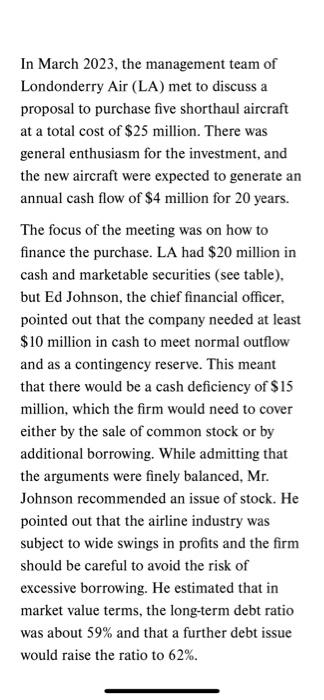
 In March 2023, the management team of
Londonderry Air (LA) met to discuss a
proposal to purchase five shorthaul aircraft
ata total cost of $25 million. There was
general enthusiasm for the investment, and
the new aircraft were expected to generate an
annual cash flow of $4 million for 20 years.
‘The focus of the meeting was on how to
finance the purchase. LA had $20 million in
cash and marketable securities (se table).
but Ed Johnson, the chief financial officer,
pointed out that the company needed at least
$10 million in cash to meet normal outflow
and as a contingency reserve. This meant
that there would be a cash deficiency of $15.
million, which the firm would need to cover
either by the sale of common stock or by
additional borrowing. While admitting that
the arguments were finely balanced, Mr.
Johnson recommended an issue of stock. He
pointed out that the airline industry was
subject to wide swings in profits and the firm
should be careful to avoid the risk of
excessive borrowing. He estimated that in
market value terms, the long-term debt ratio
was about 59% and that a further debt issue
would raise the ratio to 62%.
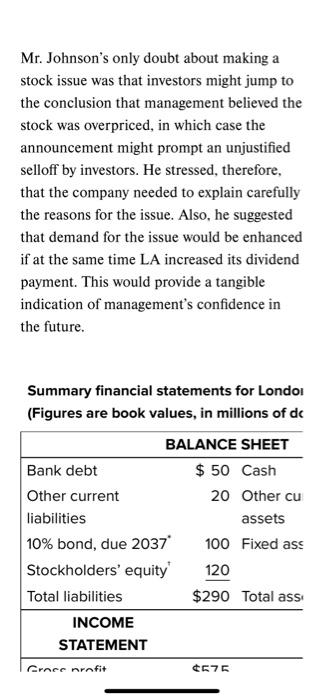
Mr. Johnson's only doubt about making a
stock issue was that investors might jump to
the conclusion that management believed the
stock was overpriced, in which case the
announcement might prompt an unjustified
selloff by investors. He stressed. therefore,
that the company needed to explain carefully
the reasons for the issue. Also, he suggested
that demand for the issue would be enhanced
if at the same time LA increased its dividend
payment. This would provide a tangible
indication of management's confidence in
the future.
Summary financial statements for Londot
(Figures are book values, in millions of dc
BALANCE SHEET
Bank debt $50 Cash
Other current 20 Other cu
liabilities assets
10% bond, due 2037" 100 Fixed asc
Stockholders’ equity’ 120
Total liabilities $290 Total ass:
INCOME
STATEMENT
Comer matt =
Mr. Johnson's only doubt about making a
stock issue was that investors might jump to
the conclusion that management believed the
stock was overpriced, in which case the
announcement might prompt an unjustified
selloff by investors. He stressed. therefore,
that the company needed to explain carefully
the reasons for the issue. Also, he suggested
that demand for the issue would be enhanced
if at the same time LA increased its dividend
payment. This would provide a tangible
indication of management's confidence in
the future.
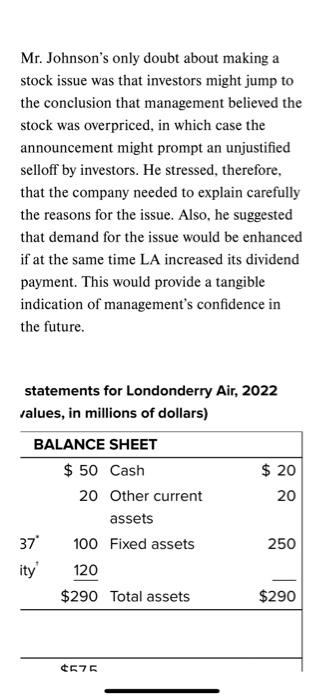
statements for Londonderry Air, 2022
salues, in millions of dollars)
BALANCE SHEET
$50 Cash $20
20 Other current 20
assets
37° 100 Fixed assets 250
ty 120 —
$290 Total assets $290
=
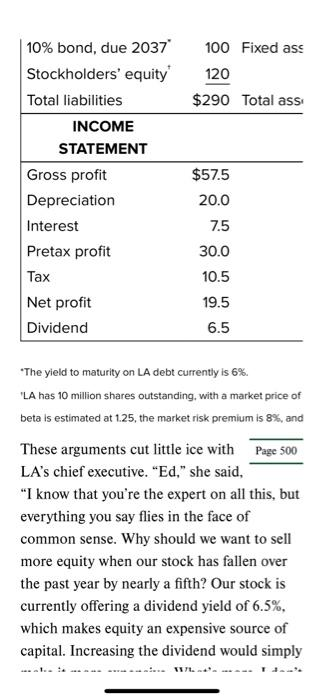
10% bond, due 2037" 100 Fixed ase
Stockholders’ equity” 120
Total liabilities $290 Total ass:
INCOME
STATEMENT
Gross profit $575
Depreciation 200
Interest 75
Pretax profit 300
Tax 105
Net profit 195
Dividend 65
“The ied to matuty on LA deb curenty is 6%
La has 10 millon shares outstanding, ith a market price of
betas estimated at 125, the marke isk premium s 8%, and
These arguments cut little ice with Paes 500
LA's chief executive. “Ed.” she said, —
“I know that you're the expert on all this, but
everything you say flies in the face of
common sense. Why should we want to sell
‘more equity when our stock has fallen over
the past year by nearly a fifth? Our stock is
currently offering a dividend yield of 6.5%,
which makes equity an expensive source of
capital. Increasing the dividend would simply
“The yield to matty on LA deb curenty fs 6%
LA has 10 millon shares outstanding with a market price of
beta i estimated at 125, the market rik premium fs 8%, nd
‘These arguments cut little ice with page 500
LA's chief executive. “Ed,” she said,
“I know that you're the expert on all this, but
everything you say flies in the face of
common sense. Why should we want to sell
more equity when our stock has fallen over
the past year by nearly a fifth? Our stock is
currently offering a dividend yield of 6.5%,
which makes equity an expensive source of
capital. Increasing the dividend would simply
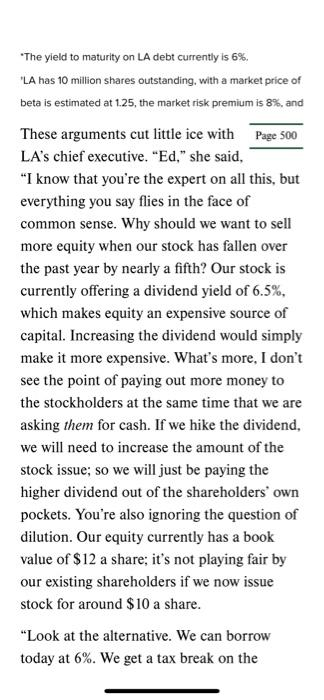
make it more expensive. What's more, I don't
see the point of paying out more money to
the stockholders at the same time that we are
asking rhem for cash. If we hike the dividend,
we will need to increase the amount of the
stock issue; so we will just be paying the
higher dividend out of the shareholders’ own
pockets. You're also ignoring the question of
dilution. Our equity currently has a book
value of $12 a share; it's not playing fair by
our existing shareholders if we now issue
stock for around $10 a share.
“Look at the alternative. We can borrow
today at 6%. We get a tax break on the
In March 2023, the management team of
Londonderry Air (LA) met to discuss a
proposal to purchase five shorthaul aircraft
ata total cost of $25 million. There was
general enthusiasm for the investment, and
the new aircraft were expected to generate an
annual cash flow of $4 million for 20 years.
‘The focus of the meeting was on how to
finance the purchase. LA had $20 million in
cash and marketable securities (se table).
but Ed Johnson, the chief financial officer,
pointed out that the company needed at least
$10 million in cash to meet normal outflow
and as a contingency reserve. This meant
that there would be a cash deficiency of $15.
million, which the firm would need to cover
either by the sale of common stock or by
additional borrowing. While admitting that
the arguments were finely balanced, Mr.
Johnson recommended an issue of stock. He
pointed out that the airline industry was
subject to wide swings in profits and the firm
should be careful to avoid the risk of
excessive borrowing. He estimated that in
market value terms, the long-term debt ratio
was about 59% and that a further debt issue
would raise the ratio to 62%.
Mr. Johnson's only doubt about making a
stock issue was that investors might jump to
the conclusion that management believed the
stock was overpriced, in which case the
announcement might prompt an unjustified
selloff by investors. He stressed. therefore,
that the company needed to explain carefully
the reasons for the issue. Also, he suggested
that demand for the issue would be enhanced
if at the same time LA increased its dividend
payment. This would provide a tangible
indication of management's confidence in
the future.
Summary financial statements for Londot
(Figures are book values, in millions of dc
BALANCE SHEET
Bank debt $50 Cash
Other current 20 Other cu
liabilities assets
10% bond, due 2037" 100 Fixed asc
Stockholders’ equity’ 120
Total liabilities $290 Total ass:
INCOME
STATEMENT
Comer matt =
Mr. Johnson's only doubt about making a
stock issue was that investors might jump to
the conclusion that management believed the
stock was overpriced, in which case the
announcement might prompt an unjustified
selloff by investors. He stressed. therefore,
that the company needed to explain carefully
the reasons for the issue. Also, he suggested
that demand for the issue would be enhanced
if at the same time LA increased its dividend
payment. This would provide a tangible
indication of management's confidence in
the future.
statements for Londonderry Air, 2022
salues, in millions of dollars)
BALANCE SHEET
$50 Cash $20
20 Other current 20
assets
37° 100 Fixed assets 250
ty 120 —
$290 Total assets $290
=
10% bond, due 2037" 100 Fixed ase
Stockholders’ equity” 120
Total liabilities $290 Total ass:
INCOME
STATEMENT
Gross profit $575
Depreciation 200
Interest 75
Pretax profit 300
Tax 105
Net profit 195
Dividend 65
“The ied to matuty on LA deb curenty is 6%
La has 10 millon shares outstanding, ith a market price of
betas estimated at 125, the marke isk premium s 8%, and
These arguments cut little ice with Paes 500
LA's chief executive. “Ed.” she said, —
“I know that you're the expert on all this, but
everything you say flies in the face of
common sense. Why should we want to sell
‘more equity when our stock has fallen over
the past year by nearly a fifth? Our stock is
currently offering a dividend yield of 6.5%,
which makes equity an expensive source of
capital. Increasing the dividend would simply
“The yield to matty on LA deb curenty fs 6%
LA has 10 millon shares outstanding with a market price of
beta i estimated at 125, the market rik premium fs 8%, nd
‘These arguments cut little ice with page 500
LA's chief executive. “Ed,” she said,
“I know that you're the expert on all this, but
everything you say flies in the face of
common sense. Why should we want to sell
more equity when our stock has fallen over
the past year by nearly a fifth? Our stock is
currently offering a dividend yield of 6.5%,
which makes equity an expensive source of
capital. Increasing the dividend would simply
make it more expensive. What's more, I don't
see the point of paying out more money to
the stockholders at the same time that we are
asking rhem for cash. If we hike the dividend,
we will need to increase the amount of the
stock issue; so we will just be paying the
higher dividend out of the shareholders’ own
pockets. You're also ignoring the question of
dilution. Our equity currently has a book
value of $12 a share; it's not playing fair by
our existing shareholders if we now issue
stock for around $10 a share.
“Look at the alternative. We can borrow
today at 6%. We get a tax break on the
Asked by: vamsi
Created at: 2025-12-07 10:29:08
Final Answer:
📢 Instructions:
- Ask anything relatd to above question only.
- For new Question goto :