Give step-by-step solution with explanation and final answer:A. Consider the utibty function of UDXY) = XY
you may study UDCYISINXY, -1/x-1/y, or 64°F your own beside others]
1. Derive the Marshallan demand curve for X (7)
2. Derive the icksan demand curve for X 0)
3. Whatis the own-price elasticity for X72
4. Whats the own price elasticity for X7
5. Whats the income elasticity of X?
6. Whats the price lasticy of with respect toy (PJ?
7. the income evel i 120, then what the 7. that masimizes total spending?
8. Show that Sutsky equation holds.
9. Show tha Euler Equation holds.
10. Show that Engle Aggregation holds. What does it mean?
1. Show that Cournot Aggregation holds. What does it mean?
12. Are x and y substitutes or complements? Why? Hint: do caculte how much
Marshallan quantity demanded of x changes s the price of y increases by 1%]
13. Are xand y net substitutes or complements? Why? [Hint do calculate how much
Hicksian (Compansated) quantity demanded of x changes as the price of y Increases
by)
8. What does the consumer demand curve lft or right?
a. Own price increases?
b. Price of substitute goods increases?
Question:
Give step-by-step solution with explanation and final answer:A. Consider the utibty function of UDXY) = XY
you may study UDCYISINXY, -1/x-1/y, or 64°F your own beside others]
1. Derive the Marshallan demand curve for X (7)
2. Derive the icksan demand curve for X 0)
3. Whatis the own-price elasticity for X72
4. Whats the own price elasticity for X7
5. Whats the income elasticity of X?
6. Whats the price lasticy of with respect toy (PJ?
7. the income evel i 120, then what the 7. that masimizes total spending?
8. Show that Sutsky equation holds.
9. Show tha Euler Equation holds.
10. Show that Engle Aggregation holds. What does it mean?
1. Show that Cournot Aggregation holds. What does it mean?
12. Are x and y substitutes or complements? Why? Hint: do caculte how much
Marshallan quantity demanded of x changes s the price of y increases by 1%]
13. Are xand y net substitutes or complements? Why? [Hint do calculate how much
Hicksian (Compansated) quantity demanded of x changes as the price of y Increases
by)
8. What does the consumer demand curve lft or right?
a. Own price increases?
b. Price of substitute goods increases?
This is AI generated Response.
Asked by: Vikram Kumar
Created at: 2025-10-30 03:32:16
Final Answer:
RenderedRaw Text
Did you like this answer?
Let's go through **Section A** step-by-step for the utility function \( U(X, Y) = X^{\alpha} Y^{\beta} \):
---
## **A. Utility maximization and demand functions**
### **1. Derive the Marshallian demand curve for X (\(X^M\)):**
#### **Budget Constraint:**
\[
P_X X + P_Y Y = I
\]
#### **Utility Function:**
\[
U(X, Y) = X^{\alpha} Y^{\beta}
\]
#### **Lagrangian:**
\[
\mathcal{L} = X^{\alpha} Y^{\beta} + \lambda (I - P_X X - P_Y Y)
\]
#### **First-Order Conditions (FOCs):**
- With respect to \(X\):
\[
\frac{\partial \mathcal{L}}{\partial X} = \alpha X^{\alpha-1} Y^{\beta} - \lambda P_X =
\]
- With respect to \(Y\):
\[
\frac{\partial \mathcal{L}}{\partial Y} = \beta X^{\alpha} Y^{\beta-1} - \lambda P_Y =
\]
- With respect to \(\lambda\):
\[
\frac{\partial \mathcal{L}}{\partial \lambda} = I - P_X X - P_Y Y =
\]
#### **Find \(X\) and \(Y\):**
Divide FOC for \(X\) by FOC for \(Y\):
\[
\frac{\alpha X^{\alpha-1} Y^{\beta}}{\beta X^{\alpha} Y^{\beta-1}} = \frac{P_X}{P_Y}
\implies \frac{\alpha}{\beta} \cdot \frac{Y}{X} = \frac{P_X}{P_Y}
\implies \frac{Y}{X} = \frac{\beta}{\alpha} \cdot \frac{P_X}{P_Y}
\implies Y = X \cdot \frac{\beta}{\alpha} \cdot \frac{P_X}{P_Y}
\]
Substitute \(Y\) into the budget constraint:
\[
P_X X + P_Y Y = I \\
P_X X + P_Y \left( X \cdot \frac{\beta}{\alpha} \cdot \frac{P_X}{P_Y} \right) = I \\
P_X X + X \cdot \frac{\beta}{\alpha} P_X = I \\
P_X X \left(1 + \frac{\beta}{\alpha}\right) = I \\
P_X X \left(\frac{\alpha + \beta}{\alpha}\right) = I \\
X = \frac{I \alpha}{P_X (\alpha + \beta)}
\]
**Marshallian demand for X:**
\[
\boxed{
X^M = \frac{I \alpha}{P_X (\alpha + \beta)}
}
\]
Similarly,
\[
Y^M = \frac{I \beta}{P_Y (\alpha + \beta)}
\]
---
### **2. Derive the Hicksian demand curve for X (\(X^H\)):**
Given utility level \(\overline{U}\):
Minimize \(P_X X + P_Y Y\) s.t. \(X^{\alpha} Y^{\beta} = \overline{U}\).
Set up the Lagrangian:
\[
\mathcal{L} = P_X X + P_Y Y + \lambda (\overline{U} - X^{\alpha} Y^{\beta})
\]
FOCs:
- \(\frac{\partial \mathcal{L}}{\partial X} = P_X - \lambda \alpha X^{\alpha-1} Y^{\beta} = \)
- \(\frac{\partial \mathcal{L}}{\partial Y} = P_Y - \lambda \beta X^{\alpha} Y^{\beta-1} = \)
- \(\frac{\partial \mathcal{L}}{\partial \lambda} = \overline{U} - X^{\alpha} Y^{\beta} = \)
Use the ratio method as before:
\[
\frac{P_X}{P_Y} = \frac{\alpha}{\beta} \cdot \frac{Y}{X}
\implies Y = X \cdot \frac{\beta}{\alpha} \cdot \frac{P_X}{P_Y}
\]
Substitute into the utility constraint:
\[
X^{\alpha} \left[ X \cdot \frac{\beta}{\alpha} \cdot \frac{P_X}{P_Y} \right]^{\beta} = \overline{U}
\implies X^{\alpha + \beta} \left( \frac{\beta}{\alpha} \cdot \frac{P_X}{P_Y} \right)^{\beta} = \overline{U}
\implies X^{\alpha + \beta} = \overline{U} \left( \frac{\beta}{\alpha} \cdot \frac{P_X}{P_Y} \right)^{-\beta}
\]
\[
X^H = \left[ \overline{U} \left( \frac{\beta}{\alpha} \cdot \frac{P_X}{P_Y} \right)^{-\beta} \right]^{\frac{1}{\alpha + \beta}}
\]
---
### **3. What is the own-price elasticity for X^M?**
From Marshallian demand:
\[
X^M = \frac{I \alpha}{P_X (\alpha + \beta)}
\]
Own-price elasticity:
\[
\epsilon_{X, P_X} = \frac{\partial X^M}{\partial P_X} \cdot \frac{P_X}{X^M}
\]
\[
\frac{\partial X^M}{\partial P_X} = -\frac{I \alpha}{P_X^2 (\alpha + \beta)} = -\frac{X^M}{P_X}
\]
\[
\epsilon_{X,P_X} = -1
\]
**Own-price elasticity is \(-1\)**
---
### **4. What is the own-price elasticity for X^H?**
For Cobb-Douglas, the Hicksian and Marshallian demands have the same price elasticity (since there is no income effect beyond the compensated effect):
\[
\epsilon_{X,P_X}^{H} = -1
\]
---
### **5. What is the income elasticity of X?**
\[
X^M = \frac{I \alpha}{P_X (\alpha + \beta)}
\]
\[
\frac{\partial X^M}{\partial I} = \frac{\alpha}{P_X (\alpha + \beta)} = \frac{X^M}{I}
\]
\[
\text{Income elasticity} = \frac{\partial X^M}{\partial I} \frac{I}{X^M} = 1
\]
**Income elasticity = 1**
---
### **6. What is the price elasticity of X with respect to \(P_Y\) (\(\epsilon_{X, P_Y}\))?**
\[
X^M = \frac{I \alpha}{P_X (\alpha + \beta)}
\]
No \(P_Y\) in the expression for \(X^M\):
\[
\epsilon_{X,P_Y} =
\]
---
## **Summary Table**
| Elasticity | Value |
|----------------------------------|-------|
| Own-price (Marshallian, \(X^M\))| -1 |
| Own-price (Hicksian, \(X^H\)) | -1 |
| Income elasticity (\(X^M\)) | 1 |
| Cross-price (\(P_Y\)) | |
---
## **B. Consumer Demand Curve: Direction of Shift**
a. **Own price increases?**
→ Demand curve moves **left** (decreases quantity demanded).
b. **Price of substitute goods increases?**
→ Demand curve moves **right** (increases demand for X).
c. **Price of complement goods increases?**
→ Demand curve moves **left** (decreases demand for X).
d. **Income increases if the product is inferior?**
→ Demand curve moves **left**.
e. **Income increases if the product is luxurious?**
→ Demand curve moves **right**.
---
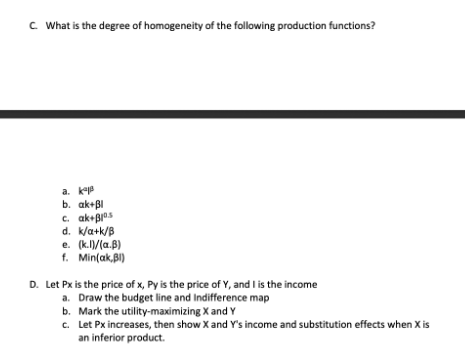
## **C. Degree of Homogeneity of Production Functions**
Recall: If \(f(\lambda K, \lambda L) = \lambda^r f(K, L)\), then degree of homogeneity is \(r\).
a. \(K^{\alpha}L^{\beta}\): **\(\alpha + \beta\)**
b. \(aK + bL\): **1**
c. \(aK^{\alpha} + bL^{\beta}\): **No definite degree** (unless \(\alpha = \beta\))
d. \(K/\alpha + L/\beta\): **1**
e. \([K^{1/\alpha}, L^{1/\beta}]\): **Take min. Degree is \(1/\alpha\) if both terms scale the same.**
f. \(\min(aK, bL)\): **1**
---
## **D. Budget Line and Indifference Map**
Let \(P_X\) be the price of X, \(P_Y\) the price of Y, and \(I\) the income.
### **a. Draw the budget line and indifference map**
Budget line: \(P_X X + P_Y Y = I\)
- X-intercept: \(X = I/P_X\)
- Y-intercept: \(Y = I/P_Y\)
Indifference curves: Level curves of \(U(X, Y)\).
### **b. Mark the utility-maximizing X and Y**
Occurs where the budget line is tangent to the highest possible indifference curve.
### **c. If \(P_X\) increases, show X and Y's income and substitution effects when X is inferior**
- When \(P_X\) increases:
- **Substitution effect**: X decreases, Y increases (movement along indifference curve).
- **Income effect** (since X is inferior): X increases (opposite direction to substitution effect), Y decreases.
- **Total effect**: Depends on which is stronger.
---
If you’d like any of these steps worked out in more detail, just ask!
Question:
utility function difination and 4. What is the own-price elasticity for X^H?
For Cobb-Douglas, the Hicksian and Marshallian demands have the same price elasticity (since there is no income effect beyond the compensated effect):
ϵ
H
X
,
P
X
=
−
1
ϵ
X,P
X
H
=−1 explanation in 50 words. ok
This is AI generated Response.
Asked by: Vikram Kumar
Created at: 2025-10-30 03:43:20
Final Answer:
RenderedRaw Text
Did you like this answer?
## Utility Function Definition
A utility function represents a consumer's preferences for a set of goods. It assigns a numerical value to different combinations of goods, reflecting the satisfaction or happiness derived from them. In the case of Cobb-Douglas utility functions, the form is \( U(X, Y) = X^{\alpha} Y^{\beta} \), where \(\alpha\) and \(\beta\) are parameters that indicate the importance of each good.
### Own-Price Elasticity for Hicksian Demand (\(X^H\))
The own-price elasticity of Hicksian demand (\( \epsilon_{X, P_X}^H \)) is \(-1\) for Cobb-Douglas utility functions. This indicates that a 1% increase in the price of good \(X\) results in a 1% decrease in the quantity demanded, demonstrating constant elasticity regardless of income effects.
Question:
Below is a precise graph of the budget line and indifference map, with the effects of a price increase for good
Budget Line and Indifference Map
The budget line is shown as
P
X
X
,
P
Y
Y
,
I
P
X
X+P
Y
Y=I, with the intercepts marked at
X
,
I
P
X
X=
P
X
I
(X-intercept) and
Y
,
I
P
Y
Y=
P
Y
I
(Y-intercept).
Budget Line & Indifference Map with Effects of P_X Increase on Inferior Good
Several convex indifference curves represent different levels of utility.
The utility-maximizing bundle—where the highest indifference curve is tangent to the budget line—is clearly marked as (X*, Y*).
Effects of an Increase in
P
X
P
X
(X is Inferior)
When
P
X
P
X
increases, the budget line rotates inward, decreasing the X-intercept and moving the optimal consumption bundle.
The substitution effect is shown as movement along the initial indifference curve toward less X and more Y (as X becomes relatively more expensive).
The income effect (since
Arrows on the graph distinguish the substitution and income effects and mark the final consumption bundle after both are combined.
This visualization captures each required concept: intercepts, optimal consumption, and the decomposition of total effect into substitution and income effects when the good is inferior. please Summary in 150 words .
This is AI generated Response.
Asked by: Vikram Kumar
Created at: 2025-10-30 04:21:04
Final Answer:
RenderedRaw Text
Did you like this answer?
## Summary of Budget Line and Indifference Map Analysis
The budget line is defined by the equation \(P_X X + P_Y Y = I\), with intercepts at \(X = \frac{I}{P_X}\) (X-intercept) and \(Y = \frac{I}{P_Y}\) (Y-intercept). Convex indifference curves illustrate various utility levels, with the utility-maximizing bundle marked at the tangent point between the highest indifference curve and the budget line \((X^*, Y^*)\).
When the price of good \(X\) increases, the budget line rotates inward, reducing the X-intercept and altering the optimal consumption bundle. The substitution effect indicates a movement along the initial indifference curve, showing reduced consumption of \(X\) and increased consumption of \(Y\) as \(X\) becomes relatively more expensive. Simultaneously, the income effect occurs since \(X\) is an inferior good, resulting in increased consumption of \(X\). Arrows on the graph distinguish these effects, illustrating the total impact on consumption after considering both substitution and income effects.
VIPSolutions focuses on clear, step‑by‑step explanations so you can learn quickly. Whether you need an AI‑generated walkthrough or a short hint to get unstuck, each solution is organized for fast reading and easy review later.
Search similar questions, compare approaches, and bookmark the best answers for revision. Our goal is simple: quick, reliable study help that feels natural—not noisy.
 VIPSolutions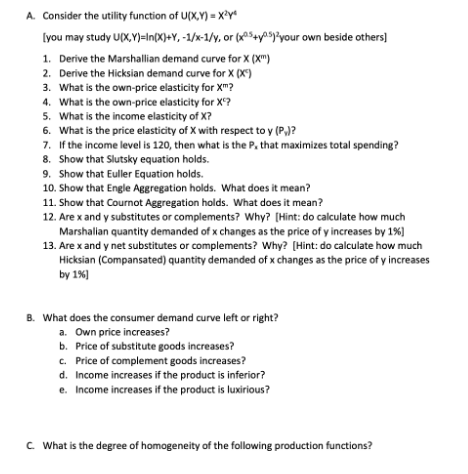
 A. Consider the utibty function of UDXY) = XY
you may study UDCYISINXY, -1/x-1/y, or 64°F your own beside others]
1. Derive the Marshallan demand curve for X (7)
2. Derive the icksan demand curve for X 0)
3. Whatis the own-price elasticity for X72
4. Whats the own price elasticity for X7
5. Whats the income elasticity of X?
6. Whats the price lasticy of with respect toy (PJ?
7. the income evel i 120, then what the 7. that masimizes total spending?
8. Show that Sutsky equation holds.
9. Show tha Euler Equation holds.
10. Show that Engle Aggregation holds. What does it mean?
1. Show that Cournot Aggregation holds. What does it mean?
12. Are x and y substitutes or complements? Why? Hint: do caculte how much
Marshallan quantity demanded of x changes s the price of y increases by 1%]
13. Are xand y net substitutes or complements? Why? [Hint do calculate how much
Hicksian (Compansated) quantity demanded of x changes as the price of y Increases
by)
8. What does the consumer demand curve lft or right?
a. Own price increases?
b. Price of substitute goods increases?
A. Consider the utibty function of UDXY) = XY
you may study UDCYISINXY, -1/x-1/y, or 64°F your own beside others]
1. Derive the Marshallan demand curve for X (7)
2. Derive the icksan demand curve for X 0)
3. Whatis the own-price elasticity for X72
4. Whats the own price elasticity for X7
5. Whats the income elasticity of X?
6. Whats the price lasticy of with respect toy (PJ?
7. the income evel i 120, then what the 7. that masimizes total spending?
8. Show that Sutsky equation holds.
9. Show tha Euler Equation holds.
10. Show that Engle Aggregation holds. What does it mean?
1. Show that Cournot Aggregation holds. What does it mean?
12. Are x and y substitutes or complements? Why? Hint: do caculte how much
Marshallan quantity demanded of x changes s the price of y increases by 1%]
13. Are xand y net substitutes or complements? Why? [Hint do calculate how much
Hicksian (Compansated) quantity demanded of x changes as the price of y Increases
by)
8. What does the consumer demand curve lft or right?
a. Own price increases?
b. Price of substitute goods increases?