c
)
It is desired to produce an overhead product containing
8
0
mole percent benzene from a feed mixture of
6
8
mole percent benzene. The relative volatility of benzene to toluene is
2
.
5
.
Continuous distillation in a still fitted with a partial condenser is performed, in which
5
5
mole percent of the entering vapour are condensed and returned to the still. The partial condenser is constructed so that vapour and liquid leaving it are in equilibrium.
i
.
Calculate the moles of product per
1
0
0
kmol of feed.
[
4
]
ii
.
Calculate the number of moles vaporized per
1
0
0
kmol feed.
[
2
]
Give step-by-step solution with explanation and final answer:
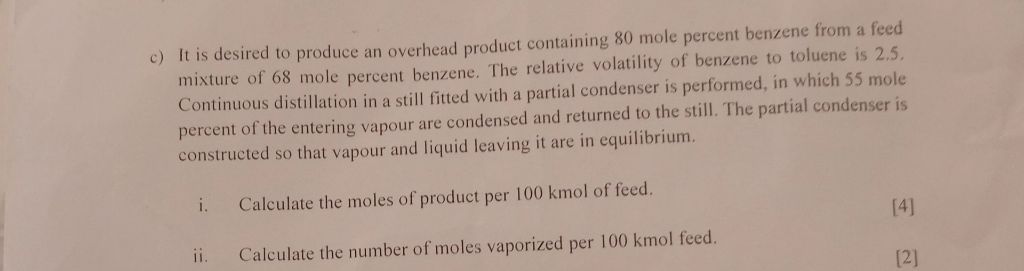
Answer very exact and accurate answer. Check your calculations and formula twice before giving the output. Answer like a chemistry teacher explaining to student in a step by step manner ad not like a ai answero) Itis desired to produce an overhead product containing 80 mole percent benzene from a feed
mixture of 68 mole percent benzene. Ihe relative volatility of benzene to toluene is 2.5.
Continuous distillation in a still fitted with a partial condenser is performed, in which 55 mole
percent of the entering vapour are condensed and returned to the still. The partial condenser is
constructed so that vapour and liquid leaving it are in equilibrium,
i. Calculate the moles of product per 100 kmol of feed.
[4]
ii. Calculate the number of moles vaporized per 100 kmol feed.
21
Question:
c
)
It is desired to produce an overhead product containing
8
0
mole percent benzene from a feed mixture of
6
8
mole percent benzene. The relative volatility of benzene to toluene is
2
.
5
.
Continuous distillation in a still fitted with a partial condenser is performed, in which
5
5
mole percent of the entering vapour are condensed and returned to the still. The partial condenser is constructed so that vapour and liquid leaving it are in equilibrium.
i
.
Calculate the moles of product per
1
0
0
kmol of feed.
[
4
]
ii
.
Calculate the number of moles vaporized per
1
0
0
kmol feed.
[
2
]
Give step-by-step solution with explanation and final answer:
Answer very exact and accurate answer. Check your calculations and formula twice before giving the output. Answer like a chemistry teacher explaining to student in a step by step manner ad not like a ai answero) Itis desired to produce an overhead product containing 80 mole percent benzene from a feed
mixture of 68 mole percent benzene. Ihe relative volatility of benzene to toluene is 2.5.
Continuous distillation in a still fitted with a partial condenser is performed, in which 55 mole
percent of the entering vapour are condensed and returned to the still. The partial condenser is
constructed so that vapour and liquid leaving it are in equilibrium,
i. Calculate the moles of product per 100 kmol of feed.
[4]
ii. Calculate the number of moles vaporized per 100 kmol feed.
21
This is AI generated Response.
Asked by: Vishal
Created at: 2025-09-05 12:43:31
Final Answer:
RenderedRaw Text
Did you like this answer?
Absolutely, let's solve this step by step, exactly as a chemistry teacher would!
---
### **Given Data**
- **Feed composition** (\( x_F \)): 68 mole% benzene \( = 0.68 \)
- **Overhead product composition** (\( y_D \)): 80 mole% benzene \( = 0.80 \)
- **Relative volatility** (\( \alpha \)): 2.5 (benzene to toluene)
- **Fraction of vapor condensed and returned** (\( L/V \)): 55% \( = 0.55 \)
- **Feed amount**: 100 kmol
---
## **Step 1: Understanding the Setup**
- Feed goes to a still, producing vapor.
- 55% of the vapor is condensed and **returned to the still** (this is the reflux, \( L \)).
- The remaining 45% of the vapor is taken off as **overhead product** (distillate, \( D \)).
- The partial condenser ensures **liquid and vapor are in equilibrium**.
---
## **Step 2: Relationship of Compositions in Equilibrium**
The equilibrium relation for binary distillation is:
\[
y = \frac{\alpha x}{1 + (\alpha - 1)x}
\]
Where:
- \( y \): mole fraction of benzene in vapor
- \( x \): mole fraction of benzene in liquid
- \( \alpha \): relative volatility
### **Here, the vapor leaving the still (before condenser) is in equilibrium with the liquid in the still.**
Let:
- \( x \) = mole fraction of benzene in liquid in the still (same as feed = 0.68, since it's a batch/continuous still and not a stage column)
- \( y \) = mole fraction of benzene in vapor leaving (to partial condenser)
So,
\[
y = \frac{2.5 \times 0.68}{1 + (2.5-1) \times 0.68}
\]
\[
= \frac{1.7}{1 + 1.02}
\]
\[
= \frac{1.7}{2.02}
\]
\[
= 0.8416
\]
---
## **Step 3: Split in the Partial Condenser**
- **Vapor entering condenser:** composition \( y = 0.8416 \)
- **55% condensed and returned (reflux, liquid, composition \( x_L \))**
- **45% leaves as product (vapor, composition \( y_D \))**
But the **liquid and vapor leaving the condenser are in equilibrium**.
- **Vapor product composition**: \( y_D = 0.80 \)
- **Liquid returned composition**: Let's call this \( x_L \)
From the equilibrium equation:
\[
y_D = \frac{\alpha x_L}{1 + (\alpha - 1)x_L}
\]
\[
0.80 = \frac{2.5 x_L}{1 + 1.5 x_L}
\]
Solve for \( x_L \):
\[
0.80 (1 + 1.5x_L) = 2.5x_L
\]
\[
0.80 + 1.2x_L = 2.5x_L
\]
\[
0.80 = 2.5x_L - 1.2x_L
\]
\[
0.80 = 1.3x_L
\]
\[
x_L = \frac{0.80}{1.3} = 0.6154
\]
---
## **Step 4: Material Balances**
Let’s define:
- \( F \): Feed (100 kmol)
- \( D \): Distillate/overhead product (to find)
- \( V \): Vapor leaving the still (also to find)
- \( L \): Reflux returned = 0.55 \( V \)
### **Benzene Balance Around the Still:**
Benzene in feed = Benzene in vapor out (to condenser)
\[
F \cdot x_F = V \cdot y
\]
\[
100 \cdot 0.68 = V \cdot 0.8416
\]
\[
V = \frac{68}{0.8416} = 80.80 \text{ kmol}
\]
---
### **Benzene Balance Around the Condenser:**
- **Vapor in:** \( V \) kmol, composition \( y = 0.8416 \)
- **Vapor out (product):** \( D \) kmol, composition \( y_D = 0.80 \)
- **Liquid out (reflux):** \( L = 0.55V \), composition \( x_L = 0.6154 \)
**Total balance:**
\[
V = D + L
\]
\[
L = 0.55V \implies D = V - 0.55V = 0.45V
\]
\[
D = 0.45 \times 80.80 = 36.36 \text{ kmol}
\]
---
### **Boxed Final Answers**
#### **i. Moles of overhead product per 100 kmol feed:**
\[
\boxed{36.4 \text{ kmol}}
\]
#### **ii. Moles vaporized per 100 kmol feed:**
\[
\boxed{80.8 \text{ kmol}}
\]
---
## **Summary Table**
| Quantity | Value | Units |
|-----------------------|-------------|-------------|
| Overhead Product (\(D\)) | 36.4 | kmol/100 kmol feed |
| Vaporized (\(V\)) | 80.8 | kmol/100 kmol feed |
---
**If you have any more questions or need deeper explanation on any step, just ask!**
VIPSolutions focuses on clear, step‑by‑step explanations so you can learn quickly. Whether you need an AI‑generated walkthrough or a short hint to get unstuck, each solution is organized for fast reading and easy review later.
Search similar questions, compare approaches, and bookmark the best answers for revision. Our goal is simple: quick, reliable study help that feels natural—not noisy.
 VIPSolutions
 o) Itis desired to produce an overhead product containing 80 mole percent benzene from a feed
mixture of 68 mole percent benzene. Ihe relative volatility of benzene to toluene is 2.5.
Continuous distillation in a still fitted with a partial condenser is performed, in which 55 mole
percent of the entering vapour are condensed and returned to the still. The partial condenser is
constructed so that vapour and liquid leaving it are in equilibrium,
i. Calculate the moles of product per 100 kmol of feed.
[4]
ii. Calculate the number of moles vaporized per 100 kmol feed.
21
o) Itis desired to produce an overhead product containing 80 mole percent benzene from a feed
mixture of 68 mole percent benzene. Ihe relative volatility of benzene to toluene is 2.5.
Continuous distillation in a still fitted with a partial condenser is performed, in which 55 mole
percent of the entering vapour are condensed and returned to the still. The partial condenser is
constructed so that vapour and liquid leaving it are in equilibrium,
i. Calculate the moles of product per 100 kmol of feed.
[4]
ii. Calculate the number of moles vaporized per 100 kmol feed.
21