 VIPSolutions
Can you create an AOA for these activities? add explanation after each part and final conclusionIMMEDIATE IMMEDIATE ACTIVITY | PREDECESSOR(S) ACTIVITY | PREDECESSOR(S) A — E [3] 8 — F [3 c A G CE D A H D,F
Question:
Can you create an AOA for these activities?
add explanation after each part and final conclusion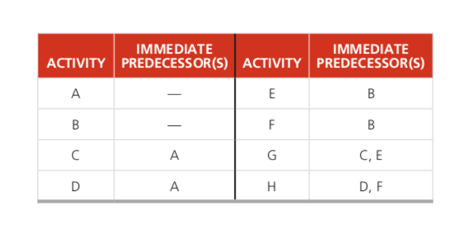 IMMEDIATE IMMEDIATE
ACTIVITY | PREDECESSOR(S) ACTIVITY | PREDECESSOR(S)
A — E [3]
8 — F [3
c A G CE
D A H D,F
IMMEDIATE IMMEDIATE
ACTIVITY | PREDECESSOR(S) ACTIVITY | PREDECESSOR(S)
A — E [3]
8 — F [3
c A G CE
D A H D,F
This is AI generated Response.
Asked by: Priyanshu Yadav
Created at: 2025-10-03 02:04:40
Asked by: Priyanshu Yadav
Created at: 2025-10-03 02:04:40
Final Answer:
Rendered
Raw Text
Did you like this answer?
# Activity-on-Arrow (AOA) Diagram Construction
Given the activity table:
| Activity | Immediate Predecessor(s) |
|----------|:-----------------------:|
| A | — |
| B | — |
| C | A |
| D | A |
| E | B |
| F | B |
| G | C, E |
| H | D, F |
Let's build the AOA diagram step by step.
---
## Step 1: Start Nodes
**Explanation:**
Activities **A** and **B** have no predecessors, so they both start from the initial event (node).
- Draw a start node (Node 1).
- Draw arrows from Node 1 to two new nodes (Node 2 for A, Node 3 for B), representing activities A and B.
---
## Step 2: Activities after A
**Explanation:**
Activities **C** and **D** depend only on **A**.
- From the end node of A (Node 2), draw arrows to new nodes (Node 4 for C, Node 5 for D).
---
## Step 3: Activities after B
**Explanation:**
Activities **E** and **F** depend only on **B**.
- From the end node of B (Node 3), draw arrows to new nodes (Node 6 for E, Node 7 for F).
---
## Step 4: Activity G (Depends on C, E)
**Explanation:**
**G** requires both **C** and **E** to be completed.
- Both C (Node 4) and E (Node 6) need to converge before G can start.
- Draw arrows from Node 4 and Node 6 to a new node (Node 8), with a dummy arrow from Node 6 to Node 8 (since E is not directly connected to C).
- From Node 8, draw the arrow for G to a new node (Node 9).
---
## Step 5: Activity H (Depends on D, F)
**Explanation:**
**H** requires both **D** and **F** to be completed.
- Both D (Node 5) and F (Node 7) need to converge before H can start.
- Draw arrows from Node 5 and Node 7 to a new node (Node 10), with a dummy arrow if necessary.
- From Node 10, draw the arrow for H to a new node (Node 11).
---
## **Full AOA Diagram Structure**
```plaintext
(Start)
|
[A] [B]
| |
(Node2) (Node3)
| \ | \
[C] [D] [E] [F]
| | | |
(Node4)(Node5) (Node6)(Node7)
| \ / \
\ \ / \
\ [dummy] [dummy]
\ / /
[G] (Node8) [H](Node10)
| |
(Node9) (Node11)
```
(Dummy arrows are used to maintain correct precedence when more than one activity depends on two or more predecessors.)
---
## **Conclusion**
The AOA diagram visually represents the sequence and interdependencies among the activities.
- **Start:** Activities A and B begin the project.
- **Parallel Paths:** After A and B, activities branch out and proceed in parallel where possible.
- **Convergence:** Activities G and H require completion of two prior activities each, necessitating dummy arrows to illustrate these convergences.
- **End:** The project concludes after activities G and H.
This structure is useful for identifying the project’s critical path, managing dependencies, and scheduling tasks efficiently.
📢 Instructions:
- Ask anything relatd to above question only.
- For new Question goto :