 VIPSolutions
Can you create an AOA for these activities?IMMEDIATE IMMEDIATE ACTIVITY | PREDECESSOR(S) ACTIVITY | PREDECESSOR(S) A — E [3] 8 — F [3 c A G CE D A H D,F
Question:
Can you create an AOA for these activities?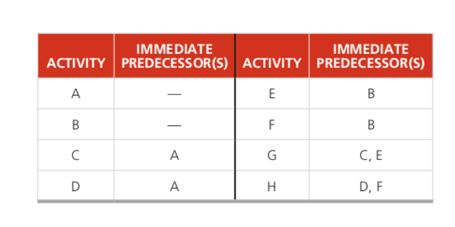 IMMEDIATE IMMEDIATE
ACTIVITY | PREDECESSOR(S) ACTIVITY | PREDECESSOR(S)
A — E [3]
8 — F [3
c A G CE
D A H D,F
IMMEDIATE IMMEDIATE
ACTIVITY | PREDECESSOR(S) ACTIVITY | PREDECESSOR(S)
A — E [3]
8 — F [3
c A G CE
D A H D,F
This is AI generated Response.
Asked by: Priyanshu Yadav
Created at: 2025-10-03 02:03:41
Asked by: Priyanshu Yadav
Created at: 2025-10-03 02:03:41
Final Answer:
Rendered
Raw Text
Did you like this answer?
# AOA (Activity-on-Arrow) Diagram
Below, I'll describe how to construct an AOA (Activity-on-Arrow) network for the activities and their dependencies.
## ** 1: Activities and DependenciesFrom the table:
| Activity | Immediate Predecessor(s) |
|----------|-------------------------|
| A | — |
| B | — |
| C | A |
| D | A |
| E | B |
| F | B |
| G | C, E |
| H | D, F |
## **Step 2: Draw the AOA Diagram**
In AOA, **arrows** represent activities, and **nodes** (circles) represent events (start or completion points).
### **Basic Steps:**
1. **Start Node (1):** Connect to A and B (as they have no predecessors).
2. **From A:** Draw arrows to:
- C
- D
3. **From B:** Draw arrows to:
- E
- F
4. **From C & E:** Both are predecessors to G. So, G starts only after both C and E are done.
5. **From D & F:** Both are predecessors to H. So, H starts only after both D and F are done.
### **AOA Diagram Structure:**
Below is a simple ASCII-style representation:
```
[Start]
|
---------
| |
[A] [B]
| |
---- -----
| | | |
[C] [D] [E] [F]
| | |
\ / \
[G] [H]
```
But in an AOA, we use arrows for activities and circles for events. Here’s a stepwise breakdown:
#### **AOA Steps**
- Node 1 (Start) → **A** → Node 2
- Node 1 (Start) → **B** → Node 3
- Node 2 → **C** → Node 4
- Node 2 → **D** → Node 5
- Node 3 → **E** → Node 6
- Node 3 → **F** → Node 7
- Node 4, Node 6 → **G** (dummy arrow from one to synchronize if needed) → Node 8
- Node 5, Node 7 → **H** (dummy arrow if needed) → Node 9
#### **AOA Diagram (Text Representation)**
```
(1)---A---(2)---C---(4)
| \ /
| D /
| \ /
| (5)
| /
B /
| /
(3)--E--(6)--G--(8)
| /
F /
| /
(7)----H----(9)
```
### **Notes:**
- Sometimes, "dummy activities" (dotted arrows) are added to clarify dependencies; they have zero duration.
- In drawing tools (like MS Visio or by hand), use arrows for activities, and circles for events.
---
## **Summary Table for Events**
| Event | Activities Out | Next Event(s) |
|-------|---------------|---------------|
| 1 | A, B | 2, 3 |
| 2 | C, D | 4, 5 |
| 3 | E, F | 6, 7 |
| 4 | G | 8 |
| 5 | H | 9 |
| 6 | G | 8 |
| 7 | H | 9 |
| 8 | | |
| 9 | | |
---
## **Visualization Tip**
If you need a visual diagram, you can create this using drawing tools or project management software. But the logic above gives you the connections needed for the AOA format.
---
**Let me know if you'd like a hand-drawn sketch or a diagram in another format!**
📢 Instructions:
- Ask anything relatd to above question only.
- For new Question goto :