 VIPSolutions
Consider the previous month's forecast to identify which technique is most effective. Use that to forecast the next month. Remember to select the forecasting technique that produces the forecast error nearest to zero. For example: a . Na ï ve Forecast is 2 3 0 and the Forecast Error is - 1 5 . b . 3 - Month Moving Forecast is 2 9 0 and the Forecast Error is - 7 5 . c . Exponential Smoothing Forecast for . 2 is 3 0 8 and the Forecast Error is - 9 3 . d . Exponential Smoothing Forecast for . 5 is 2 7 9 and the Forecast Error is - 6 4 . e . Seasonal Forecast is 2 9 7 and the Forecast Error is - 8 2 . The forecast for the next month would be 2 3 0 as the Na ï ve Forecast had the Forecast Error closest to zero with a - 1 5 . This forecasting technique was the best performing technique for that month. You do not need to do any external analysis - the forecast error for each strategy is already calculated for you in the tables below.Actual DemandNa ï ve Forecast Error 3 Month Moving Forecast 3 Month Moving Forecast ErrorExponential Smoothing Forecast for . 2 Exponential Smoothing . 2 Forecast ErrorExponential Smoothing Forecast for . 5 Exponential Smoothing . 5 Forecast ErrorSeasonal Forecast Error - Year 1 solve this problem with step by step solution with explanation and conclusionAppt Est co Consider the previous month's forecast to identify which technique is most effective. Use that to forecast the next month. Remember to select the forecasting technique that produces the forecast error nearest to zero. For example: a. Naive Forecast is 230 and the Forecast Error is -15. b. 3-Month Moving Forecast is 290 and the Forecast Error is -75. ¢. Exponential Smoothing Forecast for 2 is 308 and the Forecast Error is -93. d. Exponential Smoothing Forecast for .5 is 279 and the Forecast Error is 64. e. Seasonal Forecast is 297 and the Forecast Error is -82. The forecast for the next month would be 230 as the Naive Forecast had the Forecast Error closest to zero with a 15. This forecasting technique was the best performing technique for that month. You do not need to do any external analysis-the forecast error for each strategy is already calculated for you in the tables below. 3 > Exponential Exponential Exponential Exponential Month Period fe] Naive foment ony fod Enzi | EnEring| Ensing) Esti Seasonal ore Demand Ee Moving Bomec: Forecast for .2 Forecast Forecast for .5 Forecast Ener Forecast fe 2 Error 5 Error ¥ Year1l MAR 3 69 73 71 73 72 77 [ = | APR 4 94 69 70 72 ul 91 MAY 5 99 94 79 76 83 | © | 76 JUN 6 103 99 87 [1s] 81 91 84 [1 | JuL 7 86 103 99 85 [1] 97 EE 76 [ 10 | AUG 8 103 86 96 85 EE 92 HE 93 [ 10 | SEPT 9 73 103 97 89 IE 98 ul EEN EE EEE EEE NOV n" 73 64 IE 80 82 HE 75 86
Question:
Consider the previous month's forecast to identify which technique is most effective. Use that to forecast the next month. Remember to select the forecasting technique that produces the forecast error nearest to zero. For example: a
.
Na
ï
ve Forecast is
2
3
0
and the Forecast Error is
-
1
5
.
b
.
3
-
Month Moving Forecast is
2
9
0
and the Forecast Error is
-
7
5
.
c
.
Exponential Smoothing Forecast for
.
2
is
3
0
8
and the Forecast Error is
-
9
3
.
d
.
Exponential Smoothing Forecast for
.
5
is
2
7
9
and the Forecast Error is
-
6
4
.
e
.
Seasonal Forecast is
2
9
7
and the Forecast Error is
-
8
2
.
The forecast for the next month would be
2
3
0
as the Na
ï
ve Forecast had the Forecast Error closest to zero with a
-
1
5
.
This forecasting technique was the best performing technique for that month. You do not need to do any external analysis
-
the forecast error for each strategy is already calculated for you in the tables below.Actual DemandNa
ï
ve Forecast Error
3
Month Moving Forecast
3
Month Moving Forecast ErrorExponential Smoothing Forecast for
.
2
Exponential Smoothing
.
2
Forecast ErrorExponential Smoothing Forecast for
.
5
Exponential Smoothing
.
5
Forecast ErrorSeasonal Forecast Error
-
Year
1 solve this problem with step by step solution with explanation and conclusion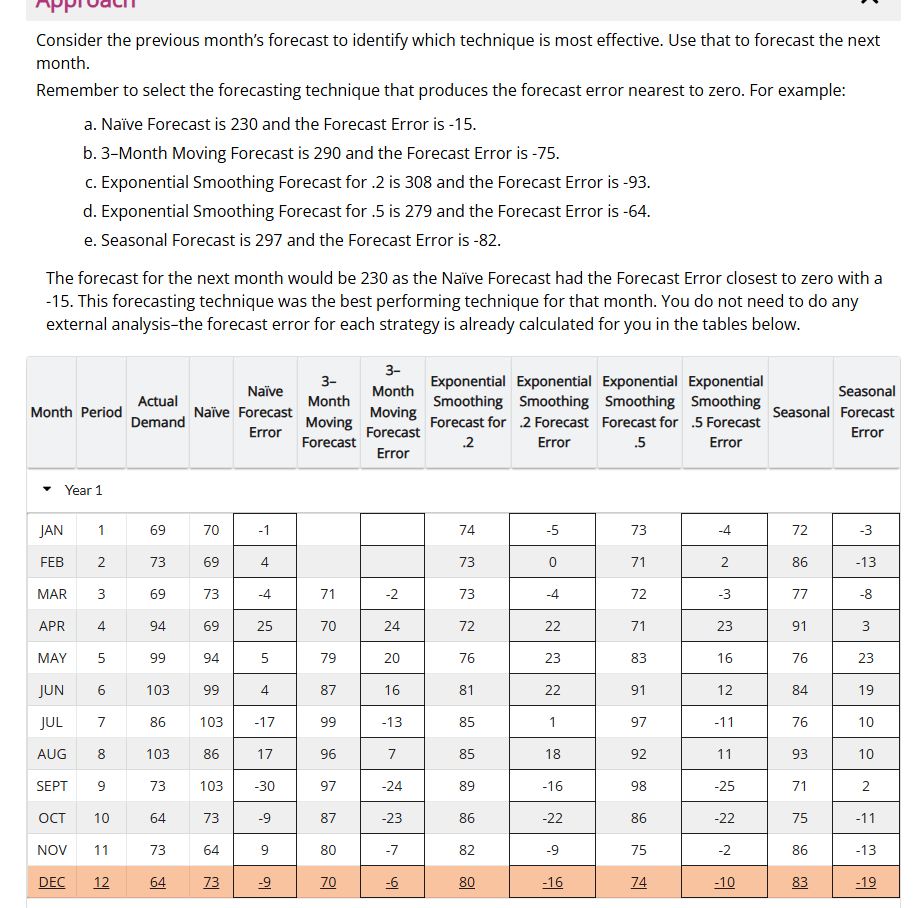 Appt Est co
Consider the previous month's forecast to identify which technique is most effective. Use that to forecast the next
month.
Remember to select the forecasting technique that produces the forecast error nearest to zero. For example:
a. Naive Forecast is 230 and the Forecast Error is -15.
b. 3-Month Moving Forecast is 290 and the Forecast Error is -75.
¢. Exponential Smoothing Forecast for 2 is 308 and the Forecast Error is -93.
d. Exponential Smoothing Forecast for .5 is 279 and the Forecast Error is 64.
e. Seasonal Forecast is 297 and the Forecast Error is -82.
The forecast for the next month would be 230 as the Naive Forecast had the Forecast Error closest to zero with a
15. This forecasting technique was the best performing technique for that month. You do not need to do any
external analysis-the forecast error for each strategy is already calculated for you in the tables below.
3 > Exponential Exponential Exponential Exponential
Month Period fe] Naive foment ony fod Enzi | EnEring| Ensing) Esti Seasonal ore
Demand Ee Moving Bomec: Forecast for .2 Forecast Forecast for .5 Forecast Ener
Forecast fe 2 Error 5 Error
¥ Year1l
MAR 3 69 73 71 73 72 77 [ = |
APR 4 94 69 70 72 ul 91
MAY 5 99 94 79 76 83 | © | 76
JUN 6 103 99 87 [1s] 81 91 84 [1 |
JuL 7 86 103 99 85 [1] 97 EE 76 [ 10 |
AUG 8 103 86 96 85 EE 92 HE 93 [ 10 |
SEPT 9 73 103 97 89 IE 98 ul
EEN EE EEE EEE
NOV n" 73 64 IE 80 82 HE 75 86
Appt Est co
Consider the previous month's forecast to identify which technique is most effective. Use that to forecast the next
month.
Remember to select the forecasting technique that produces the forecast error nearest to zero. For example:
a. Naive Forecast is 230 and the Forecast Error is -15.
b. 3-Month Moving Forecast is 290 and the Forecast Error is -75.
¢. Exponential Smoothing Forecast for 2 is 308 and the Forecast Error is -93.
d. Exponential Smoothing Forecast for .5 is 279 and the Forecast Error is 64.
e. Seasonal Forecast is 297 and the Forecast Error is -82.
The forecast for the next month would be 230 as the Naive Forecast had the Forecast Error closest to zero with a
15. This forecasting technique was the best performing technique for that month. You do not need to do any
external analysis-the forecast error for each strategy is already calculated for you in the tables below.
3 > Exponential Exponential Exponential Exponential
Month Period fe] Naive foment ony fod Enzi | EnEring| Ensing) Esti Seasonal ore
Demand Ee Moving Bomec: Forecast for .2 Forecast Forecast for .5 Forecast Ener
Forecast fe 2 Error 5 Error
¥ Year1l
MAR 3 69 73 71 73 72 77 [ = |
APR 4 94 69 70 72 ul 91
MAY 5 99 94 79 76 83 | © | 76
JUN 6 103 99 87 [1s] 81 91 84 [1 |
JuL 7 86 103 99 85 [1] 97 EE 76 [ 10 |
AUG 8 103 86 96 85 EE 92 HE 93 [ 10 |
SEPT 9 73 103 97 89 IE 98 ul
EEN EE EEE EEE
NOV n" 73 64 IE 80 82 HE 75 86
Asked by: Priyanshu Yadav
Created at: 2025-09-26 20:56:02
Final Answer:
Question:
is this solution is completed according to question requirement
Asked by: Priyanshu Yadav
Created at: 2025-09-26 20:58:25
Final Answer:
Question:
how to select the most effective forecasting technique for predicting the next month’s demand, using the provided table of actual demand, forecasts, and forecast errors for several methods. Specifically, it is asking which method to choose for the next forecast based on which one had the forecast error closest to zero in the immediately previous month. The task is to identify this method from the data and use its prediction as the official forecast for the upcoming month.
Asked by: Priyanshu Yadav
Created at: 2025-09-26 21:00:39
Final Answer:
📢 Instructions:
- Ask anything relatd to above question only.
- For new Question goto :