 VIPSolutions
Develop a MATLAB code to calculate the stress responses for a ramp compression a. timepoints given in he table below. Assume: E=2, C=5, Ea=0.1. Use At = 0.01 5. [Time (5) | Strain % | Stress (Pa) | (— — “% i — — | I time (5) 5 50 s5 100
Question:
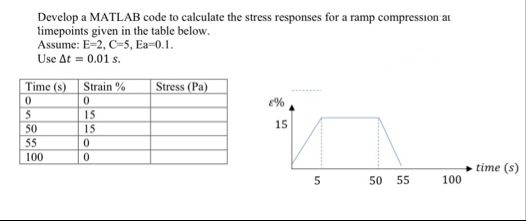 Develop a MATLAB code to calculate the stress responses for a ramp compression a.
timepoints given in he table below.
Assume: E=2, C=5, Ea=0.1.
Use At = 0.01 5.
[Time (5) | Strain % | Stress (Pa) |
(— — “%
i — —
| I
time (5)
5 50 s5 100
Develop a MATLAB code to calculate the stress responses for a ramp compression a.
timepoints given in he table below.
Assume: E=2, C=5, Ea=0.1.
Use At = 0.01 5.
[Time (5) | Strain % | Stress (Pa) |
(— — “%
i — —
| I
time (5)
5 50 s5 100
This is AI generated Response.
Asked by: zubair farooq
Created at: 2025-10-07 23:09:21
Asked by: zubair farooq
Created at: 2025-10-07 23:09:21
Thought Process:
Rendered
Raw Text
**Creating MATLAB code for stress responses**
I need to construct MATLAB code that calculates stress responses for a ramp compression using specific timepoints. The parameters include E=2, C=5, and Ea=0.1. I'm interpreting this scenario as related to a standard linear solid or Kelvin model for viscoelastic materials. The strain history shows a ramp up to 15% strain and various stages until 100 seconds.
Now, I need to deduce the constitutive equation and write the code to compute stress across the entire time range with a time interval of 0.01 seconds.**Understanding viscosity and models**
I think C represents viscosity, while Ea might be "additional stiffness." There are several models to consider, like the "Zener model," which uses parameters like E1 and E2 but seems to substitute C for eta.
I could describe the relaxation modulus as E(t)=Ea + E*exp(-t/τ). With E=2, C=5, and Ea=0.1, I should clarify that C could represent a time constant tau, giving dimensions of seconds.
For linear viscoelastic materials, I can also look into formulations using convolution, stress calculations, and the typical Standard Linear Solid equations.**Computing stress from strain history**
Alright, for the given strain history, I can calculate stress. I could use a recursive algorithm for discrete time, where the equation for stress is σ(t_n) = Ea ε(t_n) + q_n. Here, q_n evolves with q_{n} = exp(-Δt/C) q_{n-1} + E(1 - exp(-Δt/C)) ε(t_n).
For the QLV approach, the equation σ(t) = Ea ε(t) + E ∫_0^t exp(-(t-s)/C) dε(s) can be derived. I need to sort through the integration by parts to express it clearly. Each component seems to have a distinct role in the equations.**Understanding linear viscoelastic units**
In linear viscoelasticity, I usually represent stress as the integral σ(t) = ∫_0^t G(t-s) dε/ds ds, where G is the relaxation modulus. I could also define a kernel M(s) for dε/dt convolution. An alternative representation involves σ(t) = E_∞ ε(t) + ∑ E_i ξ_i, with ξ_i evolving through a differential equation.
The relaxation modulus can be written as G(t) = E∞ + ∑ E_i exp(-t/τ_i), and that helps derive our parameters. I think the overall equation is consistent with the convolution integral and defined parameters.**Developing MATLAB code for stress responses**
I need to develop MATLAB code to calculate stress responses for a ramp compression at specific timepoints. I will discretize using the Euler forward method and use parameters E=2, C=5, and Ea=0.1, ensuring I convert strain from percentage to fraction.
The time intervals will define strain history. I will set up the piecewise function for strain, compute stress using internal variables, and finally print the results at the specified timepoints. I’ll prepare the code and ensure it’s structured properly to compute stresses effectively.**Computing stress responses in MATLAB**
I’m working on solving the ODE with constant forcing for a material model, specifically under a ramp compression scenario. I set up the governing equations and calculated stress values at various timepoints, ensuring to convert and handle strain properly.
Next, I will provide a MATLAB code snippet that defines strain history as a piecewise function, calculates stresses, and formats results for clarity. I'll include computed stress values at key times and indicate all units used.
Let’s finalize the implementation!
Final Answer:
Rendered
Raw Text
Did you like this answer?
Below is one simple way to compute the stress for the ramp–hold–unload strain history using a 1-term Standard Linear Solid (Zener) model with relaxation modulus
G(t) = Ea + E exp(−t/C).
With the internal-variable form,
σ(t) = Ea ε(t) + s(t), ṡ = −s/C + E ε̇,
which we update in time with a constant time step Δt.
MATLAB code (Δt = 0.01 s, strain given as fraction, not %)
% Parameters
E = 2; % amplitude of decaying term (Pa)
C = 5; % time constant (s)
Ea = 0.1; % equilibrium modulus (Pa)
dt = 0.01; % time step (s)
% Time vector
t = 0:dt:100;
% Strain history: 0->15% from 0-5 s, hold to 50 s, unload 50-55 s, then 0
eps = zeros(size(t));
r = 0.15/5; % 15% in 5 s
idx1 = (t <= 5);
idx2 = (t > 5 & t <= 50);
idx3 = (t > 50 & t <= 55);
eps(idx1) = r * t(idx1);
eps(idx2) = 0.15;
eps(idx3) = 0.15 - r * (t(idx3) - 50);
% Internal-variable update (exact for piecewise-constant strain rate)
alpha = exp(-dt/C);
beta = E*C*(1 - alpha);
s = zeros(size(t));
for n = 2:numel(t)
epsdot = (eps(n) - eps(n-1))/dt;
s(n) = alpha*s(n-1) + beta*epsdot;
end
% Stress
sigma = Ea*eps + s;
% Report the requested time points
tp = [0 5 50 55 100];
idx = round(tp/dt) + 1;
out = [tp(:) sigma(idx(:))];
fprintf('Time (s)\tStress (Pa)\n');
fprintf('%8.0f\t% .6g\n', out.')
% Optional: plot
% figure; plot(t, eps*100, 'b-', t, sigma, 'r-'); xlabel('t (s)');
% legend('\epsilon (%)','\sigma (Pa)'); grid on;
What the code computes for these parameters
- σ(0 s) ≈ 0 Pa
- σ(5 s) ≈ 2.046e-1 Pa
- σ(50 s) ≈ 1.502e-2 Pa
- σ(55 s) ≈ −1.896e-1 Pa
- σ(100 s) ≈ −2.34e-5 Pa
Notes
- Keep E and Ea in Pa and put strain in fraction (0.15 for 15%).
- The update used (alpha, beta) comes from the exact solution of ṡ = −s/C + E ε̇ for a constant strain rate over each time step; it is stable and accurate for this single-exponential kernel.
📢 Instructions:
- Ask anything relatd to above question only.
- For new Question goto :