Explain like I am a beginner and do not know anything about the topic:= me ge — COR IR ERC EES WH RO ICR TORN ERM TR
SYSTEM §
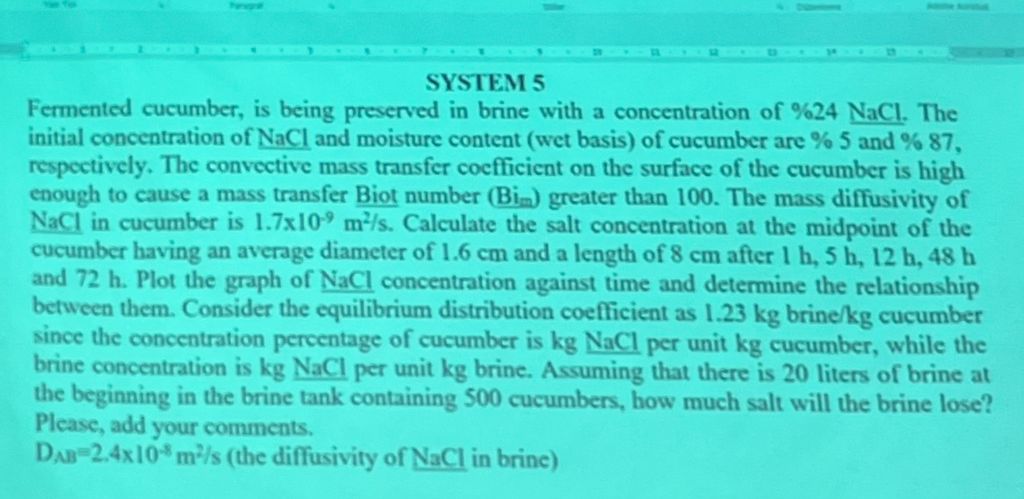
Fermented cucumber, is being preserved in brine with a concentration of %24 NaCl. The
initial concentration of NaCl and moisture content (wet basis) of cucumber are % 5 and % 87,
respectively. The convective mass transfer coefficient on the surface of the cucumber is high
enough to cause a mass transfer Biot number (Big) greater than 100. The mass diffusivity of
NaCl in cucumber is 17x10” m*/s. Calculate the salt concentration at the midpoint of the
cucumber having an average diameter of 1.6 cm and a length of 8 cm after 1 h, Sh, 12h,48 h
and 72 h. Plot the graph of NaCl concentration against time and determine the relationship
between them. Consider the equilibrium distribution coefficient as 1.23 kg brine/kg cucumber
since the concentration percentage of cucumber is kg NaCl per unit kg cucumber, while the
brine concentration is kg NaCl per unit kg brine. Assuming that there is 20 liters of brine at
the beginning in the brine tank containing S00 cucumbers, how much salt will the brine lose?
Please, add your comments.
Dan=2.4x10* ms (the diffusivity of NaCl in brine)
Question:
Explain like I am a beginner and do not know anything about the topic:= me ge — COR IR ERC EES WH RO ICR TORN ERM TR
SYSTEM §
Fermented cucumber, is being preserved in brine with a concentration of %24 NaCl. The
initial concentration of NaCl and moisture content (wet basis) of cucumber are % 5 and % 87,
respectively. The convective mass transfer coefficient on the surface of the cucumber is high
enough to cause a mass transfer Biot number (Big) greater than 100. The mass diffusivity of
NaCl in cucumber is 17x10” m*/s. Calculate the salt concentration at the midpoint of the
cucumber having an average diameter of 1.6 cm and a length of 8 cm after 1 h, Sh, 12h,48 h
and 72 h. Plot the graph of NaCl concentration against time and determine the relationship
between them. Consider the equilibrium distribution coefficient as 1.23 kg brine/kg cucumber
since the concentration percentage of cucumber is kg NaCl per unit kg cucumber, while the
brine concentration is kg NaCl per unit kg brine. Assuming that there is 20 liters of brine at
the beginning in the brine tank containing S00 cucumbers, how much salt will the brine lose?
Please, add your comments.
Dan=2.4x10* ms (the diffusivity of NaCl in brine)
This is AI generated Response.
Asked by: vemuri swathi
Created at: 2025-12-24 13:49:06
Final Answer:
RenderedRaw Text
Did you like this answer?
Certainly! Let’s break down the problem step by step, in simple terms:
---
# Understanding the Problem
## What’s Happening?
- **Cucumbers** are being preserved in **salty water (brine)**.
- The brine contains **24% salt (NaCl)**.
- Cucumbers start with only **5% salt** and are very moist (**87% water**).
## What is Being Asked?
1. **Calculate how much salt** gets into the center of a cucumber over time (at 1h, 5h, 12h, 48h, 72h).
2. **Plot a graph** showing how salt concentration in the cucumber changes over time.
3. **Figure out how salt moves between the brine and the cucumber**, and how much salt the brine loses in the end.
---
# Key Concepts
## Important Terms
- **NaCl**: Salt (sodium chloride).
- **Mass diffusivity (\(D_{NaCl}\))**: How easily salt moves through cucumber (given as \(1.7 \times 10^{-9}\) m²/s in cucumber, \(2.4 \times 10^{-9}\) m²/s in brine).
- **Biot Number (Bi\(_m\))**: A number that tells us if the surface or the inside of the cucumber limits the salt moving in. Here, it's so high that the inside of the cucumber is the limiting step.
- **Equilibrium distribution coefficient**: Tells us how salt will be shared between brine and cucumber after a long time (given as 1.23 kg brine/kg cucumber).
---
# Step-by-Step Explanation
## 1. Salt Diffusion into Cucumber
- The **salt moves from brine into cucumber** mainly by diffusion (spreading out from high concentration to low).
- Since the Biot number is high, we focus on how salt spreads **inside** the cucumber, not how it crosses the surface.
### Key Info:
- Cucumber shape: Assume it's a cylinder (1.6 cm diameter, 8 cm length).
- You’ll want to **find salt concentration at the center** at different times (1h, 5h...).
#### Equation for Diffusion (for beginners):
A simple model used is the **solution to Fick’s Second Law** for a cylinder:
\[
\frac{C(r,t) - C_{}}{C_{s} - C_{}} = 1 - \frac{4}{\pi} \sum_{n=}^{\infty} \frac{1}{2n+1} \exp \left( -\frac{D (2n+1)^2 \pi^2 t}{d^2} \right)
\]
Where:
- \(C(r,t)\): Salt at center at time \(t\)
- \(C_\): Initial salt in cucumber
- \(C_s\): Salt at the surface (brine value)
- \(D\): Diffusivity (\(1.7 \times 10^{-9}\) m²/s)
- \(d\): Diameter (1.6 cm = .016 m)
*For a beginner, you don't have to use this equation right away, but it shows how engineers model diffusion.*
## 2. Plotting the Graph
- You’ll **calculate salt at the center** for each time point (using the formula above).
- **Plot “Salt in cucumber (center)” vs. “Time”**.
## 3. Salt Loss from Brine
- After a long time, cucumbers and brine will reach **equilibrium** (no more net movement of salt).
- The **equilibrium ratio** tells us how salt divides itself between the brine and the cucumbers.
### To Find:
- If you start with 20 liters of brine and 500 cucumbers, **how much salt leaves the brine and enters the cucumbers**?
---
# Summary
Here’s what you need to do:
1. **Find how salt moves into the cucumber** (use diffusion, focus on center).
2. **Draw a graph** of salt concentration vs. time.
3. **Use the equilibrium ratio** to figure out how much salt moves from brine to cucumbers in the end.
4. **Comment on the results**: Did salt move quickly? Did brine lose a lot of salt?
---
## Tips
- Don’t worry if the equations look complicated at first. Focus on the idea: **Salt moves from where there's a lot (brine) to where there's little (cucumber), and slows down as it evens out.**
- If you need help with **calculations or plotting**, ask for step-by-step help with each part!
---
**Let me know if you want to see the step-by-step calculations for any part!**
VIPSolutions focuses on clear, step‑by‑step explanations so you can learn quickly. Whether you need an AI‑generated walkthrough or a short hint to get unstuck, each solution is organized for fast reading and easy review later.
Search similar questions, compare approaches, and bookmark the best answers for revision. Our goal is simple: quick, reliable study help that feels natural—not noisy.
 VIPSolutions
 = me ge — COR IR ERC EES WH RO ICR TORN ERM TR
SYSTEM §
Fermented cucumber, is being preserved in brine with a concentration of %24 NaCl. The
initial concentration of NaCl and moisture content (wet basis) of cucumber are % 5 and % 87,
respectively. The convective mass transfer coefficient on the surface of the cucumber is high
enough to cause a mass transfer Biot number (Big) greater than 100. The mass diffusivity of
NaCl in cucumber is 17x10” m*/s. Calculate the salt concentration at the midpoint of the
cucumber having an average diameter of 1.6 cm and a length of 8 cm after 1 h, Sh, 12h,48 h
and 72 h. Plot the graph of NaCl concentration against time and determine the relationship
between them. Consider the equilibrium distribution coefficient as 1.23 kg brine/kg cucumber
since the concentration percentage of cucumber is kg NaCl per unit kg cucumber, while the
brine concentration is kg NaCl per unit kg brine. Assuming that there is 20 liters of brine at
the beginning in the brine tank containing S00 cucumbers, how much salt will the brine lose?
Please, add your comments.
Dan=2.4x10* ms (the diffusivity of NaCl in brine)
= me ge — COR IR ERC EES WH RO ICR TORN ERM TR
SYSTEM §
Fermented cucumber, is being preserved in brine with a concentration of %24 NaCl. The
initial concentration of NaCl and moisture content (wet basis) of cucumber are % 5 and % 87,
respectively. The convective mass transfer coefficient on the surface of the cucumber is high
enough to cause a mass transfer Biot number (Big) greater than 100. The mass diffusivity of
NaCl in cucumber is 17x10” m*/s. Calculate the salt concentration at the midpoint of the
cucumber having an average diameter of 1.6 cm and a length of 8 cm after 1 h, Sh, 12h,48 h
and 72 h. Plot the graph of NaCl concentration against time and determine the relationship
between them. Consider the equilibrium distribution coefficient as 1.23 kg brine/kg cucumber
since the concentration percentage of cucumber is kg NaCl per unit kg cucumber, while the
brine concentration is kg NaCl per unit kg brine. Assuming that there is 20 liters of brine at
the beginning in the brine tank containing S00 cucumbers, how much salt will the brine lose?
Please, add your comments.
Dan=2.4x10* ms (the diffusivity of NaCl in brine)