 VIPSolutions
Explain like I am a beginner and do not know anything about the topic: Act like a helpful tutor and exlain me : Give step-by-step solution with explanation and final answer: Solve completelyNew hi-tech fountains Ancient Egyptians used fountains in their palaces for decorative and cooling purposes. Current use of fountains continues but with a hi-tech flair. Although the basic fountain still consists of a typical pipe system (i.c., pump, pipe, regulating valve, nozzle, filter, and basin), recent use of computer-controlled devices has led to the design of innovative fountains with special effects. For example, using several rows of multiple nozzles, it is possible to program and activate control valves to produce water jets that resemble symbols, letters, or the time of day. Other fountains use specially designed nozzles to produce coherent, laminar streams of water that look like glass rods flying through the air. Using fast-acting control valves in a synchronized manner itis possible to produce mesmerizing three-dimensional patterns of water droplets. The possibilities are nearly limitless. With the initial artistic design of the fountain established, the initial engineering design (i.e., the capacity and pressure requirements of the nozzles and the size of the pipes and pumps) can be carried out. It is often necessary to modify the artistic and/or engineering aspects of the design in order to obtain a functional, pleasing fountain. The fountain shown in the figure below is designed to provide a stream of water that rises h = 10 ft to h = 19 ft above the nozzle exit in aperiodic fashion. To do this the water from the pool enters a pump, passes through a pressure regulator that maintains a constant pressure ahead of the flow control valve. The valve is electronically adjusted to provide the desired water height. With h = 10 ft the loss coefficient for the valve is K, = 50. Determine the valve loss coefficient needed for h = 19 ft. All losses except for the flow control valve are negligible. The area of the pipe is 5 times the area of the exit nozzle.
Question:
Explain like I am a beginner and do not know anything about the topic:
Act like a helpful tutor and exlain me :
Give step-by-step solution with explanation and final answer:
Solve completely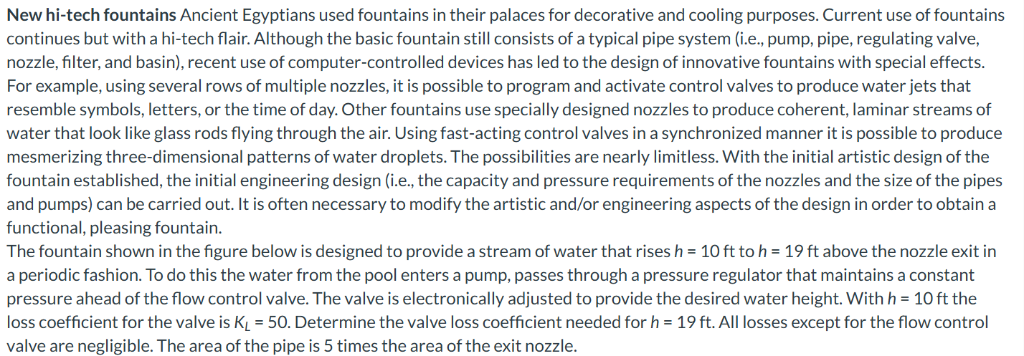 New hi-tech fountains Ancient Egyptians used fountains in their palaces for decorative and cooling purposes. Current use of fountains
continues but with a hi-tech flair. Although the basic fountain still consists of a typical pipe system (i.c., pump, pipe, regulating valve,
nozzle, filter, and basin), recent use of computer-controlled devices has led to the design of innovative fountains with special effects.
For example, using several rows of multiple nozzles, it is possible to program and activate control valves to produce water jets that
resemble symbols, letters, or the time of day. Other fountains use specially designed nozzles to produce coherent, laminar streams of
water that look like glass rods flying through the air. Using fast-acting control valves in a synchronized manner itis possible to produce
mesmerizing three-dimensional patterns of water droplets. The possibilities are nearly limitless. With the initial artistic design of the
fountain established, the initial engineering design (i.e., the capacity and pressure requirements of the nozzles and the size of the pipes
and pumps) can be carried out. It is often necessary to modify the artistic and/or engineering aspects of the design in order to obtain a
functional, pleasing fountain.
The fountain shown in the figure below is designed to provide a stream of water that rises h = 10 ft to h = 19 ft above the nozzle exit in
aperiodic fashion. To do this the water from the pool enters a pump, passes through a pressure regulator that maintains a constant
pressure ahead of the flow control valve. The valve is electronically adjusted to provide the desired water height. With h = 10 ft the
loss coefficient for the valve is K, = 50. Determine the valve loss coefficient needed for h = 19 ft. All losses except for the flow control
valve are negligible. The area of the pipe is 5 times the area of the exit nozzle.
New hi-tech fountains Ancient Egyptians used fountains in their palaces for decorative and cooling purposes. Current use of fountains
continues but with a hi-tech flair. Although the basic fountain still consists of a typical pipe system (i.c., pump, pipe, regulating valve,
nozzle, filter, and basin), recent use of computer-controlled devices has led to the design of innovative fountains with special effects.
For example, using several rows of multiple nozzles, it is possible to program and activate control valves to produce water jets that
resemble symbols, letters, or the time of day. Other fountains use specially designed nozzles to produce coherent, laminar streams of
water that look like glass rods flying through the air. Using fast-acting control valves in a synchronized manner itis possible to produce
mesmerizing three-dimensional patterns of water droplets. The possibilities are nearly limitless. With the initial artistic design of the
fountain established, the initial engineering design (i.e., the capacity and pressure requirements of the nozzles and the size of the pipes
and pumps) can be carried out. It is often necessary to modify the artistic and/or engineering aspects of the design in order to obtain a
functional, pleasing fountain.
The fountain shown in the figure below is designed to provide a stream of water that rises h = 10 ft to h = 19 ft above the nozzle exit in
aperiodic fashion. To do this the water from the pool enters a pump, passes through a pressure regulator that maintains a constant
pressure ahead of the flow control valve. The valve is electronically adjusted to provide the desired water height. With h = 10 ft the
loss coefficient for the valve is K, = 50. Determine the valve loss coefficient needed for h = 19 ft. All losses except for the flow control
valve are negligible. The area of the pipe is 5 times the area of the exit nozzle.
Asked by: manish kumar
Created at: 2025-10-24 11:58:37
Final Answer:
📢 Instructions:
- Ask anything relatd to above question only.
- For new Question goto :