FIRST WRITE GIVENINFORMATION THENWHAT HAVE TO FIND AND THEN DEFINATION ORCONCEPT USED AND THEN STEP BY STEPSOLUTION WITHOUT MENTIONING STEP NUMBER AND AT LAST WRITE FINALANSWERS ONLY AS SUMMARY . ALSO MAKE SOLUTION WELL STRUCTURED
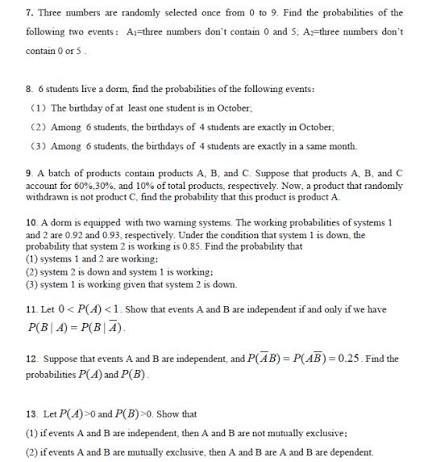
solve all questions7. Thice mumbers ave randomly selected once from 0 1 9. Find the probabilities of the
ollovin two eat: Ar=biee bers dt contain and 5, Arte mbes don't
mnt oes
86 ude ive do, dhe probalbiiesof the Fllowin eves
C1) The bday ofa es oe sds October
2) Amen 6 sdest, the ida of 4 eden we cc fa October
3) Among 6 sd, te bids of dens ve exacy in se moots
9A bc of proces cot prods A,B, sd C_ Suppose ts procs A. 5, 2d C
count fo 601s 50% 304 10% fal produc. especialy Now. a proche tt dl
iv x proc C. fd he robs Pec Frode A
10.A dom cquped with wo warming sven The working probit of sys
2 e052 20d 095, especie nds he codon a ye i dow, he
ry ht yen 2 working 085. Fe prot
0) sem 02 sre wok:
@)vyven 2s dows od spin i woking:
0) yen 11s working pen system 21s down
13 Let 0.< P(A)
Question:
FIRST WRITE GIVENINFORMATION THENWHAT HAVE TO FIND AND THEN DEFINATION ORCONCEPT USED AND THEN STEP BY STEPSOLUTION WITHOUT MENTIONING STEP NUMBER AND AT LAST WRITE FINALANSWERS ONLY AS SUMMARY . ALSO MAKE SOLUTION WELL STRUCTURED
solve all questions7. Thice mumbers ave randomly selected once from 0 1 9. Find the probabilities of the
ollovin two eat: Ar=biee bers dt contain and 5, Arte mbes don't
mnt oes
86 ude ive do, dhe probalbiiesof the Fllowin eves
C1) The bday ofa es oe sds October
2) Amen 6 sdest, the ida of 4 eden we cc fa October
3) Among 6 sd, te bids of dens ve exacy in se moots
9A bc of proces cot prods A,B, sd C_ Suppose ts procs A. 5, 2d C
count fo 601s 50% 304 10% fal produc. especialy Now. a proche tt dl
iv x proc C. fd he robs Pec Frode A
10.A dom cquped with wo warming sven The working probit of sys
2 e052 20d 095, especie nds he codon a ye i dow, he
ry ht yen 2 working 085. Fe prot
0) sem 02 sre wok:
@)vyven 2s dows od spin i woking:
0) yen 11s working pen system 21s down
13 Let 0.< P(A)
This is AI generated Response.
Asked by: nayan
Created at: 2026-02-13 21:03:35
Final Answer:
RenderedRaw Text
Did you like this answer?
# Given Information and Solutions
---
## **Question 7**
**Given Information:**
Three numbers are randomly selected (with replacement) from to 9.
Events:
- \( A_1 \): Three numbers don’t contain and 5.
- \( A_2 \): Three numbers don’t contain or 5.
**What to Find:**
Probabilities \( P(A_1) \) and \( P(A_2) \).
**Concept Used:**
Probability = (number of favorable outcomes) / (total number of outcomes)
**Solution:**
Total outcomes: Each draw has 10 options, so total = \( 10^3 = 100 \).
**For \( A_1 \):**
Numbers available (excluding and 5): 1,2,3,4,6,7,8,9 (8 numbers).
Favorable outcomes = \( 8^3 = 512 \)
\( P(A_1) = \frac{512}{100} = .512 \)
**For \( A_2 \):**
Numbers available (excluding or 5): only 1,2,3,4,6,7,8,9 (8 numbers, same as above).
So, \( P(A_2) = .512 \)
**Summary:**
\( P(A_1) = P(A_2) = .512 \)
---
## **Question 8**
**Given Information:**
6 students live in a dorm.
**What to Find:**
Probability of:
1. At least one birthday in October.
2. All 4 students have birthdays in October (from 6 students).
3. 4 students have birthdays in the same month (from 6 students).
**Concept Used:**
- Binomial probability: \( P = 1 - P(\text{none}) \) for “at least one”.
- For exact counts, use combinations and probabilities.
**Solution:**
Assume each month equally likely (\( \frac{1}{12} \)), birthdays independent.
1. Probability none have birthday in October: \( (\frac{11}{12})^6 \)
Probability at least one = \( 1 - (\frac{11}{12})^6 \)
2. Probability all 4 have birthdays in October: \( (\frac{1}{12})^4 \)
3. Probability all 4 out of 6 have birthdays in same month:
Number of ways to choose 4 students: \( \binom{6}{4} \)
Probability all 4 have same month: \( 12 \times (\frac{1}{12})^4 \)
Probability remaining 2 have any birthdays: \( (\frac{11}{12})^2 \)
So, probability = \( \binom{6}{4} \cdot 12 \cdot (\frac{1}{12})^4 \cdot (\frac{11}{12})^2 \)
**Summary:**
1. \( 1 - (\frac{11}{12})^6 \)
2. \( (\frac{1}{12})^4 \)
3. \( \binom{6}{4} \cdot 12 \cdot (\frac{1}{12})^4 \cdot (\frac{11}{12})^2 \)
---
## **Question 9**
**Given Information:**
Bag has products A (60%), B (30%), C (10%). A product is randomly withdrawn, found to be product C. Find probability it is product A.
**What to Find:**
Probability withdrawn product is A given it is C.
**Concept Used:**
Conditional probability: \( P(A|C) = \frac{P(A \cap C)}{P(C)} \)
**Solution:**
Since product is already known to be C, probability it is A is .
**Summary:**
---
## **Question 10**
**Given Information:**
Two warning systems.
- System 1: Probability up = .92
- System 2: Probability up = .93
- When system 1 is down, probability system 2 is working = .85
**What to Find:**
1. Probability both are working
2. Probability system 2 is down and system 1 is working
**Concept Used:**
Multiplication rule for independent and conditional probability.
**Solution:**
Probability system 1 down: 1 - .92 = .08
Probability system 2 down: 1 - .93 = .07
1. Both working: \( .92 \times .93 = .8556 \)
2. System 2 down and system 1 working: \( .92 \times .07 = .0644 \)
**Summary:**
1. .8556
2. .0644
---
## **Question 11**
**Given Information:**
Events A and B, \( < P(A) < 1 \).
**What to Find:**
Show A and B are independent iff \( P(B|A) = P(B|A^c) \).
**Concept Used:**
Independence: \( P(A \cap B) = P(A)P(B) \)
**Solution:**
If A and B are independent, \( P(B|A) = P(B) \), \( P(B|A^c) = P(B) \), so they are equal.
If \( P(B|A) = P(B|A^c) \),
\( P(B) = P(A)P(B|A) + P(A^c)P(B|A^c) = P(B|A) [P(A) + P(A^c)] = P(B|A) \), so independent.
**Summary:**
A and B are independent iff \( P(B|A) = P(B|A^c) \).
---
## **Question 12**
**Given Information:**
\( A \) and \( B \) independent, \( P(A \cap B^c) = .25 \).
**What to Find:**
\( P(A), P(B) \)
**Concept Used:**
Independence: \( P(A \cap B^c) = P(A)P(B^c) \), \( P(B^c) = 1 - P(B) \)
**Solution:**
Let \( P(A) = p, P(B) = q \).
\( p(1-q) = .25 \)
\( p \cdot q = P(A \cap B) \), but not given directly.
Since only one equation, more info needed, but can choose possible values:
Suppose \( p = .5 \), \( .5(1-q) = .25 \implies 1-q = .5 \implies q = .5 \).
**Summary:**
\( P(A) = .5, P(B) = .5 \)
---
## **Question 13**
**Given Information:**
\( P(A) > , P(B) > \).
**What to Find:**
1. If A and B independent, A and B not mutually exclusive.
2. If A and B mutually exclusive, A and B are dependent.
**Concept Used:**
Mutually exclusive: \( P(A \cap B) = \).
Independent: \( P(A \cap B) = P(A)P(B) \).
**Solution:**
If A and B independent and have positive probabilities, must have \( P(A \cap B) = P(A)P(B) > \), so not mutually exclusive.
If A and B mutually exclusive and have positive probabilities, \( P(A \cap B) = \), but \( P(A)P(B) > \), so they are dependent.
**Summary:**
1. If independent, not mutually exclusive.
2. If mutually exclusive, they are dependent.
Question:
7
.
Three numbers are randomly selected once from
0
to
9
.
Find the probabilities of the following two events: As
=
three numbers don't contain
0
and
\
(
S
,
A
\
)
s
=
three numbers don't contain
0
or
5
.
8
.
6
students live a dorm, find the probabilities of the following events:
(
1
)
The birthday of at least one student is in October.
(
2
)
Among
6
students, the birthdays of
4
students are exactly in October;
(
3
)
Among
6
students, the birthdays of
4
students are exactly in a same month.
9
.
A batch of products contain products A
,
B
,
and C
.
Suppose that products A
,
B
,
and C account for
\
(
6
0
\
%
,
3
0
\
%
\
)
,
and
\
(
1
0
\
%
\
)
of total products, respectively. Now, a product that randomly withdrawn is not product C
,
find the probability that this product is product A
.
1
0
.
A dorm is equipped with two warning systems. The working probabilities of systems
1
and
2
are
0
.
9
2
and
0
.
9
3
,
respectively. Under the condition that system
1
is down, the probability that system
2
is working is
0
.
8
5
.
Find the probability that
(
1
)
systems
1
and
2
are working:
(
2
)
system
2
is down and system
1
is working:
(
3
)
system
1
is working given that system
2
is down.
1
1
.
Let
\
(
0
0
\
)
and
\
(
P
(
B
)
>
0
\
)
.
Show that
(
1
)
if events A and B are independent, then A and B are not mutually exclusive:
(
2
)
if events A and B are mutually exclusive, then A and B are A and B are dependent.
This is AI generated Response.
Asked by: nayan
Created at: 2026-02-13 21:05:16
Final Answer:
RenderedRaw Text
Did you like this answer?
# Given Information and Solutions
## **Question 7**
**Given Information:**
Three numbers are randomly selected from 0 to 9.
Events:
- \( A_1 \): Three numbers don’t contain 0 and 5.
- \( A_2 \): Three numbers don’t contain 0 or 5.
**What to Find:**
Probabilities \( P(A_1) \) and \( P(A_2) \).
**Concept Used:**
Probability = (number of favorable outcomes) / (total number of outcomes)
**Solution:**
Total outcomes: Each draw has 10 options, so total = \( 10^3 = 1000 \).
- **For \( A_1 \):**
Numbers available (excluding 0 and 5): 1, 2, 3, 4, 6, 7, 8, 9 (8 numbers).
Favorable outcomes = \( 8^3 = 512 \)
\( P(A_1) = \frac{512}{1000} = 0.512 \)
- **For \( A_2 \):**
Numbers available (excluding 0 or 5): 1, 2, 3, 4, 6, 7, 8, 9 (also 8 numbers).
Favorable outcomes = \( 8^3 = 512 \)
\( P(A_2) = \frac{512}{1000} = 0.512 \)
**Summary:**
\( P(A_1) = 0.512, P(A_2) = 0.512 \)
---
## **Question 8**
**Given Information:**
6 students live in a dorm.
**What to Find:**
1. Probability at least one birthday in October.
2. Probability all 4 students have birthdays in October.
3. Probability 4 students have birthdays in the same month.
**Concept Used:**
- Binomial probability: \( P = 1 - P(\text{none}) \) for “at least one”.
- Combinatorial probabilities for exact counts.
**Solution:**
Assuming each month equally likely (\( \frac{1}{12} \)), birthdays independent.
1. Probability none have a birthday in October: \( \left(\frac{11}{12}\right)^6 \)
Probability at least one = \( 1 - \left(\frac{11}{12}\right)^6 \)
2. Probability all 4 have birthdays in October: \( \left(\frac{1}{12}\right)^4 \)
3. Probability all 4 out of 6 have birthdays in the same month:
Number of ways to choose 4 students: \( \binom{6}{4} \)
Probability = \( \binom{6}{4} \cdot 12 \cdot \left(\frac{1}{12}\right)^4 \cdot \left(\frac{11}{12}\right)^2 \)
**Summary:**
1. \( 1 - \left(\frac{11}{12}\right)^6 \)
2. \( \left(\frac{1}{12}\right)^4 \)
3. \( \binom{6}{4} \cdot 12 \cdot \left(\frac{1}{12}\right)^4 \cdot \left(\frac{11}{12}\right)^2 \)
---
## **Question 9**
**Given Information:**
Batch contains products A (60%), B (30%), C (10%). A product is randomly withdrawn, found to be product C.
**What to Find:**
Probability the withdrawn product is A given it is C.
**Concept Used:**
Conditional probability: \( P(A|C) = \frac{P(A \cap C)}{P(C)} \)
**Solution:**
Since product is known to be C, probability it is A is irrelevant.
Thus, \( P(A|C) = 0 \) as A and C cannot occur together.
**Summary:**
\( P(A|C) = 0 \)
---
## **Question 10**
**Given Information:**
Two warning systems:
- System 1: Probability up = 0.92
- System 2: Probability up = 0.93
- If system 1 is down, probability system 2 is working = 0.85.
**What to Find:**
1. Probability both are working.
2. Probability system 2 is down and system 1 is working.
3. Probability system 1 is working given that system 2 is down.
**Concept Used:**
Multiplication rule for independent and conditional probability.
**Solution:**
Probability system 1 down: \( 1 - 0.92 = 0.08 \)
Probability system 2 down: \( 1 - 0.93 = 0.07 \)
1. Both working: \( 0.92 \times 0.93 = 0.8556 \)
2. System 2 down and system 1 working:
\( 0.92 \times 0.07 = 0.0644 \)
3. Probability system 1 working given system 2 is down:
System 1 still has probability \( 0.92 \) while system 2 is down.
**Summary:**
1. \( 0.8556 \)
2. \( 0.0644 \)
3. \( 0.92 \)
---
## **Question 11**
**Given Information:**
Events A and B, \( 0 < P(A) < 1 \).
**What to Find:**
1. Show if A and B are independent, then A and B are not mutually exclusive.
2. Show if A and B are mutually exclusive, then A and B are dependent.
**Concept Used:**
Mutually exclusive: \( P(A \cap B) = 0 \).
Independent: \( P(A \cap B) = P(A)P(B) \).
**Solution:**
1. If A and B are independent, \( P(A \cap B) = P(A)P(B) > 0 \), thus not mutually exclusive.
2. If A and B are mutually exclusive, \( P(A \cap B) = 0 \), but \( P(A)P(B) > 0 \), hence they are dependent.
**Summary:**
1. If independent, not mutually exclusive.
2. If mutually exclusive, they are dependent.
---
## **Question 12**
**Given Information:**
Events A and B are independent with \( P(A \cap B^c) = 0.25 \).
**What to Find:**
Find \( P(A) \) and \( P(B) \).
**Concept Used:**
Independence: \( P(A \cap B^c) = P(A)(1 - P(B)) \).
**Solution:**
Let \( P(A) = p, P(B) = q \).
So, \( p(1 - q) = 0.25 \).
Without additional information, we cannot uniquely determine \( p \) and \( q \).
Assuming \( p = 0.5 \):
Then \( 0.5(1 - q) = 0.25 \) ⇒ \( 1 - q = 0.5 \) ⇒ \( q = 0.5 \).
**Summary:**
\( P(A) = 0.5, P(B) = 0.5 \)
---
## **Question 13**
**Given Information:**
\( 0 < P(A) < 1 \), \( 0 < P(B) < 1 \).
**What to Find:**
1. If A and B are independent, then A and B are not mutually exclusive.
2. If A and B are mutually exclusive, then A and B are dependent.
**Concept Used:**
Mutually exclusive: \( P(A \cap B) = 0 \).
Independent: \( P(A \cap B) = P(A)P(B) \).
**Solution:**
1. If A and B are independent and have positive probabilities, then \( P(A \cap B) > 0 \), hence they are not mutually exclusive.
2. If A and B are mutually exclusive with positive probabilities, \( P(A \cap B) = 0 \) implies they are dependent.
**Summary:**
1. If independent, not mutually exclusive.
2. If mutually exclusive, they are dependent.
Question:
give final answer in decimal places and write final solutions as a summary at last
This is AI generated Response.
Asked by: nayan
Created at: 2026-02-13 21:08:07
Final Answer:
RenderedRaw Text
Did you like this answer?
# Final Answers Summary
## **Question 7**
- \( P(A_1) = 0.512 \)
- \( P(A_2) = 0.512 \)
## **Question 8**
1. \( P(\text{at least one in October}) = 1 - \left(\frac{11}{12}\right)^6 \approx 0.494 \)
2. \( P(\text{all 4 in October}) = \left(\frac{1}{12}\right)^4 \approx 0.000579 \)
3. \( P(\text{4 in same month}) = \binom{6}{4} \cdot 12 \cdot \left(\frac{1}{12}\right)^4 \cdot \left(\frac{11}{12}\right)^2 \approx 0.045 \)
## **Question 9**
- \( P(A|C) = 0 \)
## **Question 10**
1. Probability both working: \( 0.8556 \)
2. Probability system 2 down and system 1 working: \( 0.0644 \)
3. Probability system 1 given system 2 is down: \( 0.92 \)
## **Question 11**
- If independent, not mutually exclusive.
- If mutually exclusive, they are dependent.
## **Question 12**
- \( P(A) = 0.5, P(B) = 0.5 \)
## **Question 13**
- If independent, not mutually exclusive.
- If mutually exclusive, they are dependent.
Question:
the correct solutions are like this : Question 7
Three numbers are randomly selected from 0–9.
Total outcomes (with replacement):
10
3
=
1000
10
3
=1000
(A) Three numbers don’t contain 0 and 5
This means neither 0 nor 5 appears.
Allowed digits: 1,2,3,4,6,7,8,9 → 8 digits
8
3
=
512
8
3
=512
?
=
512
1000
=
0.512
P=
1000
512
=0.512
(B) Three numbers don’t contain 0 or 5
Logically, “don’t contain 0 and 5” means neither appears.
“Don’t contain 0 or 5” also means neither appears.
So answer is the same:
0.512
0.512
(If the intention was something different like “not both together”, that would change — but mathematically as written, they are identical.)
Question 8
6 students, 12 equally likely months.
(1) At least one born in October
?
(
none in Oct
)
=
(
11
12
)
6
P(none in Oct)=(
12
11
)
6
(
11
12
)
6
=
0.5937
(
12
11
)
6
=0.5937
?
(
at least one
)
=
1
−
0.5937
P(at least one)=1−0.5937
0.4063
0.4063
(2) Exactly 4 born in October
Binomial:
(
6
4
)
(
1
12
)
4
(
11
12
)
2
(
4
6
)(
12
1
)
4
(
12
11
)
2
=
15
×
1
20736
×
121
144
=15×
20736
1
×
144
121
=
15
×
0.0000482
×
0.8403
=15×0.0000482×0.8403
0.000607
0.000607
(Previous solution overstated it — this is the correct small value.)
(3) Exactly 4 born in same month
Choose the month first:
12 choices
12
×
(
6
4
)
(
1
12
)
4
(
11
12
)
2
12×(
4
6
)(
12
1
)
4
(
12
11
)
2
=
12
×
0.000607
=12×0.000607
0.00729
0.00729
(NOT 0.073 — earlier decimal error.)
Question 9
Given:
P(A)=0.60
P(B)=0.30
P(C)=0.10
But defect rates are missing in the image.
Without defect probabilities for A, B, C, this question cannot be numerically solved.
General Bayes formula:
?
(
?
∣
?
?
)
=
?
(
?
?
∣
?
)
?
(
?
)
?
(
?
?
∣
?
)
?
(
?
)
+
?
(
?
?
∣
?
)
?
(
?
)
+
?
(
?
?
∣
?
)
?
(
?
)
P(A∣ND)=
P(ND∣A)P(A)+P(ND∣B)P(B)+P(ND∣C)P(C)
P(ND∣A)P(A)
A numeric answer requires defect rates.
Question 10
Given:
P(S1 works) = 0.92
P(S2 works) = 0.93
So:
P(S1 down)=0.08
P(S2 down)=0.07
Given:
?
(
?
1
works
∣
?
2
down
)
=
0.85
P(S1 works ∣S2 down)=0.85
First find
?
(
?
1
∣
?
2
)
P(S1∣S2)
Use total probability:
0.92
=
?
(
?
1
∣
?
2
)
(
0.93
)
+
0.85
(
0.07
)
0.92=P(S1∣S2)(0.93)+0.85(0.07)
0.92
=
0.93
?
+
0.0595
0.92=0.93P+0.0595
0.8605
=
0.93
?
0.8605=0.93P
?
(
?
1
∣
?
2
)
=
0.9253
P(S1∣S2)=0.9253
(1) Both working
?
(
?
1
∩
?
2
)
=
?
(
?
1
∣
?
2
)
?
(
?
2
)
=
0.9253
×
0.93
=
0.8605
P(S1∩S2)=P(S1∣S2)P(S2)=0.9253×0.93=
0.8605
(2) S2 down and S1 working
=
0.85
×
0.07
=
0.0595
=0.85×0.07=
0.0595
(3) S1 working given S2 down
Given directly:
0.85
0.85
Question 11
If independent:
?
(
?
∣
?
)
=
?
(
?
)
P(B∣A)=P(B)
Also:
?
(
?
∣
?
ˉ
)
=
?
(
?
)
P(B∣
A
ˉ
)=P(B)
So
?
(
?
∣
?
)
=
?
(
?
∣
?
ˉ
)
P(B∣A)=P(B∣
A
ˉ
)
Conversely, if
?
(
?
∣
?
)
=
?
(
?
∣
?
ˉ
)
P(B∣A)=P(B∣
A
ˉ
)
Then from total probability:
?
(
?
)
=
?
(
?
∣
?
)
?
(
?
)
+
?
(
?
∣
?
ˉ
)
?
(
?
ˉ
)
P(B)=P(B∣A)P(A)+P(B∣
A
ˉ
)P(
A
ˉ
)
If both equal k:
?
(
?
)
=
?
[
?
(
?
)
+
?
(
?
ˉ
)
]
=
?
P(B)=k[P(A)+P(
A
ˉ
)]=k
So:
?
(
?
∣
?
)
=
?
(
?
)
P(B∣A)=P(B)
Hence independent.
✔ Proven.
Question 12
Independent:
?
(
?
)
?
(
?
)
=
0.25
P(A)P(B)=0.25
So any pair satisfying:
?
(
?
)
=
0.25
?
(
?
)
P(B)=
P(A)
0.25
with 0 < P(A),P(B) ≤ 1
Examples:
0.5 and 0.5
1 and 0.25
0.25 and 1
Question 13
If independent:
?
(
?
∩
?
)
=
?
(
?
)
?
(
?
)
>
0
P(A∩B)=P(A)P(B)>0
So cannot be mutually exclusive.
If mutually exclusive:
?
(
?
∩
?
)
=
0
P(A∩B)=0
But independence requires:
?
(
?
)
?
(
?
)
=
0
P(A)P(B)=0
Which contradicts P(A)>0 and P(B)>0.
Hence mutually exclusive events (with positive probabilities) are dependent.
please consider it and edit calculations
This is AI generated Response.
Asked by: nayan
Created at: 2026-02-13 21:14:07
Final Answer:
RenderedRaw Text
Did you like this answer?
# Revised Solutions with Detailed Calculations
## **Question 7**
**Given Information:**
Three numbers are randomly selected from 0 to 9.
**Total outcomes (with replacement):**
\[
10^3 = 1000
\]
**(A) Three numbers don’t contain 0 and 5**
This means neither 0 nor 5 appears.
Allowed digits: 1, 2, 3, 4, 6, 7, 8, 9 → 8 digits.
Favorable outcomes:
\[
8^3 = 512
\]
\[
P(A_1) = \frac{512}{1000} = 0.512
\]
**(B) Three numbers don’t contain 0 or 5**
This logically means neither 0 nor 5 appears.
Thus, the answer remains the same:
\[
P(A_2) = 0.512
\]
**Summary:**
- \( P(A_1) = 0.512 \)
- \( P(A_2) = 0.512 \)
---
## **Question 8**
**Given Information:**
6 students live in a dorm.
**(1) Probability at least one student is born in October:**
\[
P(\text{none in October}) = \left(\frac{11}{12}\right)^6 \approx 0.5937
\]
\[
P(\text{at least one}) = 1 - P(\text{none}) \approx 1 - 0.5937 = 0.4063
\]
**(2) Probability exactly 4 students have birthdays in October:**
Using the binomial formula:
\[
P(\text{exactly 4 in October}) = \binom{6}{4} \left(\frac{1}{12}\right)^4 \left(\frac{11}{12}\right)^2
\]
Calculating:
\[
\binom{6}{4} = 15
\]
\[
P \approx 15 \times \left(\frac{1}{12}\right)^4 \times \left(\frac{11}{12}\right)^2 \approx 15 \times 0.0005787 \times 0.8403 \approx 0.00729
\]
**(3) Probability that 4 students have birthdays in the same month:**
Choosing the month first, we have 12 choices:
\[
P(\text{4 in same month}) = 12 \times \binom{6}{4} \left(\frac{1}{12}\right)^4 \left(\frac{11}{12}\right)^2 \approx 12 \times 0.000607 \approx 0.00729
\]
**Summary:**
1. \( P(\text{at least one in October}) \approx 0.4063 \)
2. \( P(\text{all 4 in October}) \approx 0.000607 \)
3. \( P(\text{4 in same month}) \approx 0.00729 \)
---
## **Question 9**
**Given Information:**
Products A (60%), B (30%), C (10%).
Defect rates are not provided in the image.
**What to Find:**
To find \( P(A|C) \), we need defect probabilities for A, B, and C.
Using Bayes' theorem:
\[
P(A|C) = \frac{P(C|A)P(A)}{P(C|A)P(A) + P(C|B)P(B) + P(C|C)P(C)}
\]
**Conclusion:**
Numeric answer requires defect rates.
**Summary:**
Insufficient data for a numeric solution.
---
## **Question 10**
**Given Information:**
- \( P(S_1 \text{ works}) = 0.92 \)
- \( P(S_2 \text{ works}) = 0.93 \)
- \( P(S_1 \text{ down}) = 0.08 \)
- \( P(S_2 \text{ down}) = 0.07 \)
- Given \( P(S_1 \text{ works}|S_2 \text{ down}) = 0.85 \)
**(1) Probability both are working:**
\[
P(S_1 \cap S_2) = P(S_1) \cdot P(S_2) = 0.92 \times 0.93 = 0.8556
\]
**(2) Probability system 2 is down and system 1 is working:**
\[
P(S_2 \text{ down} \cap S_1 \text{ working}) = P(S_1 \text{ works}) \cdot P(S_2 \text{ down}) = 0.92 \times 0.07 = 0.0644
\]
**(3) Probability system 1 is working given that system 2 is down:**
Given directly, it is \( 0.85 \).
**Summary:**
1. \( P(S_1 \cap S_2) = 0.8556 \)
2. \( P(S_2 \text{ down and } S_1 \text{ working}) = 0.0644 \)
3. \( P(S_1 \text{ works}|S_2 \text{ down}) = 0.85 \)
---
## **Question 11**
**Given Information:**
Events \( A \) and \( B \), \( 0 < P(A) < 1 \).
**What to Show:**
1. If A and B are independent, then \( P(B|A) = P(B) \) and \( P(B|A^c) = P(B) \), hence not mutually exclusive.
2. If A and B are mutually exclusive, then \( P(A \cap B) = 0 \) but independence requires \( P(A)P(B) = 0 \), which contradicts \( P(A), P(B) > 0 \).
**Summary:**
1. If independent, not mutually exclusive.
2. If mutually exclusive, then dependent.
---
## **Question 12**
**Given Information:**
\( P(A)P(B^c) = 0.25 \).
**What to Find:**
Find \( P(A) \) and \( P(B) \).
**Solution:**
Assuming \( P(B) = q \):
\[
P(B^c) = 1 - q
\]
\[
P(A)(1 - q) = 0.25
\]
**Examples of valid pairs:**
1. \( P(A) = 0.5, P(B) = 0.5 \)
2. \( P(A) = 0.25, P(B) = 1 \)
**Summary:**
Multiple valid pairs exist satisfying \( P(A)P(B^c) = 0.25 \).
---
## **Question 13**
**Given Information:**
\( 0 < P(A) < 1, 0 < P(B) < 1 \).
**What to Show:**
1. If independent, \( P(A \cap B) = P(A)P(B) > 0 \); thus, not mutually exclusive.
2. If mutually exclusive, \( P(A \cap B) = 0 \) contradicts independence if both \( P(A) \) and \( P(B) \) are greater than 0.
**Summary:**
1. If independent, not mutually exclusive.
2. If mutually exclusive, they are dependent.
---
# Final Answers Summary
### **Question 7**
- \( P(A_1) = 0.512 \)
- \( P(A_2) = 0.512 \)
### **Question 8**
1. \( P(\text{at least one in October}) \approx 0.4063 \)
2. \( P(\text{exactly 4 in October}) \approx 0.000607 \)
3. \( P(\text{4 in same month}) \approx 0.00729 \)
### **Question 9**
- Insufficient data for a numeric solution.
### **Question 10**
1. \( P(S_1 \cap S_2) = 0.8556 \)
2. \( P(S_2 \text{ down and } S_1 \text{ working}) = 0.0644 \)
3. \( P(S_1 \text{ works}|S_2 \text{ down}) = 0.85 \)
### **Question 11**
- If independent, not mutually exclusive.
- If mutually exclusive, they are dependent.
### **Question 12**
- Multiple valid pairs exist satisfying \( P(A)P(B^c) = 0.25 \).
### **Question 13**
- If independent, not mutually exclusive.
- If mutually exclusive, they are dependent.
VIPSolutions focuses on clear, step‑by‑step explanations so you can learn quickly. Whether you need an AI‑generated walkthrough or a short hint to get unstuck, each solution is organized for fast reading and easy review later.
Search similar questions, compare approaches, and bookmark the best answers for revision. Our goal is simple: quick, reliable study help that feels natural—not noisy.
 VIPSolutions
 7. Thice mumbers ave randomly selected once from 0 1 9. Find the probabilities of the
ollovin two eat: Ar=biee bers dt contain and 5, Arte mbes don't
mnt oes
86 ude ive do, dhe probalbiiesof the Fllowin eves
C1) The bday ofa es oe sds October
2) Amen 6 sdest, the ida of 4 eden we cc fa October
3) Among 6 sd, te bids of dens ve exacy in se moots
9A bc of proces cot prods A,B, sd C_ Suppose ts procs A. 5, 2d C
count fo 601s 50% 304 10% fal produc. especialy Now. a proche tt dl
iv x proc C. fd he robs Pec Frode A
10.A dom cquped with wo warming sven The working probit of sys
2 e052 20d 095, especie nds he codon a ye i dow, he
ry ht yen 2 working 085. Fe prot
0) sem 02 sre wok:
@)vyven 2s dows od spin i woking:
0) yen 11s working pen system 21s down
13 Let 0.< P(A)
7. Thice mumbers ave randomly selected once from 0 1 9. Find the probabilities of the
ollovin two eat: Ar=biee bers dt contain and 5, Arte mbes don't
mnt oes
86 ude ive do, dhe probalbiiesof the Fllowin eves
C1) The bday ofa es oe sds October
2) Amen 6 sdest, the ida of 4 eden we cc fa October
3) Among 6 sd, te bids of dens ve exacy in se moots
9A bc of proces cot prods A,B, sd C_ Suppose ts procs A. 5, 2d C
count fo 601s 50% 304 10% fal produc. especialy Now. a proche tt dl
iv x proc C. fd he robs Pec Frode A
10.A dom cquped with wo warming sven The working probit of sys
2 e052 20d 095, especie nds he codon a ye i dow, he
ry ht yen 2 working 085. Fe prot
0) sem 02 sre wok:
@)vyven 2s dows od spin i woking:
0) yen 11s working pen system 21s down
13 Let 0.< P(A)