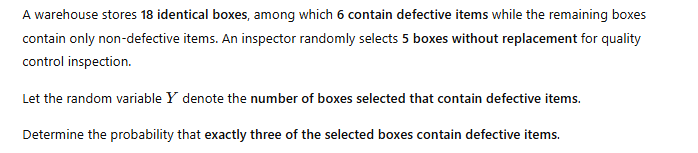
FIRST WRITE GIVENINFORMATION THENWHAT HAVE TO FIND AND THEN DEFINATION ORCONCEPT USED AND THEN STEP BY STEPSOLUTION WITHOUT MENTIONING STEP NUMBER AND AT LAST WRITE FINALANSWERS ONLY AS SUMMARY . ALSO MAKE SOLUTION WELL STRUCTUREDA warehouse stores 18 identical boxes, among which 6 contain defective items while the remaining boxes
contain only non-defective items. An inspector randomly selects 5 boxes without replacement for quality
control inspection.
Let the random variable Y denote the number of boxes selected that contain defective items.
Determine the probability that exactly three of the selected boxes contain defective items.
Question:
FIRST WRITE GIVENINFORMATION THENWHAT HAVE TO FIND AND THEN DEFINATION ORCONCEPT USED AND THEN STEP BY STEPSOLUTION WITHOUT MENTIONING STEP NUMBER AND AT LAST WRITE FINALANSWERS ONLY AS SUMMARY . ALSO MAKE SOLUTION WELL STRUCTUREDA warehouse stores 18 identical boxes, among which 6 contain defective items while the remaining boxes
contain only non-defective items. An inspector randomly selects 5 boxes without replacement for quality
control inspection.
Let the random variable Y denote the number of boxes selected that contain defective items.
Determine the probability that exactly three of the selected boxes contain defective items.
This is AI generated Response.
Asked by: nayan
Created at: 2026-03-07 11:09:48
Final Answer:
RenderedRaw Text
Did you like this answer?
# Given Information
- Total boxes in the warehouse: **18**
- Boxes containing defective items:6**
- containing non-defective items: **18 - 6 = 12**
- Number of boxes selected: **5 (without replacement)
- Random variable \( Y \): Number of boxes selected that contain defective items.
# What Have to Find
- Probability that **exactly three** of the selected boxes contain defective items, i.e., \( P(Y = 3) \).
# Definition or Concept Used
- **Hypergeometric Distribution**:
The probability of getting exactly \( k \) successes (defective boxes) in \( n \) draws, from a finite population of size \( N \) containing exactly \( K \) successes, without replacement, is given by:
\[
P(Y = k) = \frac{\binom{K}{k} \binom{N-K}{n-k}}{\binom{N}{n}}
\]
Where:
\( N = 18 \) (total boxes)
\( K = 6 \) (defective boxes)
\( n = 5 \) (boxes selected)
\( k = 3 \) (defective boxes selected)
# Step by Step Solution
First, plug the values into the formula:
\[
P(Y = 3) = \frac{\binom{6}{3} \binom{12}{2}}{\binom{18}{5}}
\]
Calculate each combination:
- \(\binom{6}{3} = \frac{6!}{3! \times 3!} = 20\)
- \(\binom{12}{2} = \frac{12!}{2! \times 10!} = 66\)
- \(\binom{18}{5} = \frac{18!}{5! \times 13!} = 8568\)
Multiply the numerators:
\[
20 \times 66 = 132
\]
Find the probability:
\[
P(Y = 3) = \frac{132}{8568}
\]
Simplify the fraction:
\[
\frac{132}{8568} = \frac{55}{357}
\]
# Final Answers Only as Summary
The probability that exactly three of the selected boxes contain defective items is \(\boxed{\dfrac{55}{357}}\).
Question:
Which of the following is a measure of central tendency? A
)
Range B
)
Variance C
)
Mean D
)
Standard deviation
This is AI generated Response.
Asked by: nayan
Created at: 2026-03-07 11:36:14
Final Answer:
RenderedRaw Text
Did you like this answer?
# Given Information
- Options provided:
A) Range
B) Variance
C) Mean
D) Standard deviation
# What Have to Find
- Identify which of the provided options is a measure of central tendency.
# Definition or Concept Used
- **Measure of Central Tendency**: Statistics that summarize or describe the center point of a dataset. Common measures include:
- Mean: The average of a set of values.
- Median: The middle value when data is ordered.
- Mode: The most frequently occurring value in a dataset.
# Step by Step Solution
Evaluate each option against the definition of central tendency:
- **Range**: Measures the spread of data, not central tendency.
- **Variance**: Measures how much the data varies from the mean, not central tendency.
- **Mean**: The average value of a dataset. This is a measure of central tendency.
- **Standard Deviation**: Measures the amount of variation or dispersion in a set of values, not central tendency.
# Final Answers Only as Summary
The measure of central tendency from the options is **C) Mean**.
Question:
EXPLAKION WHY OTHER OPTIONS ARE INCORRECT AND MAKE ANSWER WEELL EXPLAINED
This is AI generated Response.
Asked by: nayan
Created at: 2026-03-07 11:36:56
Final Answer:
RenderedRaw Text
Did you like this answer?
# Explanation of Incorrect Options
## A) Range
- **Definition**: The range is calculated as the difference between the maximum and minimum values in a dataset.
- **Reason for Incorrectness**: The range measures the spread or dispersion of data rather than its central value. It tells you how wide the data set is but does not indicate where the center lies.
## B) Variance
- **Definition**: Variance is a statistical measure that represents the degree to which each number in a set differs from the mean of the set.
- **Reason for Incorrectness**: Variance quantifies the extent of variation within a dataset. While it is a useful measure for understanding data distribution, it does not provide information about the central value itself.
## D) Standard Deviation
- **Definition**: Standard deviation is a measure of the amount of variation or dispersion in a set of values. It is the square root of variance.
- **Reason for Incorrectness**: Like variance, standard deviation focuses on the spread of data around the mean rather than identifying a central value. It indicates how much individual data points deviate from the mean.
# Summary of Correct Option
In contrast to the other options, the **Mean** is a definitive measure of central tendency, representing the average of all data points. It is the only option that directly summarizes the "center" of the dataset.
Question:
GENERATE IEN RMEO UNQIEU SOLUTION
This is AI generated Response.
Asked by: nayan
Created at: 2026-03-07 11:40:26
Final Answer:
RenderedRaw Text
Did you like this answer?
# Given Information
- Total boxes in the warehouse: **18**
- Boxes containing defective items: **6**
- Boxes containing non-defective items: **12** (calculated as \( 18 - 6 \))
- Number of boxes selected: **5** (without replacement)
- Random variable \( Y \): Number of boxes selected that contain defective items
# What Have to Find
- Probability that **exactly three** of the selected boxes contain defective items, denoted as \( P(Y = 3) \).
# Definition or Concept Used
- **Hypergeometric Distribution**: This distribution describes the probability of drawing a certain number of successes (defective boxes) in a specified number of draws from a finite population without replacement. The formula is:
\[
P(Y = k) = \frac{\binom{K}{k} \binom{N-K}{n-k}}{\binom{N}{n}}
\]
Where:
\( N = 18 \) (total boxes)
\( K = 6 \) (defective boxes)
\( n = 5 \) (boxes selected)
\( k = 3 \) (defective boxes selected)
# Step by Step Solution
Substituting the values into the hypergeometric distribution formula:
\[
P(Y = 3) = \frac{\binom{6}{3} \binom{12}{2}}{\binom{18}{5}}
\]
Calculating the combinations:
- For defective boxes:
\[
\binom{6}{3} = \frac{6!}{3! \times 3!} = 20
\]
- For non-defective boxes:
\[
\binom{12}{2} = \frac{12!}{2! \times 10!} = 66
\]
- Total combinations of selecting 5 boxes from 18:
\[
\binom{18}{5} = \frac{18!}{5! \times 13!} = 8568
\]
Now, multiply the combinations for the numerator:
\[
20 \times 66 = 132
\]
Calculating the probability:
\[
P(Y = 3) = \frac{132}{8568}
\]
Simplifying the fraction:
\[
\frac{132}{8568} = \frac{55}{357}
\]
# Final Answers Only as Summary
The probability that exactly three of the selected boxes contain defective items is \(\boxed{\dfrac{55}{357}}\).
Question:
.
Which of the following is a measure of central tendency? A
)
Range B
)
Variance C
)
Mean D
)
Standard deviation
This is AI generated Response.
Asked by: nayan
Created at: 2026-03-07 11:41:39
Final Answer:
RenderedRaw Text
Did you like this answer?
# Given Information
- Options provided:
A) Range
B) Variance
C) Mean
D) Standard deviation
# What Have to Find
- Identify which of the provided options is a measure of central tendency.
# Definition or Concept Used
- **Measure of Central Tendency**: Statistics that summarize or describe the center point of a dataset. Common measures include:
- **Mean**: The average of a set of values.
- **Median**: The middle value when data is ordered.
- **Mode**: The most frequently occurring value in a dataset.
# Step by Step Solution
Evaluate each option against the definition of central tendency:
- **A) Range**:
- **Definition**: The range is the difference between the maximum and minimum values in a dataset.
- **Reason for Incorrectness**: It measures the spread of data, not the center.
- **B) Variance**:
- **Definition**: Variance quantifies how much the data varies from the mean.
- **Reason for Incorrectness**: It indicates variation within the dataset, not its central value.
- **C) Mean**:
- **Definition**: The average of a dataset, calculated by summing all values and dividing by the count.
- **Reason for Correctness**: It is a primary measure of central tendency.
- **D) Standard Deviation**:
- **Definition**: A measure of the amount of variation or dispersion in a set of values.
- **Reason for Incorrectness**: It focuses on data spread rather than identifying a central value.
# Summary of Correct Option
The measure of central tendency from the options is **C) Mean**.
In contrast to the other options, the mean provides a direct summary of the dataset's center.
Question:
generate ie nmroe unqiue solution ion different wording
This is AI generated Response.
Asked by: nayan
Created at: 2026-03-07 11:44:45
Final Answer:
RenderedRaw Text
Did you like this answer?
# Given Information
- Total number of boxes: **18**
- Defective boxes: **6**
- Non-defective boxes: **12** (calculated as \( 18 - 6 \))
- Boxes selected for inspection: **5** (without replacement)
- Random variable \( Y \): Number of defective boxes selected
# What Needs to Be Determined
- Calculate the probability that exactly **three** of the selected boxes have defective items, represented as \( P(Y = 3) \).
# Definition or Concept Utilized
- **Hypergeometric Distribution**: This distribution is used to determine the probability of obtaining a specified number of successes (defective boxes) in a certain number of draws from a finite population without replacement. The formula is:
\[
P(Y = k) = \frac{\binom{K}{k} \binom{N-K}{n-k}}{\binom{N}{n}}
\]
Where:
\( N = 18 \) (total boxes)
\( K = 6 \) (defective boxes)
\( n = 5 \) (boxes drawn)
\( k = 3 \) (defective boxes drawn)
# Detailed Solution Process
Start by substituting the values into the hypergeometric formula:
\[
P(Y = 3) = \frac{\binom{6}{3} \binom{12}{2}}{\binom{18}{5}}
\]
Calculate each combination:
- For defective boxes:
\[
\binom{6}{3} = \frac{6!}{3! \times 3!} = 20
\]
- For non-defective boxes:
\[
\binom{12}{2} = \frac{12!}{2! \times 10!} = 66
\]
- Total combinations for selecting 5 boxes from 18:
\[
\binom{18}{5} = \frac{18!}{5! \times 13!} = 8568
\]
Next, multiply the combinations in the numerator:
\[
20 \times 66 = 132
\]
Now, calculate the probability:
\[
P(Y = 3) = \frac{132}{8568}
\]
Finally, simplify the fraction:
\[
\frac{132}{8568} = \frac{55}{357}
\]
# Final Answer Summary
The probability that exactly three of the selected boxes contain defective items is \(\boxed{\dfrac{55}{357}}\).
---
# Identification of Measure of Central Tendency
## Given Options
- A) Range
- B) Variance
- C) Mean
- D) Standard Deviation
## Objective
- Determine which of the options represents a measure of central tendency.
## Definition or Concept Employed
- **Measures of Central Tendency**: Statistics that describe the center or typical value of a dataset, including:
- **Mean**: The arithmetic average of a set of numbers.
- **Median**: The middle value when the data are arranged in order.
- **Mode**: The value that appears most frequently in a dataset.
## Evaluation of Each Option
- **A) Range**:
- **Definition**: The range is the difference between the largest and smallest values in a dataset.
- **Reason for Incorrectness**: It reflects the spread of data rather than indicating a central location.
- **B) Variance**:
- **Definition**: Variance measures how much individual data points differ from the mean.
- **Reason for Incorrectness**: While informative about data distribution, it does not convey the dataset's center.
- **C) Mean**:
- **Definition**: The mean is calculated by summing all data points and dividing by the count of those points.
- **Reason for Correctness**: It serves as a primary indicator of central tendency.
- **D) Standard Deviation**:
- **Definition**: This statistic indicates the amount of variation or dispersion in a set of values.
- **Reason for Incorrectness**: It focuses on how spread out the data points are, not on the center value.
## Summary of Correct Option
From the options provided, the measure of central tendency is **C) Mean**.
Unlike the other options, the mean accurately represents the average position of the dataset.
Question:
Question: In a class of
8
0
0
students, Anjali scored better than
7
6
0
students. What is her percentile rank?
This is AI generated Response.
Asked by: nayan
Created at: 2026-03-07 12:29:44
Final Answer:
RenderedRaw Text
Did you like this answer?
# Given Information
- Total number of students in the class: **800**
- Number of students Anjali scored better than: **760**
# What Have to Find
- Calculate Anjali's **percentile rank**.
# Definition or Concept Used
- **Percentile Rank**: The percentile rank of a score is the percentage of scores in its frequency distribution that are equal to or below it. It can be calculated using the formula:
\[
\text{Percentile Rank} = \left( \frac{\text{Number of students below the score}}{\text{Total number of students}} \right) \times 100
\]
# Step by Step Solution
Identify the number of students below Anjali's score:
- Since Anjali scored better than 760 students, the number of students below her score is:
\[
800 - 760 = 40
\]
Substituting into the percentile rank formula:
\[
\text{Percentile Rank} = \left( \frac{760}{800} \right) \times 100
\]
Calculating the percentile rank:
\[
\text{Percentile Rank} = 0.95 \times 100 = 95
\]
# Final Answers Only as Summary
Anjali's percentile rank is \(\boxed{95}\).
Question:
GENERATE EIO MROE NIQUE SOLUTION IN DFFERENT WORDING
This is AI generated Response.
Asked by: nayan
Created at: 2026-03-07 12:30:30
Final Answer:
RenderedRaw Text
Did you like this answer?
# Given Information
- Total students in the class: **800**
- Students Anjali scored better than: **760**
# Objective
- Determine Anjali's **percentile rank**.
# Definition or Concept Utilized
- **Percentile Rank**: This metric indicates the percentage of scores in a distribution that fall below a particular score. It can be calculated with the following formula:
\[
\text{Percentile Rank} = \left( \frac{\text{Number of students below the score}}{\text{Total number of students}} \right) \times 100
\]
# Detailed Solution Steps
First, calculate the number of students who scored lower than Anjali:
- Since she performed better than 760 students, the count of students below her is:
\[
800 - 760 = 40
\]
Next, apply the values to the percentile rank formula:
\[
\text{Percentile Rank} = \left( \frac{760}{800} \right) \times 100
\]
Now, perform the calculation:
\[
\text{Percentile Rank} = 0.95 \times 100 = 95
\]
# Final Answer Summary
Anjali's percentile rank is \(\boxed{95}\).
Question:
generat eon emroe different wording solution
This is AI generated Response.
Asked by: nayan
Created at: 2026-03-07 12:32:35
Final Answer:
RenderedRaw Text
Did you like this answer?
# Given Information
- Total number of students in the class: **800**
- Number of students Anjali outperformed: **760**
# Objective
- Find Anjali's **percentile rank**.
# Definition or Concept Used
- **Percentile Rank**: This is a measure that indicates the percentage of scores in a distribution that are equal to or below a specific score. The formula for calculating percentile rank is:
\[
\text{Percentile Rank} = \left( \frac{\text{Number of students below the score}}{\text{Total number of students}} \right) \times 100
\]
# Solution Process
First, determine how many students scored lower than Anjali:
- Since Anjali scored better than 760 students, the number of students below her score can be calculated as:
\[
800 - 760 = 40
\]
Now, substitute the number of students below her into the percentile rank formula:
\[
\text{Percentile Rank} = \left( \frac{760}{800} \right) \times 100
\]
Perform the calculation:
\[
\text{Percentile Rank} = 0.95 \times 100 = 95
\]
# Final Answer Summary
Anjali's percentile rank is \(\boxed{95}\).
Question:
Which of the following is a measure of central tendency? A
)
Range B
)
Variance C
)
Mean D
)
Standard deviation
This is AI generated Response.
Asked by: nayan
Created at: 2026-03-07 12:34:48
Final Answer:
RenderedRaw Text
Did you like this answer?
# Given Information
- Options provided:
A) Range
B) Variance
C) Mean
D) Standard Deviation
# What Have to Find
- Identify which of the provided options is a measure of central tendency.
# Definition or Concept Used
- **Measure of Central Tendency**: Statistics that summarize or describe the center point of a dataset. Common measures include:
- **Mean**: The average of a set of values.
- **Median**: The middle value when data is ordered.
- **Mode**: The most frequently occurring value in a dataset.
# Evaluation of Each Option
- **A) Range**:
- **Definition**: The range is the difference between the maximum and minimum values in a dataset.
- **Reason for Incorrectness**: This statistic measures the spread of data rather than its center.
- **B) Variance**:
- **Definition**: Variance quantifies how much the values in a dataset differ from the mean.
- **Reason for Incorrectness**: Variance indicates dispersion within the dataset, not its central value.
- **C) Mean**:
- **Definition**: The mean is calculated by summing all values in a dataset and dividing by the number of values.
- **Reason for Correctness**: It is a fundamental measure of central tendency, summarizing the average value.
- **D) Standard Deviation**:
- **Definition**: Standard deviation measures the amount of variation or dispersion in a set of values.
- **Reason for Incorrectness**: Like variance, it focuses on the spread rather than identifying a central point.
# Summary of Correct Option
The measure of central tendency from the options is **C) Mean**.
The mean is the only option that directly summarizes the average or center of the dataset, distinguishing it from the other statistics provided.
Question:
generate o nemroe unqiue solution
This is AI generated Response.
Asked by: nayan
Created at: 2026-03-07 12:36:57
Final Answer:
RenderedRaw Text
Did you like this answer?
# Given Information
- Options provided:
A) Range
B) Variance
C) Mean
D) Standard Deviation
# What Needs to Be Determined
- Identify which of the options represents a measure of central tendency.
# Definition or Concept Used
- **Measures of Central Tendency**: These are statistical measures that describe the center or typical value within a dataset. Common examples include:
- **Mean**: The arithmetic average of a collection of values.
- **Median**: The middle value when the data is sorted in ascending or descending order.
- **Mode**: The value that appears most frequently in a dataset.
# Analysis of Each Option
- **A) Range**:
- **Definition**: The range is calculated as the difference between the highest and lowest values in a dataset.
- **Why Incorrect**: It provides information about the dispersion of data, not the center.
- **B) Variance**:
- **Definition**: Variance measures how much the values in a dataset differ from the mean.
- **Why Incorrect**: This statistic tells us about variability but does not indicate a central value.
- **C) Mean**:
- **Definition**: The mean is obtained by adding all the values in a dataset and dividing by the number of values.
- **Why Correct**: It serves as the primary measure of central tendency, summarizing the average of the dataset.
- **D) Standard Deviation**:
- **Definition**: Standard deviation measures the extent of variation or dispersion in a set of values.
- **Why Incorrect**: Similar to variance, it focuses on spread rather than identifying a central point.
# Summary of Correct Option
From the provided options, the measure of central tendency is **C) Mean**.
The mean effectively represents the average value of the dataset, distinguishing it from the other options which deal with variability or spread.
Question:
Question: Two groups have means
1
3
5
and
1
0
5
with a pooled standard deviation of
3
0
.
Calculate Cohen's d
.
This is AI generated Response.
Asked by: nayan
Created at: 2026-03-07 12:39:12
Final Answer:
RenderedRaw Text
Did you like this answer?
# Given Information
- Mean of Group 1: \( \mu_1 = 135 \)
- Mean of Group 2: \( \mu_2 = 105 \)
- Pooled standard deviation: \( s_p = 30 \)
# What Needs to Be Found
- Calculate **Cohen's d**.
# Definition or Concept Used
- **Cohen's d**: A measure of effect size that indicates the standardized difference between two means. It is calculated using the formula:
\[
d = \frac{\mu_1 - \mu_2}{s_p}
\]
# Step by Step Solution
Substitute the values into the Cohen's d formula:
\[
d = \frac{135 - 105}{30}
\]
Calculate the difference in means:
\[
d = \frac{30}{30}
\]
Now compute the value of \( d \):
\[
d = 1
\]
# Final Answer Summary
Cohen's d is \(\boxed{1}\).
Question:
generate oen mroe unique different wording solution
This is AI generated Response.
Asked by: nayan
Created at: 2026-03-07 12:42:20
Final Answer:
RenderedRaw Text
Did you like this answer?
# Given Information
- Mean of Group 1: \( \mu_1 = 135 \)
- Mean of Group 2: \( \mu_2 = 105 \)
- Pooled standard deviation: \( s_p = 30 \)
# Objective
- Calculate **Cohen's d**.
# Definition or Concept Used
- **Cohen's d**: This statistic measures the effect size, indicating the standardized difference between two group means. The formula for Cohen's d is:
\[
d = \frac{\mu_1 - \mu_2}{s_p}
\]
# Calculation Process
Begin by substituting the known values into the Cohen's d formula:
\[
d = \frac{135 - 105}{30}
\]
Calculate the difference between the two means:
\[
d = \frac{30}{30}
\]
Now, compute the value of \( d \):
\[
d = 1
\]
# Final Answer Summary
Cohen's d is \(\boxed{1}\).
Question:
generate oen mroe unqieu solutino in different wording and keep answer well explained also show frmula when put values also
This is AI generated Response.
Asked by: nayan
Created at: 2026-03-07 12:43:58
Final Answer:
RenderedRaw Text
Did you like this answer?
# Given Information
- Mean of Group 1: \( \mu_1 = 135 \)
- Mean of Group 2: \( \mu_2 = 105 \)
- Pooled standard deviation: \( s_p = 30 \)
# Objective
- Determine **Cohen's d**, which reflects the effect size between the two groups.
# Definition or Concept Used
- **Cohen's d**: This metric quantifies the standardized difference between two means, providing insight into the effect size. The formula for calculating Cohen's d is:
\[
d = \frac{\mu_1 - \mu_2}{s_p}
\]
# Calculation Process
1. **Substituting Values into the Formula**:
Using the means and pooled standard deviation, insert the values into the formula:
\[
d = \frac{135 - 105}{30}
\]
2. **Calculate the Difference Between the Means**:
First, compute the difference in means:
\[
d = \frac{30}{30}
\]
3. **Final Calculation**:
Now, simplify the expression:
\[
d = 1
\]
# Final Answer Summary
Cohen's d is \(\boxed{1}\).
This indicates a large effect size, suggesting a significant difference between the two group means, with the mean of Group 1 being one standard deviation higher than the mean of Group 2.
Question:
Which of the following is a measure of central tendency? A
)
Range B
)
Variance C
)
Mean D
)
Standard deviation
GIVE WELL EXPLAINED SOLUTION
This is AI generated Response.
Asked by: nayan
Created at: 2026-03-07 13:48:37
Final Answer:
RenderedRaw Text
Did you like this answer?
# Given Information
- Options provided:
A) Range
B) Variance
C) Mean
D) Standard Deviation
# What Needs to Be Determined
- Identify which of the provided options represents a measure of central tendency.
# Definition or Concept Used
- **Measures of Central Tendency**: These are statistical metrics that describe the center or typical value of a dataset. Common measures include:
- **Mean**: The average of a set of values, calculated by summing all values and dividing by the count of values.
- **Median**: The middle value in an ordered dataset.
- **Mode**: The most frequently occurring value in a dataset.
# Analysis of Each Option
- **A) Range**:
- **Definition**: The range is the difference between the maximum and minimum values in a dataset.
- **Reason for Incorrectness**: It measures the spread or dispersion of data rather than indicating a central value. As such, it does not provide information about where most values lie.
- **B) Variance**:
- **Definition**: Variance quantifies how much the values in a dataset differ from the mean.
- **Reason for Incorrectness**: While variance is useful for understanding the variability of data, it does not give a central point or average of the dataset. It simply indicates how spread out the values are.
- **C) Mean**:
- **Definition**: The mean is calculated by adding all the values in a dataset and dividing by the number of values:
\[
\text{Mean} = \frac{\sum x_i}{n}
\]
- **Reason for Correctness**: The mean is a fundamental measure of central tendency, summarizing the average value of the dataset. It provides a direct representation of the "center" of the data.
- **D) Standard Deviation**:
- **Definition**: Standard deviation measures the amount of variation or dispersion in a set of values.
- **Reason for Incorrectness**: Like variance, standard deviation focuses on the spread of data points around the mean rather than providing a central value.
# Summary of Correct Option
From the analysis of the options, the measure of central tendency is **C) Mean**. The mean serves as a crucial statistical measure that effectively summarizes the average value in a dataset, distinguishing it from the other options which primarily deal with variability or dispersion.
Question:
2
.
If two events cannot occur at the same time, they are called: A
)
Independent events B
)
Mutually exclusive events C
)
Complementary events D
)
Random events
This is AI generated Response.
Asked by: nayan
Created at: 2026-03-07 13:55:04
Final Answer:
RenderedRaw Text
Did you like this answer?
# Given Information
- Options provided:
A) Independent events
B) Mutually exclusive events
C) Complementary events
D) Random events
# What Needs to Be Determined
- Identify the term that describes two events that cannot occur simultaneously.
# Definition or Concept Used
- **Mutually Exclusive Events**: Two events are considered mutually exclusive if the occurrence of one event excludes the possibility of the other event occurring at the same time. For example, when flipping a coin, getting heads and tails are mutually exclusive events because both cannot happen in a single flip.
# Analysis of Each Option
- **A) Independent Events**:
- **Definition**: Independent events are those whose occurrence does not affect the probability of the occurrence of the other event. For example, rolling a die and flipping a coin are independent events.
- **Reason for Incorrectness**: The definition does not imply that the events cannot occur simultaneously; they can occur together without interference.
- **B) Mutually Exclusive Events**:
- **Definition**: As defined earlier, mutually exclusive events cannot occur at the same time. For example, if one event happens, the other cannot.
- **Reason for Correctness**: This is the correct definition for events that cannot occur together.
- **C) Complementary Events**:
- **Definition**: Complementary events are pairs of events where one event represents all outcomes not covered by the other event. For example, the event of getting a heads and the event of not getting a heads are complementary.
- **Reason for Incorrectness**: While complementary events cover all possible outcomes, they do not necessarily exclude each other in the way that mutually exclusive events do.
- **D) Random Events**:
- **Definition**: Random events are those whose outcomes are determined by chance. They can occur without any specific pattern.
- **Reason for Incorrectness**: This term does not specifically refer to the ability or inability of events to occur simultaneously.
# Summary of Correct Option
The correct answer is **B) Mutually exclusive events**. This term accurately describes events that cannot occur at the same time, distinguishing them from independent, complementary, and random events.
Question:
1
.
Statistics is mainly concerned with: A
)
Exact values B
)
Collection, analysis, and interpretation of data C
)
Guessing numbers D
)
Solving algebraic equations
This is AI generated Response.
Asked by: nayan
Created at: 2026-03-07 13:56:59
Final Answer:
RenderedRaw Text
Did you like this answer?
# Given Information
- Options provided:
A) Exact values
B) Collection, analysis, and interpretation of data
C) Guessing numbers
D) Solving algebraic equations
# What Needs to Be Determined
- Identify what statistics is primarily concerned with.
# Definition or Concept Used
- **Statistics**: This field involves the collection, analysis, interpretation, presentation, and organization of data. It provides tools for understanding and making inferences about data, drawing conclusions, and making decisions based on data analysis.
# Analysis of Each Option
- **A) Exact Values**:
- **Definition**: This suggests a focus on precise numerical outcomes.
- **Reason for Incorrectness**: Statistics is not solely about exact values; it encompasses variability, trends, and patterns in data rather than just precise figures.
- **B) Collection, Analysis, and Interpretation of Data**:
- **Definition**: This option covers the essential functions of statistics, which include gathering data, performing analyses, and drawing conclusions.
- **Reason for Correctness**: This is the correct definition of statistics, as it accurately reflects the discipline's comprehensive approach to understanding data.
- **C) Guessing Numbers**:
- **Definition**: This implies making random or uneducated estimates.
- **Reason for Incorrectness**: Statistics is based on methods and analysis rather than random guessing. It employs systematic techniques to draw conclusions.
- **D) Solving Algebraic Equations**:
- **Definition**: This refers to a mathematical process of finding unknown values.
- **Reason for Incorrectness**: While statistics may involve some mathematical concepts, its main focus lies in data rather than solely solving equations.
# Summary of Correct Option
The correct answer is **B) Collection, analysis, and interpretation of data**. This option encapsulates the core activities and objectives of statistics, highlighting its role in understanding and making sense of data.
Question:
.
If two events cannot occur at the same time, they are called: A
)
Independent events B
)
Mutually exclusive events C
)
Complementary events D
)
Random events
egenrate uniqwue solution in different wording
This is AI generated Response.
Asked by: nayan
Created at: 2026-03-07 14:43:11
Final Answer:
RenderedRaw Text
Did you like this answer?
# Given Information
- Options provided:
A) Independent events
B) Mutually exclusive events
C) Complementary events
D) Random events
# Objective
- Determine the correct term that describes two events that cannot happen simultaneously.
# Definition or Concept Used
- **Mutually Exclusive Events**: These are events where the occurrence of one event prevents the occurrence of the other. For instance, when rolling a die, the outcomes of rolling a 3 and rolling a 5 are mutually exclusive, as both cannot happen at once.
# Evaluation of Each Option
- **A) Independent Events**:
- **Definition**: These events do not influence each other's probabilities; the occurrence of one event has no effect on the other. For example, flipping a coin and rolling a die are independent events.
- **Reason for Incorrectness**: This term does not imply that the events cannot occur together; they can occur simultaneously without any impact on each other.
- **B) Mutually Exclusive Events**:
- **Definition**: As previously defined, mutually exclusive events cannot occur at the same time. If one event occurs, the other must not.
- **Reason for Correctness**: This accurately captures the essence of events that cannot happen together.
- **C) Complementary Events**:
- **Definition**: Complementary events encompass all possible outcomes, where the occurrence of one event means the other cannot occur. For instance, getting heads and not getting heads when flipping a coin are complementary.
- **Reason for Incorrectness**: Although they cover all outcomes, complementary events are not the same as mutually exclusive events, as they can be considered as a pair of events that are not independent.
- **D) Random Events**:
- **Definition**: Random events result from chance and can occur unpredictably.
- **Reason for Incorrectness**: This term does not specifically address whether two events can happen at the same time.
# Summary of Correct Option
The correct answer is **B) Mutually exclusive events**. This term specifically describes events that cannot occur simultaneously, distinguishing them from independent, complementary, and random events.
Question:
A random variable that takes only finite or countable values is called: A
)
Continuous random variable B
)
Discrete random variable C
)
Constant variable D
)
Independent variable
This is AI generated Response.
Asked by: nayan
Created at: 2026-03-07 14:44:53
Final Answer:
RenderedRaw Text
Did you like this answer?
# Given Information
- Options provided:
A) Continuous random variable
B) Discrete random variable
C) Constant variable
D) Independent variable
# What Needs to Be Determined
- Identify the term that describes a random variable that can take only finite or countable values.
# Definition or Concept Used
- **Discrete Random Variable**: A discrete random variable is one that can take on a countable number of distinct values. This includes integers or a finite set of values, such as the number of students in a class or the outcome of rolling a die.
# Analysis of Each Option
- **A) Continuous Random Variable**:
- **Definition**: A continuous random variable can take an infinite number of values within a given range. Examples include height, weight, or time.
- **Reason for Incorrectness**: This option refers to variables that can assume any value within a continuum, not finite or countable values.
- **B) Discrete Random Variable**:
- **Definition**: As defined earlier, a discrete random variable can assume only specific, separate values. Examples include the number of cars in a parking lot or the result of a dice roll.
- **Reason for Correctness**: This accurately describes a random variable that takes finite or countable values.
- **C) Constant Variable**:
- **Definition**: A constant variable does not change; it has a fixed value throughout an analysis.
- **Reason for Incorrectness**: This term does not pertain to randomness or variability, as it refers to an unchanging quantity.
- **D) Independent Variable**:
- **Definition**: An independent variable is a variable that is manipulated or changed in an experiment to observe its effect on a dependent variable.
- **Reason for Incorrectness**: This term is related to experimental design, not to the characteristics of random variables.
# Summary of Correct Option
The correct answer is **B) Discrete random variable**. This term specifically identifies a random variable that can take on finite or countable values, distinguishing it from continuous, constant, and independent variables.
Question:
A variable that can take any value within a range is called: A
)
Continuous random variable B
)
Discrete random variable C
)
Binomial variable D
)
Poisson variable
give answer well explained woth examples
This is AI generated Response.
Asked by: nayan
Created at: 2026-03-07 14:47:05
Final Answer:
RenderedRaw Text
Did you like this answer?
# Given Information
- Options provided:
A) Continuous random variable
B) Discrete random variable
C) Binomial variable
D) Poisson variable
# What Needs to Be Determined
- Identify the term that describes a variable capable of taking any value within a specified range.
# Definition or Concept Used
- **Continuous Random Variable**: A continuous random variable is one that can take any value within a given interval or range. This means it can assume an infinite number of values. Examples include measurements like height, weight, temperature, or time.
# Analysis of Each Option
- **A) Continuous Random Variable**:
- **Definition**: As stated, a continuous random variable can take any value within a range. For example, the height of individuals can be 170.5 cm, 170.55 cm, or any value within a realistic range.
- **Reason for Correctness**: This option correctly identifies a variable that can assume any value in a continuum.
- **B) Discrete Random Variable**:
- **Definition**: A discrete random variable can only take specific, distinct values. For instance, the number of students in a classroom (which can only be whole numbers: 20, 21, etc.) is an example of a discrete variable.
- **Reason for Incorrectness**: This does not fit the description of variables that can take any value within a range.
- **C) Binomial Variable**:
- **Definition**: A binomial variable is associated with a binomial distribution, which arises from a scenario with two possible outcomes (success or failure) across a fixed number of trials. An example is flipping a coin 10 times and counting the number of heads.
- **Reason for Incorrectness**: This term specifically refers to a type of discrete random variable and does not pertain to continuous values.
- **D) Poisson Variable**:
- **Definition**: A Poisson variable is used in scenarios where events occur independently over a fixed interval or space, such as the number of phone calls received at a call center in an hour. This is also a type of discrete random variable.
- **Reason for Incorrectness**: Like the binomial variable, it is not relevant to the definition of a variable that can take any value within a range.
# Summary of Correct Option
The correct answer is **A) Continuous random variable**. This term accurately describes a variable that can assume any value within a specified range, making it distinct from discrete, binomial, and Poisson variables. Examples of continuous random variables include measurements such as weight (e.g., 65.3 kg) and temperature (e.g., 22.7°C).
VIPSolutions focuses on clear, step‑by‑step explanations so you can learn quickly. Whether you need an AI‑generated walkthrough or a short hint to get unstuck, each solution is organized for fast reading and easy review later.
Search similar questions, compare approaches, and bookmark the best answers for revision. Our goal is simple: quick, reliable study help that feels natural—not noisy.
 VIPSolutions
 A warehouse stores 18 identical boxes, among which 6 contain defective items while the remaining boxes
contain only non-defective items. An inspector randomly selects 5 boxes without replacement for quality
control inspection.
Let the random variable Y denote the number of boxes selected that contain defective items.
Determine the probability that exactly three of the selected boxes contain defective items.
A warehouse stores 18 identical boxes, among which 6 contain defective items while the remaining boxes
contain only non-defective items. An inspector randomly selects 5 boxes without replacement for quality
control inspection.
Let the random variable Y denote the number of boxes selected that contain defective items.
Determine the probability that exactly three of the selected boxes contain defective items.