Explain like I am a beginner and do not know anything about the topic:
Act like a helpful tutor and exlain me :
Give step-by-step solution with explanation and final answer:
FIRST WRITE GIVENINFORMATION THENWHAT HAVE TO FIND AND THEN DEFINATION ORCONCEPT USED AND THEN STEP BY STEPSOLUTION WITHOUT MENTIONING STEP NUMBER AND AT LAST WRITE FINALANSWERS ONLY AS SUMMARY . ALSO MAKE SOLUTION WELL STRUCTURED
also do not mention step number in solution.
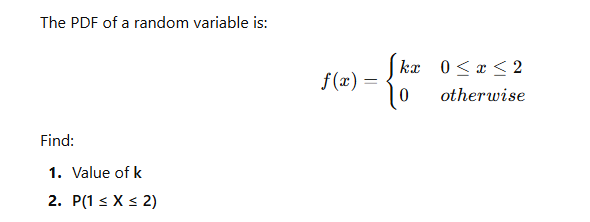
do not make too much bullet points.The PDF of a random variable is:
kr 0
Question:
Explain like I am a beginner and do not know anything about the topic:
Act like a helpful tutor and exlain me :
Give step-by-step solution with explanation and final answer:
FIRST WRITE GIVENINFORMATION THENWHAT HAVE TO FIND AND THEN DEFINATION ORCONCEPT USED AND THEN STEP BY STEPSOLUTION WITHOUT MENTIONING STEP NUMBER AND AT LAST WRITE FINALANSWERS ONLY AS SUMMARY . ALSO MAKE SOLUTION WELL STRUCTURED
also do not mention step number in solution.
do not make too much bullet points.The PDF of a random variable is:
kr 0
This is AI generated Response.
Asked by: nayan
Created at: 2026-03-09 12:37:50
Final Answer:
RenderedRaw Text
Did you like this answer?
## Given Information
The probability density function (PDF) of a random variable is\[
f(x) =
\begin{cases}
kx & \text{if } \leq x \leq 2 \\
& \text{otherwise}
\end{cases}
\]
We are asked to find:
1. The value of \( k \)
2. \( P(1 \leq X \leq 2) \)
---
## What To Find
- The value of \( k \) so that \( f(x) \) is a valid PDF.
- The probability that \( X \) lies between 1 and 2.
---
## Definition or Concept Used
A probability density function must satisfy:
1. \( f(x) \geq \) for all \( x \)
2. The total area under the curve must be 1:
\(\int_{-\infty}^{\infty} f(x) \, dx = 1\)
To find the probability that \( X \) lies within an interval \([a, b]\), you integrate the PDF over that interval:
\[
P(a \leq X \leq b) = \int_{a}^{b} f(x) \, dx
\]
---
## Step-by-Step Solution
To find \( k \), use the rule that the total area under the PDF must be 1. Since \( f(x) = \) outside \( [, 2] \), integrate from to 2:
\[
\int_{}^{2} kx \, dx = 1
\]
Calculate the integral:
\[
k \int_{}^{2} x \, dx = k \left[ \frac{x^2}{2} \right]_{}^{2}
\]
Substitute the limits:
\[
k \left( \frac{2^2}{2} - \frac{^2}{2} \right) = k \left( \frac{4}{2} \right) = k \times 2
\]
Set equal to 1:
\[
k \times 2 = 1 \implies k = \frac{1}{2}
\]
Now, to find \( P(1 \leq X \leq 2) \):
\[
P(1 \leq X \leq 2) = \int_{1}^{2} f(x) dx = \int_{1}^{2} kx \, dx
\]
Substitute \( k = \frac{1}{2} \):
\[
\int_{1}^{2} \frac{1}{2}x \, dx = \frac{1}{2} \int_{1}^{2} x \, dx = \frac{1}{2} \left[ \frac{x^2}{2} \right]_{1}^{2}
\]
Calculate the values:
\[
\frac{1}{2} \left( \frac{2^2}{2} - \frac{1^2}{2} \right) = \frac{1}{2} \left( \frac{4}{2} - \frac{1}{2} \right) = \frac{1}{2} \left( 2 - .5 \right) = \frac{1}{2} \times 1.5 = .75
\]
---
## Summary (Final Answers)
- The value of \( k \) is \( \frac{1}{2} \).
- \( P(1 \leq X \leq 2) = .75 \).
Question:
make soluti9no well structured
This is AI generated Response.
Asked by: nayan
Created at: 2026-03-09 12:38:39
Final Answer:
RenderedRaw Text
Did you like this answer?
# Solution to the Problem
## Given Information
The probability density function (PDF) of a random variable is defined as:
\[
f(x) =
\begin{cases}
kx & \text{if } 0 < x < 2 \\
0 & \text{otherwise}
\end{cases}
\]
We need to find:
1. The value of \( k \)
2. The probability \( P(1 \leq X \leq 2) \)
---
## What To Find
- Determine the constant \( k \) such that \( f(x) \) is a valid PDF.
- Calculate the probability that \( X \) falls within the interval from 1 to 2.
---
## Definition or Concept Used
A probability density function must adhere to the following rules:
1. \( f(x) \geq 0 \) for all \( x \)
2. The total area under the PDF must equal 1:
\[
\int_{-\infty}^{\infty} f(x) \, dx = 1
\]
To find the probability that \( X \) lies within an interval \([a, b]\), use:
\[
P(a \leq X \leq b) = \int_{a}^{b} f(x) \, dx
\]
---
## Solution Steps
To find the value of \( k \), we need to ensure that the total area under the PDF equals 1. Given that \( f(x) = kx \) for \( 0 < x < 2 \), we compute the integral:
\[
\int_0^2 kx \, dx = 1
\]
Calculate the integral:
\[
k \int_0^2 x \, dx = k \left[ \frac{x^2}{2} \right]_0^2
\]
Evaluate the limits:
\[
k \left( \frac{2^2}{2} - \frac{0^2}{2} \right) = k \left( \frac{4}{2} \right) = k \times 2
\]
Set this equal to 1:
\[
k \times 2 = 1 \implies k = \frac{1}{2}
\]
Next, to find \( P(1 \leq X \leq 2) \):
\[
P(1 \leq X \leq 2) = \int_{1}^{2} f(x) \, dx = \int_{1}^{2} kx \, dx
\]
Substituting \( k = \frac{1}{2} \):
\[
P(1 \leq X \leq 2) = \int_{1}^{2} \frac{1}{2} x \, dx = \frac{1}{2} \int_{1}^{2} x \, dx
\]
Calculate the integral:
\[
= \frac{1}{2} \left[ \frac{x^2}{2} \right]_{1}^{2}
\]
Evaluate the limits:
\[
= \frac{1}{2} \left( \frac{2^2}{2} - \frac{1^2}{2} \right) = \frac{1}{2} \left( \frac{4}{2} - \frac{1}{2} \right) = \frac{1}{2} \left( 2 - 0.5 \right) = \frac{1}{2} \times 1.5 = 0.75
\]
---
## Summary (Final Answers)
- The value of \( k \) is \( \frac{1}{2} \).
- \( P(1 \leq X \leq 2) = 0.75 \).
Question:
genrate oen mroe unqieu and differnt wording solution
This is AI generated Response.
Asked by: nayan
Created at: 2026-03-09 12:55:06
Final Answer:
RenderedRaw Text
Did you like this answer?
# Solution to the Problem
## Given Information
We are provided with the probability density function (PDF) for a random variable, which is defined as:
\[
f(x) =
\begin{cases}
kx & \text{if } 0 < x < 2 \\
0 & \text{otherwise}
\end{cases}
\]
We need to determine:
1. The constant \( k \)
2. The probability \( P(1 \leq X \leq 2) \)
---
## What To Find
- Find the value of \( k \) so that \( f(x) \) represents a valid probability density function.
- Calculate the probability that the random variable \( X \) lies within the interval from 1 to 2.
---
## Definition or Concept Used
A valid probability density function must satisfy the following conditions:
1. \( f(x) \geq 0 \) for all \( x \)
2. The total area under the PDF must equal 1:
\[
\int_{-\infty}^{\infty} f(x) \, dx = 1
\]
To find the probability of \( X \) being in the interval \([a, b]\), use the formula:
\[
P(a \leq X \leq b) = \int_{a}^{b} f(x) \, dx
\]
---
## Solution Steps
To compute \( k \), we start by ensuring that the total area under the PDF equals 1. Since \( f(x) = kx \) is applicable for \( 0 < x < 2 \), we integrate:
\[
\int_0^2 kx \, dx = 1
\]
Calculating the integral yields:
\[
k \int_0^2 x \, dx = k \left[ \frac{x^2}{2} \right]_0^2
\]
Evaluating the limits gives:
\[
k \left( \frac{2^2}{2} - \frac{0^2}{2} \right) = k \left( \frac{4}{2} \right) = k \times 2
\]
Setting the equation equal to 1:
\[
k \times 2 = 1 \implies k = \frac{1}{2}
\]
Next, we find \( P(1 \leq X \leq 2) \):
\[
P(1 \leq X \leq 2) = \int_{1}^{2} f(x) \, dx = \int_{1}^{2} kx \, dx
\]
Substituting the value of \( k \):
\[
P(1 \leq X \leq 2) = \int_{1}^{2} \frac{1}{2} x \, dx = \frac{1}{2} \int_{1}^{2} x \, dx
\]
Calculating the integral:
\[
= \frac{1}{2} \left[ \frac{x^2}{2} \right]_{1}^{2}
\]
Evaluating this results in:
\[
= \frac{1}{2} \left( \frac{2^2}{2} - \frac{1^2}{2} \right) = \frac{1}{2} \left( \frac{4}{2} - \frac{1}{2} \right) = \frac{1}{2} \left( 2 - 0.5 \right) = \frac{1}{2} \times 1.5 = 0.75
\]
---
## Summary (Final Answers)
- The value of \( k \) is \( \frac{1}{2} \).
- The probability \( P(1 \leq X \leq 2) = 0.75 \).
Question:
generate oe nrmeo solution
This is AI generated Response.
Asked by: nayan
Created at: 2026-03-09 12:58:44
Final Answer:
RenderedRaw Text
Did you like this answer?
# Solution to the Problem
## Given Information
The probability density function (PDF) for a random variable is expressed as:
\[
f(x) =
\begin{cases}
kx & \text{if } 0 < x < 2 \\
0 & \text{otherwise}
\end{cases}
\]
We need to determine:
1. The value of \( k \)
2. The probability \( P(1 \leq X \leq 2) \)
---
## What To Find
- Calculate the value of \( k \) to ensure \( f(x) \) is a valid PDF.
- Determine the probability that \( X \) falls within the range from 1 to 2.
---
## Definition or Concept Used
A valid probability density function must meet these criteria:
1. The function must be non-negative: \( f(x) \geq 0 \) for all \( x \).
2. The total area under the PDF must equal 1:
\[
\int_{-\infty}^{\infty} f(x) \, dx = 1
\]
To find the probability of \( X \) being in the interval \([a, b]\), the formula is:
\[
P(a \leq X \leq b) = \int_{a}^{b} f(x) \, dx
\]
---
## Solution Steps
To find \( k \), we enforce that the total area under the PDF equals 1. Since \( f(x) = kx \) for \( 0 < x < 2 \), we compute the integral:
\[
\int_0^2 kx \, dx = 1
\]
Calculating the integral yields:
\[
k \int_0^2 x \, dx = k \left[ \frac{x^2}{2} \right]_0^2
\]
Evaluating this gives:
\[
k \left( \frac{2^2}{2} - \frac{0^2}{2} \right) = k \left( \frac{4}{2} \right) = k \times 2
\]
Setting this equal to 1:
\[
k \times 2 = 1 \implies k = \frac{1}{2}
\]
Next, we find \( P(1 \leq X \leq 2) \):
\[
P(1 \leq X \leq 2) = \int_{1}^{2} f(x) \, dx = \int_{1}^{2} kx \, dx
\]
Substituting \( k = \frac{1}{2} \):
\[
P(1 \leq X \leq 2) = \int_{1}^{2} \frac{1}{2} x \, dx = \frac{1}{2} \int_{1}^{2} x \, dx
\]
Calculating the integral:
\[
= \frac{1}{2} \left[ \frac{x^2}{2} \right]_{1}^{2}
\]
Evaluating results in:
\[
= \frac{1}{2} \left( \frac{2^2}{2} - \frac{1^2}{2} \right) = \frac{1}{2} \left( \frac{4}{2} - \frac{1}{2} \right) = \frac{1}{2} \left( 2 - 0.5 \right) = \frac{1}{2} \times 1.5 = 0.75
\]
---
## Summary (Final Answers)
- The value of \( k \) is \( \frac{1}{2} \).
- The probability \( P(1 \leq X \leq 2) = 0.75 \).
Question:
genearte oen mroe unique solution
This is AI generated Response.
Asked by: nayan
Created at: 2026-03-09 13:00:50
Final Answer:
RenderedRaw Text
Did you like this answer?
# Solution to the Problem
## Given Information
We have a probability density function (PDF) defined as:
\[
f(x) =
\begin{cases}
kx & \text{if } 0 < x < 2 \\
0 & \text{otherwise}
\end{cases}
\]
Our goals are:
1. To find the constant \( k \).
2. To calculate the probability \( P(1 \leq X \leq 2) \).
---
## What To Find
- The appropriate value of \( k \) that makes \( f(x) \) a valid PDF.
- The probability that the random variable \( X \) is between 1 and 2.
---
## Definition or Concept Used
A probability density function must satisfy two main conditions:
1. It must be non-negative across its range: \( f(x) \geq 0 \) for all \( x \).
2. The total area under the PDF must equal 1:
\[
\int_{-\infty}^{\infty} f(x) \, dx = 1
\]
To find the probability of \( X \) being within the interval \([a, b]\), we use:
\[
P(a \leq X \leq b) = \int_{a}^{b} f(x) \, dx
\]
---
## Solution Steps
To determine \( k \), we start by ensuring the total area under the curve of \( f(x) \) is 1. Since \( f(x) = kx \) for \( 0 < x < 2 \), we calculate the integral:
\[
\int_0^2 kx \, dx = 1
\]
Evaluating the integral gives:
\[
k \int_0^2 x \, dx = k \left[ \frac{x^2}{2} \right]_0^2
\]
Calculating the limits results in:
\[
k \left( \frac{2^2}{2} - \frac{0^2}{2} \right) = k \left( \frac{4}{2} \right) = 2k
\]
Setting the equation equal to 1:
\[
2k = 1 \implies k = \frac{1}{2}
\]
Next, we find the probability \( P(1 \leq X \leq 2) \):
\[
P(1 \leq X \leq 2) = \int_{1}^{2} f(x) \, dx = \int_{1}^{2} kx \, dx
\]
Substituting \( k = \frac{1}{2} \):
\[
P(1 \leq X \leq 2) = \int_{1}^{2} \frac{1}{2} x \, dx = \frac{1}{2} \int_{1}^{2} x \, dx
\]
Calculating the integral:
\[
= \frac{1}{2} \left[ \frac{x^2}{2} \right]_{1}^{2}
\]
Evaluating this results in:
\[
= \frac{1}{2} \left( \frac{2^2}{2} - \frac{1^2}{2} \right) = \frac{1}{2} \left( \frac{4}{2} - \frac{1}{2} \right) = \frac{1}{2} \left( 2 - 0.5 \right) = \frac{1}{2} \times 1.5 = 0.75
\]
---
## Summary (Final Answers)
- The value of \( k \) is \( \frac{1}{2} \).
- The probability \( P(1 \leq X \leq 2) = 0.75 \).
Question:
gernerate onemroe unique spution
This is AI generated Response.
Asked by: nayan
Created at: 2026-03-09 13:04:59
Final Answer:
RenderedRaw Text
Did you like this answer?
# Solution to the Problem
## Given Information
We have a probability density function (PDF) defined as:
\[
f(x) =
\begin{cases}
kx & \text{if } 0 < x < 2 \\
0 & \text{otherwise}
\end{cases}
\]
We need to find:
1. The value of \( k \).
2. The probability \( P(1 \leq X \leq 2) \).
---
## What To Find
- Determine the constant \( k \) that makes \( f(x) \) a valid probability density function.
- Calculate the probability that the random variable \( X \) lies in the range from 1 to 2.
---
## Definition or Concept Used
A valid probability density function must satisfy the following conditions:
1. \( f(x) \geq 0 \) for all \( x \).
2. The total area under the PDF must equal 1:
\[
\int_{-\infty}^{\infty} f(x) \, dx = 1
\]
To find the probability of \( X \) being in the interval \([a, b]\), the formula is:
\[
P(a \leq X \leq b) = \int_{a}^{b} f(x) \, dx
\]
---
## Solution Steps
To find the value of \( k \), we need the total area under the PDF to equal 1. Since \( f(x) = kx \) is valid for \( 0 < x < 2 \), we compute the integral:
\[
\int_0^2 kx \, dx = 1
\]
Calculating the integral results in:
\[
k \int_0^2 x \, dx = k \left[ \frac{x^2}{2} \right]_0^2
\]
Evaluating this yields:
\[
k \left( \frac{2^2}{2} - \frac{0^2}{2} \right) = k \left( \frac{4}{2} \right) = 2k
\]
Setting the total area equal to 1 gives:
\[
2k = 1 \implies k = \frac{1}{2}
\]
Next, we find \( P(1 \leq X \leq 2) \):
\[
P(1 \leq X \leq 2) = \int_{1}^{2} f(x) \, dx = \int_{1}^{2} kx \, dx
\]
Substituting \( k = \frac{1}{2} \):
\[
P(1 \leq X \leq 2) = \int_{1}^{2} \frac{1}{2} x \, dx = \frac{1}{2} \int_{1}^{2} x \, dx
\]
Calculating the integral gives:
\[
= \frac{1}{2} \left[ \frac{x^2}{2} \right]_{1}^{2}
\]
Evaluating the limits results in:
\[
= \frac{1}{2} \left( \frac{2^2}{2} - \frac{1^2}{2} \right) = \frac{1}{2} \left( \frac{4}{2} - \frac{1}{2} \right) = \frac{1}{2} \left( 2 - 0.5 \right) = \frac{1}{2} \times 1.5 = 0.75
\]
---
## Summary (Final Answers)
- The value of \( k \) is \( \frac{1}{2} \).
- The probability \( P(1 \leq X \leq 2) = 0.75 \).
Question:
generate oen mroe unqiue solution in different wording
This is AI generated Response.
Asked by: nayan
Created at: 2026-03-09 14:45:13
Final Answer:
RenderedRaw Text
Did you like this answer?
# Solution to the Problem
## Given Information
We are dealing with a probability density function (PDF) defined as:
\[
f(x) =
\begin{cases}
kx & \text{if } 0 < x < 2 \\
0 & \text{otherwise}
\end{cases}
\]
The tasks are to determine:
1. The constant \( k \).
2. The probability \( P(1 \leq X \leq 2) \).
---
## What To Find
- Calculate the value of \( k \) that ensures \( f(x) \) is a legitimate PDF.
- Compute the probability that the random variable \( X \) is within the range of 1 to 2.
---
## Definition or Concept Used
For a function to be a valid probability density function, it must satisfy these criteria:
1. The function must be non-negative: \( f(x) \geq 0 \) for all \( x \).
2. The total area under the PDF curve must equal 1:
\[
\int_{-\infty}^{\infty} f(x) \, dx = 1
\]
To find the probability that \( X \) falls within the interval \([a, b]\), we utilize:
\[
P(a \leq X \leq b) = \int_{a}^{b} f(x) \, dx
\]
---
## Solution Steps
To determine \( k \), we first ensure that the total area under the curve of the PDF equals 1. Since \( f(x) = kx \) for \( 0 < x < 2 \), we compute the integral:
\[
\int_0^2 kx \, dx = 1
\]
Evaluating the integral gives:
\[
k \int_0^2 x \, dx = k \left[ \frac{x^2}{2} \right]_0^2
\]
Calculating the limits results in:
\[
k \left( \frac{2^2}{2} - \frac{0^2}{2} \right) = k \left( \frac{4}{2} \right) = 2k
\]
Setting this equal to 1:
\[
2k = 1 \implies k = \frac{1}{2}
\]
Next, we calculate \( P(1 \leq X \leq 2) \):
\[
P(1 \leq X \leq 2) = \int_{1}^{2} f(x) \, dx = \int_{1}^{2} kx \, dx
\]
Substituting \( k = \frac{1}{2} \):
\[
P(1 \leq X \leq 2) = \int_{1}^{2} \frac{1}{2} x \, dx = \frac{1}{2} \int_{1}^{2} x \, dx
\]
Calculating the integral:
\[
= \frac{1}{2} \left[ \frac{x^2}{2} \right]_{1}^{2}
\]
Evaluating this expression gives:
\[
= \frac{1}{2} \left( \frac{2^2}{2} - \frac{1^2}{2} \right) = \frac{1}{2} \left( \frac{4}{2} - \frac{1}{2} \right) = \frac{1}{2} \left( 2 - 0.5 \right) = \frac{1}{2} \times 1.5 = 0.75
\]
---
## Summary (Final Answers)
- The value of \( k \) is \( \frac{1}{2} \).
- The probability \( P(1 \leq X \leq 2) = 0.75 \).
Question:
generate 0oenmrmeo uniqu solution
This is AI generated Response.
Asked by: nayan
Created at: 2026-03-09 14:46:02
Final Answer:
RenderedRaw Text
Did you like this answer?
# Solution to the Problem
## Given Information
We have a probability density function (PDF) represented as:
\[
f(x) =
\begin{cases}
kx & \text{if } 0 < x < 2 \\
0 & \text{otherwise}
\end{cases}
\]
We are tasked with finding:
1. The value of \( k \).
2. The probability \( P(1 \leq X \leq 2) \).
---
## What To Find
- Determine the constant \( k \) that ensures \( f(x) \) behaves as a valid probability density function.
- Calculate the probability that the random variable \( X \) is within the interval from 1 to 2.
---
## Definition or Concept Used
A valid probability density function must satisfy two essential conditions:
1. The function must be non-negative for all \( x \): \( f(x) \geq 0 \).
2. The total area under the PDF must equal 1:
\[
\int_{-\infty}^{\infty} f(x) \, dx = 1
\]
To find the probability of \( X \) falling within the interval \([a, b]\), we utilize the formula:
\[
P(a \leq X \leq b) = \int_{a}^{b} f(x) \, dx
\]
---
## Solution Steps
To find \( k \), we need to ensure that the total area under the PDF equals 1. The integration is performed over the range \( 0 < x < 2 \):
\[
\int_0^2 kx \, dx = 1
\]
Evaluating the integral yields:
\[
k \int_0^2 x \, dx = k \left[ \frac{x^2}{2} \right]_0^2
\]
Calculating this gives:
\[
k \left( \frac{2^2}{2} - \frac{0^2}{2} \right) = k \left( \frac{4}{2} \right) = 2k
\]
Setting the total area equal to 1, we have:
\[
2k = 1 \implies k = \frac{1}{2}
\]
Next, we calculate \( P(1 \leq X \leq 2) \):
\[
P(1 \leq X \leq 2) = \int_{1}^{2} f(x) \, dx = \int_{1}^{2} kx \, dx
\]
Substituting \( k = \frac{1}{2} \):
\[
P(1 \leq X \leq 2) = \int_{1}^{2} \frac{1}{2} x \, dx = \frac{1}{2} \int_{1}^{2} x \, dx
\]
Calculating the integral:
\[
= \frac{1}{2} \left[ \frac{x^2}{2} \right]_{1}^{2}
\]
Evaluating this results in:
\[
= \frac{1}{2} \left( \frac{2^2}{2} - \frac{1^2}{2} \right) = \frac{1}{2} \left( \frac{4}{2} - \frac{1}{2} \right) = \frac{1}{2} \left( 2 - 0.5 \right) = \frac{1}{2} \times 1.5 = 0.75
\]
---
## Summary (Final Answers)
- The value of \( k \) is \( \frac{1}{2} \).
- The probability \( P(1 \leq X \leq 2) = 0.75 \).
Question:
generate oie nrmeo unqiue solution
This is AI generated Response.
Asked by: nayan
Created at: 2026-03-09 14:47:33
Final Answer:
RenderedRaw Text
Did you like this answer?
# Solution to the Problem
## Given Information
We are presented with a probability density function (PDF) defined as follows:
\[
f(x) =
\begin{cases}
kx & \text{if } 0 < x < 2 \\
0 & \text{otherwise}
\end{cases}
\]
Our objectives are to find:
1. The constant \( k \).
2. The probability \( P(1 \leq X \leq 2) \).
---
## What To Find
- Calculate the value of \( k \) that ensures \( f(x) \) is a valid probability density function.
- Determine the probability that the random variable \( X \) is within the range from 1 to 2.
---
## Definition or Concept Used
A valid probability density function must meet two criteria:
1. The function must be non-negative: \( f(x) \geq 0 \) for all \( x \).
2. The total area under the PDF must equal 1:
\[
\int_{-\infty}^{\infty} f(x) \, dx = 1
\]
To calculate the probability of \( X \) falling between the limits \( a \) and \( b \), we use:
\[
P(a \leq X \leq b) = \int_{a}^{b} f(x) \, dx
\]
---
## Solution Steps
To find \( k \), we first ensure that the total area under the PDF equals 1. We integrate over the interval \( 0 < x < 2 \):
\[
\int_0^2 kx \, dx = 1
\]
Calculating the integral gives:
\[
k \int_0^2 x \, dx = k \left[ \frac{x^2}{2} \right]_0^2
\]
Evaluating the limits results in:
\[
k \left( \frac{2^2}{2} - \frac{0^2}{2} \right) = k \left( \frac{4}{2} \right) = 2k
\]
Setting this equal to 1:
\[
2k = 1 \implies k = \frac{1}{2}
\]
Next, we calculate \( P(1 \leq X \leq 2) \):
\[
P(1 \leq X \leq 2) = \int_{1}^{2} f(x) \, dx = \int_{1}^{2} kx \, dx
\]
Substituting \( k = \frac{1}{2} \):
\[
P(1 \leq X \leq 2) = \int_{1}^{2} \frac{1}{2} x \, dx = \frac{1}{2} \int_{1}^{2} x \, dx
\]
Calculating the integral:
\[
= \frac{1}{2} \left[ \frac{x^2}{2} \right]_{1}^{2}
\]
Evaluating this gives:
\[
= \frac{1}{2} \left( \frac{2^2}{2} - \frac{1^2}{2} \right) = \frac{1}{2} \left( \frac{4}{2} - \frac{1}{2} \right) = \frac{1}{2} \left( 2 - 0.5 \right) = \frac{1}{2} \times 1.5 = 0.75
\]
---
## Summary (Final Answers)
- The value of \( k \) is \( \frac{1}{2} \).
- The probability \( P(1 \leq X \leq 2) = 0.75 \).
Question:
generate one mroe unique solutino in different wording and well explained
This is AI generated Response.
Asked by: nayan
Created at: 2026-03-09 14:49:37
Final Answer:
RenderedRaw Text
Did you like this answer?
# Solution to the Problem
## Given Information
We are provided with a probability density function (PDF) defined as:
\[
f(x) =
\begin{cases}
kx & \text{if } 0 < x < 2 \\
0 & \text{otherwise}
\end{cases}
\]
Our objectives are to determine:
1. The value of the constant \( k \).
2. The probability \( P(1 \leq X \leq 2) \).
---
## What To Find
- Calculate the value of \( k \) that ensures \( f(x) \) is a proper PDF.
- Compute the probability of the random variable \( X \) falling within the interval from 1 to 2.
---
## Definition or Concept Used
A valid probability density function must meet the following criteria:
1. The function must be non-negative for all \( x \) in its domain: \( f(x) \geq 0 \).
2. The total area under the PDF must equal 1:
\[
\int_{-\infty}^{\infty} f(x) \, dx = 1
\]
To find the probability that \( X \) lies within an interval \([a, b]\), the formula used is:
\[
P(a \leq X \leq b) = \int_{a}^{b} f(x) \, dx
\]
---
## Solution Steps
To find the value of \( k \), we first need to ensure that the total area under the PDF equals 1. Since \( f(x) = kx \) is valid for \( 0 < x < 2 \), we set up the integral:
\[
\int_0^2 kx \, dx = 1
\]
Calculating the integral:
\[
k \int_0^2 x \, dx = k \left[ \frac{x^2}{2} \right]_0^2
\]
Evaluating the limits gives:
\[
k \left( \frac{2^2}{2} - \frac{0^2}{2} \right) = k \left( \frac{4}{2} \right) = 2k
\]
Setting this equal to 1:
\[
2k = 1 \implies k = \frac{1}{2}
\]
Next, we compute the probability \( P(1 \leq X \leq 2) \):
\[
P(1 \leq X \leq 2) = \int_{1}^{2} f(x) \, dx = \int_{1}^{2} kx \, dx
\]
Substituting \( k = \frac{1}{2} \):
\[
P(1 \leq X \leq 2) = \int_{1}^{2} \frac{1}{2} x \, dx = \frac{1}{2} \int_{1}^{2} x \, dx
\]
Calculating the integral:
\[
= \frac{1}{2} \left[ \frac{x^2}{2} \right]_{1}^{2}
\]
Evaluating this results in:
\[
= \frac{1}{2} \left( \frac{2^2}{2} - \frac{1^2}{2} \right) = \frac{1}{2} \left( \frac{4}{2} - \frac{1}{2} \right) = \frac{1}{2} \left( 2 - 0.5 \right) = \frac{1}{2} \times 1.5 = 0.75
\]
---
## Summary (Final Answers)
- The value of \( k \) is \( \frac{1}{2} \).
- The probability \( P(1 \leq X \leq 2) = 0.75 \).
Question:
generate one mroe unique solution
This is AI generated Response.
Asked by: nayan
Created at: 2026-03-09 14:53:48
Final Answer:
RenderedRaw Text
Did you like this answer?
# Solution to the Problem
## Given Information
The probability density function (PDF) is defined as:
\[
f(x) =
\begin{cases}
kx & \text{if } 0 < x < 2 \\
0 & \text{otherwise}
\end{cases}
\]
We need to determine:
1. The constant \( k \).
2. The probability \( P(1 \leq X \leq 2) \).
---
## What To Find
- Identify the correct value of \( k \) that makes \( f(x) \) a valid probability density function.
- Calculate the probability that the random variable \( X \) lies within the interval from 1 to 2.
---
## Definition or Concept Used
A valid probability density function must satisfy two primary conditions:
1. The function must be non-negative for all \( x \): \( f(x) \geq 0 \).
2. The total area under the PDF must equal 1:
\[
\int_{-\infty}^{\infty} f(x) \, dx = 1
\]
To find the probability of \( X \) being in the interval \([a, b]\), we use:
\[
P(a \leq X \leq b) = \int_{a}^{b} f(x) \, dx
\]
---
## Solution Steps
To determine the value of \( k \), we need the total area under the PDF to equal 1. Since \( f(x) = kx \) for \( 0 < x < 2 \), we set up the integral:
\[
\int_0^2 kx \, dx = 1
\]
Calculating the integral:
\[
k \int_0^2 x \, dx = k \left[ \frac{x^2}{2} \right]_0^2
\]
Evaluating the integral gives:
\[
k \left( \frac{2^2}{2} - \frac{0^2}{2} \right) = k \left( \frac{4}{2} \right) = 2k
\]
Setting this equal to 1:
\[
2k = 1 \implies k = \frac{1}{2}
\]
Next, we calculate \( P(1 \leq X \leq 2) \):
\[
P(1 \leq X \leq 2) = \int_{1}^{2} f(x) \, dx = \int_{1}^{2} kx \, dx
\]
Substituting \( k = \frac{1}{2} \):
\[
P(1 \leq X \leq 2) = \int_{1}^{2} \frac{1}{2} x \, dx = \frac{1}{2} \int_{1}^{2} x \, dx
\]
Calculating the integral:
\[
= \frac{1}{2} \left[ \frac{x^2}{2} \right]_{1}^{2}
\]
Evaluating this gives:
\[
= \frac{1}{2} \left( \frac{2^2}{2} - \frac{1^2}{2} \right) = \frac{1}{2} \left( \frac{4}{2} - \frac{1}{2} \right) = \frac{1}{2} \left( 2 - 0.5 \right) = \frac{1}{2} \times 1.5 = 0.75
\]
---
## Summary (Final Answers)
- The value of \( k \) is \( \frac{1}{2} \).
- The probability \( P(1 \leq X \leq 2) = 0.75 \).
Question:
fgenerate oen mroe unqieusand different wording solution
This is AI generated Response.
Asked by: nayan
Created at: 2026-03-09 14:55:49
Final Answer:
RenderedRaw Text
Did you like this answer?
# Solution to the Problem
## Given Information
We are given a probability density function (PDF) defined as:
\[
f(x) =
\begin{cases}
kx & \text{if } 0 < x < 2 \\
0 & \text{otherwise}
\end{cases}
\]
The tasks are to find:
1. The value of the constant \( k \).
2. The probability \( P(1 \leq X \leq 2) \).
---
## What To Find
- Identify the value of \( k \) that ensures \( f(x) \) is a valid PDF.
- Compute the probability that the random variable \( X \) falls within the interval from 1 to 2.
---
## Definition or Concept Used
To be a valid probability density function, \( f(x) \) must satisfy the following conditions:
1. The function must be non-negative for all \( x \): \( f(x) \geq 0 \).
2. The total area under the PDF must equal 1:
\[
\int_{-\infty}^{\infty} f(x) \, dx = 1
\]
To determine the probability that \( X \) lies within the interval \([a, b]\), the formula used is:
\[
P(a \leq X \leq b) = \int_{a}^{b} f(x) \, dx
\]
---
## Solution Steps
To find the value of \( k \), we start by ensuring that the total area under the PDF equals 1. Since \( f(x) = kx \) for \( 0 < x < 2 \), we set up the integral:
\[
\int_0^2 kx \, dx = 1
\]
Calculating the integral gives us:
\[
k \int_0^2 x \, dx = k \left[ \frac{x^2}{2} \right]_0^2
\]
Evaluating this integral:
\[
k \left( \frac{2^2}{2} - \frac{0^2}{2} \right) = k \left( \frac{4}{2} \right) = 2k
\]
Setting this equal to 1:
\[
2k = 1 \implies k = \frac{1}{2}
\]
Now, to find \( P(1 \leq X \leq 2) \):
\[
P(1 \leq X \leq 2) = \int_{1}^{2} f(x) \, dx = \int_{1}^{2} kx \, dx
\]
Substituting \( k = \frac{1}{2} \):
\[
P(1 \leq X \leq 2) = \int_{1}^{2} \frac{1}{2} x \, dx = \frac{1}{2} \int_{1}^{2} x \, dx
\]
Calculating the integral:
\[
= \frac{1}{2} \left[ \frac{x^2}{2} \right]_{1}^{2}
\]
Evaluating the limits results in:
\[
= \frac{1}{2} \left( \frac{2^2}{2} - \frac{1^2}{2} \right) = \frac{1}{2} \left( \frac{4}{2} - \frac{1}{2} \right) = \frac{1}{2} \left( 2 - 0.5 \right) = \frac{1}{2} \times 1.5 = 0.75
\]
---
## Summary (Final Answers)
- The value of \( k \) is \( \frac{1}{2} \).
- The probability \( P(1 \leq X \leq 2) = 0.75 \).
Question:
generate oen mreo unqieu soluton in different wording
This is AI generated Response.
Asked by: nayan
Created at: 2026-03-09 15:03:07
Final Answer:
RenderedRaw Text
Did you like this answer?
# Solution to the Problem
## Given Information
The probability density function (PDF) is specified as:
\[
f(x) =
\begin{cases}
kx & \text{if } 0 < x < 2 \\
0 & \text{otherwise}
\end{cases}
\]
We need to find:
1. The value of the constant \( k \).
2. The probability \( P(1 \leq X \leq 2) \).
---
## What To Find
- Determine the constant \( k \) that makes \( f(x) \) a valid PDF.
- Compute the probability that the random variable \( X \) falls within the range from 1 to 2.
---
## Definition or Concept Used
For a function to qualify as a valid probability density function, it must satisfy these two conditions:
1. The function must be non-negative for all \( x \): \( f(x) \geq 0 \).
2. The total area under the PDF must equal 1:
\[
\int_{-\infty}^{\infty} f(x) \, dx = 1
\]
To find the probability that \( X \) is in the interval \([a, b]\), we use:
\[
P(a \leq X \leq b) = \int_{a}^{b} f(x) \, dx
\]
---
## Solution Steps
To calculate \( k \), we need to ensure that the total area under the PDF equals 1. Since \( f(x) = kx \) is valid for \( 0 < x < 2 \), we set up the integral:
\[
\int_0^2 kx \, dx = 1
\]
Calculating the integral:
\[
k \int_0^2 x \, dx = k \left[ \frac{x^2}{2} \right]_0^2
\]
Evaluating this gives:
\[
k \left( \frac{2^2}{2} - \frac{0^2}{2} \right) = k \left( \frac{4}{2} \right) = 2k
\]
Setting this equation equal to 1:
\[
2k = 1 \implies k = \frac{1}{2}
\]
Now, to find \( P(1 \leq X \leq 2) \):
\[
P(1 \leq X \leq 2) = \int_{1}^{2} f(x) \, dx = \int_{1}^{2} kx \, dx
\]
Substituting \( k = \frac{1}{2} \):
\[
P(1 \leq X \leq 2) = \int_{1}^{2} \frac{1}{2} x \, dx = \frac{1}{2} \int_{1}^{2} x \, dx
\]
Calculating the integral:
\[
= \frac{1}{2} \left[ \frac{x^2}{2} \right]_{1}^{2}
\]
Evaluating this results in:
\[
= \frac{1}{2} \left( \frac{2^2}{2} - \frac{1^2}{2} \right) = \frac{1}{2} \left( \frac{4}{2} - \frac{1}{2} \right) = \frac{1}{2} \left( 2 - 0.5 \right) = \frac{1}{2} \times 1.5 = 0.75
\]
---
## Summary (Final Answers)
- The value of \( k \) is \( \frac{1}{2} \).
- The probability \( P(1 \leq X \leq 2) = 0.75 \).
Question:
generat onemroe unqieu sltuino in differet wrding
This is AI generated Response.
Asked by: nayan
Created at: 2026-03-09 15:04:47
Final Answer:
RenderedRaw Text
Did you like this answer?
# Solution to the Problem
## Given Information
The probability density function (PDF) is defined as follows:
\[
f(x) =
\begin{cases}
kx & \text{if } 0 < x < 2 \\
0 & \text{otherwise}
\end{cases}
\]
We are tasked with determining:
1. The value of the constant \( k \).
2. The probability \( P(1 \leq X \leq 2) \).
---
## What To Find
- Calculate the constant \( k \) that ensures \( f(x) \) is a valid probability density function.
- Compute the probability that the random variable \( X \) falls within the interval from 1 to 2.
---
## Definition or Concept Used
For a function to be a valid probability density function, it must satisfy two essential criteria:
1. The function must be non-negative across its range: \( f(x) \geq 0 \).
2. The total area under the PDF must equal 1:
\[
\int_{-\infty}^{\infty} f(x) \, dx = 1
\]
To find the probability that \( X \) lies within the interval \([a, b]\), we use the formula:
\[
P(a \leq X \leq b) = \int_{a}^{b} f(x) \, dx
\]
---
## Solution Steps
To find \( k \), we start by ensuring that the total area under the PDF equals 1. Since \( f(x) = kx \) for \( 0 < x < 2 \), we set up the integral:
\[
\int_0^2 kx \, dx = 1
\]
Calculating the integral:
\[
k \int_0^2 x \, dx = k \left[ \frac{x^2}{2} \right]_0^2
\]
Evaluating the limits gives:
\[
k \left( \frac{2^2}{2} - \frac{0^2}{2} \right) = k \left( \frac{4}{2} \right) = 2k
\]
Setting this equal to 1:
\[
2k = 1 \implies k = \frac{1}{2}
\]
Next, we compute \( P(1 \leq X \leq 2) \):
\[
P(1 \leq X \leq 2) = \int_{1}^{2} f(x) \, dx = \int_{1}^{2} kx \, dx
\]
Substituting \( k = \frac{1}{2} \):
\[
P(1 \leq X \leq 2) = \int_{1}^{2} \frac{1}{2} x \, dx = \frac{1}{2} \int_{1}^{2} x \, dx
\]
Calculating the integral:
\[
= \frac{1}{2} \left[ \frac{x^2}{2} \right]_{1}^{2}
\]
Evaluating this results in:
\[
= \frac{1}{2} \left( \frac{2^2}{2} - \frac{1^2}{2} \right) = \frac{1}{2} \left( \frac{4}{2} - \frac{1}{2} \right) = \frac{1}{2} \left( 2 - 0.5 \right) = \frac{1}{2} \times 1.5 = 0.75
\]
---
## Summary (Final Answers)
- The value of \( k \) is \( \frac{1}{2} \).
- The probability \( P(1 \leq X \leq 2) = 0.75 \).
VIPSolutions focuses on clear, step‑by‑step explanations so you can learn quickly. Whether you need an AI‑generated walkthrough or a short hint to get unstuck, each solution is organized for fast reading and easy review later.
Search similar questions, compare approaches, and bookmark the best answers for revision. Our goal is simple: quick, reliable study help that feels natural—not noisy.
 VIPSolutions
 The PDF of a random variable is:
kr 0
The PDF of a random variable is:
kr 0