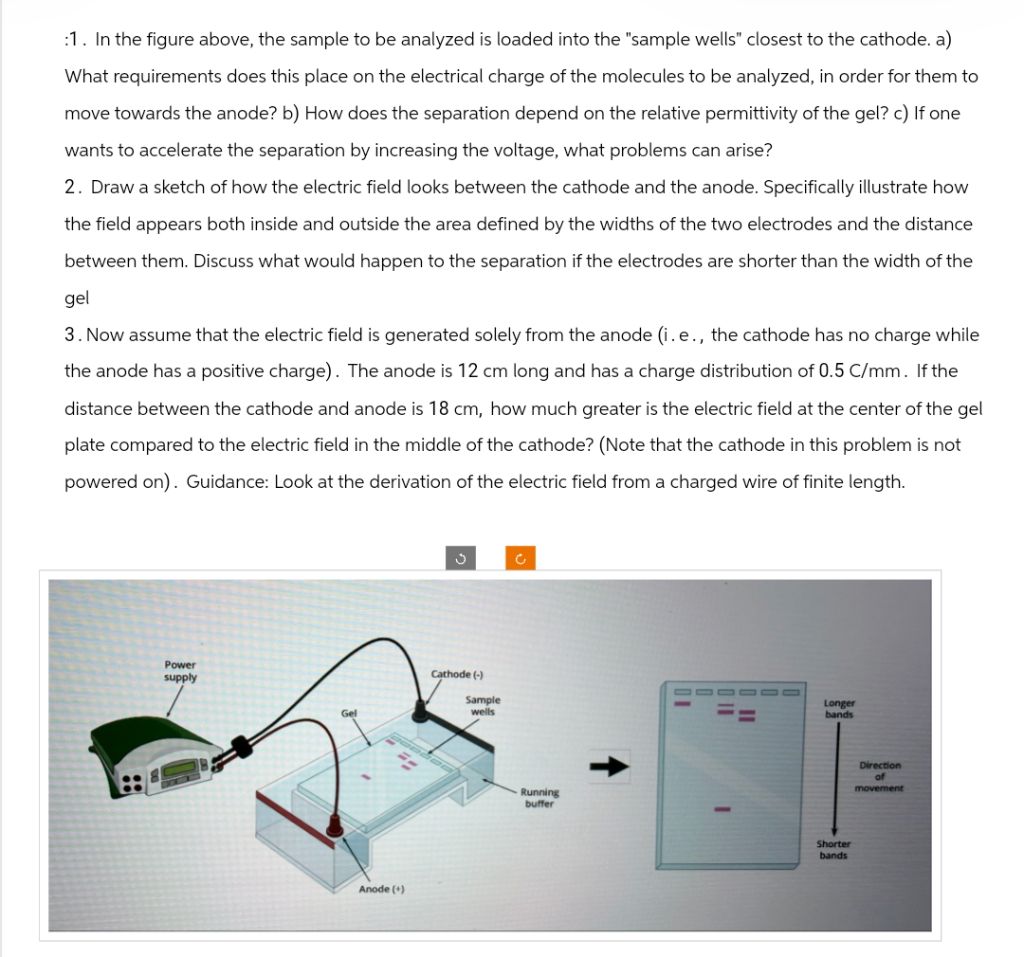
give answer in 2 step with all parts explanation at the end of each step and final answer at the end::1. In the figure above, the sample to be analyzed is loaded into the "sample wells" closest to the cathode. a)
What requirements does this place on the electrical charge of the molecules to be analyzed, in order for them to
move towards the anode? b) How does the separation depend on the relative permittivity of the gel? c) If one
wants to accelerate the separation by increasing the voltage, what problems can arise?
2. Draw a sketch of how the electric field looks between the cathode and the anode. Specifically illustrate how
the field appears both inside and outside the area defined by the widths of the two electrodes and the distance
between them. Discuss what would happen to the separation if the electrodes are shorter than the width of the
gel
3. Now assume that the electric field is generated solely from the anode (i. e., the cathode has no charge while
the anode has a positive charge). The anode is 12 cm long and has a charge distribution of 0.5 C/mm. If the
distance between the cathode and anode is 18 cm, how much greater is the electric field at the center of the gel
plate compared to the electric field in the middle of the cathode? (Note that the cathode in this problem is not
powered on). Guidance: Look at the derivation of the electric field from a charged wire of finite length.
[oI |
aii : gt ; Be:
Lite E
iy Ee “= ysl EE.
== So. oo
ee > =
E eo F
Question:
give answer in 2 step with all parts explanation at the end of each step and final answer at the end::1. In the figure above, the sample to be analyzed is loaded into the "sample wells" closest to the cathode. a)
What requirements does this place on the electrical charge of the molecules to be analyzed, in order for them to
move towards the anode? b) How does the separation depend on the relative permittivity of the gel? c) If one
wants to accelerate the separation by increasing the voltage, what problems can arise?
2. Draw a sketch of how the electric field looks between the cathode and the anode. Specifically illustrate how
the field appears both inside and outside the area defined by the widths of the two electrodes and the distance
between them. Discuss what would happen to the separation if the electrodes are shorter than the width of the
gel
3. Now assume that the electric field is generated solely from the anode (i. e., the cathode has no charge while
the anode has a positive charge). The anode is 12 cm long and has a charge distribution of 0.5 C/mm. If the
distance between the cathode and anode is 18 cm, how much greater is the electric field at the center of the gel
plate compared to the electric field in the middle of the cathode? (Note that the cathode in this problem is not
powered on). Guidance: Look at the derivation of the electric field from a charged wire of finite length.
[oI |
aii : gt ; Be:
Lite E
iy Ee “= ysl EE.
== So. oo
ee > =
E eo F
This is AI generated Response.
Asked by: Rahul
Created at: 2025-11-27 02:40:06
Final Answer:
RenderedRaw Text
Did you like this answer?
# Step 1: Conceptual Questions (Parts 1 & 2)
## 1a. **Requirement on Electrical Charge**
- **Explanation:** For molecules to move toward the anode, they must be **negatively charged**. This is because the anode is positively and attracts negative charges. Positively charged molecules would move toward the cathode instead.
## 1b. **Separation and Permittivity**
- **Explanation:** The separation depends on the **relative permittivity (\(\epsilon_r\))** of the gel:
- The electric field in the gel is \(E = V/(d \epsilon_r)\) (where \(V\) is voltage, \(d\) is distance).
- A **higher permittivity** reduces the electric field, thus **slowing down separation**.
## 1c. **Increasing Voltage: Problems**
- **Explanation:** Accelerating separation by increasing voltage can cause:
- **Excessive heating** (Joule heating), risking gel melting or sample denaturation.
- **Band distortion** due to uneven migration.
- **Buffer breakdown** or electrolysis.
## 2. **Electric Field Sketch and Electrode Width**
- **Explanation:**
- **Inside the area between electrodes:** The electric field is mostly uniform and vertical (from cathode to anode).
- **Outside the area:** The field lines curve outward due to edge effects.
- **If electrodes are shorter than the gel width:** Edge effects become significant, leading to a **non-uniform field**. This causes **uneven separation**, with molecules near the edges migrating differently from those in the center.
---
**Summary for Step 1:**
- Molecules must be negatively charged to move toward the anode.
- Higher gel permittivity slows separation.
- Increasing voltage can cause overheating and distortion.
- Short electrodes create non-uniform electric fields, harming separation accuracy.
---
# Step 2: Electric Field Calculation (Part 3)
### **Given:**
- Anode length (\(L\)) = 12 cm = .12 m
- Charge distribution (\(\lambda\)) = .5 C/mm = 500 C/m
- Distance between electrodes (\(d\)) = 18 cm = .18 m
#### **We want:**
The ratio:
\[
\frac{E_{\text{center, anode}}}{E_{\text{center, cathode}}}
\]
#### **Electric Field from a Finite Line of Charge:**
At a distance \(r\) perpendicular to the center of a line of length \(L\):
\[
E = \frac{1}{4\pi\epsilon_} \cdot \frac{2\lambda L}{r \sqrt{L^2 + 4r^2}}
\]
- **At the center of the gel plate (midpoint between electrodes):**
- Distance to anode: \(d = .18\) m
Plug in the numbers (cathode not powered, so only anode field matters):
\[
E_{\text{center}} = \frac{1}{4\pi\epsilon_} \frac{2 \lambda L}{d \sqrt{L^2 + 4d^2}}
\]
- **At the center of the cathode (i.e., directly above the anode, but at a distance):**
- The field is much weaker due to geometry and distance.
#### **Since the cathode is not powered, the field at the center of the cathode is almost zero**, so the field at the center of the gel (from the anode) is **much greater**.
---
## **Final Answer**
### - **Step 1:**
- Molecules must be negatively charged.
- Separation slows as gel permittivity increases.
- High voltage risks overheating and separation errors.
- Short electrodes cause field non-uniformity, impacting separation.
### - **Step 2:**
- The electric field at the center of the gel, generated solely by the anode, is **much greater** than at the center of the (unpowered) cathode.
- **Ratio:** The field at the center of the gel is essentially all that matters; at the cathode, the field is nearly zero.
---
**If you want the exact electric field value, substitute the numbers into the formula above.**
If you need the full numeric calculation, let me know!
VIPSolutions focuses on clear, step‑by‑step explanations so you can learn quickly. Whether you need an AI‑generated walkthrough or a short hint to get unstuck, each solution is organized for fast reading and easy review later.
Search similar questions, compare approaches, and bookmark the best answers for revision. Our goal is simple: quick, reliable study help that feels natural—not noisy.
 VIPSolutions
 :1. In the figure above, the sample to be analyzed is loaded into the "sample wells" closest to the cathode. a)
What requirements does this place on the electrical charge of the molecules to be analyzed, in order for them to
move towards the anode? b) How does the separation depend on the relative permittivity of the gel? c) If one
wants to accelerate the separation by increasing the voltage, what problems can arise?
2. Draw a sketch of how the electric field looks between the cathode and the anode. Specifically illustrate how
the field appears both inside and outside the area defined by the widths of the two electrodes and the distance
between them. Discuss what would happen to the separation if the electrodes are shorter than the width of the
gel
3. Now assume that the electric field is generated solely from the anode (i. e., the cathode has no charge while
the anode has a positive charge). The anode is 12 cm long and has a charge distribution of 0.5 C/mm. If the
distance between the cathode and anode is 18 cm, how much greater is the electric field at the center of the gel
plate compared to the electric field in the middle of the cathode? (Note that the cathode in this problem is not
powered on). Guidance: Look at the derivation of the electric field from a charged wire of finite length.
[oI |
aii : gt ; Be:
Lite E
iy Ee “= ysl EE.
== So. oo
ee > =
E eo F
:1. In the figure above, the sample to be analyzed is loaded into the "sample wells" closest to the cathode. a)
What requirements does this place on the electrical charge of the molecules to be analyzed, in order for them to
move towards the anode? b) How does the separation depend on the relative permittivity of the gel? c) If one
wants to accelerate the separation by increasing the voltage, what problems can arise?
2. Draw a sketch of how the electric field looks between the cathode and the anode. Specifically illustrate how
the field appears both inside and outside the area defined by the widths of the two electrodes and the distance
between them. Discuss what would happen to the separation if the electrodes are shorter than the width of the
gel
3. Now assume that the electric field is generated solely from the anode (i. e., the cathode has no charge while
the anode has a positive charge). The anode is 12 cm long and has a charge distribution of 0.5 C/mm. If the
distance between the cathode and anode is 18 cm, how much greater is the electric field at the center of the gel
plate compared to the electric field in the middle of the cathode? (Note that the cathode in this problem is not
powered on). Guidance: Look at the derivation of the electric field from a charged wire of finite length.
[oI |
aii : gt ; Be:
Lite E
iy Ee “= ysl EE.
== So. oo
ee > =
E eo F