 VIPSolutions
give answer in 2 step with explanation at the end of each step and final answer at the end:Sections AUS & ALU 2/3/2025 12/3/2025 Worksheet 24 a aa and trave’ ers Question 1. Suppose you have two identical satellites with the same ie constant. All ansWe obits of radius R around their center-of-mass. G is the universal gravita!
Question:
give answer in 2 step with explanation at the end of each step and final answer at the end: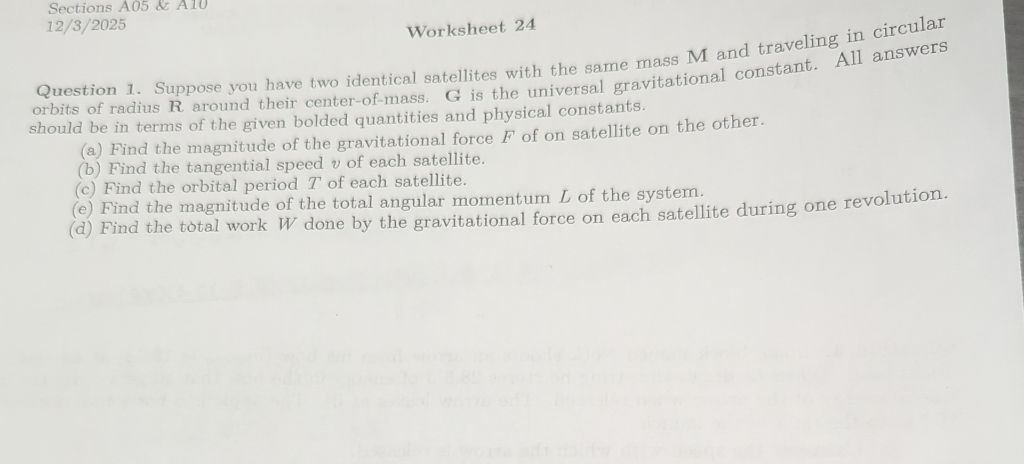 Sections AUS & ALU
2/3/2025
12/3/2025 Worksheet 24 a aa
and trave’ ers
Question 1. Suppose you have two identical satellites with the same ie constant. All ansWe
obits of radius R around their center-of-mass. G is the universal gravita!
Sections AUS & ALU
2/3/2025
12/3/2025 Worksheet 24 a aa
and trave’ ers
Question 1. Suppose you have two identical satellites with the same ie constant. All ansWe
obits of radius R around their center-of-mass. G is the universal gravita!
This is AI generated Response.
Asked by: Rahul
Created at: 2025-12-04 04:31:48
Asked by: Rahul
Created at: 2025-12-04 04:31:48
Final Answer:
Rendered
Raw Text
Did you like this answer?
Let's solve each part in two steps with explanations:
---
## (a) Gravitational Force \( F \)
### **Step 1: Write down Newton's Law of Gravitation**
\[
F = \frac{G m_1 m_2}{r^2}
\]
Here, both satellites have mass \( M \), so \( m_1 = m_2 = M \), and they are separated by distance \( 2R \) (since each is a radius \( R \) away from the center, so from each other, it's \( 2R \)).
**Explanation:**
We set \( r = 2R \) because the satellites are on opposite sides of the center of mass.
---
### **Step 2: Substitute values**
\[
F = \frac{G M M}{(2R)^2} = \frac{G M^2}{4R^2}
\]
**Explanation:**
Plugging in the masses and distance gives the gravitational force between the two satellites.
---
**Final Answer (a):**
\[
\boxed{F = \frac{G M^2}{4R^2}}
\]
---
## (b) Tangential Speed \( v \)
### **Step 1: Set gravitational force as centripetal force**
For circular motion, centripetal force is provided by gravity:
\[
F = \frac{M v^2}{R}
\]
We already found \( F = \frac{G M^2}{4R^2} \).
**Explanation:**
For each satellite, the gravitational force acts as the centripetal force keeping it in orbit.
---
### **Step 2: Solve for \( v \)**
\[
\frac{G M^2}{4R^2} = \frac{M v^2}{R}
\]
\[
\frac{G M}{4R} = v^2
\]
\[
v = \sqrt{\frac{G M}{4R}}
\]
**Explanation:**
We solved for \( v \) by equating the two forces isolating \( v \).
---
**Final Answer (b):**
\[
\boxed{v = \sqrt{\{G M}{4R}}}
\]
---
Let me know if you want the remaining parts (c), (d), and (e)!
Question:
Please solved all parts
This is AI generated Response.
Asked by: Rahul
Created at: 2025-12-04 04:32:11
Asked by: Rahul
Created at: 2025-12-04 04:32:11
Final Answer:
Rendered
Raw Text
Did you like this answer?
Sure! Let's continue solving the remaining parts of the question.
---
## (c) Orbital Period \( T \)
### **Step 1: Use the formula for orbital period**
The orbital period for circular motion is given by:
\[
T = \frac{2\pi R}{v}
\]
**Explanation:**
This formula relates the distance traveled in one complete orbit to the tangential speed.
---
### **Step 2: Substitute \( v \)**
From part (b), we found \( v = \sqrt{\frac{G M}{4R}} \). Substituting this into the orbital period formula gives:
\[
T = \frac{2\pi R}{\sqrt{\frac{G M}{4R}}}
\]
This simplifies to:
\[
T = 2\pi R \cdot \sqrt{\frac{4R}{G M}} = 2\pi \sqrt{\frac{4R^2}{G M}} = 4\pi \sqrt{\frac{R^2}{G M}}
\]
**Explanation:**
We simplified the expression to show the relationship between the orbital period, the radius, and the mass.
---
**Final Answer (c):**
\[
\boxed{T = 4\pi \sqrt{\frac{R^2}{G M}}}
\]
---
## (d) Total Work \( W \)
### **Step 1: Understand the work done by gravitational force**
The work done by gravitational force in a closed orbit is zero because the force is always perpendicular to the displacement.
**Explanation:**
In circular motion, the gravitational force acts towards the center, while the displacement is tangential to the orbit. Thus, no work is done.
---
### **Step 2: Conclude the work done**
\[
W = 0
\]
**Explanation:**
Since the gravitational force does no work during one complete orbit, the total work done is zero.
---
**Final Answer (d):**
\[
\boxed{W = 0}
\]
---
## (e) Total Angular Momentum \( L \)
### **Step 1: Use the formula for angular momentum**
The angular momentum \( L \) for a single satellite is given by:
\[
L = M v R
\]
**Explanation:**
This formula considers the mass, tangential speed, and radius of the satellite's orbit.
---
### **Step 2: Calculate total angular momentum for both satellites**
Since there are two identical satellites:
\[
L_{total} = 2 \cdot M v R
\]
Substituting \( v \) from part (b):
\[
L_{total} = 2 M \left( \sqrt{\frac{G M}{4R}} \right) R = 2 M R \sqrt{\frac{G M}{4R}} = \sqrt{G M} \cdot 2 \sqrt{R^3}
\]
**Explanation:**
We simplified the expression to find the total angular momentum considering both satellites.
---
**Final Answer (e):**
\[
\boxed{L_{total} = 2 \sqrt{G M} R^{3/2}}
\]
---
This concludes the problem with all parts solved. If you have further questions, feel free to ask!
📢 Instructions:
- Ask anything relatd to above question only.
- For new Question goto :