 VIPSolutions
give answer in 2 step with explanation at the end of each step and final answer at the end:A Gauss gun has a strong magnet and a number of steel spheres that are attracted to the magnet and can move on a track. We will [1] sume that cut magnet and ack are attached t a heavy tle an the combination doesnt move significant. Ths means wecan | A mg x ignore momentum conservation since the hea table can cary away €xcess momentum without moving obsenably. All our motions ae horizontal so we ignore ravi. 1a sphere is put within ew inches of the magnet ticks to the magnet. We can describe the interaction of the spheres withthe magnet in terms of a potential energy, U. Take the energy of a sphere to be 0 when it is a rest and far from the magnet. Three situations, | B A.B,3n0 Care shown at th ight. We describe postion in our System sing the x coordinate shown with the zo taken to be nthe coner ofthe magnet. ’ 0 B000 Af youty 9 pull he sphere away from the magnet cae A, you will ind that tis held by strong sactiv force that gets wesker a5 Pre the sphere get fothr from the magnet. A force is no longer detectable once you are more than 30 a away. On th graph at the ight etch the potential nergy of he sphere- magne system as a function of x hte x epresens he position of Sphere 1. Your raph Should correctly represent the qualtative features ofthe interaction. A Energy Energy At the left is shown a different kind of representation — an energy bar chart. This identifies various components of the energy of each object Shown at it location by br. Th vertical energy as represent the positon of the magnet, Th leftmost chart represents sphre 0 moving on x he le of the magnet and shows it KE. The chart a the right represents the potential energy of sphere 1 and the magnet (shown attached tothe postion of sphere 1). So th ef bar might represent the KE of sphere On stustion C. while he ight one represents the PE of the magne and ) PEx sphere 1 in situations A.B, or C. In situation 8. sphere 3 fit ea 0 remove from the complex sphere harder, and sphere 1 very iffcult, On a chart ike the ane at th right, assuming that everything | Envy is stationary and gnoring ny possible potential anergies rom interaction between the spheres themselves) draw bar representing the various energies for ach sphere) in susiion in situation C, sphere 0 i released about 30 cm fom the magnet with a small KE. It slowly spseds up unt t slam into the magnet going fast an sticks to the magnet. As a result sphere 3 fies off the right t a high speed in the charts below, draw bar charts representing the energie in the nial state an aftr the coon when sphere 2 is moving away at a distance of 30 cm. Draw your diagrams carefully represent an important relations among th emerges Explain what considerations you used to draw your diagrams Initial Energy Final Energy Situation Situation 0- D. To see how this works, choose arbitrary numbers like integers to represent teach of the energies -- ignoring units. For example we might call the blue KE bar in the figure at the left of part A, "4", and the re PE bar in the figure 85 "10". Use your numbers 0 wie the total energy i th intial situation and the total nergy in th final station, choosing numbers tha both represen the relative scale ofthe bars you drew and odd up comety to show energy consenation. Now answer the question: In ths reaction a panicle came in at a ow kinetic energy and another went ut ata igh ine energy. Where dd the extra energy come rom? Joe Redish and Dave Buehrle 4717/14
Question:
give answer in 2 step with explanation at the end of each step and final answer at the end: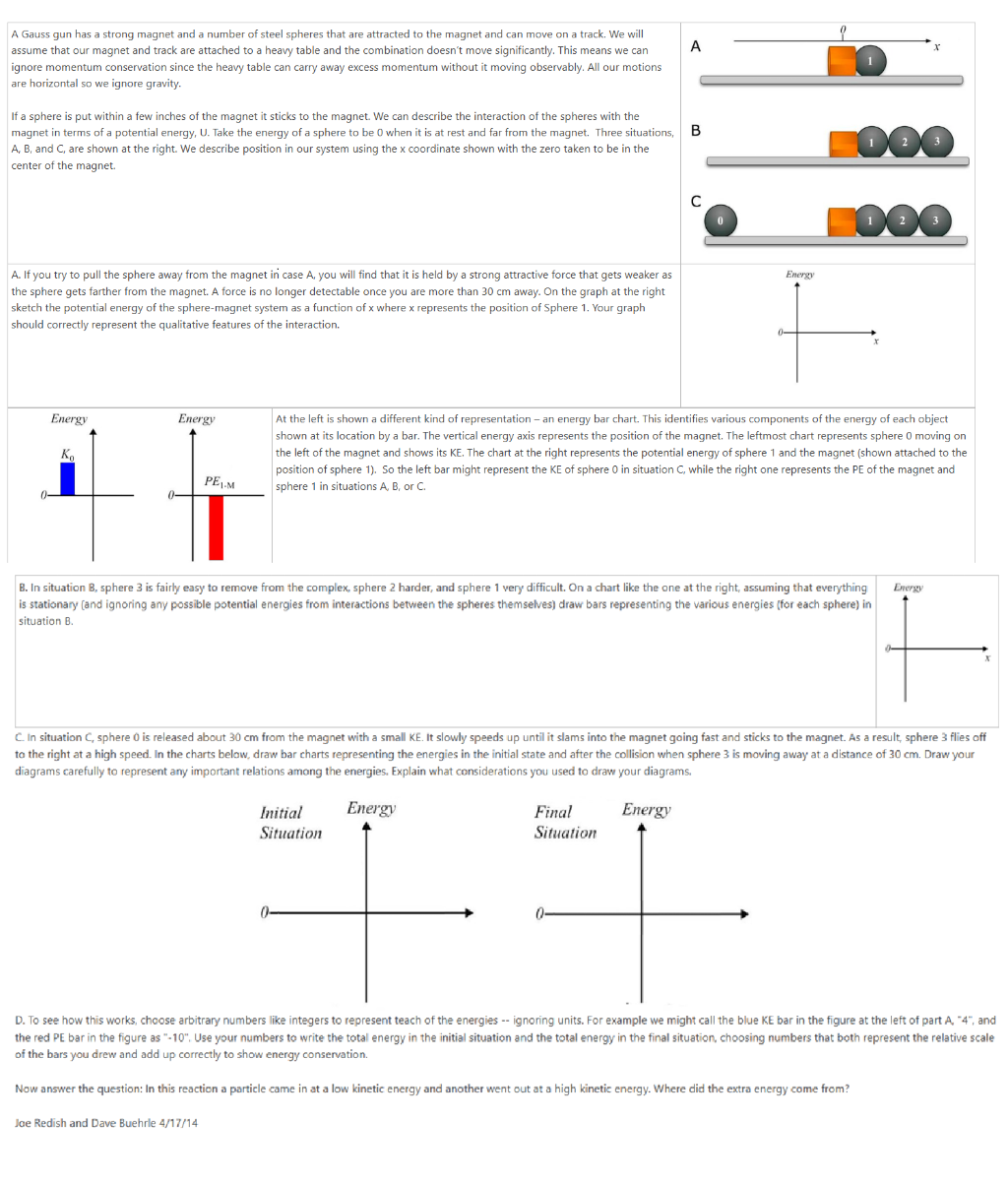 A Gauss gun has a strong magnet and a number of steel spheres that are attracted to the magnet and can move on a track. We will [1]
sume that cut magnet and ack are attached t a heavy tle an the combination doesnt move significant. Ths means wecan | A mg x
ignore momentum conservation since the hea table can cary away €xcess momentum without moving obsenably. All our motions
ae horizontal so we ignore ravi.
1a sphere is put within ew inches of the magnet ticks to the magnet. We can describe the interaction of the spheres withthe
magnet in terms of a potential energy, U. Take the energy of a sphere to be 0 when it is a rest and far from the magnet. Three situations, | B
A.B,3n0 Care shown at th ight. We describe postion in our System sing the x coordinate shown with the zo taken to be nthe
coner ofthe magnet.
’ 0 B000
Af youty 9 pull he sphere away from the magnet cae A, you will ind that tis held by strong sactiv force that gets wesker a5 Pre
the sphere get fothr from the magnet. A force is no longer detectable once you are more than 30 a away. On th graph at the ight
etch the potential nergy of he sphere- magne system as a function of x hte x epresens he position of Sphere 1. Your raph
Should correctly represent the qualtative features ofthe interaction. A
Energy Energy At the left is shown a different kind of representation — an energy bar chart. This identifies various components of the energy of each object
Shown at it location by br. Th vertical energy as represent the positon of the magnet, Th leftmost chart represents sphre 0 moving on
x he le of the magnet and shows it KE. The chart a the right represents the potential energy of sphere 1 and the magnet (shown attached tothe
postion of sphere 1). So th ef bar might represent the KE of sphere On stustion C. while he ight one represents the PE of the magne and
) PEx sphere 1 in situations A.B, or C.
In situation 8. sphere 3 fit ea 0 remove from the complex sphere harder, and sphere 1 very iffcult, On a chart ike the ane at th right, assuming that everything | Envy
is stationary and gnoring ny possible potential anergies rom interaction between the spheres themselves) draw bar representing the various energies for ach sphere) in
susiion
in situation C, sphere 0 i released about 30 cm fom the magnet with a small KE. It slowly spseds up unt t slam into the magnet going fast an sticks to the magnet. As a result sphere 3 fies off
the right t a high speed in the charts below, draw bar charts representing the energie in the nial state an aftr the coon when sphere 2 is moving away at a distance of 30 cm. Draw your
diagrams carefully represent an important relations among th emerges Explain what considerations you used to draw your diagrams
Initial Energy Final Energy
Situation Situation
0-
D. To see how this works, choose arbitrary numbers like integers to represent teach of the energies -- ignoring units. For example we might call the blue KE bar in the figure at the left of part A, "4", and
the re PE bar in the figure 85 "10". Use your numbers 0 wie the total energy i th intial situation and the total nergy in th final station, choosing numbers tha both represen the relative scale
ofthe bars you drew and odd up comety to show energy consenation.
Now answer the question: In ths reaction a panicle came in at a ow kinetic energy and another went ut ata igh ine energy. Where dd the extra energy come rom?
Joe Redish and Dave Buehrle 4717/14
A Gauss gun has a strong magnet and a number of steel spheres that are attracted to the magnet and can move on a track. We will [1]
sume that cut magnet and ack are attached t a heavy tle an the combination doesnt move significant. Ths means wecan | A mg x
ignore momentum conservation since the hea table can cary away €xcess momentum without moving obsenably. All our motions
ae horizontal so we ignore ravi.
1a sphere is put within ew inches of the magnet ticks to the magnet. We can describe the interaction of the spheres withthe
magnet in terms of a potential energy, U. Take the energy of a sphere to be 0 when it is a rest and far from the magnet. Three situations, | B
A.B,3n0 Care shown at th ight. We describe postion in our System sing the x coordinate shown with the zo taken to be nthe
coner ofthe magnet.
’ 0 B000
Af youty 9 pull he sphere away from the magnet cae A, you will ind that tis held by strong sactiv force that gets wesker a5 Pre
the sphere get fothr from the magnet. A force is no longer detectable once you are more than 30 a away. On th graph at the ight
etch the potential nergy of he sphere- magne system as a function of x hte x epresens he position of Sphere 1. Your raph
Should correctly represent the qualtative features ofthe interaction. A
Energy Energy At the left is shown a different kind of representation — an energy bar chart. This identifies various components of the energy of each object
Shown at it location by br. Th vertical energy as represent the positon of the magnet, Th leftmost chart represents sphre 0 moving on
x he le of the magnet and shows it KE. The chart a the right represents the potential energy of sphere 1 and the magnet (shown attached tothe
postion of sphere 1). So th ef bar might represent the KE of sphere On stustion C. while he ight one represents the PE of the magne and
) PEx sphere 1 in situations A.B, or C.
In situation 8. sphere 3 fit ea 0 remove from the complex sphere harder, and sphere 1 very iffcult, On a chart ike the ane at th right, assuming that everything | Envy
is stationary and gnoring ny possible potential anergies rom interaction between the spheres themselves) draw bar representing the various energies for ach sphere) in
susiion
in situation C, sphere 0 i released about 30 cm fom the magnet with a small KE. It slowly spseds up unt t slam into the magnet going fast an sticks to the magnet. As a result sphere 3 fies off
the right t a high speed in the charts below, draw bar charts representing the energie in the nial state an aftr the coon when sphere 2 is moving away at a distance of 30 cm. Draw your
diagrams carefully represent an important relations among th emerges Explain what considerations you used to draw your diagrams
Initial Energy Final Energy
Situation Situation
0-
D. To see how this works, choose arbitrary numbers like integers to represent teach of the energies -- ignoring units. For example we might call the blue KE bar in the figure at the left of part A, "4", and
the re PE bar in the figure 85 "10". Use your numbers 0 wie the total energy i th intial situation and the total nergy in th final station, choosing numbers tha both represen the relative scale
ofthe bars you drew and odd up comety to show energy consenation.
Now answer the question: In ths reaction a panicle came in at a ow kinetic energy and another went ut ata igh ine energy. Where dd the extra energy come rom?
Joe Redish and Dave Buehrle 4717/14
Asked by: Rahul
Created at: 2025-12-04 19:47:18
Final Answer:
📢 Instructions:
- Ask anything relatd to above question only.
- For new Question goto :