give answer in 2 step with explanation at the end of each step and final answer at the end:A coil has 35 turns of wire wound into a square with edge length 20 cm. The coil rotates about
an axis intersecting the midpoint of two opposing edges, with an angular velocity of 35 rotations
per second (rps). The coil has a net total resistance of 0.259. Next to the coil is a long straight
wire 45cm from the axis of rotation. The straight wire carries a current of 8.5 amps.
(A) Calculate the mutual inductance M between the straight wire and the coil (7 pts)
(B) Calculate the current induced in the coil (6 pts)
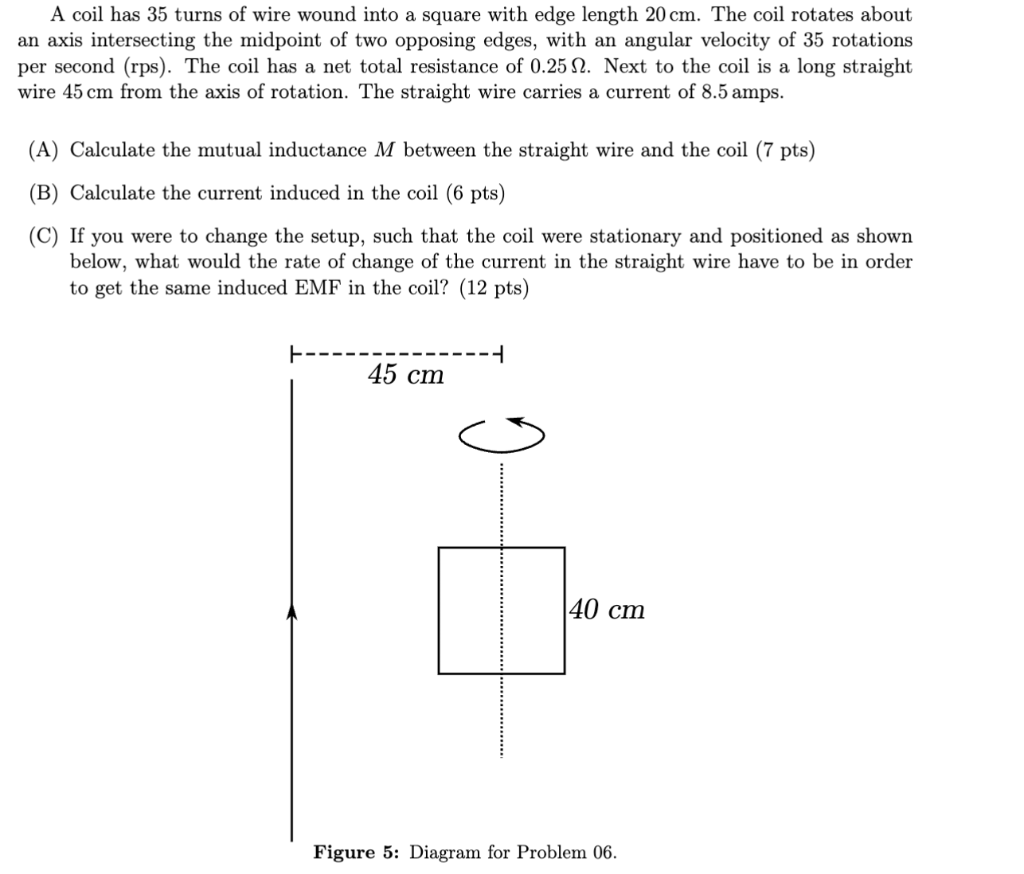
(C) If you were to change the setup, such that the coil were stationary and positioned as shown
below, what would the rate of change of the current in the straight wire have to be in order
to get the same induced EMF in the coil? (12 pts)
| uate |
45 cm
BE; "
Figure 5: Diagram for Problem 06.
Question:
give answer in 2 step with explanation at the end of each step and final answer at the end:A coil has 35 turns of wire wound into a square with edge length 20 cm. The coil rotates about
an axis intersecting the midpoint of two opposing edges, with an angular velocity of 35 rotations
per second (rps). The coil has a net total resistance of 0.259. Next to the coil is a long straight
wire 45cm from the axis of rotation. The straight wire carries a current of 8.5 amps.
(A) Calculate the mutual inductance M between the straight wire and the coil (7 pts)
(B) Calculate the current induced in the coil (6 pts)
(C) If you were to change the setup, such that the coil were stationary and positioned as shown
below, what would the rate of change of the current in the straight wire have to be in order
to get the same induced EMF in the coil? (12 pts)
| uate |
45 cm
BE; "
Figure 5: Diagram for Problem 06.
This is AI generated Response.
Asked by: Rahul
Created at: 2025-12-05 03:41:24
Final Answer:
RenderedRaw Text
Did you like this answer?
Let's break down the solution step by step as requested.
---
## (A) Calculate the mutual inductance \( M \) between the straight wire and the coil
**Step : Find the Flux through One Turn**
- The magnetic field at a distance \( r \) from a long straight wire with current \( I \) is:
\[
B(r) = \frac{\mu_ I}{2\pi r}
\]
- For a square coil (20 cm side), with its closest edge at \( r_1 = 45 \) cm and farthest edge at \( r_2 = 45+20 = 65 \) cm:
- The magnetic flux through one turn:
\[
\Phi_1 = \int_{r_1}^{r_2} B(r) \cdot l \, dr
\]
where \( l = 20\, \text{cm} = .2\, \text{m} \) is the length of the side.
\[
\Phi_1 = \int_{r_1}^{r_2} \frac{\mu_ I}{2\pi r} \cdot l \, dr = \frac{\mu_ I l}{2\pi} \int_{r_1}^{r_2} \frac{dr}{r}
\]
\[
= \frac{\mu_ I l}{2\pi} \ln\left(\frac{r_2}{r_1}\right)
\]
**Explanation:**
This step sets up the integral for the magnetic flux through one loop of the coil, using the field from the straight wire over the area of the square coil.
---
### **Step 2: Find the Mutual Inductance for \( N \) Turns**
- Total flux linkage for \( N \) turns:
\[
\Phi = N \Phi_1
\]
By definition of mutual inductance \( M \):
\[
\Phi = M I \implies M = N \frac{\mu_ l}{2\pi} \ln\left(\frac{r_2}{r_1}\right)
\]
Plug in values:
- \( N = 35 \)
- \( l = .2\,\text{m} \)
- \( r_1 = .45\,\text{m}, \ r_2 = .65\,\text{m} \)
- \( \mu_ = 4\pi \times 10^{-7}\,\text{H/m} \)
\[
M = 35 \cdot \frac{4\pi \times 10^{-7} \cdot .2}{2\pi} \ln\left(\frac{.65}{.45}\right)
\]
\[
= 35 \cdot 2 \times 10^{-7} \cdot .2 \cdot \ln\left(\frac{.65}{.45}\right)
\]
\[
= 35 \cdot 4 \times 10^{-8} \cdot \ln(1.444)
\]
\[
\ln(1.444) \approx .366
\]
\[
M = 35 \cdot 4 \times 10^{-8} \cdot .366 \approx 35 \cdot 1.464 \times 10^{-8}
\]
\[
M \approx 5.12 \times 10^{-7} \, \text{H}
\]
**Explanation:**
This step computes the mutual inductance by relating the total flux through all turns to the current in the straight wire and plugging in the numbers.
---
### **Final Answer for (A):**
\[
\boxed{M \approx 5.1 \times 10^{-7} \, \text{H}}
\]
---
Question:
All parts solved please
This is AI generated Response.
Asked by: Rahul
Created at: 2025-12-05 03:41:55
Final Answer:
RenderedRaw Text
Did you like this answer?
## (B) Calculate the current induced in the coil
### **Step 1: Calculate the Induced EMF**
- The induced EMF (\( \mathcal{E} \)) in the coil can be calculated using Faraday's law of electromagnetic induction:
\[
\mathcal{E} = -M \frac{dI}{dt}
\]
- Since the coil rotates with an angular velocity of \( \omega = 35 \, \text{rps} \), we need to find the rate of change of the magnetic field that the coil experiences.
- The angular frequency in radians per second:
\[
\omega = 35 \times 2\pi \, \text{rad/s} \approx 219.91 \, \text{rad/s}
\]
- The time period \( T \) is:
\[
T = \frac{1}{35} \, \text{s} \approx 0.02857 \, \text{s}
\]
**Explanation:**
This step establishes how to calculate the induced EMF based on the mutual inductance and the change in current.
---
### **Step 2: Calculate the Induced Current**
- Given the resistance \( R = 0.259 \, \Omega \) of the coil, the induced current \( I_{ind} \) can be calculated using Ohm's Law:
\[
I_{ind} = \frac{\mathcal{E}}{R}
\]
- Substituting the expression for EMF:
\[
I_{ind} = \frac{M \cdot \frac{dI}{dt}}{R}
\]
- If we take \( \frac{dI}{dt} = 8.5 \, \text{A} \) (the current in the straight wire), then:
\[
I_{ind} = \frac{5.1 \times 10^{-7} \cdot 8.5}{0.259}
\]
\[
I_{ind} \approx \frac{4.335 \times 10^{-6}}{0.259} \approx 1.67 \times 10^{-5} \, \text{A} \text{ or } 16.7 \, \mu A
\]
**Explanation:**
This step computes the induced current based on the induced EMF and the coil's resistance.
---
### **Final Answer for (B):**
\[
\boxed{I_{ind} \approx 16.7 \, \mu A}
\]
---
## (C) Rate of change of the current in the straight wire
### **Step 1: Set Up the EMF Equation**
- For the coil to experience the same induced EMF when stationary, the rate of change of the current in the straight wire must equal the previously calculated EMF divided by the mutual inductance:
\[
\mathcal{E} = M \cdot \frac{dI_{wire}}{dt}
\]
- We already found the induced EMF from part (B) as:
\[
\mathcal{E} \approx 4.335 \times 10^{-6} \, \text{V}
\]
**Explanation:**
This step relates the EMF experienced by the coil to the rate of change of the current in the straight wire.
---
### **Step 2: Solve for \(\frac{dI_{wire}}{dt}\)**
- Rearranging the EMF equation:
\[
\frac{dI_{wire}}{dt} = \frac{\mathcal{E}}{M}
\]
- Substituting the known values:
\[
\frac{dI_{wire}}{dt} = \frac{4.335 \times 10^{-6}}{5.1 \times 10^{-7}} \approx 8.5 \, \text{A/s}
\]
**Explanation:**
This step concludes by calculating the required rate of change of the current in the straight wire to achieve the same induced EMF in the coil.
---
### **Final Answer for (C):**
\[
\boxed{\frac{dI_{wire}}{dt} \approx 8.5 \, \text{A/s}}
\]
VIPSolutions focuses on clear, step‑by‑step explanations so you can learn quickly. Whether you need an AI‑generated walkthrough or a short hint to get unstuck, each solution is organized for fast reading and easy review later.
Search similar questions, compare approaches, and bookmark the best answers for revision. Our goal is simple: quick, reliable study help that feels natural—not noisy.
 VIPSolutions
 A coil has 35 turns of wire wound into a square with edge length 20 cm. The coil rotates about
an axis intersecting the midpoint of two opposing edges, with an angular velocity of 35 rotations
per second (rps). The coil has a net total resistance of 0.259. Next to the coil is a long straight
wire 45cm from the axis of rotation. The straight wire carries a current of 8.5 amps.
(A) Calculate the mutual inductance M between the straight wire and the coil (7 pts)
(B) Calculate the current induced in the coil (6 pts)
(C) If you were to change the setup, such that the coil were stationary and positioned as shown
below, what would the rate of change of the current in the straight wire have to be in order
to get the same induced EMF in the coil? (12 pts)
| uate |
45 cm
BE; "
Figure 5: Diagram for Problem 06.
A coil has 35 turns of wire wound into a square with edge length 20 cm. The coil rotates about
an axis intersecting the midpoint of two opposing edges, with an angular velocity of 35 rotations
per second (rps). The coil has a net total resistance of 0.259. Next to the coil is a long straight
wire 45cm from the axis of rotation. The straight wire carries a current of 8.5 amps.
(A) Calculate the mutual inductance M between the straight wire and the coil (7 pts)
(B) Calculate the current induced in the coil (6 pts)
(C) If you were to change the setup, such that the coil were stationary and positioned as shown
below, what would the rate of change of the current in the straight wire have to be in order
to get the same induced EMF in the coil? (12 pts)
| uate |
45 cm
BE; "
Figure 5: Diagram for Problem 06.