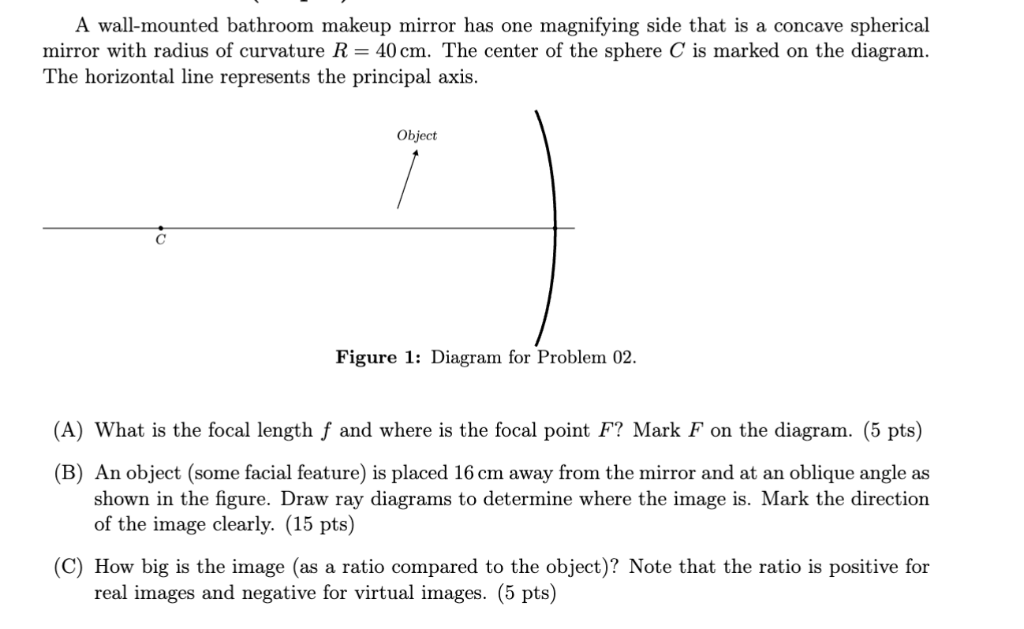
give answer in 2 step with explanation at the end of each step and final answer at the end:A wall-mounted bathroom makeup mirror has one magnifying side that is a concave spherical
mirror with radius of curvature R = 40cm. The center of the sphere C' is marked on the diagram.
The horizontal line represents the principal axis.
Object
[4
Figure 1: Diagram for Problem 02.
(A) What is the focal length f and where is the focal point F'? Mark F on the diagram. (5 pts)
(B) An object (some facial feature) is placed 16 cm away from the mirror and at an oblique angle as
shown in the figure. Draw ray diagrams to determine where the image is. Mark the direction
of the image clearly. (15 pts)
(C) How big is the image (as a ratio compared to the object)? Note that the ratio is positive for
real images and negative for virtual images. (5 pts)
Question:
give answer in 2 step with explanation at the end of each step and final answer at the end:A wall-mounted bathroom makeup mirror has one magnifying side that is a concave spherical
mirror with radius of curvature R = 40cm. The center of the sphere C' is marked on the diagram.
The horizontal line represents the principal axis.
Object
[4
Figure 1: Diagram for Problem 02.
(A) What is the focal length f and where is the focal point F'? Mark F on the diagram. (5 pts)
(B) An object (some facial feature) is placed 16 cm away from the mirror and at an oblique angle as
shown in the figure. Draw ray diagrams to determine where the image is. Mark the direction
of the image clearly. (15 pts)
(C) How big is the image (as a ratio compared to the object)? Note that the ratio is positive for
real images and negative for virtual images. (5 pts)
This is AI generated Response.
Asked by: Rahul
Created at: 2025-12-05 05:45:42
Final Answer:
RenderedRaw Text
Did you like this answer?
## Step 1: Find the Focal Length and Mark F on the Diagram
The **focal length** \( f \) of a concave mirror is related to its **radius of curvature** \( R \) by the formula:
\[
f = \{R}{2}
\]
Given:
- \( R = 40\, \text{cm} \)
So:
\[
f = \frac{40\, \text{cm}}{2} = 20\, \text{cm}
\]
**Explanation:**
The focal point \( F \) is always located halfway between the center of curvature \( C \) and the mirror’s surface on the principal axis. On the diagram, mark \( F \) at a point 20 cm from the mirror along the principal axis, between the mirror and \( C \).
---
## Step 2: Ray Diagram and Image Location
Given:
- **Object distance** \( d_o = 16\,\text{cm} \) (from mirror)
Use the **mirror equation**:
\[
\frac{1}{f} = \frac{1}{d_o} + \frac{1}{d_i}
\]
Plug in values (\( f = +20\,\text{cm} \), \( d_o = +16\,\text{cm} \)):
\[
\frac{1}{20} = \frac{1}{16} + \frac{1}{d_i}
\]
\[
\frac{1}{d_i} = \frac{1}{20} - \frac{1}{16} = \frac{4 - 5}{80} = -\frac{1}{80}
\]
\[
d_i = -80\,\text{cm}
\]
**Explanation:**
The negative sign means the image is formed **behind the mirror** (virtual image), on the same side as the object. In your ray diagram:
- Draw one ray parallel to the principal axis, reflecting through \( F \).
- Draw another ray headed toward \( C \), reflecting back on itself.
- The reflected rays diverge; extend them backward behind the mirror to meet at the image location, 80 cm behind the mirror.
---
## Step 3: Magnification
Magnification (\( m \)):
\[
m = -\frac{d_i}{d_o}
\]
Plug in values:
\[
m = -\frac{-80}{16} = 5
\]
**Explanation:**
The positive magnification means the image is upright and virtual, and the value 5 means the image is **5 times larger** than the object.
---
# Final Answers
**A.**
- Focal length \( f = 20\,\text{cm} \)
- Mark \( F \) halfway between the mirror and \( C \) on the principal axis.
**B.**
- The image is **virtual** and forms **80 cm behind the mirror** (on the same side as the object).
**C.**
- The image is **5 times larger** than the object (magnification \( m = 5 \), upright and virtual).
Question:
Solve correct answer
This is AI generated Response.
Asked by: Rahul
Created at: 2025-12-05 05:47:32
Final Answer:
RenderedRaw Text
Did you like this answer?
# Step 1: Find the Focal Length and Mark F on the Diagram
The **focal length** \( f \) of a concave mirror is given by the formula:
\[
f = \frac{R}{2}
\]
Given:
- Radius of curvature \( R = 40\, \text{cm} \)
Calculating the focal length:
\[
f = \frac{40\, \text{cm}}{2} = 20\, \text{cm}
\]
**Explanation:**
The focal point \( F \) is located halfway between the center of curvature \( C \) and the mirror’s surface along the principal axis. On the diagram, mark \( F \) at 20 cm from the mirror along the principal axis, between the mirror and \( C \).
---
# Step 2: Ray Diagram and Image Location
Given:
- **Object distance** \( d_o = 16\,\text{cm} \) (from mirror)
Using the **mirror equation**:
\[
\frac{1}{f} = \frac{1}{d_o} + \frac{1}{d_i}
\]
Substituting the values (\( f = +20\,\text{cm} \), \( d_o = +16\,\text{cm} \)):
\[
\frac{1}{20} = \frac{1}{16} + \frac{1}{d_i}
\]
Rearranging gives:
\[
\frac{1}{d_i} = \frac{1}{20} - \frac{1}{16} = \frac{4 - 5}{80} = -\frac{1}{80}
\]
Thus:
\[
d_i = -80\,\text{cm}
\]
**Explanation:**
The negative sign indicates that the image is formed **behind the mirror** (a virtual image), on the same side as the object. In the ray diagram:
- Draw one ray parallel to the principal axis, reflecting through \( F \).
- Draw another ray aimed toward \( C \), reflecting back on itself.
- The reflected rays diverge; extend them backward behind the mirror to meet at the image location, which is 80 cm behind the mirror.
---
# Step 3: Magnification
Calculating magnification (\( m \)):
\[
m = -\frac{d_i}{d_o}
\]
Substituting the values:
\[
m = -\frac{-80}{16} = 5
\]
**Explanation:**
The positive magnification indicates the image is upright and virtual, and the value 5 means the image is **5 times larger** than the object.
---
# Final Answers
**A.**
- Focal length \( f = 20\,\text{cm} \)
- Mark \( F \) 20 cm from the mirror along the principal axis.
**B.**
- The image is **virtual** and located **80 cm behind the mirror** (on the same side as the object).
**C.**
- The image is **5 times larger** than the object (magnification \( m = 5 \), upright and virtual).
VIPSolutions focuses on clear, step‑by‑step explanations so you can learn quickly. Whether you need an AI‑generated walkthrough or a short hint to get unstuck, each solution is organized for fast reading and easy review later.
Search similar questions, compare approaches, and bookmark the best answers for revision. Our goal is simple: quick, reliable study help that feels natural—not noisy.
 VIPSolutions
 A wall-mounted bathroom makeup mirror has one magnifying side that is a concave spherical
mirror with radius of curvature R = 40cm. The center of the sphere C' is marked on the diagram.
The horizontal line represents the principal axis.
Object
[4
Figure 1: Diagram for Problem 02.
(A) What is the focal length f and where is the focal point F'? Mark F on the diagram. (5 pts)
(B) An object (some facial feature) is placed 16 cm away from the mirror and at an oblique angle as
shown in the figure. Draw ray diagrams to determine where the image is. Mark the direction
of the image clearly. (15 pts)
(C) How big is the image (as a ratio compared to the object)? Note that the ratio is positive for
real images and negative for virtual images. (5 pts)
A wall-mounted bathroom makeup mirror has one magnifying side that is a concave spherical
mirror with radius of curvature R = 40cm. The center of the sphere C' is marked on the diagram.
The horizontal line represents the principal axis.
Object
[4
Figure 1: Diagram for Problem 02.
(A) What is the focal length f and where is the focal point F'? Mark F on the diagram. (5 pts)
(B) An object (some facial feature) is placed 16 cm away from the mirror and at an oblique angle as
shown in the figure. Draw ray diagrams to determine where the image is. Mark the direction
of the image clearly. (15 pts)
(C) How big is the image (as a ratio compared to the object)? Note that the ratio is positive for
real images and negative for virtual images. (5 pts)