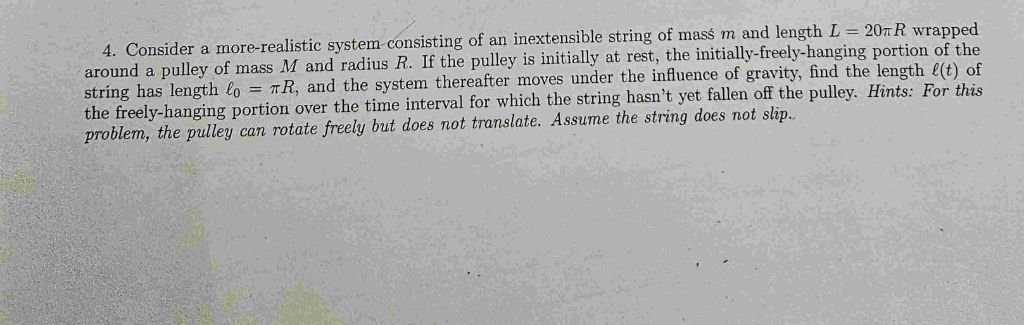
give answer in 2 step with explanation at the end of each step and final answer at the end: 4. Consider a more - realistic system consisting of an inextensible string of masś \(m \) and length \(L = 20 \pi R \) wrapped around a pulley of mass \(M \) and radius \(R \). If the pulley is initially at rest, the initially - freely - hanging portion of the string has length \( \ell_{0} = \pi R \), and the system thereafter moves under the influence of gravity, find the length \(\ell(t) \) of the freely - hanging portion over the time interval for which the string hasn't yet fallen off the pulley. Hints: For this problem, the pulley can rotate freely but does not translate.
Assume the string does not slip.4. Consider a more-realistic system consisting of an inextensible string of mass m and length I = 207R wrapped
around a pulley of mass M and radius R. If the pulley is initially at rest, the initially-freely-hanging portion of the
string has length fp = 7B, and the system thereafter moves under the influence of gravity, find the length £(t) of
the freely-hanging portion over the time interval for which the string hasn't yet fallen off the pulley. Hints: For this
problem, the pulley can rotate freely but does not translate. Assume the string does not slip.
NFER
Question:
give answer in 2 step with explanation at the end of each step and final answer at the end: 4. Consider a more - realistic system consisting of an inextensible string of masś \(m \) and length \(L = 20 \pi R \) wrapped around a pulley of mass \(M \) and radius \(R \). If the pulley is initially at rest, the initially - freely - hanging portion of the string has length \( \ell_{0} = \pi R \), and the system thereafter moves under the influence of gravity, find the length \(\ell(t) \) of the freely - hanging portion over the time interval for which the string hasn't yet fallen off the pulley. Hints: For this problem, the pulley can rotate freely but does not translate.
Assume the string does not slip.4. Consider a more-realistic system consisting of an inextensible string of mass m and length I = 207R wrapped
around a pulley of mass M and radius R. If the pulley is initially at rest, the initially-freely-hanging portion of the
string has length fp = 7B, and the system thereafter moves under the influence of gravity, find the length £(t) of
the freely-hanging portion over the time interval for which the string hasn't yet fallen off the pulley. Hints: For this
problem, the pulley can rotate freely but does not translate. Assume the string does not slip.
NFER
This is AI generated Response.
Asked by: Rahul
Created at: 2025-12-05 08:09:44
Final Answer:
RenderedRaw Text
Did you like this answer?
Let's break the problem into two logical steps:
---
## **Step 1: Relating Linear and Angular Variables**
Since the string is inextensible, mass \( m \), and **does not slip** on the pulley (radius \( R \), mass \( M \)), the **unwinding string length** \( \ell(t) \) is related to the **angle** \( \theta(t) \) the pulley has rotated:
- **Total length of string:** \( L = 20\pi R \)
- **Initially hanging:** \( \ell_ = \pi R \)
- **Unwrapped (hanging) length increases as the pulley rotates:**
\[
\ell(t) = \ell_ + R\theta(t)
\]
where \( \theta(t) \) is the angle the pulley has rotated (in radians).
### **Explanation (Step 1):**
As the string unwinds, the length hanging freely increases by exactly the length that leaves the pulley, which corresponds to the arc length \( R\theta \) due to rotation.
---
## **Step 2: Dynamics and Acceleration**
**Forces and Accelerations:**
- Let \( a \) be the downward acceleration of the hanging part.
- Let \( T \) be the tension in the string.
- The pulley rotates, so torque = tension × radius = \( TR \), and moment of inertia for a disk: \( I = \frac{1}{2}MR^2 \).
- **No slipping:** acceleration of string \( a = R \alpha \) (where \( \alpha \) is angular acceleration).
**Write equations:**
1. **For the mass \( m \):**
\[
m a = m g - T
\]
2. **For the pulley (rotational):**
\[
TR = I \alpha = \frac{1}{2}MR^2 \alpha
\]
\[
\alpha = a/R \implies TR = \frac{1}{2}MR^2 \frac{a}{R} \implies T = \frac{1}{2} M a
\]
**Substitute \( T \) into (1):**
\[
m a = m g - \frac{1}{2}Ma
\]
\[
a\left(m + \frac{1}{2}M\right) = mg
\]
\[
a = \frac{mg}{m + \frac{1}{2}M}
\]
**This is a constant acceleration.**
Now, the hanging part grows as:
\[
\ell(t) = \ell_ + \frac{1}{2} a t^2
\]
(Since initial velocity is zero, and the end of the string accelerates downward with \( a \).)
### **Explanation (Step 2):**
We have related the unwinding length to the angular rotation, and then used Newton’s laws and rotational dynamics to find that the end of the string accelerates downward at \( a = \frac{mg}{m + \frac{1}{2}M} \), so the length of the hanging part grows quadratically with time.
---
## **Final Answer**
\[
\boxed{
\ell(t) = \pi R + \frac{1}{2} \left( \frac{mg}{m + \frac{1}{2}M} \right) t^2
}
\]
**This formula gives the length of the freely hanging portion of the string as a function of time, until the string leaves the pulley.**
VIPSolutions focuses on clear, step‑by‑step explanations so you can learn quickly. Whether you need an AI‑generated walkthrough or a short hint to get unstuck, each solution is organized for fast reading and easy review later.
Search similar questions, compare approaches, and bookmark the best answers for revision. Our goal is simple: quick, reliable study help that feels natural—not noisy.
 VIPSolutions
 4. Consider a more-realistic system consisting of an inextensible string of mass m and length I = 207R wrapped
around a pulley of mass M and radius R. If the pulley is initially at rest, the initially-freely-hanging portion of the
string has length fp = 7B, and the system thereafter moves under the influence of gravity, find the length £(t) of
the freely-hanging portion over the time interval for which the string hasn't yet fallen off the pulley. Hints: For this
problem, the pulley can rotate freely but does not translate. Assume the string does not slip.
NFER
4. Consider a more-realistic system consisting of an inextensible string of mass m and length I = 207R wrapped
around a pulley of mass M and radius R. If the pulley is initially at rest, the initially-freely-hanging portion of the
string has length fp = 7B, and the system thereafter moves under the influence of gravity, find the length £(t) of
the freely-hanging portion over the time interval for which the string hasn't yet fallen off the pulley. Hints: For this
problem, the pulley can rotate freely but does not translate. Assume the string does not slip.
NFER