 VIPSolutions
give answer in 2 step with explanation at the end of each step and final answer at the end:TRAE COCOA NU JURE SPONGE SSS: SVE plat IA SH CA SVN SO, Circe and able appropri suctures “end of reaction 1 ad “nd of ection 2° inthe mechanism. | side Dp] : ‘ | nd i : 0 = Ce | 3. HS04 BION (roms sreoninsoprcct mo som - H i ; rrr Sod | TOL sae | ret saesona) ; on | 180, ; i i : % Pi er i ! | 3 NOEL BION (sober rsoner of cht wok worm H i ; TMOELEON foe mo : ; ; RE TE TPS | abc of ho Ghar | rn soomonen 2. In gencral, you should assume that products ae purified i necessary afr cach reaction na mulisicp ibe action sequence. Why migh he product of rection #1 ced ob puri elore ging Sonos Ute foams eae
Question:
give answer in 2 step with explanation at the end of each step and final answer at the end: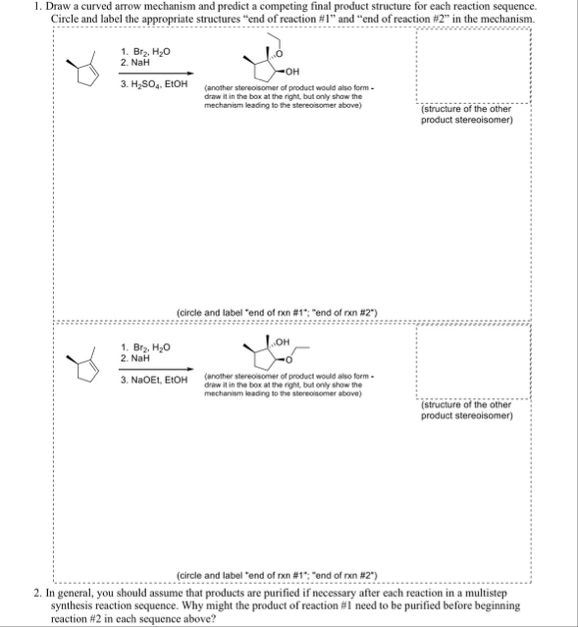 TRAE COCOA NU JURE SPONGE SSS: SVE plat IA SH CA SVN SO,
Circe and able appropri suctures “end of reaction 1 ad “nd of ection 2° inthe mechanism.
| side Dp] : ‘
| nd i :
0 = Ce
| 3. HS04 BION (roms sreoninsoprcct mo som - H i
; rrr Sod
| TOL sae
| ret saesona)
; on
| 180, ; i i
: % Pi er i !
| 3 NOEL BION (sober rsoner of cht wok worm H i
; TMOELEON foe mo : ;
; RE TE TPS
| abc of ho Ghar
| rn soomonen
2. In gencral, you should assume that products ae purified i necessary afr cach reaction na mulisicp
ibe action sequence. Why migh he product of rection #1 ced ob puri elore ging
Sonos Ute foams eae
TRAE COCOA NU JURE SPONGE SSS: SVE plat IA SH CA SVN SO,
Circe and able appropri suctures “end of reaction 1 ad “nd of ection 2° inthe mechanism.
| side Dp] : ‘
| nd i :
0 = Ce
| 3. HS04 BION (roms sreoninsoprcct mo som - H i
; rrr Sod
| TOL sae
| ret saesona)
; on
| 180, ; i i
: % Pi er i !
| 3 NOEL BION (sober rsoner of cht wok worm H i
; TMOELEON foe mo : ;
; RE TE TPS
| abc of ho Ghar
| rn soomonen
2. In gencral, you should assume that products ae purified i necessary afr cach reaction na mulisicp
ibe action sequence. Why migh he product of rection #1 ced ob puri elore ging
Sonos Ute foams eae
This is AI generated Response.
Asked by: Rahul
Created at: 2025-12-05 13:46:25
Asked by: Rahul
Created at: 2025-12-05 13:46:25
Final Answer:
Rendered
Raw Text
Did you like this answer?
Let's break down each sequence into two steps and provide explanations after each.
---
## Sequence 1
### Step 1: Addition of Br₂, H₂O (End of Reaction #1)
**Mechanism:**
This is a bromohydrin formation reaction. Br₂ reacts with the alkene to form a bromonium ion intermediate. Water then attacks the more substituted carbon (Markovnikov addition), opening the bromonium ion and placing OH and Br anti to each other.
**Product:**
You get a trans-1-bromo-2-hydroxy cyclohexane (two stereoisomers, but show one main product):
- Br and OH are on adjacent carbons, trans to each other.
**Explanation:**
Bromonium ion formation ensures anti addition, leading to two possible enantiomers (stereoisomers) of the product.
---
### Step 2: Treatment with NaH (End of Reaction #2)
**Mechanism:**
NaH is a strong base and deprotonates the alcohol, forming an alkoxide. The alkoxide then does an intramolecular SN2 reaction, displacing Br and forming an epoxide (oxirane ring).
**Product:**
You get a cyclohexene oxide (epoxide) at the same position where the OH and Br were originally.
**Explanation:**
The SN2 reaction inverts the configuration at the carbon where Br was attached. Both stereoisomers from step 1 can give their corresponding epoxide stereoisomers.
---
**Final Answer for Sequence 1:**
- **End of reaction #1:** Trans-1-bromo-2-hydroxycyclohexane (show both possible trans isomers)
- **End of reaction #2:** Cyclohexene oxide (epoxide), show both stereoisomers
---
## Sequence 2
### Step 1: Addition of Br₂, H₂O (End of Reaction #1)
**Mechanism:**
Same as above—bromohydrin formation by anti addition of Br and OH across the double bond.
**Explanation:**
The product is a trans-1-bromo-2-hydroxycyclohexane (two possible stereoisomers).
---
### Step 2: Treatment with NaOEt, EtOH (End of Reaction #2)
**Mechanism:**
NaOEt is a strong base, leading to E2 elimination. The base removes a β-hydrogen, causing loss of Br and formation of a double bond, resulting in a cyclohexenol.
**Product:**
You get a cyclohexenol (alkene with an alcohol group), with the double bond formed where Br was eliminated.
**Explanation:**
E2 elimination forms the most substituted alkene (Zaitsev product), and the configuration of the OH may lead to different stereoisomers.
---
**Final Answer for Sequence 2:**
- **End of reaction #1:** Trans-1-bromo-2-hydroxycyclohexane (both possible isomers)
- **End of reaction #2:** Cyclohexenol (alkene with an OH group), show both possible isomers
---
## Purification Explanation (Question 2)
**Why purify after reaction #1?**
If the product of reaction #1 is not purified, leftover starting materials, byproducts, or other stereoisomers may react undesirably in step 2, leading to reduced yield or formation of unwanted products. Purification ensures that only the desired intermediate undergoes the next transformation, improving selectivity and yield.
---
### **Summary Table**
| Step | Sequence 1 | Sequence 2 |
|----------------|------------------------------------------------------|----------------------------------------------------|
| End of rxn #1 | Trans-1-bromo-2-hydroxycyclohexane (both isomers) | Trans-1-bromo-2-hydroxycyclohexane (both isomers) |
| End of rxn #2 | Cyclohexene oxide (epoxide, both isomers) | Cyclohexenol (alkene with OH, both isomers) |
Let me know if you need the structures drawn!
📢 Instructions:
- Ask anything relatd to above question only.
- For new Question goto :