 VIPSolutions
give answer in 2 step with explanation at the end of each step and final answer at the end:Question 2. In Singapore, it takes 4 months for 15 workers to make 100 tons of oil. It also requires 60 workers to work | year to produce 6 million micro conductors; In Malaysia, 10 workers can make 80 tons of ol in 6 months. And it requires 100 workers working 1 year to produce 4 million micro conductors. Assume constant marginal production of bor. Determine the comparative advantage in oil and micro conductors for Malaysia and Singapore. Question 3. There are two sectors, all Industries (I) and Apparel (A). Think of Bangladesh as Home and China as Foreign. Examine the table below and answer the questions Bangladeshi Output per Worker Bangladeshi exports 5% of China as % of Chima Allindustries 85 10 Apparct n 155 Source: McKinsey and Company, “Bangladesh's ready-made garments industry: The chllnge of srowth.” 2012: UN Mootbly Bulletin of Ssisics a. Determine the comparative advantage in the two sectors for the two countries. b. Isthe data in line with or against the Ricardian model? Question 4. Colombia is one of the richest countries in terms of natural resources. It exports products like coffee and is the number two supplier of flowers in the world, Consider the specific factors model with two goods: coffee (C) and flowers (F), and assume Colombia has comparative advantage in producing coffe. Coffee is produced using land T and capital K, while flowers are made with land T and labor L. Answer the following questions: a. In this version of the model, what are the specific factors? Which factor is the mobile factor? b. How is the real rental of land affected by opening to trade? c.. How do the nominal and real wages of workers change? d. Suppose that after Columbia has opened 0 trade, it receives foreign direct investment (ie, an increase in K). Discuss the short-run effects on the quantities of two goods produced, the real rental of land, the real rental of capital and the real wage. Question 5. In the Heckscher-Ohlin model, assume home is capital abundant, There are two ‘goods: computer and shoe. Computer is capital-intensive and shoe is labor-intensive. Starting from the free trade equilibrium, if we downsize the home country’s endowment level (shrink the endowment of capital and labor proportionally). a. Discuss its effect on the relative price of computer. b.. Will labor or capital be beter off due to this endowment change? ©. What s the effect on labor/capital ratio in computer production? d. Will it change the trade pattem (or comparative advantage) between Home and Foreign?
Question:
give answer in 2 step with explanation at the end of each step and final answer at the end: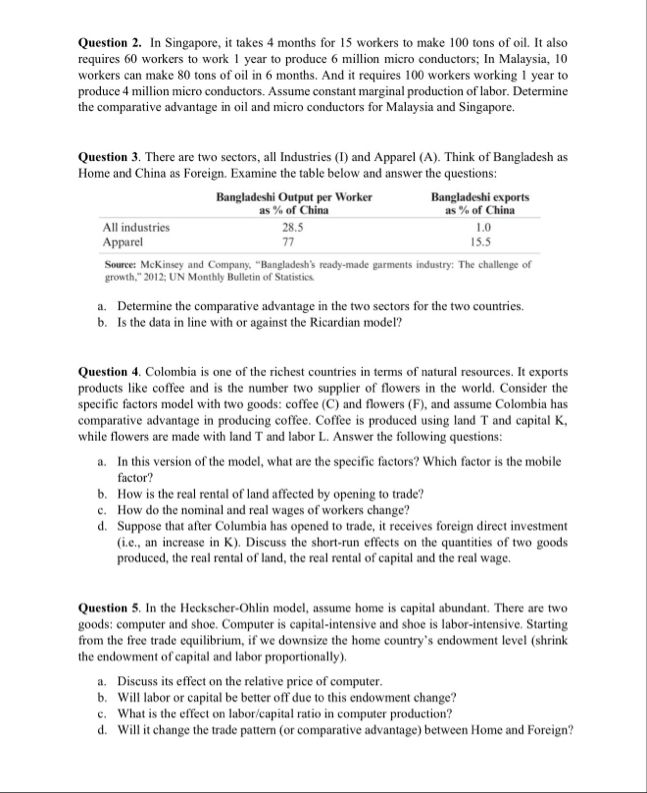 Question 2. In Singapore, it takes 4 months for 15 workers to make 100 tons of oil. It also
requires 60 workers to work | year to produce 6 million micro conductors; In Malaysia, 10
workers can make 80 tons of ol in 6 months. And it requires 100 workers working 1 year to
produce 4 million micro conductors. Assume constant marginal production of bor. Determine
the comparative advantage in oil and micro conductors for Malaysia and Singapore.
Question 3. There are two sectors, all Industries (I) and Apparel (A). Think of Bangladesh as
Home and China as Foreign. Examine the table below and answer the questions
Bangladeshi Output per Worker Bangladeshi exports
5% of China as % of Chima
Allindustries 85 10
Apparct n 155
Source: McKinsey and Company, “Bangladesh's ready-made garments industry: The chllnge of
srowth.” 2012: UN Mootbly Bulletin of Ssisics
a. Determine the comparative advantage in the two sectors for the two countries.
b. Isthe data in line with or against the Ricardian model?
Question 4. Colombia is one of the richest countries in terms of natural resources. It exports
products like coffee and is the number two supplier of flowers in the world, Consider the
specific factors model with two goods: coffee (C) and flowers (F), and assume Colombia has
comparative advantage in producing coffe. Coffee is produced using land T and capital K,
while flowers are made with land T and labor L. Answer the following questions:
a. In this version of the model, what are the specific factors? Which factor is the mobile
factor?
b. How is the real rental of land affected by opening to trade?
c.. How do the nominal and real wages of workers change?
d. Suppose that after Columbia has opened 0 trade, it receives foreign direct investment
(ie, an increase in K). Discuss the short-run effects on the quantities of two goods
produced, the real rental of land, the real rental of capital and the real wage.
Question 5. In the Heckscher-Ohlin model, assume home is capital abundant, There are two
‘goods: computer and shoe. Computer is capital-intensive and shoe is labor-intensive. Starting
from the free trade equilibrium, if we downsize the home country’s endowment level (shrink
the endowment of capital and labor proportionally).
a. Discuss its effect on the relative price of computer.
b.. Will labor or capital be beter off due to this endowment change?
©. What s the effect on labor/capital ratio in computer production?
d. Will it change the trade pattem (or comparative advantage) between Home and Foreign?
Question 2. In Singapore, it takes 4 months for 15 workers to make 100 tons of oil. It also
requires 60 workers to work | year to produce 6 million micro conductors; In Malaysia, 10
workers can make 80 tons of ol in 6 months. And it requires 100 workers working 1 year to
produce 4 million micro conductors. Assume constant marginal production of bor. Determine
the comparative advantage in oil and micro conductors for Malaysia and Singapore.
Question 3. There are two sectors, all Industries (I) and Apparel (A). Think of Bangladesh as
Home and China as Foreign. Examine the table below and answer the questions
Bangladeshi Output per Worker Bangladeshi exports
5% of China as % of Chima
Allindustries 85 10
Apparct n 155
Source: McKinsey and Company, “Bangladesh's ready-made garments industry: The chllnge of
srowth.” 2012: UN Mootbly Bulletin of Ssisics
a. Determine the comparative advantage in the two sectors for the two countries.
b. Isthe data in line with or against the Ricardian model?
Question 4. Colombia is one of the richest countries in terms of natural resources. It exports
products like coffee and is the number two supplier of flowers in the world, Consider the
specific factors model with two goods: coffee (C) and flowers (F), and assume Colombia has
comparative advantage in producing coffe. Coffee is produced using land T and capital K,
while flowers are made with land T and labor L. Answer the following questions:
a. In this version of the model, what are the specific factors? Which factor is the mobile
factor?
b. How is the real rental of land affected by opening to trade?
c.. How do the nominal and real wages of workers change?
d. Suppose that after Columbia has opened 0 trade, it receives foreign direct investment
(ie, an increase in K). Discuss the short-run effects on the quantities of two goods
produced, the real rental of land, the real rental of capital and the real wage.
Question 5. In the Heckscher-Ohlin model, assume home is capital abundant, There are two
‘goods: computer and shoe. Computer is capital-intensive and shoe is labor-intensive. Starting
from the free trade equilibrium, if we downsize the home country’s endowment level (shrink
the endowment of capital and labor proportionally).
a. Discuss its effect on the relative price of computer.
b.. Will labor or capital be beter off due to this endowment change?
©. What s the effect on labor/capital ratio in computer production?
d. Will it change the trade pattem (or comparative advantage) between Home and Foreign?
Asked by: Rahul
Created at: 2025-12-06 02:20:04
Final Answer:
📢 Instructions:
- Ask anything relatd to above question only.
- For new Question goto :