 VIPSolutions
give answer in 2 step with explanation at the end of each step and final answer at the end:Automation Procedure: An injection molding process is being automated to measure the weight of molded parts and to automatically reject short shots. The order of operations with necessary timing will proceed as follows: © T=0sec— Mold reaches mold open limit (triggers automation cycle) © T=2sec Part jected and received by robot EOAT © T=7sec— EOAT de-gates parts, drops runner in grinder, and places parts on conveyer belt T= 10sec — Conveyer belt advances forward dropping part onto weighing scale © T= 15 sec — Scale weighs parts © T=20 sec Part sorting initiated. © Ifweight is over setpoint valve for full shot air jet blows parts into inventory bin. © Ifweight is below setpoint valve for full shot —air jet blows parts into scrap bin. © T=30 sec — Molding cycle completes, and mold reaches mold open limit triggering next automation cycle. Design Specifications: «Assume that you are wiring this onto the Sumitomo injection molding machine using the relays on the robot interface board as shown in the figure below. The machine controls these relay contacts and closes them at the corresponding point in the molding cycle. «Assume that you are wiring to an Arlyn scale with setpoint control using the provided relay wiring. The scale will close these relay contacts based on programmed weight setpoint. «Assume that you are using an Allen Bradley PLC identical to the ones used during lab. After 10 defective cycles a buzzer should be activated to alert the operator. Question 1: Design the pneumatic circuit required for part sorting and explain the operation. Question #2: Design the electrical circuit(s) that connects the machine, the PLC, and the scale. Assume that all the inputs and outputs to and from the PLC should be 24VDC. Question #3: Design the PLC ladder logic that will initiate on the Mold Open Limit trigger, delay until the conveyor has dropped the parts onto the scale and then allow time for weighing. Subsequently, a 5 second air jet will either send the parts to the inventory bin while illuminating a green light, or the scrap bin while illuminating a red light. All scrap parts will be counted, and the program will initiate a buzzer when the defect count reaches 10 bad cycles and pause the injection ‘molding machine by prohibiting mold close. Submission: Model your solution in Automation Studio and document the operation with images of the simulation and descriptions thereof. Include the electrical circuits, pneumatic circuits, and PLC ladder logic. Substitute manual switches for machine-controlled relay contacts. Recommended Reading: An excerpt from the Sumitomo manual is provided, which covers how to interface external equipment to the molding machine. You will need this to find how to send a signal back to the machine to interrupt the molding cycle.
Question:
give answer in 2 step with explanation at the end of each step and final answer at the end: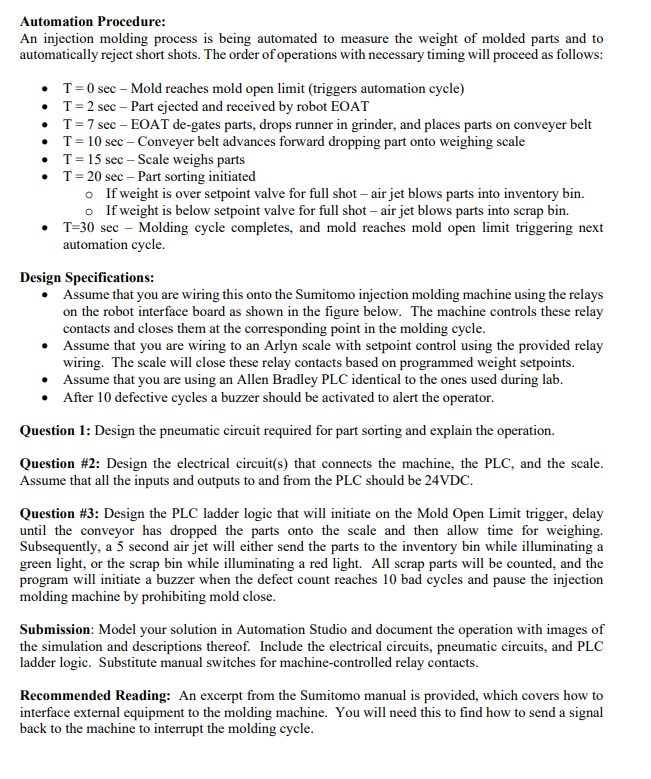 Automation Procedure:
An injection molding process is being automated to measure the weight of molded parts and to
automatically reject short shots. The order of operations with necessary timing will proceed as follows:
© T=0sec— Mold reaches mold open limit (triggers automation cycle)
© T=2sec Part jected and received by robot EOAT
© T=7sec— EOAT de-gates parts, drops runner in grinder, and places parts on conveyer belt
T= 10sec — Conveyer belt advances forward dropping part onto weighing scale
© T= 15 sec — Scale weighs parts
© T=20 sec Part sorting initiated.
© Ifweight is over setpoint valve for full shot air jet blows parts into inventory bin.
© Ifweight is below setpoint valve for full shot —air jet blows parts into scrap bin.
© T=30 sec — Molding cycle completes, and mold reaches mold open limit triggering next
automation cycle.
Design Specifications:
«Assume that you are wiring this onto the Sumitomo injection molding machine using the relays
on the robot interface board as shown in the figure below. The machine controls these relay
contacts and closes them at the corresponding point in the molding cycle.
«Assume that you are wiring to an Arlyn scale with setpoint control using the provided relay
wiring. The scale will close these relay contacts based on programmed weight setpoint.
«Assume that you are using an Allen Bradley PLC identical to the ones used during lab.
After 10 defective cycles a buzzer should be activated to alert the operator.
Question 1: Design the pneumatic circuit required for part sorting and explain the operation.
Question #2: Design the electrical circuit(s) that connects the machine, the PLC, and the scale.
Assume that all the inputs and outputs to and from the PLC should be 24VDC.
Question #3: Design the PLC ladder logic that will initiate on the Mold Open Limit trigger, delay
until the conveyor has dropped the parts onto the scale and then allow time for weighing.
Subsequently, a 5 second air jet will either send the parts to the inventory bin while illuminating a
green light, or the scrap bin while illuminating a red light. All scrap parts will be counted, and the
program will initiate a buzzer when the defect count reaches 10 bad cycles and pause the injection
‘molding machine by prohibiting mold close.
Submission: Model your solution in Automation Studio and document the operation with images of
the simulation and descriptions thereof. Include the electrical circuits, pneumatic circuits, and PLC
ladder logic. Substitute manual switches for machine-controlled relay contacts.
Recommended Reading: An excerpt from the Sumitomo manual is provided, which covers how to
interface external equipment to the molding machine. You will need this to find how to send a signal
back to the machine to interrupt the molding cycle.
Automation Procedure:
An injection molding process is being automated to measure the weight of molded parts and to
automatically reject short shots. The order of operations with necessary timing will proceed as follows:
© T=0sec— Mold reaches mold open limit (triggers automation cycle)
© T=2sec Part jected and received by robot EOAT
© T=7sec— EOAT de-gates parts, drops runner in grinder, and places parts on conveyer belt
T= 10sec — Conveyer belt advances forward dropping part onto weighing scale
© T= 15 sec — Scale weighs parts
© T=20 sec Part sorting initiated.
© Ifweight is over setpoint valve for full shot air jet blows parts into inventory bin.
© Ifweight is below setpoint valve for full shot —air jet blows parts into scrap bin.
© T=30 sec — Molding cycle completes, and mold reaches mold open limit triggering next
automation cycle.
Design Specifications:
«Assume that you are wiring this onto the Sumitomo injection molding machine using the relays
on the robot interface board as shown in the figure below. The machine controls these relay
contacts and closes them at the corresponding point in the molding cycle.
«Assume that you are wiring to an Arlyn scale with setpoint control using the provided relay
wiring. The scale will close these relay contacts based on programmed weight setpoint.
«Assume that you are using an Allen Bradley PLC identical to the ones used during lab.
After 10 defective cycles a buzzer should be activated to alert the operator.
Question 1: Design the pneumatic circuit required for part sorting and explain the operation.
Question #2: Design the electrical circuit(s) that connects the machine, the PLC, and the scale.
Assume that all the inputs and outputs to and from the PLC should be 24VDC.
Question #3: Design the PLC ladder logic that will initiate on the Mold Open Limit trigger, delay
until the conveyor has dropped the parts onto the scale and then allow time for weighing.
Subsequently, a 5 second air jet will either send the parts to the inventory bin while illuminating a
green light, or the scrap bin while illuminating a red light. All scrap parts will be counted, and the
program will initiate a buzzer when the defect count reaches 10 bad cycles and pause the injection
‘molding machine by prohibiting mold close.
Submission: Model your solution in Automation Studio and document the operation with images of
the simulation and descriptions thereof. Include the electrical circuits, pneumatic circuits, and PLC
ladder logic. Substitute manual switches for machine-controlled relay contacts.
Recommended Reading: An excerpt from the Sumitomo manual is provided, which covers how to
interface external equipment to the molding machine. You will need this to find how to send a signal
back to the machine to interrupt the molding cycle.
Asked by: Rahul
Created at: 2025-12-10 07:02:24
Final Answer:
Question:
All parts solved
Asked by: Rahul
Created at: 2025-12-10 07:03:04
Final Answer:
📢 Instructions:
- Ask anything relatd to above question only.
- For new Question goto :