 VIPSolutions
give answer in 2 step with explanation at the end of each step and final answer at the end:An infamous event that came to be known as the Saturday Night Massacre took place during the second term of the presidential administration of Richard Nixon. Though no one was fired upon, many were effectively fired from their high - level positions in the federal government. The Nixon White House was in the midst of covering up crimes committed by close aides to the president. As part of the investigation, Attorney General Elliot Richard - son (who was not part of the cover - up) named Harvard Law professor Archibald Cox as a special prosecutor. During the investigation, President Nixon was acutely concerned with Cox's investigation and contemplated ordering Richardson to fire Cox (expressed as the initial decision node in the figure below. When Nixon's intent was expressed to Richard - son, the latter conveyed that if he did fire Cox, he might feel compelled to resign, but also that he might be inclined not to fire Cox and, in that case, might also resign. Richardson's four possible combinations of firing Cox or not and resigning or not are depicted in the extensive form. If Richardson did choose to resign and not fire Cox, then Nixon would still be left with the matter of getting rid of Cox. And if Richardson chose not to fire Cox and did not resign, then Nixon would have to decide whether to fire Richardson. Upon Richardson's departure, Deputy Attorney General William Ruckelshaus would assume the position of acting attorney general and would face the same four options as Richardson. If Ruckelshaus also chose to resign and not fire Cox, then Solicitor General Robert Bork would become acting attorney general, and again, he would have the same four choices. To simplify matters, we'll not model Bork, even though what happened was that Richardson refused to fire Cox and resigned and Ruckelshaus did the same, at which point Bork came in and did fire Cox and did not resign. Find all subgame perfect Nash equilibria. —~ 2 Donot omer Richardson 12 Nixon Ruckelshaus 12 Order Richardson Do not fire &, Do not fire & Resign Do not resign Fire & Fire & Resign Do not resign Ruckelshaus Nixon 1" 12 2 1 Do not fire &, 6 s ae Fire &\_ Do not fire & Fre & Do not "\ D0 not resign Fire, Doct ie Resign resign 6 ° 10 5 10 6 5 8 10 4 2 ° Ruckelshaus 1" Do not fire & Do not fire & 1 Resign Do not resign Fre & Fire & roel Do not resign 4 7 8 3 ° 4 3 7 8 3 1 7
Question:
give answer in 2 step with explanation at the end of each step and final answer at the end: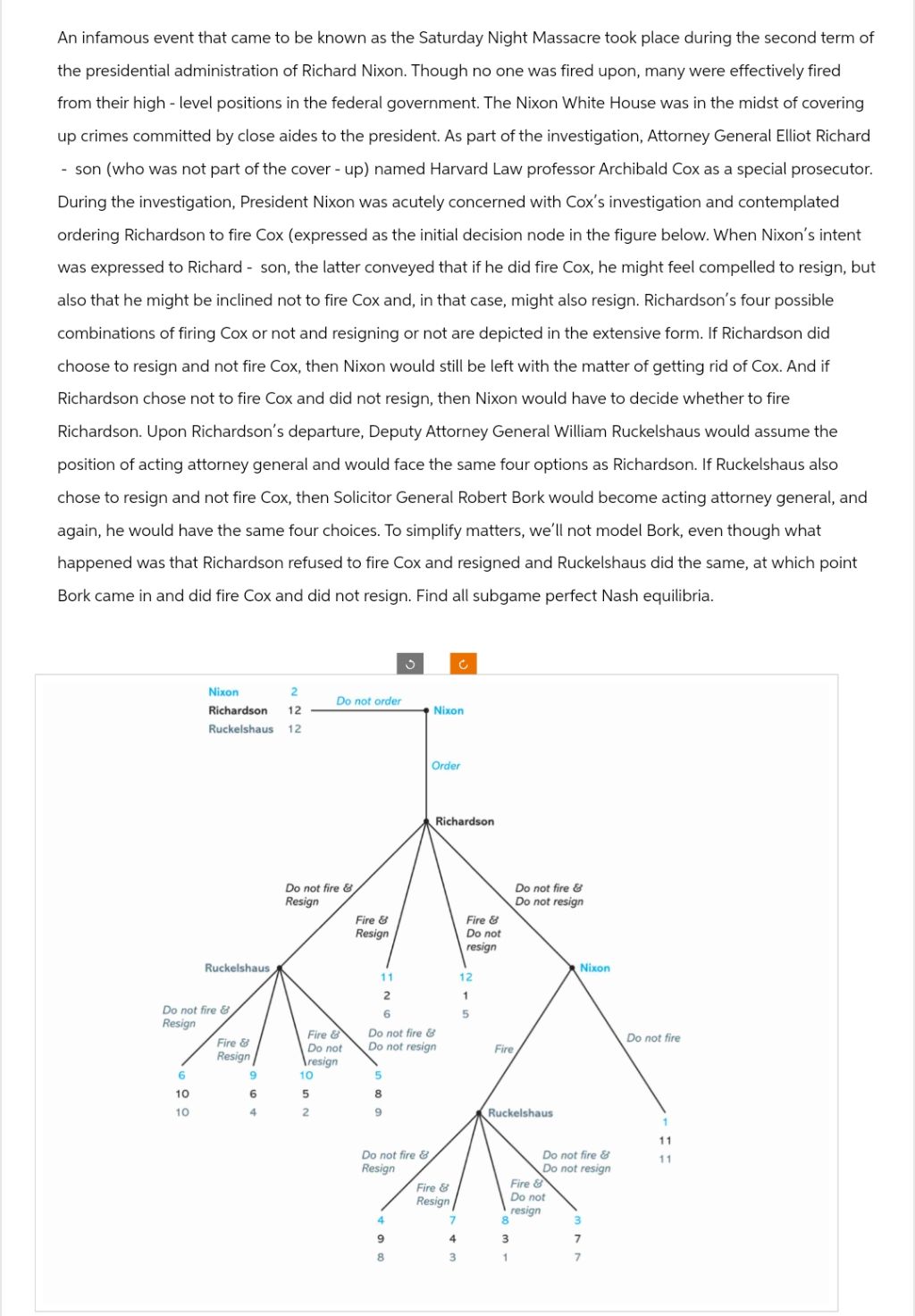 An infamous event that came to be known as the Saturday Night Massacre took place during the second term of
the presidential administration of Richard Nixon. Though no one was fired upon, many were effectively fired
from their high - level positions in the federal government. The Nixon White House was in the midst of covering
up crimes committed by close aides to the president. As part of the investigation, Attorney General Elliot Richard
- son (who was not part of the cover - up) named Harvard Law professor Archibald Cox as a special prosecutor.
During the investigation, President Nixon was acutely concerned with Cox's investigation and contemplated
ordering Richardson to fire Cox (expressed as the initial decision node in the figure below. When Nixon's intent
was expressed to Richard - son, the latter conveyed that if he did fire Cox, he might feel compelled to resign, but
also that he might be inclined not to fire Cox and, in that case, might also resign. Richardson's four possible
combinations of firing Cox or not and resigning or not are depicted in the extensive form. If Richardson did
choose to resign and not fire Cox, then Nixon would still be left with the matter of getting rid of Cox. And if
Richardson chose not to fire Cox and did not resign, then Nixon would have to decide whether to fire
Richardson. Upon Richardson's departure, Deputy Attorney General William Ruckelshaus would assume the
position of acting attorney general and would face the same four options as Richardson. If Ruckelshaus also
chose to resign and not fire Cox, then Solicitor General Robert Bork would become acting attorney general, and
again, he would have the same four choices. To simplify matters, we'll not model Bork, even though what
happened was that Richardson refused to fire Cox and resigned and Ruckelshaus did the same, at which point
Bork came in and did fire Cox and did not resign. Find all subgame perfect Nash equilibria.
—~ 2 Donot omer
Richardson 12 Nixon
Ruckelshaus 12
Order
Richardson
Do not fire &, Do not fire &
Resign Do not resign
Fire & Fire &
Resign Do not
resign
Ruckelshaus Nixon
1" 12
2 1
Do not fire &, 6 s
ae Fire &\_ Do not fire &
Fre & Do not "\ D0 not resign Fire, Doct ie
Resign resign
6 ° 10 5
10 6 5 8
10 4 2 ° Ruckelshaus
1"
Do not fire & Do not fire & 1
Resign Do not resign
Fre & Fire &
roel Do not
resign
4 7 8 3
° 4 3 7
8 3 1 7
An infamous event that came to be known as the Saturday Night Massacre took place during the second term of
the presidential administration of Richard Nixon. Though no one was fired upon, many were effectively fired
from their high - level positions in the federal government. The Nixon White House was in the midst of covering
up crimes committed by close aides to the president. As part of the investigation, Attorney General Elliot Richard
- son (who was not part of the cover - up) named Harvard Law professor Archibald Cox as a special prosecutor.
During the investigation, President Nixon was acutely concerned with Cox's investigation and contemplated
ordering Richardson to fire Cox (expressed as the initial decision node in the figure below. When Nixon's intent
was expressed to Richard - son, the latter conveyed that if he did fire Cox, he might feel compelled to resign, but
also that he might be inclined not to fire Cox and, in that case, might also resign. Richardson's four possible
combinations of firing Cox or not and resigning or not are depicted in the extensive form. If Richardson did
choose to resign and not fire Cox, then Nixon would still be left with the matter of getting rid of Cox. And if
Richardson chose not to fire Cox and did not resign, then Nixon would have to decide whether to fire
Richardson. Upon Richardson's departure, Deputy Attorney General William Ruckelshaus would assume the
position of acting attorney general and would face the same four options as Richardson. If Ruckelshaus also
chose to resign and not fire Cox, then Solicitor General Robert Bork would become acting attorney general, and
again, he would have the same four choices. To simplify matters, we'll not model Bork, even though what
happened was that Richardson refused to fire Cox and resigned and Ruckelshaus did the same, at which point
Bork came in and did fire Cox and did not resign. Find all subgame perfect Nash equilibria.
—~ 2 Donot omer
Richardson 12 Nixon
Ruckelshaus 12
Order
Richardson
Do not fire &, Do not fire &
Resign Do not resign
Fire & Fire &
Resign Do not
resign
Ruckelshaus Nixon
1" 12
2 1
Do not fire &, 6 s
ae Fire &\_ Do not fire &
Fre & Do not "\ D0 not resign Fire, Doct ie
Resign resign
6 ° 10 5
10 6 5 8
10 4 2 ° Ruckelshaus
1"
Do not fire & Do not fire & 1
Resign Do not resign
Fre & Fire &
roel Do not
resign
4 7 8 3
° 4 3 7
8 3 1 7
Asked by: Rahul
Created at: 2025-12-10 08:26:24
Final Answer:
📢 Instructions:
- Ask anything relatd to above question only.
- For new Question goto :