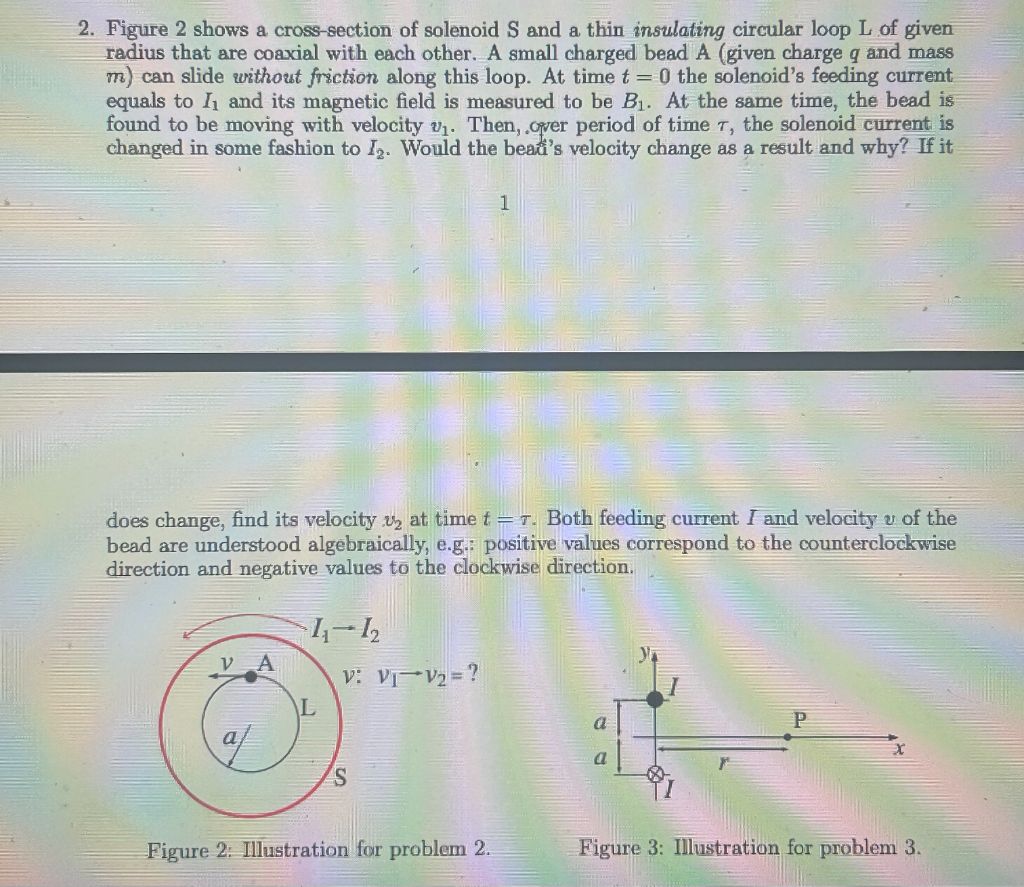
give answer in 2 step with explanation at the end of each step and final answer at the end:2. Figure 2 shows a cross-section of solenoid S and a thin insulating circular loop L of given 5
radius that are coaxial with each other. A small charged bead A (given charge g and mass
m) can slide without friction along this loop. At time ¢ = 0 the solenoid’s feeding current
equals to I; and its magnetic field is measured to be Bj. At the same time, the bead is
= found to be moving with velocity v;. hen, eer period of time 7, the solenoid current is =
changed in some fashion to J,. Would the beadi’s velocity change as a result and why? Ifit
> 1 =
does change, find its velocity v, at time { = 7. Both feeding current I and velocity v of the
bead are understood algebraically, e.g.: positive values correspond to the counterclockwise
direction and negative values to the clockwise direction, = =
= =i 4
= Ys = =
= Led \v: vi—v=? Bm = i
= IE a = =
= = a | br i= x =
= —— 3 He E—
E ie fh = ==
fal = = he —
= Figure 2: Illustration for problem 2. Figure 3: oe fe —
== — — — EEE ities ===
Question:
give answer in 2 step with explanation at the end of each step and final answer at the end:2. Figure 2 shows a cross-section of solenoid S and a thin insulating circular loop L of given 5
radius that are coaxial with each other. A small charged bead A (given charge g and mass
m) can slide without friction along this loop. At time ¢ = 0 the solenoid’s feeding current
equals to I; and its magnetic field is measured to be Bj. At the same time, the bead is
= found to be moving with velocity v;. hen, eer period of time 7, the solenoid current is =
changed in some fashion to J,. Would the beadi’s velocity change as a result and why? Ifit
> 1 =
does change, find its velocity v, at time { = 7. Both feeding current I and velocity v of the
bead are understood algebraically, e.g.: positive values correspond to the counterclockwise
direction and negative values to the clockwise direction, = =
= =i 4
= Ys = =
= Led \v: vi—v=? Bm = i
= IE a = =
= = a | br i= x =
= —— 3 He E—
E ie fh = ==
fal = = he —
= Figure 2: Illustration for problem 2. Figure 3: oe fe —
== — — — EEE ities ===
This is AI generated Response.
Asked by: Rahul
Created at: 2025-12-12 04:06:39
Final Answer:
RenderedRaw Text
Did you like this answer?
## Step 1: Understanding the Physical Situation
The solenoid creates a magnetic field \( B \) along its axis, which passes through the loop \( L \). The bead of charge \( q \) moves on the loop (radius \( a \)), with initial velocity \( v_1 \) at \( t= \). The solenoid current changes from \( I_1 \) to \( I_2 \) over time \( \tau \), causing the magnetic field to change from \( B_1 \) to \( B_2).
**Explanation:**
A changing magnetic field through loop \( L \) induces an electromotive force (EMF) in the loop (Faraday's Law). This EMF will exert a tangential electric force on the charged bead, changing its velocity.
---
## Step 2: Applying Faraday's Law and Newton's 2nd Law
**Faraday’s Law:**
The induced EMF around the loop is
\[
\mathcal{E} = -\frac{d\Phi_B}{dt}
\]
where \(\Phi_B = B \cdot A = B \cdot \pi a^2\).
So,
\[
\mathcal{E} = -\pi a^2 \frac{dB}{dt}
\]
This EMF causes a tangential electric field \( E = \frac{\mathcal{E}}{2\pi a} \), which exerts a force \( F = qE \) on the bead:
\[
F = q \cdot \left(-\frac{a}{2} \frac{dB}{dt}\right)
\]
By Newton’s 2nd Law:
\[
F = m \frac{dv}{dt}
\]
\[
m \frac{dv}{dt} = -\frac{q a}{2}\frac{dB}{dt}
\]
Integrating both sides over time from to \(\tau\):
\[
\int_{v_1}^{v_2} m\,dv = -\frac{q a}{2} \int_{B_1}^{B_2} dB
\]
\[
m(v_2-v_1) = -\frac{q a}{2}(B_2 - B_1)
\]
\[
v_2 = v_1 - \frac{q a}{2m} (B_2 - B_1)
\]
**Explanation:**
The bead's velocity changes due to the induced electric field from the changing magnetic field. The direction/sign of the change depends on the sign of \(q\) and whether \(B\) increases or decreases.
---
## Final Answer
\[
\boxed{v_2 = v_1 - \frac{q a}{2m} (B_2 - B_1)}
\]
Where:
- \(v_1\) = initial bead velocity,
- \(q\) = bead's charge,
- \(a\) = loop radius,
- \(m\) = bead's mass,
- \(B_1\), \(B_2\) = initial and final magnetic fields (proportional to \(I_1, I_2\)).
**Summary:**
Yes, the bead's velocity changes as a result of the changing solenoid current due to the induced electric field (Faraday's Law). The exact change is given by the formula above.
Question:
Then solved
This is AI generated Response.
Asked by: Rahul
Created at: 2025-12-12 04:07:39
Final Answer:
RenderedRaw Text
Did you like this answer?
## Step 1: Understanding the Physical Situation
The solenoid generates a magnetic field \( B \) along its axis, affecting the circular loop \( L \) that is coaxial with it. A charged bead \( A \), with charge \( q \) and mass \( m \), slides along the loop without friction. At time \( t = 0 \), the solenoid has a current \( I_1 \) and a magnetic field \( B_1 \), while the bead has an initial velocity \( v_1 \). When the current changes to \( I_2 \) at time \( t = \tau \), the magnetic field changes from \( B_1 \) to \( B_2 \).
**Explanation:**
The change in the magnetic field through the loop induces an electromotive force (EMF) in the loop, according to Faraday's Law. This EMF generates an electric field that exerts a force on the charged bead, which can change its velocity.
---
## Step 2: Applying Faraday's Law and Newton's 2nd Law
**Faraday’s Law:**
The induced EMF around the loop is given by
\[
\mathcal{E} = -\frac{d\Phi_B}{dt}
\]
where \(\Phi_B = B \cdot A = B \cdot \pi a^2\) (area of the loop).
Thus, the induced EMF is:
\[
\mathcal{E} = -\pi a^2 \frac{dB}{dt}
\]
This EMF creates a tangential electric field \( E \) around the loop:
\[
E = \frac{\mathcal{E}}{2\pi a} = -\frac{a}{2} \frac{dB}{dt}
\]
The force \( F \) acting on the bead is:
\[
F = qE = q \left(-\frac{a}{2} \frac{dB}{dt}\right)
\]
Using Newton’s second law, we have:
\[
F = m \frac{dv}{dt}
\]
Setting the forces equal gives:
\[
m \frac{dv}{dt} = -\frac{q a}{2} \frac{dB}{dt}
\]
Integrating from \( v_1 \) to \( v_2 \) over time \( \tau \):
\[
\int_{v_1}^{v_2} m\,dv = -\frac{q a}{2} \int_{B_1}^{B_2} dB
\]
This results in:
\[
m(v_2 - v_1) = -\frac{q a}{2}(B_2 - B_1)
\]
Rearranging gives:
\[
v_2 = v_1 - \frac{q a}{2m} (B_2 - B_1)
\]
**Explanation:**
The bead's velocity changes due to the induced electric field resulting from the changing magnetic field. The direction and magnitude of this change depend on the charge \( q \) of the bead and the nature of the change in the magnetic field.
---
## Final Answer
\[
\boxed{v_2 = v_1 - \frac{q a}{2m} (B_2 - B_1)}
\]
Where:
- \( v_1 \) = initial velocity of the bead,
- \( q \) = charge of the bead,
- \( a \) = radius of the loop,
- \( m \) = mass of the bead,
- \( B_1 \), \( B_2 \) = initial and final magnetic fields (related to \( I_1 \) and \( I_2 \)).
**Summary:**
Yes, the bead's velocity changes due to the induced electric field from the changing solenoid current. The change in velocity is given by the formula above.
VIPSolutions focuses on clear, step‑by‑step explanations so you can learn quickly. Whether you need an AI‑generated walkthrough or a short hint to get unstuck, each solution is organized for fast reading and easy review later.
Search similar questions, compare approaches, and bookmark the best answers for revision. Our goal is simple: quick, reliable study help that feels natural—not noisy.
 VIPSolutions
 2. Figure 2 shows a cross-section of solenoid S and a thin insulating circular loop L of given 5
radius that are coaxial with each other. A small charged bead A (given charge g and mass
m) can slide without friction along this loop. At time ¢ = 0 the solenoid’s feeding current
equals to I; and its magnetic field is measured to be Bj. At the same time, the bead is
= found to be moving with velocity v;. hen, eer period of time 7, the solenoid current is =
changed in some fashion to J,. Would the beadi’s velocity change as a result and why? Ifit
> 1 =
does change, find its velocity v, at time { = 7. Both feeding current I and velocity v of the
bead are understood algebraically, e.g.: positive values correspond to the counterclockwise
direction and negative values to the clockwise direction, = =
= =i 4
= Ys = =
= Led \v: vi—v=? Bm = i
= IE a = =
= = a | br i= x =
= —— 3 He E—
E ie fh = ==
fal = = he —
= Figure 2: Illustration for problem 2. Figure 3: oe fe —
== — — — EEE ities ===
2. Figure 2 shows a cross-section of solenoid S and a thin insulating circular loop L of given 5
radius that are coaxial with each other. A small charged bead A (given charge g and mass
m) can slide without friction along this loop. At time ¢ = 0 the solenoid’s feeding current
equals to I; and its magnetic field is measured to be Bj. At the same time, the bead is
= found to be moving with velocity v;. hen, eer period of time 7, the solenoid current is =
changed in some fashion to J,. Would the beadi’s velocity change as a result and why? Ifit
> 1 =
does change, find its velocity v, at time { = 7. Both feeding current I and velocity v of the
bead are understood algebraically, e.g.: positive values correspond to the counterclockwise
direction and negative values to the clockwise direction, = =
= =i 4
= Ys = =
= Led \v: vi—v=? Bm = i
= IE a = =
= = a | br i= x =
= —— 3 He E—
E ie fh = ==
fal = = he —
= Figure 2: Illustration for problem 2. Figure 3: oe fe —
== — — — EEE ities ===