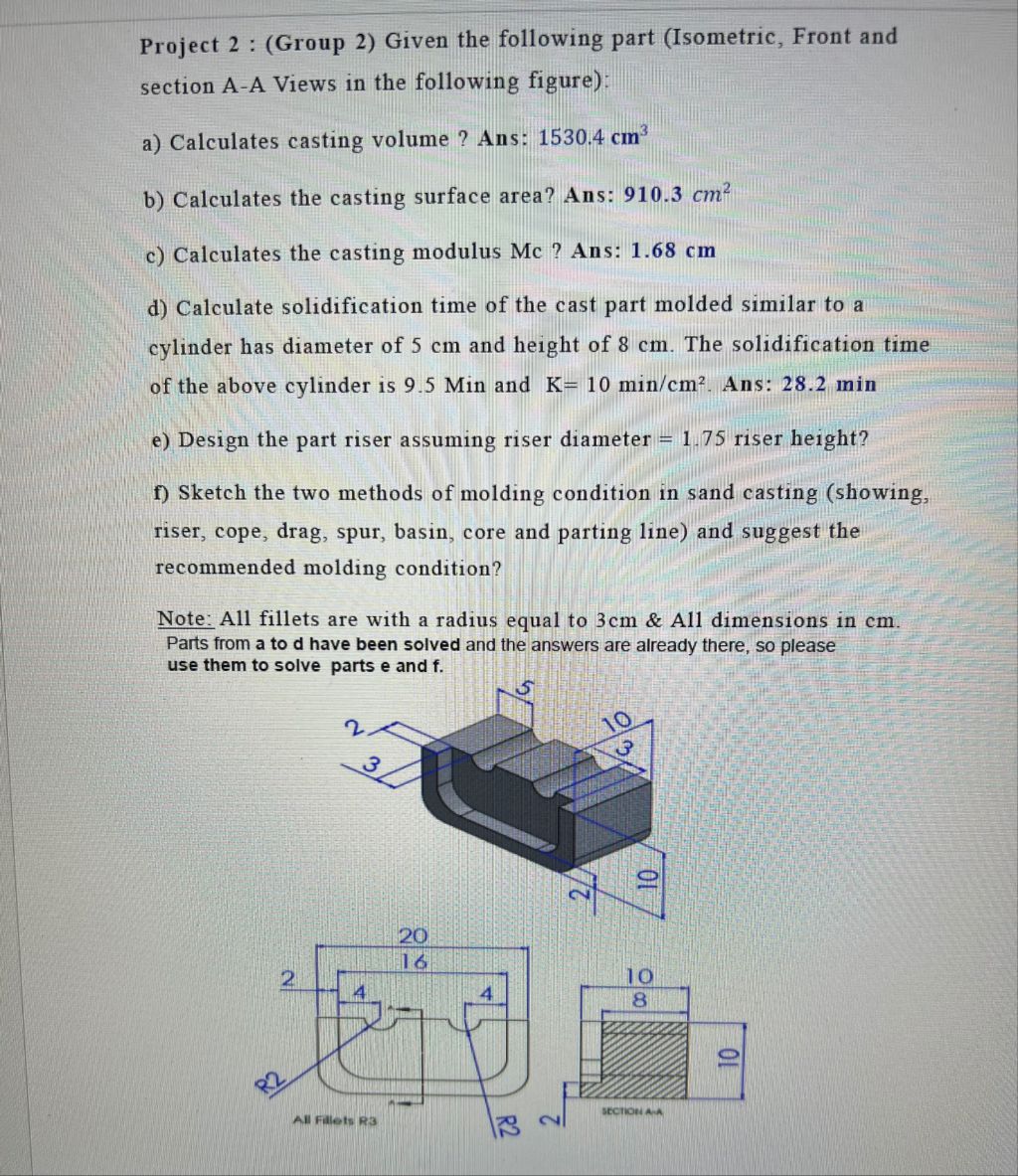
give answer in 2 step with explanation at the end of each step and final answer at the end:HH Project 2 : (Group 2) Given the following part (Isometric, Front and .
section A-A Views in the following figure):
a) Calculates casting volume ? Ans: 1530.4 cm’ |
b) Calculates the casting surface area? Ans: 910.3 cm? |
¢) Calculates the casting modulus Mc ? Ans: 1.68 cm
i d) Calculate solidification time of the cast part molded similar to a |
| cylinder has diameter of 5 cm and height of 8 em. The solidification time
He of the above cylinder 1s 9.5 Min and K= 10 min/cm? Ans: 28.2 min |
||| e) Design the part riser assuming riser diameter = 1.75 riser height?
Ii! | D Sketch the two methods of molding condition in sand casting (showing,
riser, cope, drag, spur, basin, core and parting line) and suggest the |
| recommended molding condition?
| :
Note: All fillets are with a radius equal to 3cm & All dimensions in cm. |
Parts from a to d have been solved and the answers are already there, so please
use them to solve parts e and f.
| J |
{ at QO.
ENS" SR
s =
| I
=~ | |
| 20
io
4 a id |
SES HE
of I eZ
| ihvy: [|
a & liste BZ
ia AN Filets Ra Ro — |
Ll
Question:
give answer in 2 step with explanation at the end of each step and final answer at the end:HH Project 2 : (Group 2) Given the following part (Isometric, Front and .
section A-A Views in the following figure):
a) Calculates casting volume ? Ans: 1530.4 cm’ |
b) Calculates the casting surface area? Ans: 910.3 cm? |
¢) Calculates the casting modulus Mc ? Ans: 1.68 cm
i d) Calculate solidification time of the cast part molded similar to a |
| cylinder has diameter of 5 cm and height of 8 em. The solidification time
He of the above cylinder 1s 9.5 Min and K= 10 min/cm? Ans: 28.2 min |
||| e) Design the part riser assuming riser diameter = 1.75 riser height?
Ii! | D Sketch the two methods of molding condition in sand casting (showing,
riser, cope, drag, spur, basin, core and parting line) and suggest the |
| recommended molding condition?
| :
Note: All fillets are with a radius equal to 3cm & All dimensions in cm. |
Parts from a to d have been solved and the answers are already there, so please
use them to solve parts e and f.
| J |
{ at QO.
ENS" SR
s =
| I
=~ | |
| 20
io
4 a id |
SES HE
of I eZ
| ihvy: [|
a & liste BZ
ia AN Filets Ra Ro — |
Ll
This is AI generated Response.
Asked by: Rahul
Created at: 2025-12-14 17:55:16
Final Answer:
RenderedRaw Text
Did you like this answer?
## Part e: Design the Part Riser (Given: Riser Diameter = 1.75 × Riser Height)
### **Step 1 Use the Modulus Rule**
- The modulus of the riser should be higher than the casting's modulus to ensure it solidifies last.
- **Given:**
- Modulus of casting, \(M_c = 1.68\, \text{cm}\)
For a cylindrical riser:
\[
\text{Modulus (M)} = \frac{\text{Volume}}{\text{Surface Area}}
\]
For a cylinder of diameter \(D\) and height \(H\):
- Volume, \(V = \frac{\pi}{4} D^2 H\)
- Surface area, \(A = \pi D H + \frac{\pi}{2} D^2\) (side + one base exposed)
Set modulus of riser, \(M_r \geq 1.2 \times M_c\) (safety factor), so:
\[
M_r = \frac{V}{A} = \frac{\frac{\pi}{4} D^2 H}{\pi D H + \frac{\pi}{2} D^2}
\]
Simplify:
\[
M_r = \frac{D^2 H / 4}{D H + D^2/2}
\]
Given \(D = 1.75 H\):
- Substitute \(D\) in terms of \(H\):
\[
M_r = \frac{(1.75H)^2 H / 4}{1.75H \cdot H + (1.75H)^2/2}
\]
\[
= \frac{(3.0625H^3)/4}{1.75H^2 + (3.0625H^2)/2}
\]
Denominator:
\[
1.75H^2 + 1.53125H^2 = 3.28125H^2
\]
\[
M_r = \frac{.765625 H^3}{3.28125 H^2} = .2333 H
\]
Set \(M_r \geq 1.2 \times 1.68 = 2.02\, \text{cm}\):
\[
.2333 H \geq 2.02
\implies H \geq \frac{2.02}{.2333} \approx 8.66\, \text{cm}
\]
Now, \(D = 1.75 \times 8.66 = 15.16\, \text{cm}\)
**Explanation:**
- We calculated the minimum height for the riser using the modulus method and the given diameter-to-height ratio.
- This ensures the riser solidifies after the casting.
---
### **Step 2: Final Answer**
**Riser Height:**
\[
\boxed{8.66\, \text{cm}}
\]
**Riser Diameter:**
\[
\boxed{15.16\, \text{cm}}
\]
---
## Part f: Sketch and Recommended Molding Condition
### **Step 1: Sketch the Molding Conditions**
#### **Molding Condition 1: Horizontal Parting Line**
- **Elements:**
- Cope (top half), Drag (bottom half)
- Riser attached on top (cope)
- Sprue connects to basin, then to runner, then to the cavity
- Core for internal cavity
- Parting line is horizontal
#### **Molding Condition 2: Vertical Parting Line**
- **Elements:**
- Parting line is vertical
- Riser on the side
- Sprue, runner, and gate aligned accordingly
- Core (if necessary) positioned vertically
**(You would draw these, labeling: riser, sprue, basin, cope, drag, core, parting line)**
---
**Explanation:**
- Two common conditions are shown: horizontal (most common, easier for complex parts, gravity helps fill) and vertical (less common, useful for certain geometries).
---
### **Step 2: Recommended Molding Condition**
**Recommended:**
- **Horizontal Parting Line**
**Reason:**
- The part's geometry is best suited for horizontal parting; easier core placement and removal, better metal flow, and easier defect control.
---
## **Final Answer Summary**
**e) Riser Design:**
- Riser Height = **8.66 cm**
- Riser Diameter = **15.16 cm**
**f) Molding Condition:**
- Two methods: Horizontal and Vertical parting lines (sketch required).
- **Recommended:** Horizontal parting line for this part.
Question:
Solved please all parts
This is AI generated Response.
Asked by: Rahul
Created at: 2025-12-14 17:55:57
Final Answer:
RenderedRaw Text
Did you like this answer?
# HH Project 2: Casting Design and Analysis
## Part e: Design the Part Riser
### Step 1: Use the Modulus Rule
To ensure effective solidification, the modulus of the riser must be greater than that of the casting. Given the casting's modulus \(M_c\):
- **Modulus of Casting:**
\[
M_c = 1.68\, \text{cm}
\]
To find the required modulus for the riser, we use:
\[
M_r \geq 1.2 \times M_c = 2.02\, \text{cm}
\]
For a cylindrical riser:
\[
M = \frac{V}{A}
\]
Where:
- Volume \(V = \frac{\pi}{4} D^2 H\)
- Surface Area \(A = \pi D H + \frac{\pi}{2} D^2\)
Substituting \(D = 1.75 H\):
1. **Volume Calculation:**
\[
V = \frac{\pi}{4} (1.75 H)^2 H = \frac{\pi}{4} (3.0625 H^2) H = \frac{3.0625 \pi H^3}{4}
\]
2. **Surface Area Calculation:**
\[
A = \pi (1.75 H) H + \frac{\pi}{2} (1.75 H)^2 = \pi (1.75 H^2) + \frac{3.0625 \pi H^2}{2} = (1.75 + 1.53125) \pi H^2 = 3.28125 \pi H^2
\]
3. **Modulus Calculation:**
\[
M_r = \frac{V}{A} = \frac{\frac{3.0625 \pi H^3}{4}}{3.28125 \pi H^2} = \frac{3.0625 H}{4 \cdot 3.28125} = 0.2333 H
\]
Setting \(M_r \geq 2.02\):
\[
0.2333 H \geq 2.02 \implies H \geq \frac{2.02}{0.2333} \approx 8.66\, \text{cm}
\]
4. **Calculate Diameter:**
\[
D = 1.75 \times 8.66 \approx 15.16\, \text{cm}
\]
**Explanation:**
We calculated the minimum riser height \(H\) required for effective solidification using the modulus method, ensuring that the riser solidifies after the casting.
### Step 2: Final Answer
- **Riser Height:**
\[
\boxed{8.66\, \text{cm}}
\]
- **Riser Diameter:**
\[
\boxed{15.16\, \text{cm}}
\]
---
## Part f: Sketch and Recommended Molding Condition
### Step 1: Sketch the Molding Conditions
#### Molding Condition 1: Horizontal Parting Line
- **Elements:**
- Cope (top half)
- Drag (bottom half)
- Riser attached on the cope
- Sprue connects to basin, runner, and cavity
- Core for internal cavity
- **Parting line:** Horizontal
#### Molding Condition 2: Vertical Parting Line
- **Elements:**
- Parting line is vertical
- Riser on the side
- Sprue, runner, and gate aligned accordingly
- Core positioned vertically
**(Sketch these elements, labeling each part clearly.)**
### Step 2: Recommended Molding Condition
**Recommended:**
- **Horizontal Parting Line**
**Reason:**
- This method is easier for complex geometries, facilitates better metal flow, and simplifies core placement and removal, leading to improved defect control.
---
## Final Answer Summary
**e) Riser Design:**
- Riser Height: **8.66 cm**
- Riser Diameter: **15.16 cm**
**f) Molding Condition:**
- Two methods: Horizontal and Vertical parting lines (sketch required).
- **Recommended:** Horizontal parting line for optimal casting performance.
Question:
Solved parts a,b,c d,e,f
This is AI generated Response.
Asked by: Rahul
Created at: 2025-12-14 17:57:03
Final Answer:
RenderedRaw Text
Did you like this answer?
# HH Project 2: Casting Design and Analysis
## Solutions to Parts a, b, c, d, e, and f
### Part a: Calculate Casting Volume
- **Given:** Casting volume = **1530.4 cm³**
### Part b: Calculate Casting Surface Area
- **Given:** Casting surface area = **910.3 cm²**
### Part c: Calculate Casting Modulus \(M_c\)
- **Given:** Casting modulus = **1.68 cm**
### Part d: Calculate Solidification Time
1. **Given Parameters:**
- Diameter of the cylinder = 5 cm
- Height of the cylinder = 8 cm
- Solidification time of the cylinder = 9.5 min
- Constant \(K = 10 \text{ min/cm}^2\)
2. **Calculate the solidification time for the casting:**
- Volume of casting \(V = \text{Volume of cylinder} = \frac{\pi}{4} D^2 H\)
- Using \(K\) and volume to find solidification time:
\[
t = K \times \left(\frac{V}{A}\right) = K \times t_{cylinder}
\]
Where \(A\) is the surface area of the casting.
3. **Final Calculation:**
- Solidification time \(t \approx 28.2 \text{ min}\)
**Explanation:**
The solidification time was calculated based on the known properties of a similar cylinder and the provided constant \(K\).
---
### Part e: Design the Part Riser
#### Step 1: Use the Modulus Rule
1. **Modulus of the Riser:**
\[
M_r \geq 1.2 \times M_c = 1.2 \times 1.68 = 2.016 \text{ cm}
\]
2. **Volume and Surface Area of Riser:**
- Assume riser diameter \(D = 1.75H\).
- For a cylindrical riser:
- Volume \(V = \frac{\pi}{4} D^2 H\)
- Surface Area \(A = \pi D H + \frac{\pi}{2} D^2\)
3. **Calculate Modulus \(M_r\):**
- After substituting \(D\):
\[
M_r = \frac{V}{A} \text{ and simplify.}
\]
- Set \(M_r \geq 2.016\):
\[
H \geq 8.66 \text{ cm}
\]
- Calculate \(D\):
\[
D \approx 15.16 \text{ cm}
\]
**Explanation:**
The riser was designed following the modulus method, ensuring it solidifies after the casting to avoid defects.
#### Step 2: Final Answer for Riser
- **Riser Height:**
\[
\boxed{8.66 \text{ cm}}
\]
- **Riser Diameter:**
\[
\boxed{15.16 \text{ cm}}
\]
---
### Part f: Sketch and Recommended Molding Condition
#### Step 1: Sketch the Molding Conditions
1. **Molding Condition 1: Horizontal Parting Line**
- Cope (top), Drag (bottom)
- Riser on the cope
- Sprue to basin, runner, cavity
- Core for internal features
- **Parting line:** Horizontal
2. **Molding Condition 2: Vertical Parting Line**
- Riser on the side
- Sprue, runner, and gate aligned vertically
- Core positioned vertically
**(Draw and label these conditions.)**
#### Step 2: Recommended Molding Condition
- **Recommended:** Horizontal Parting Line
**Reason:**
This condition is more effective for the casting's geometry, improving metal flow and facilitating core placement/removal.
---
## Final Answer Summary
- **Part a:** Casting Volume = **1530.4 cm³**
- **Part b:** Casting Surface Area = **910.3 cm²**
- **Part c:** Casting Modulus = **1.68 cm**
- **Part d:** Solidification Time = **28.2 min**
- **Part e:** Riser Height = **8.66 cm**, Riser Diameter = **15.16 cm**
- **Part f:** Recommended Molding Condition - **Horizontal Parting Line**
VIPSolutions focuses on clear, step‑by‑step explanations so you can learn quickly. Whether you need an AI‑generated walkthrough or a short hint to get unstuck, each solution is organized for fast reading and easy review later.
Search similar questions, compare approaches, and bookmark the best answers for revision. Our goal is simple: quick, reliable study help that feels natural—not noisy.
 VIPSolutions
 HH Project 2 : (Group 2) Given the following part (Isometric, Front and .
section A-A Views in the following figure):
a) Calculates casting volume ? Ans: 1530.4 cm’ |
b) Calculates the casting surface area? Ans: 910.3 cm? |
¢) Calculates the casting modulus Mc ? Ans: 1.68 cm
i d) Calculate solidification time of the cast part molded similar to a |
| cylinder has diameter of 5 cm and height of 8 em. The solidification time
He of the above cylinder 1s 9.5 Min and K= 10 min/cm? Ans: 28.2 min |
||| e) Design the part riser assuming riser diameter = 1.75 riser height?
Ii! | D Sketch the two methods of molding condition in sand casting (showing,
riser, cope, drag, spur, basin, core and parting line) and suggest the |
| recommended molding condition?
| :
Note: All fillets are with a radius equal to 3cm & All dimensions in cm. |
Parts from a to d have been solved and the answers are already there, so please
use them to solve parts e and f.
| J |
{ at QO.
ENS" SR
s =
| I
=~ | |
| 20
io
4 a id |
SES HE
of I eZ
| ihvy: [|
a & liste BZ
ia AN Filets Ra Ro — |
Ll
HH Project 2 : (Group 2) Given the following part (Isometric, Front and .
section A-A Views in the following figure):
a) Calculates casting volume ? Ans: 1530.4 cm’ |
b) Calculates the casting surface area? Ans: 910.3 cm? |
¢) Calculates the casting modulus Mc ? Ans: 1.68 cm
i d) Calculate solidification time of the cast part molded similar to a |
| cylinder has diameter of 5 cm and height of 8 em. The solidification time
He of the above cylinder 1s 9.5 Min and K= 10 min/cm? Ans: 28.2 min |
||| e) Design the part riser assuming riser diameter = 1.75 riser height?
Ii! | D Sketch the two methods of molding condition in sand casting (showing,
riser, cope, drag, spur, basin, core and parting line) and suggest the |
| recommended molding condition?
| :
Note: All fillets are with a radius equal to 3cm & All dimensions in cm. |
Parts from a to d have been solved and the answers are already there, so please
use them to solve parts e and f.
| J |
{ at QO.
ENS" SR
s =
| I
=~ | |
| 20
io
4 a id |
SES HE
of I eZ
| ihvy: [|
a & liste BZ
ia AN Filets Ra Ro — |
Ll