give answer in 2 step with explanation at the end of each step and final answer at the end:. a
9:18 all T @)
< Assignment 1.docx cee
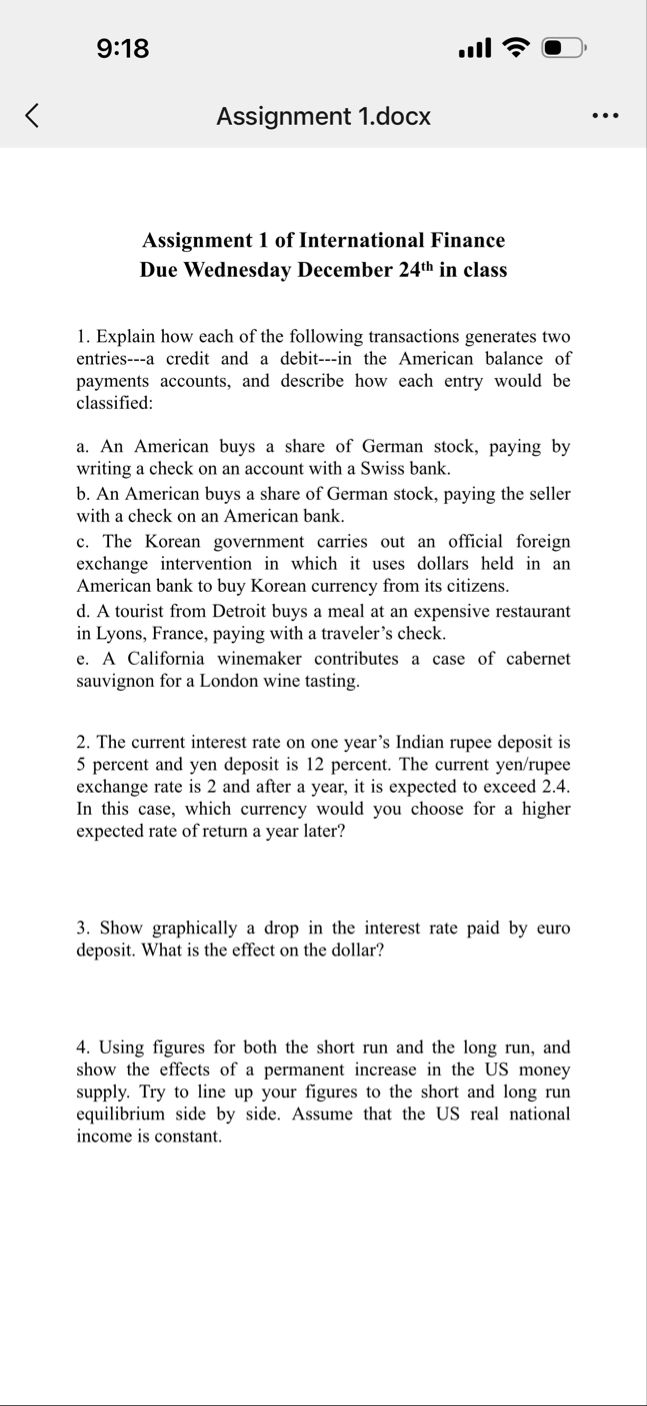
Assignment 1 of International Finance
Due Wednesday December 24% in class
1. Explain how each of the following transactions generates two
entries---a credit and a debit-—-in the American balance of
payments accounts, and describe how each entry would be
classified:
a. An American buys a share of German stock, paying by
writing a check on an account with a Swiss bank.
b. An American buys a share of German stock, paying the seller
with a check on an American bank.
c. The Korean government carries out an official foreign
exchange intervention in which it uses dollars held in an
American bank to buy Korean currency from its citizens.
d. A tourist from Detroit buys a meal at an expensive restaurant
in Lyons, France, paying with a travelers check.
e. A California winemaker contributes a case of cabernet
sauvignon for a London wine tasting.
2. The current interest rate on one year’s Indian rupee deposit is
5 percent and yen deposit is 12 percent. The current yen/rupee
exchange rate is 2 and after a year, it is expected to exceed 2.4.
In this case, which currency would you choose for a higher
expected rate of return a year later?
3. Show graphically a drop in the interest rate paid by euro
deposit. What is the effect on the dollar?
4. Using figures for both the short run and the long run, and
show the effects of a permanent increase in the US money
supply. Try to line up your figures to the short and long run
equilibrium side by side. Assume that the US real national
income is constant.
Question:
give answer in 2 step with explanation at the end of each step and final answer at the end:. a
9:18 all T @)
< Assignment 1.docx cee
Assignment 1 of International Finance
Due Wednesday December 24% in class
1. Explain how each of the following transactions generates two
entries---a credit and a debit-—-in the American balance of
payments accounts, and describe how each entry would be
classified:
a. An American buys a share of German stock, paying by
writing a check on an account with a Swiss bank.
b. An American buys a share of German stock, paying the seller
with a check on an American bank.
c. The Korean government carries out an official foreign
exchange intervention in which it uses dollars held in an
American bank to buy Korean currency from its citizens.
d. A tourist from Detroit buys a meal at an expensive restaurant
in Lyons, France, paying with a travelers check.
e. A California winemaker contributes a case of cabernet
sauvignon for a London wine tasting.
2. The current interest rate on one year’s Indian rupee deposit is
5 percent and yen deposit is 12 percent. The current yen/rupee
exchange rate is 2 and after a year, it is expected to exceed 2.4.
In this case, which currency would you choose for a higher
expected rate of return a year later?
3. Show graphically a drop in the interest rate paid by euro
deposit. What is the effect on the dollar?
4. Using figures for both the short run and the long run, and
show the effects of a permanent increase in the US money
supply. Try to line up your figures to the short and long run
equilibrium side by side. Assume that the US real national
income is constant.
This is AI generated Response.
Asked by: Rahul
Created at: 2025-12-16 19:07:19
Final Answer:
RenderedRaw Text
Did you like this answer?
Sure! Here are answers for each question in **2 steps with short explanations after each step and clear **final**.
---
## . **Class Transactions: Credits & Debits in American Balance of**
### a. ** buys German stock, pays with Swiss bank check**
**Step 1:**
- **Debit:** Purchase of a foreign financial asset (German stock) is a debit in the US financial account.
- **Explanation:** The US resident is sending money abroad to buy a foreign asset.
**Step 2:**
- **Credit:** Drawing on a Swiss bank account (a foreign asset being reduced) is a credit in the US financial account.
- **Explanation:** The US reduces its claim on a foreign bank, which is an inflow of funds.
**Final Answer:**
- **Debit:** Financial account (purchase of foreign stock)
- **Credit:** Financial account (reduction of foreign bank deposit)
---
### b. **American buys German stock, pays with American bank check**
**Step 1:**
- **Debit:** Purchase of German stock is a debit in the financial account.
- **Explanation:** Outflow for buying a foreign asset.
**Step 2:**
- **Credit:** Payment from an American bank account means a foreigner (German seller) gains a US asset (bank deposit), which is a credit in the financial account.
- **Explanation:** Increase in foreign holdings of US assets.
**Final Answer:**
- **Debit:** Financial account (purchase of foreign stock)
- **Credit:** Financial account (increase in foreign holding of US bank deposits)
---
### c. **Korean government uses dollars in American bank to buy Korean currency**
**Step 1:**
- **Debit:** US bank loses foreign currency (dollars held by Korea), which is a debit in the financial account.
- **Explanation:** Foreign official reduces its US asset.
**Step 2:**
- **Credit:** Korean currency is purchased, so Americans gain a foreign asset (Korean currency), a credit in the financial account.
- **Explanation:** US claims on foreigners increase.
**Final Answer:**
- **Debit:** Financial account (foreign official reduces US asset)
- **Credit:** Financial account (US increases foreign asset)
---
### d. **Tourist from Detroit buys a meal in France**
**Step 1:**
- **Debit:** Import of a service (meal) is a debit in the current account.
- **Explanation:** US resident pays for foreign service.
**Step 2:**
- **Credit:** Payment with traveler’s check is a credit in the financial account (French restaurant gets US asset).
- **Explanation:** Foreign recipient gains US financial asset.
**Final Answer:**
- **Debit:** Current account (import of service)
- **Credit:** Financial account (increase in foreign holding of US asset)
---
### e. **California winemaker sends wine to London tasting**
**Step 1:**
- **Debit:** Export of goods (wine) is a credit in the current account.
- **Explanation:** US exports increase.
**Step 2:**
- **Credit:** But if it’s a contribution (no payment), it's a debit as a unilateral transfer in the current account.
- **Explanation:** US gives away a good without receiving payment.
**Final Answer:**
- **Debit:** Current account (unilateral transfer)
- **Credit:** Current account (export of good)
---
## 2. **Which Currency for Higher Expected Return?**
**Step 1:**
- **Calculate Return on Rupee Deposit:**
Interest rate = 5%.
If you invest 1 unit, after 1 year you have 1.05 units.
If the rupee depreciates (exchange rate from 2 to 2.4), value in yen = 1.05 × (2 / 2.4) = .875 yen.
**Step 2:**
- **Calculate Return on Yen Deposit:**
Interest rate = 12%.
If you invest 1 yen, after 1 year you have 1.12 yen.
**Final Answer:**
- **Yen deposit gives higher expected return (1.12 > .875)**
---
## 3. **Graphical Effect of Drop in Euro Interest Rate on Dollar**
**Step 1:**
- **Draw Supply/Demand for Dollar:**
Lower euro interest rates make dollar deposits more attractive; capital flows into dollars.
- Dollar demand increases (shift right)
**Step 2:**
- **Effect on Dollar:**
Increased demand for dollars leads to dollar appreciation.
**Final Answer:**
- **Dollar appreciates as euro interest rates fall.**
---
## 4. **Permanent Increase in US Money Supply (Short and Long Run)**
**Step 1:**
- **Short Run:**
Money supply ↑ → US interest rate ↓ → capital outflow → dollar depreciates (exchange rate rises).
**Step 2:**
- **Long Run:**
All prices adjust, real money balances return to pre-shock level, but price level is higher and dollar remains depreciated.
**Final Answer:**
- **Short run:** Dollar depreciates due to lower rates.
- **Long run:** Price level rises, dollar remains depreciated.
---
Let me know if you'd like any of these steps expanded or clarified!
VIPSolutions focuses on clear, step‑by‑step explanations so you can learn quickly. Whether you need an AI‑generated walkthrough or a short hint to get unstuck, each solution is organized for fast reading and easy review later.
Search similar questions, compare approaches, and bookmark the best answers for revision. Our goal is simple: quick, reliable study help that feels natural—not noisy.
 VIPSolutions
 . a
9:18 all T @)
< Assignment 1.docx cee
Assignment 1 of International Finance
Due Wednesday December 24% in class
1. Explain how each of the following transactions generates two
entries---a credit and a debit-—-in the American balance of
payments accounts, and describe how each entry would be
classified:
a. An American buys a share of German stock, paying by
writing a check on an account with a Swiss bank.
b. An American buys a share of German stock, paying the seller
with a check on an American bank.
c. The Korean government carries out an official foreign
exchange intervention in which it uses dollars held in an
American bank to buy Korean currency from its citizens.
d. A tourist from Detroit buys a meal at an expensive restaurant
in Lyons, France, paying with a travelers check.
e. A California winemaker contributes a case of cabernet
sauvignon for a London wine tasting.
2. The current interest rate on one year’s Indian rupee deposit is
5 percent and yen deposit is 12 percent. The current yen/rupee
exchange rate is 2 and after a year, it is expected to exceed 2.4.
In this case, which currency would you choose for a higher
expected rate of return a year later?
3. Show graphically a drop in the interest rate paid by euro
deposit. What is the effect on the dollar?
4. Using figures for both the short run and the long run, and
show the effects of a permanent increase in the US money
supply. Try to line up your figures to the short and long run
equilibrium side by side. Assume that the US real national
income is constant.
. a
9:18 all T @)
< Assignment 1.docx cee
Assignment 1 of International Finance
Due Wednesday December 24% in class
1. Explain how each of the following transactions generates two
entries---a credit and a debit-—-in the American balance of
payments accounts, and describe how each entry would be
classified:
a. An American buys a share of German stock, paying by
writing a check on an account with a Swiss bank.
b. An American buys a share of German stock, paying the seller
with a check on an American bank.
c. The Korean government carries out an official foreign
exchange intervention in which it uses dollars held in an
American bank to buy Korean currency from its citizens.
d. A tourist from Detroit buys a meal at an expensive restaurant
in Lyons, France, paying with a travelers check.
e. A California winemaker contributes a case of cabernet
sauvignon for a London wine tasting.
2. The current interest rate on one year’s Indian rupee deposit is
5 percent and yen deposit is 12 percent. The current yen/rupee
exchange rate is 2 and after a year, it is expected to exceed 2.4.
In this case, which currency would you choose for a higher
expected rate of return a year later?
3. Show graphically a drop in the interest rate paid by euro
deposit. What is the effect on the dollar?
4. Using figures for both the short run and the long run, and
show the effects of a permanent increase in the US money
supply. Try to line up your figures to the short and long run
equilibrium side by side. Assume that the US real national
income is constant.