 VIPSolutions
give answer in 2 step with explanation at the end of each step and final answer at the end:‘QUESTION 3 (10 marks) a. Let * be the operation on R defined by a*b= a + b— ab? forall a,b € R. i. Find the inverse element, if it exists, given the identity element is 0. [2 marks] ii. Determine if it is a semi-group. [4 marks] b. Given state table as below, where S= {0v. 01, 02, 03}. I= {a, b, ¢} and F= {01, 03}. NEE [o>] [ 2 [ 6] c | IE I A lo lolol ol i. Draw the transition diagram of the finite-state automaton (S, I, £; ov, F). [2 marks] ii. Determine whether the following strings are accepted by the Deterministic Finite Automata (DFA) or not. [2 marks] o cccab o bebaa
Question:
give answer in 2 step with explanation at the end of each step and final answer at the end: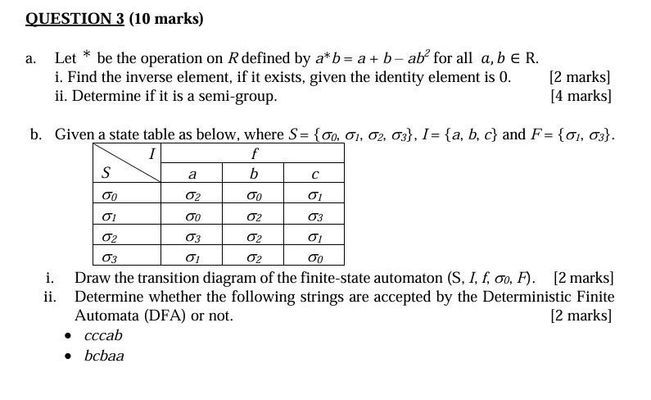 ‘QUESTION 3 (10 marks)
a. Let * be the operation on R defined by a*b= a + b— ab? forall a,b € R.
i. Find the inverse element, if it exists, given the identity element is 0. [2 marks]
ii. Determine if it is a semi-group. [4 marks]
b. Given state table as below, where S= {0v. 01, 02, 03}. I= {a, b, ¢} and F= {01, 03}.
NEE
[o>] [ 2 [ 6] c |
IE I A
lo lolol ol
i. Draw the transition diagram of the finite-state automaton (S, I, £; ov, F). [2 marks]
ii. Determine whether the following strings are accepted by the Deterministic Finite
Automata (DFA) or not. [2 marks]
o cccab
o bebaa
‘QUESTION 3 (10 marks)
a. Let * be the operation on R defined by a*b= a + b— ab? forall a,b € R.
i. Find the inverse element, if it exists, given the identity element is 0. [2 marks]
ii. Determine if it is a semi-group. [4 marks]
b. Given state table as below, where S= {0v. 01, 02, 03}. I= {a, b, ¢} and F= {01, 03}.
NEE
[o>] [ 2 [ 6] c |
IE I A
lo lolol ol
i. Draw the transition diagram of the finite-state automaton (S, I, £; ov, F). [2 marks]
ii. Determine whether the following strings are accepted by the Deterministic Finite
Automata (DFA) or not. [2 marks]
o cccab
o bebaa
This is AI generated Response.
Asked by: Pagal
Created at: 2025-06-26 22:18:00
Asked by: Pagal
Created at: 2025-06-26 22:18:00
Final Answer:
Rendered
Raw Text
Did you like this answer?
Let's break down each part step by step with explanations and the final answer at the end.
---
### **a. Operation \(*\) on \( \mathbb{R} \) defined by \( a * b = a + b - ab^2 \)**
#### **Step 1: Find the inverse element, given the identity element is 0**
**Explanation:**
- The identity element \( e = 0 \) means \( a * 0 = a \) for all \( a \).
- \( a * b = a + b - ab^2 \)
- Let \( x \) be the inverse of \( a \) such that \( a * x = 0 \).
So,
\[
a * x = a + x - a x^2 = 0
\]
\[
a + x - a x^2 = 0
\]
\[
x - a x^2 = -a
\]
\[
x(1 - a x) = -a
\]
Solve for \( x \):
If \( a \neq 0 \):
\[
x(1 - a x) = -a
\]
\[
x - a x^2 = -a
\]
\[
a x^2 - x - a = 0
\]
This is a quadratic in \( x \):
\[
a x^2 - x - a = 0
\]
\[
x = \frac{1 \pm \sqrt{1 + 4a^2}}{2a}
\]
If \( a = 0 \):
\[
0 * x = 0 + x - 0 = x = 0
\]
So, the inverse of 0 is 0.
**Step 1 Final Answer:**
- The inverse element of \( a \) is \( x = \frac{1 \pm \sqrt{1 + 4a^2}}{2a} \) if \( a \neq 0 \), and 0 if \( a = 0 \).
---
#### **Step 2: Determine if it is a semigroup (i.e., is it associative?)**
**Explanation:**
- Check if \((a * b) * c = a * (b * c)\) for all \(a, b, c \in \mathbb{R}\).
Compute both sides:
**Left side:**
\[
(a * b) * c = [a + b - ab^2] * c = (a + b - ab^2) + c - (a + b - ab^2) c^2
\]
\[
= a + b - ab^2 + c - (a + b - ab^2)c^2
\]
\[
= a + b - ab^2 + c - a c^2 - b c^2 + ab^2 c^2
\]
**Right side:**
\[
a * (b * c) = a * (b + c - b c^2) = a + [b + c - b c^2] - a[b + c - b c^2]^2
\]
Let’s expand \([b + c - b c^2]^2\):
First,
\[
b + c - b c^2 = (b + c) - b c^2
\]
So,
\[
[b + c - b c^2]^2 = (b + c)^2 - 2(b + c) b c^2 + (b c^2)^2
\]
\[
= b^2 + 2bc + c^2 - 2b^2 c^2 - 2b c^3 + b^2 c^4
\]
So,
\[
a * (b * c) = a + b + c - b c^2 - a[b^2 + 2bc + c^2 - 2b^2 c^2 - 2b c^3 + b^2 c^4]
\]
Comparing both sides, the expressions are not generally equal. Hence, the operation is **not associative**.
**Step 2 Final Answer:**
- The operation is **not a semigroup** because it is **not associative**.
---
### **b. State Table and DFA**
#### **Step 1: Draw the transition diagram**
**Explanation:**
- States: \( S = \{\sigma_0, \sigma_1, \sigma_2, \sigma_3\} \)
- Alphabet: \( I = \{a, b, c\} \)
- Start state: \( \sigma_0 \)
- Final states: \( F = \{\sigma_1, \sigma_3\} \)
**Transition Table:**
| S | a | b | c |
|--------|--------|--------|--------|
| σ₀ | σ₂ | σ₀ | σ₁ |
| σ₁ | σ₁ | σ₃ | σ₀ |
| σ₂ | σ₃ | σ₂ | σ₀ |
| σ₃ | σ₁ | σ₂ | σ₀ |
**Transition diagram:**
- From σ₀: a→σ₂, b→σ₀, c→σ₁
- From σ₁: a→σ₁, b→σ₃, c→σ₀
- From σ₂: a→σ₃, b→σ₂, c→σ₀
- From σ₃: a→σ₁, b→σ₂, c→σ₀
*Draw as a diagram with arrows as above.*
---
#### **Step 2: Check if the strings are accepted**
Let’s trace each string starting from σ₀:
**String 1: "cccab"**
- σ₀ → c → σ₁
- σ₁ → c → σ₀
- σ₀ → c → σ₁
- σ₁ → a → σ₁
- σ₁ → b → σ₃
Ends at σ₃, which is a final state. **Accepted**.
---
**String 2: "bcbaa"**
- σ₀ → b → σ₀
- σ₀ → c → σ₁
- σ₁ → b → σ₃
- σ₃ → a → σ₁
- σ₁ → a → σ₁
Ends at σ₁, which is a final state. **Accepted**.
---
### **Final Answers:**
#### a.
i. The inverse of \( a \) is \( x = \frac{1 \pm \sqrt{1 + 4a^2}}{2a} \) if \( a \neq 0 \), and 0 if \( a = 0 \).
ii. The operation is **not a semigroup** (not associative).
#### b.
i. Transition diagram as described above.
ii. Both strings **"cccab"** and **"bcbaa"** are **accepted** by the DFA.
📢 Instructions:
- Ask anything relatd to above question only.
- For new Question goto :