give answer in 2 step with explanation at the end of each step and final answer at the end:
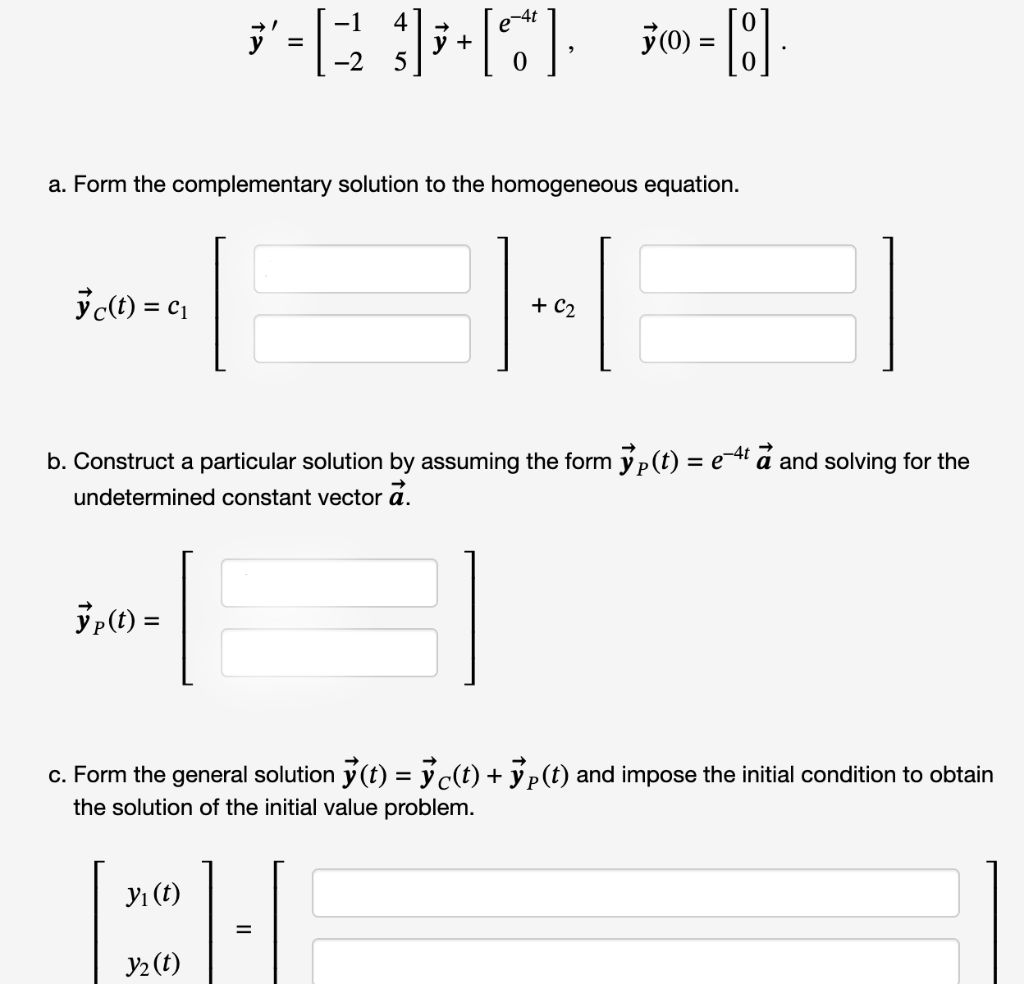
vec y ^ prime =[ matrix -1&4\\ -2&5 matrix ] vec y + [[e ^ (-4t)], [0]]
vec y(0) = [[0], [0]]
a. Form the complementary solution to the homogeneous equation.
c(t) = C1
+ C2
b. Construct a particular solution by assuming the form vec y P (t)= e ^ (-4t) vec a and solving for the undetermined constant vector vec a
p(t) =
c. Form the general solution vec y (t)= vec y_{C}(t) + vec y P (t) and impose the initial condition to obtain the solution of the initial value problem.
[[y_{1}(t)], [y_{2}(t)]] =sr [1 4]- [e* > 0
= + : 0) = .
2 a EA A PEL
a. Form the complementary solution to the homogeneous equation.
=>
Ye®) =¢ | | +c | |
b. Construct a particular solution by assuming the form Vp (t) = ed and solving for the
undetermined constant vector @.
->
yet) = | |
c. Form the general solution 0) = 0) + Vp (t) and impose the initial condition to obtain
the solution of the initial value problem.
ni)
y(t)
Question:
give answer in 2 step with explanation at the end of each step and final answer at the end:
vec y ^ prime =[ matrix -1&4\\ -2&5 matrix ] vec y + [[e ^ (-4t)], [0]]
vec y(0) = [[0], [0]]
a. Form the complementary solution to the homogeneous equation.
c(t) = C1
+ C2
b. Construct a particular solution by assuming the form vec y P (t)= e ^ (-4t) vec a and solving for the undetermined constant vector vec a
p(t) =
c. Form the general solution vec y (t)= vec y_{C}(t) + vec y P (t) and impose the initial condition to obtain the solution of the initial value problem.
[[y_{1}(t)], [y_{2}(t)]] =sr [1 4]- [e* > 0
= + : 0) = .
2 a EA A PEL
a. Form the complementary solution to the homogeneous equation.
=>
Ye®) =¢ | | +c | |
b. Construct a particular solution by assuming the form Vp (t) = ed and solving for the
undetermined constant vector @.
->
yet) = | |
c. Form the general solution 0) = 0) + Vp (t) and impose the initial condition to obtain
the solution of the initial value problem.
ni)
y(t)
This is AI generated Response.
Asked by: Pagal
Created at: 2025-07-28 05:37:34
Final Answer:
RenderedRaw Text
Did you like this answer?
Let's solve the system step by step.
---
## **Step 1: Complementary Solution (Homogeneous System)**
The homogeneous system is:
\[
\vec{y}' =
\begin{bmatrix}
-1 & 4 \\
-2 & 5
\end{bmatrix}
\vec{y}
\]
**Find eigenvalues λ:**
\[
\left| \begin{matrix} -1-\lambda & 4 \\ -2 & 5-\lambda \end{matrix} \right| = 0
\]
\[
(-1-\lambda)(5-\lambda) + 8 = 0
\]
\[
(-1-\lambda)(5-\lambda) + 8 = 0
\implies ( -1-\lambda )(5-\lambda) + 8 = 0
\]
\[
(-1-\lambda)(5-\lambda) + 8 = 0
\implies ( -1-\lambda )(5-\lambda ) + 8 = 0
\implies (\lambda + 1)(\lambda - 5) + 8 = 0
\implies \lambda^2 - 4\lambda + 3 = 0
\]
\[
\lambda^2 - 4\lambda + 3 = 0
\implies (\lambda - 3)(\lambda - 1) = 0
\implies \lambda = 1, 3
\]
**Find eigenvectors:**
* For **λ = 1**:
\[
\begin{bmatrix}
-2 & 4 \\
-2 & 4
\end{bmatrix}
\vec{v} = 0
\implies -2v_1 + 4v_2 = 0
\implies v_1 = 2v_2
\implies \vec{v}_1 = \begin{bmatrix} 2 \\ 1 \end{bmatrix}
\]
* For **λ = 3**:
\[
\begin{bmatrix}
-4 & 4 \\
-2 & 2
\end{bmatrix}
\vec{v} = 0
\implies -4v_1 + 4v_2 = 0
\implies v_1 = v_2
\implies \vec{v}_2 = \begin{bmatrix} 1 \\ 1 \end{bmatrix}
\]
So, the complementary solution is:
\[
\boxed{
\vec{y}_c(t) = c_1
\begin{bmatrix}
2 \\
1
\end{bmatrix}
e^{t}
+
c_2
\begin{bmatrix}
1 \\
1
\end{bmatrix}
e^{3t}
}
\]
---
#### **Step 2 Explanation:**
We found the eigenvalues and corresponding eigenvectors to write the general solution to the homogeneous system.
---
## **Step 2: Particular Solution (Nonhomogeneous System)**
Guess: \(\vec{y}_p(t) = e^{-4t} \vec{a}\), with constant vector \(\vec{a}\).
Plug into the equation:
\[
\frac{d}{dt}(e^{-4t}\vec{a}) =
\begin{bmatrix}
-1 & 4 \\
-2 & 5
\end{bmatrix}
e^{-4t}\vec{a} +
\begin{bmatrix}
e^{-4t} \\
0
\end{bmatrix}
\]
\[
-4e^{-4t}\vec{a} =
\begin{bmatrix}
-1 & 4 \\
-2 & 5
\end{bmatrix}
e^{-4t}\vec{a} +
\begin{bmatrix}
e^{-4t} \\
0
\end{bmatrix}
\]
Divide both sides by \(e^{-4t}\):
\[
-4\vec{a} =
\begin{bmatrix}
-1 & 4 \\
-2 & 5
\end{bmatrix}
\vec{a} +
\begin{bmatrix}
1 \\
0
\end{bmatrix}
\]
\[
\left(-4I -
\begin{bmatrix}
-1 & 4 \\
-2 & 5
\end{bmatrix}
\right)
\vec{a} =
\begin{bmatrix}
1 \\
0
\end{bmatrix}
\]
\[
\left(
\begin{bmatrix}
-4 & 0 \\
0 & -4
\end{bmatrix}
-
\begin{bmatrix}
-1 & 4 \\
-2 & 5
\end{bmatrix}
\right)
\vec{a} =
\begin{bmatrix}
1 \\
0
\end{bmatrix}
\]
\[
\begin{bmatrix}
-3 & -4 \\
2 & -9
\end{bmatrix}
\vec{a} =
\begin{bmatrix}
1 \\
0
\end{bmatrix}
\]
Let \(\vec{a} = \begin{bmatrix} a_1 \\ a_2 \end{bmatrix}\):
\[
-3a_1 - 4a_2 = 1 \\
2a_1 - 9a_2 = 0 \implies a_1 = \frac{9}{2}a_2
\]
Plug into first equation:
\[
-3\left(\frac{9}{2}a_2\right) - 4a_2 = 1 \\
-\frac{27}{2}a_2 - 4a_2 = 1 \\
-\frac{27}{2}a_2 - \frac{8}{2}a_2 = 1 \\
-\frac{35}{2}a_2 = 1 \\
a_2 = -\frac{2}{35}
\]
\[
a_1 = \frac{9}{2}(-\frac{2}{35}) = -\frac{9}{35}
\]
So,
\[
\vec{a} = \begin{bmatrix} -\frac{9}{35} \\ -\frac{2}{35} \end{bmatrix}
\]
Thus,
\[
\boxed{
\vec{y}_p(t) = e^{-4t}
\begin{bmatrix}
-\frac{9}{35} \\
-\frac{2}{35}
\end{bmatrix}
}
\]
---
#### **Step 2 Explanation:**
We assumed a particular solution, substituted it into the nonhomogeneous equation, and solved for the vector of constants.
---
## **Final Step: General Solution and Initial Condition**
Combine the solutions:
\[
\vec{y}(t) = \vec{y}_c(t) + \vec{y}_p(t)
\]
\[
\vec{y}(t) = c_1
\begin{bmatrix}
2 \\
1
\end{bmatrix}
e^{t}
+
c_2
\begin{bmatrix}
1 \\
1
\end{bmatrix}
e^{3t}
+
e^{-4t}
\begin{bmatrix}
-\frac{9}{35} \\
-\frac{2}{35}
\end{bmatrix}
\]
**Use initial condition \(\vec{y}(0) = \begin{bmatrix} 0 \\ 0 \end{bmatrix}\):**
At \(t=0\):
\[
c_1
\begin{bmatrix}
2 \\
1
\end{bmatrix}
+
c_2
\begin{bmatrix}
1 \\
1
\end{bmatrix}
+
\begin{bmatrix}
-\frac{9}{35} \\
-\frac{2}{35}
\end{bmatrix}
=
\begin{bmatrix}
0 \\
0
\end{bmatrix}
\]
So,
\[
2c_1 + c_2 - \frac{9}{35} = 0 \\
c_1 + c_2 - \frac{2}{35} = 0
\]
From the second equation:
\[
c_1 + c_2 = \frac{2}{35}
\]
From the first equation:
\[
2c_1 + c_2 = \frac{9}{35}
\]
Subtract the second from the first:
\[
(2c_1 + c_2) - (c_1 + c_2) = \frac{9}{35} - \frac{2}{35} \\
c_1 = \frac{7}{35} = \frac{1}{5}
\]
Then,
\[
c_1 + c_2 = \frac{2}{35} \implies c_2 = \frac{2}{35} - \frac{7}{35} = -\frac{5}{35} = -\frac{1}{7}
\]
**Final Answer:**
\[
\boxed{
\begin{bmatrix}
y_1(t) \\
y_2(t)
\end{bmatrix}
=
\frac{1}{5}
\begin{bmatrix}
2 \\
1
\end{bmatrix}
e^{t}
-
\frac{1}{7}
\begin{bmatrix}
1 \\
1
\end{bmatrix}
e^{3t}
+
e^{-4t}
\begin{bmatrix}
-\frac{9}{35} \\
-\frac{2}{35}
\end{bmatrix}
}
\]
---
### **Summary of Steps and Explanations**
1. **Step 1:** Find the complementary solution using eigenvalues and eigenvectors of the matrix.
2. **Step 2:** Guess a particular solution, substitute into the equation, and solve for constants.
3. **Final:** Combine both and use the initial condition to solve for constants.
Let me know if you need this broken down into matrix form for each blank!
VIPSolutions focuses on clear, step‑by‑step explanations so you can learn quickly. Whether you need an AI‑generated walkthrough or a short hint to get unstuck, each solution is organized for fast reading and easy review later.
Search similar questions, compare approaches, and bookmark the best answers for revision. Our goal is simple: quick, reliable study help that feels natural—not noisy.
 VIPSolutions
 sr [1 4]- [e* > 0
= + : 0) = .
2 a EA A PEL
a. Form the complementary solution to the homogeneous equation.
=>
Ye®) =¢ | | +c | |
b. Construct a particular solution by assuming the form Vp (t) = ed and solving for the
undetermined constant vector @.
->
yet) = | |
c. Form the general solution 0) = 0) + Vp (t) and impose the initial condition to obtain
the solution of the initial value problem.
ni)
y(t)
sr [1 4]- [e* > 0
= + : 0) = .
2 a EA A PEL
a. Form the complementary solution to the homogeneous equation.
=>
Ye®) =¢ | | +c | |
b. Construct a particular solution by assuming the form Vp (t) = ed and solving for the
undetermined constant vector @.
->
yet) = | |
c. Form the general solution 0) = 0) + Vp (t) and impose the initial condition to obtain
the solution of the initial value problem.
ni)
y(t)