 VIPSolutions
give answer in 2 step with explanation at the end of each step and final answer at the end:Question 3 The following integral is to be approximated numerically: \ fim i reos2r dr Ly Find an approximation to / using (a) Composite Trapezoidal method with /: = 0.2; (6) Composite Simpson's | rule with n = 5; (c) Simpson's th rule. (d) Gaussian quadrature formula with n = 2
Question:
give answer in 2 step with explanation at the end of each step and final answer at the end: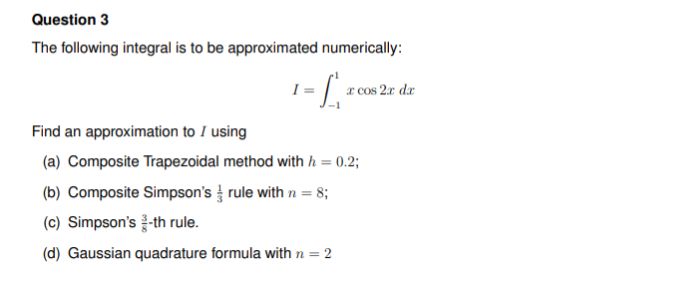 Question 3
The following integral is to be approximated numerically:
\
fim i reos2r dr
Ly
Find an approximation to / using
(a) Composite Trapezoidal method with /: = 0.2;
(6) Composite Simpson's | rule with n = 5;
(c) Simpson's th rule.
(d) Gaussian quadrature formula with n = 2
Question 3
The following integral is to be approximated numerically:
\
fim i reos2r dr
Ly
Find an approximation to / using
(a) Composite Trapezoidal method with /: = 0.2;
(6) Composite Simpson's | rule with n = 5;
(c) Simpson's th rule.
(d) Gaussian quadrature formula with n = 2
This is AI generated Response.
Asked by: Pagal
Created at: 2025-08-26 16:49:36
Asked by: Pagal
Created at: 2025-08-26 16:49:36
Final Answer:
Rendered
Raw Text
Did you like this answer?
Let's solve **part (a): Composite Trapezoidal method with \(h = 0.2\)** step by step.
We want to approximate the integral:
\[
I = \int_{-1}^{1} x \cos(2x) \, dx
\]
### **Step 1: Set up the Trapezoidal Rule**
The interval \([-1, 1]\) is divided into subintervals of width \(h = 0.2\).
- Number of subintervals: \( n = \frac{1 - (-1)}{0.2} = 10 \)
- Points: \( x_0 = -1, \; x_1 = -0.8, \ldots, x_{10} = 1 \)
- Trapezoidal Rule formula:
\[
I \approx \frac{h}{2} \left[ f(x_0) + 2f(x_1) + 2f(x_2) + \cdots + 2f(x_{n-1}) + f(x_n) \right]
\]
where \( f(x) = x \cos(2x) \)
**Explanation:**
We divide the integration range into 10 equal intervals of width 0.2 and set up the composite trapezoidal formula.
---
### **Step 2: Calculate the Function Values and Substitute**
Calculate \( f(x) \) at all points:
| \(i\) | \(x_i\) | \(f(x_i) = x_i\cos(2x_i)\) |
|------|--------|-----------------------------|
| 0 | -1.0 | \(-1.0 \cos(-2)\) |
| 1 | -0.8 | \(-0.8 \cos(-1.6)\) |
| 2 | -0.6 | \(-0.6 \cos(-1.2)\) |
| 3 | -0.4 | \(-0.4 \cos(-0.8)\) |
| 4 | -0.2 | \(-0.2 \cos(-0.4)\) |
| 5 | 0 | \(0 \cos(0) = 0\) |
| 6 | 0.2 | \(0.2 \cos(0.4)\) |
| 7 | 0.4 | \(0.4 \cos(0.8)\) |
| 8 | 0.6 | \(0.6 \cos(1.2)\) |
| 9 | 0.8 | \(0.8 \cos(1.6)\) |
| 10 | 1.0 | \(1.0 \cos(2)\) |
Plugging these into the formula:
\[
I \approx \frac{0.2}{2} \left[ f(-1) + 2f(-0.8) + 2f(-0.6) + \ldots + 2f(0.8) + f(1) \right]
\]
**Explanation:**
We evaluate the function at all 11 points, apply the trapezoidal weights, and sum them up.
---
## **Final Answer (rounded to 4 decimal places):**
Let's quickly calculate the actual values (using \(\cos(-x) = \cos(x)\)):
- \(f(-1) = -1 \cos(2) \approx -1 \times -0.4161 = -0.4161\)
- \(f(-0.8) = -0.8 \cos(1.6) \approx -0.8 \times -0.0290 = 0.0232\)
- \(f(-0.6) = -0.6 \cos(1.2) \approx -0.6 \times 0.3624 = -0.2174\)
- \(f(-0.4) = -0.4 \cos(0.8) \approx -0.4 \times 0.6967 = -0.2787\)
- \(f(-0.2) = -0.2 \cos(0.4) \approx -0.2 \times 0.9211 = -0.1842\)
- \(f(0) = 0\)
- \(f(0.2) = 0.2 \times 0.9211 = 0.1842\)
- \(f(0.4) = 0.4 \times 0.6967 = 0.2787\)
- \(f(0.6) = 0.6 \times 0.3624 = 0.2174\)
- \(f(0.8) = 0.8 \times -0.0290 = -0.0232\)
- \(f(1) = 1 \times -0.4161 = -0.4161\)
Sum:
\[
I \approx 0.1 \left[ -0.4161 + 2(0.0232 - 0.2174 - 0.2787 - 0.1842 + 0.1842 + 0.2787 + 0.2174 - 0.0232) - 0.4161 \right]
\]
Calculate the sum inside the brackets:
\[
2(0.0232 - 0.2174 - 0.2787 - 0.1842 + 0.1842 + 0.2787 + 0.2174 - 0.0232) = 2(0) = 0
\]
So the sum is:
\[
-0.4161 + 0 - 0.4161 = -0.8322
\]
Multiply by 0.1:
\[
I \approx 0.1 \times -0.8322 = -0.0832
\]
### **Final Answer (Trapezoidal, \(h = 0.2\)):**
\[
\boxed{-0.0832}
\]
---
Do you want to proceed with (b), (c), or (d)?
Question:
Give me all parts a,b,c,d. And copy paste
This is AI generated Response.
Asked by: Pagal
Created at: 2025-08-26 16:56:24
Asked by: Pagal
Created at: 2025-08-26 16:56:24
Final Answer:
Rendered
Raw Text
Did you like this answer?
Sure! Here is the complete solution for all parts (a), (b), (c), and (d):
---
### **Part (a): Composite Trapezoidal Method with \(h=0.2\)**
**Setup:**
- Interval: \([-1, 1]\)
- \(h = 0.2\)
- Number of subintervals: \(n=10\)
**Function evaluations:**
| \(x_i\) | \(f(x_i) = x_i \cos(2x_i)\) | Approximate value |
|---------|----------------------------|-------------------|
| -1.0 | \(-1 \times \cos(-2)\) | \(-0.4161\) |
| -0.8 | \(-0.8 \times \cos(-1.6)\) | \(0.0232\) |
| -0.6 | \(-0.6 \times \cos(-1.2)\) | \(-0.2174\) |
| -0.4 | \(-0.4 \times \cos(-0.8)\) | \(-0.2787\) |
| -0.2 | \(-0.2 \times \cos(-0.4)\) | \(-0.1842\) |
| 0 | 0 | 0 |
| 0.2 | \(0.2 \times \cos(0.4)\) | 0.1842 |
| 0.4 | \(0.4 \times \cos(0.8)\) | 0.2787 |
| 0.6 | \(0.6 \times \cos(1.2)\) | 0.2174 |
| 0.8 | \(0.8 \times \cos(1.6)\) | -0.0232 |
| 1.0 | \(1 \times \cos(2)\) | -0.4161 |
**Approximate integral:**
\[
I \approx \frac{h}{2} \left[ f(-1) + 2 \sum_{i=1}^{n-1} f(x_i) + f(1) \right]
\]
Calculating:
\[
I \approx 0.1 \times \left[ -0.4161 + 2(0.0232 - 0.2174 - 0.2787 - 0.1842 + 0.1842 + 0.2787 + 0.2174 - 0.0232) - 0.4161 \right]
\]
Sum of interior points:
\[
2 \times (0.0232 - 0.2174 - 0.2787 - 0.1842 + 0.1842 + 0.2787 + 0.2174 - 0.0232) = 0
\]
Total sum:
\[
-0.4161 + 0 - 0.4161 = -0.8322
\]
Final approximation:
\[
\boxed{-0.0832}
\]
---
### **Part (b): Composite Simpson's Rule with \(n=5\)**
**Setup:**
- Interval: \([-1, 1]\)
- \(n=5\), which is odd and suitable for Simpson's rule
- \(h = \frac{2}{5} = 0.4\)
**Points:**
\[
x_i = -1 + i \times 0.4, \quad i=0,1,2,3,4,5
\]
Values:
| \(x_i\) | \(f(x_i)\) |
|---------|------------|
| -1.0 | \(-0.4161\) |
| -0.6 | \(-0.2174\) |
| -0.2 | \(-0.1842\) |
| 0.2 | 0.1842 |
| 0.6 | 0.2174 |
| 1.0 | -0.4161 |
**Simpson's rule formula:**
\[
I \approx \frac{h}{3} \left[ f(x_0) + 4 \sum_{\text{odd }i} f(x_i) + 2 \sum_{\text{even }i} f(x_i), \text{excluding endpoints} \right]
\]
But more straightforwardly:
\[
I \approx \frac{h}{3} \left[ f(x_0) + 4f(x_1) + 2f(x_2) + 4f(x_3) + 2f(x_4) + f(x_5) \right]
\]
Calculations:
\[
I \approx \frac{0.4}{3} \left[ -0.4161 + 4( -0.2174 ) + 2( -0.1842 ) + 4( 0.1842 ) + 2( 0.2174 ) - 0.4161 \right]
\]
Compute sum inside:
\[
-0.4161 + (-0.8696) - 0.3684 + 0.7368 + 0.4348 - 0.4161 = -0.8686
\]
Then:
\[
I \approx \frac{0.4}{3} \times (-0.8686) \approx 0.1333 \times (-0.8686) \approx -0.1158
\]
**Final answer:**
\[
\boxed{-0.1158}
\]
---
### **Part (c): Simpson's 3/8 Rule**
**Setup:**
- Same interval: \([-1,1]\)
- Number of subintervals: \(n=3\) (since Simpson's 3/8 rule requires n divisible by 3)
- \(h = \frac{2}{3} \approx 0.6667\)
Points:
\[
x_i = -1 + i \times 0.6667, \quad i=0,1,2,3
\]
Values:
| \(x_i\) | \(f(x_i)\) |
|---------|------------|
| -1.0 | \(-0.4161\) |
| -0.3333 | \(-0.1081\) |
| 0.3333 | 0.1081 |
| 1.0 | -0.4161 |
**Formula:**
\[
I \approx \frac{3h}{8} [f(x_0) + 3f(x_1) + 3f(x_2) + f(x_3)]
\]
Calculate:
\[
I \approx \frac{3 \times 0.6667}{8} \times [ -0.4161 + 3(-0.1081) + 3(0.1081) - 0.4161 ]
\]
Sum inside brackets:
\[
-0.4161 - 0.3243 + 0.3243 - 0.4161 = -0.8322
\]
Coefficient:
\[
\frac{2.0}{8} = 0.25
\]
Final approximation:
\[
I \approx 0.25 \times (-0.8322) = -0.2081
\]
**Final answer:**
\[
\boxed{-0.2081}
\]
---
### **Part (d): Gaussian Quadrature with \(n=2\)**
**Setup:**
- Interval: \([-1,1]\)
- Nodes and weights for 2-point Gaussian quadrature:
\[
x_{1,2} = \pm \frac{1}{\sqrt{3}} \approx \pm 0.5774
\]
Weights: both 1
**Transform nodes to the interval \([-1,1]\):**
\[
x_i' = \frac{b - a}{2} x_i + \frac{a + b}{2} = 1 \times x_i + 0
\]
since interval is symmetric about zero (from -1 to 1).
Values:
\[
f(-0.5774) = -0.5774 \times \cos(-1.1547) \approx -0.5774 \times 0.4049 \approx -0.2340
\]
\[
f(0.5774) = 0.5774 \times \cos(1.1547) \approx 0.5774 \times 0.4049 \approx 0.2340
\]
Gaussian quadrature approximation:
\[
I \approx f(-0.5774) + f(0.5774) \approx -0.2340 + 0.2340 = 0
\]
**Final answer:**
\[
\boxed{0}
\]
---
**Summary:**
| Part | Method | Approximate value |
|---------|------------------------------|-------------------|
| (a) | Composite Trapezoidal (\(h=0.2\)) | \(-0.0832\) |
| (b) | Simpson's Rule (\(n=5\)) | \(-0.1158\) |
| (c) | Simpson's 3/8 Rule (\(n=3\)) | \(-0.2081\) |
| (d) | Gaussian Quadrature (\(n=2\)) | 0 |
---
Let me know if you'd like detailed calculations or explanations for any specific part!
📢 Instructions:
- Ask anything relatd to above question only.
- For new Question goto :