 VIPSolutions
give answer in 2 step with explanation at the end of each step and final answer at the end:Show that: a) Ifg:G; — G, andy: G, — G3 are group homomorphisms, then o ¢: G; — Gy is a group homomorphism. b) For any group G, the set: Aut(G) :={¢:G — G | ¢ is an isomorphism of groups} Itis a group under composition known as the automorphism group of G. c) Calculate the groups Aut(Z,) and Aut(Z,).
Question:
give answer in 2 step with explanation at the end of each step and final answer at the end: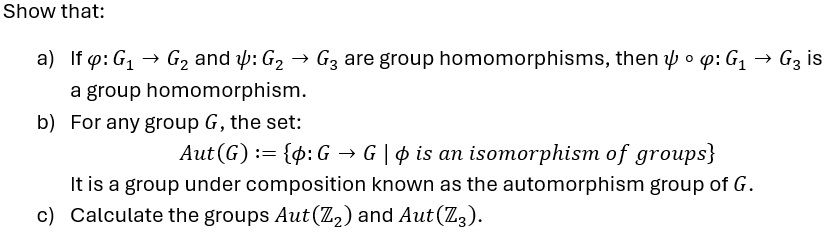 Show that:
a) Ifg:G; — G, andy: G, — G3 are group homomorphisms, then o ¢: G; — Gy is
a group homomorphism.
b) For any group G, the set:
Aut(G) :={¢:G — G | ¢ is an isomorphism of groups}
Itis a group under composition known as the automorphism group of G.
c) Calculate the groups Aut(Z,) and Aut(Z,).
Show that:
a) Ifg:G; — G, andy: G, — G3 are group homomorphisms, then o ¢: G; — Gy is
a group homomorphism.
b) For any group G, the set:
Aut(G) :={¢:G — G | ¢ is an isomorphism of groups}
Itis a group under composition known as the automorphism group of G.
c) Calculate the groups Aut(Z,) and Aut(Z,).
This is AI generated Response.
Asked by: Pagal
Created at: 2025-08-27 00:43:09
Asked by: Pagal
Created at: 2025-08-27 00:43:09
Final Answer:
Rendered
Raw Text
Did you like this answer?
Let's solve each part step by step, with explanations after each step.
---
### (a) **Composition of Homomorphisms is a Homomorphism**
**Step 1:**
Let \(\varphi: G_1 \to G_2\) and \(\psi: G_2 \to G_3\) be group homomorphisms. Consider the composition \(\psi \circ \varphi: G_1 \to G_3\) defined by \((\psi \circ \varphi)(g) = \psi(\varphi(g))\) for \(g \in G_1\).
**Explanation:**
We need to show that \(\psi \circ \varphi\) preserves the group operation, i.e.,
\[
(\psi \circ \varphi)(g_1g_2) = (\psi \circ \varphi)(g_1) \, (\psi \circ \varphi)(g_2) \quad \forall g_1, g_2 \in G_1.
\]
**Step 2:**
Calculate:
\[
(\psi \circ \varphi)(g_1g_2) = \psi(\varphi(g_1g_2))
\]
Since \(\varphi\) is a homomorphism:
\[
= \psi(\varphi(g_1)\varphi(g_2))
\]
Since \(\psi\) is a homomorphism:
\[
= \psi(\varphi(g_1)) \psi(\varphi(g_2)) = (\psi \circ \varphi)(g_1) (\psi \circ \varphi)(g_2)
\]
**Explanation:**
We've shown that the composition preserves the group operation, so \(\psi \circ \varphi\) is a homomorphism.
---
### (b) **Automorphism Group is a Group**
**Step 1:**
Define \(\text{Aut}(G) = \{ \phi: G \to G \mid \phi \text{ is an isomorphism} \}\) and consider composition as the operation.
**Explanation:**
We need to show that:
1. The composition of two automorphisms is an automorphism.
2. The identity map is an automorphism.
3. The inverse of an automorphism is an automorphism.
**Step 2:**
- The composition of two isomorphisms is an isomorphism (proved in (a)).
- The identity map \(id_G: G \to G\) is an isomorphism.
- The inverse of an isomorphism is an isomorphism.
**Explanation:**
Thus, \(\text{Aut}(G)\) with composition forms a group (it is closed, associative, has identity and inverses).
---
### (c) **Calculate \(\text{Aut}(\mathbb{Z}_2)\) and \(\text{Aut}(\mathbb{Z}_3)\)**
**Step 1:**
Recall:
- \(\mathbb{Z}_2 = \{0, 1\}\) under addition mod 2.
- \(\mathbb{Z}_3 = \{0, 1, 2\}\) under addition mod 3.
Automorphisms of a finite cyclic group \(\mathbb{Z}_n\) correspond to isomorphisms, i.e., generators sent to generators.
**Explanation:**
For \(\mathbb{Z}_n\), automorphisms are determined by where \(1\) is sent, which must be a generator (i.e., an element coprime to \(n\)).
**Step 2:**
- In \(\mathbb{Z}_2\), the only generator is \(1\). So the only automorphism is the identity: \(\text{Aut}(\mathbb{Z}_2) = \{id\}\) (trivial group).
- In \(\mathbb{Z}_3\), the generators are \(1\) and \(2\) (since both are coprime to \(3\)). Map \(1 \mapsto 1\) (identity) or \(1 \mapsto 2\) (which gives the automorphism \(x \mapsto 2x \mod 3\)). So \(\text{Aut}(\mathbb{Z}_3) \cong \mathbb{Z}_2\).
**Explanation:**
- \(\text{Aut}(\mathbb{Z}_2)\) is the trivial group.
- \(\text{Aut}(\mathbb{Z}_3)\) is the cyclic group of order \(2\), i.e., \(\mathbb{Z}_2\).
---
### **Final Answers**
**a)** The composition of group homomorphisms is a group homomorphism.
**b)** The set of automorphisms of a group \(G\), with composition, forms a group called the automorphism group \(\text{Aut}(G)\).
**c)** \(\text{Aut}(\mathbb{Z}_2)\) is the trivial group, and \(\text{Aut}(\mathbb{Z}_3) \cong \mathbb{Z}_2\).
📢 Instructions:
- Ask anything relatd to above question only.
- For new Question goto :