This is AI generated Response.
Asked by: Pagal
Created at: 2025-09-05 12:10:36
Final Answer:
RenderedRaw Text
Did you like this answer?
Let's answer **(b)** in **two steps**, with explanations after each step:
---
### Step 1: Constructing closed sets \( F_k \)
Since \( A \) is **not compact** in the metric space \( (X, d) \), by the definition of compactness, **there exists an open cover of \( A \) with no finite subcover**.
- Let \( \{U_n\}_{n=1}^\infty \) be a countable open cover of \( A \) with no finite subcover.
- Define \( F_k = X \setminus \bigcup_{n=1}^k U_n \). Each \( F_k \) is closed as it is the complement of a finite union of open sets.
- Notice \( F_1 \supseteq F_2 \supseteq \cdots \) as more open sets are added to the union as \( k \) increases.
**Explanation:**
We used the definition of non-compactness to construct a sequence of closed sets \( F_k \) whose complements are finite unions of members of the open cover. This guarantees that these sets are nested and closed.
---
### Step 2: Show \( F_k \cap A \neq \emptyset \) for all \( k \) and \( \left( \bigcap_{k=1}^\infty F_k \right) \cap A = \emptyset \)
- Since \(\{U_n\}_{n=1}^\infty\) does **not** have a finite subcover, for each \( k \), \( A \not\subseteq \bigcup_{n=1}^k U_n \). Thus, there exists \( x_k \in A \) such that \( x_k \notin \bigcup_{n=1}^k U_n \), i.e., \( x_k \in F_k \cap A \). So, \( F_k \cap A \neq \emptyset \).
- Now, \( \bigcap_{k=1}^\infty F_k = X \setminus \left( \bigcup_{k=1}^\infty \bigcup_{n=1}^k U_n \right) = X \setminus \left( \bigcup_{n=1}^\infty U_n \right) \). Thus, \( \left( \bigcap_{k=1}^\infty F_k \right) \cap A = A \setminus \left( \bigcup_{n=1}^\infty U_n \right) = \emptyset \), since the \( U_n \) cover \( A \).
**Explanation:**
For each \( k \), if \( F_k \cap A \) were empty, then \( U_1, ..., U_k \) would cover \( A \), contradicting our choice of the cover. The intersection over all \( k \) is disjoint from \( A \) because the \( U_n \) cover \( A \).
---
## **Final Answer:**
If \( A \) is not compact, then there exist closed sets \( F_1 \supseteq F_2 \supseteq \cdots \) such that \( F_k \cap A \neq \emptyset \) for all \( k \), but \( \left( \bigcap_{k=1}^\infty F_k \right) \cap A = \emptyset \).
Question:
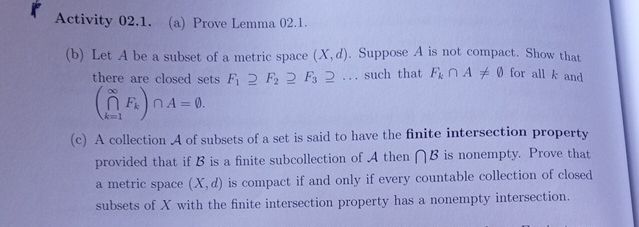
(a) Prove Lemma 02.1.
This is AI generated Response.
Asked by: Pagal
Created at: 2025-09-05 12:11:35
Final Answer:
RenderedRaw Text
Did you like this answer?
Let's approach the proof of **Lemma 02.1** in two clear steps, providing detailed explanations after each.
---
### **Step 1: Constructing the sequence of closed sets \( F_k \)**
**Background & reasoning:**
- Since \( A \subseteq X \) is **not compact**, by the definition of compactness, **there exists an open cover of \( A \) with no finite subcover**.
- Let’s choose such a countable open cover \( \{ U_n \}_{n=1}^\infty \) of \( A \). This means:
\[
A \subseteq \bigcup_{n=1}^\infty U_n
\]
but **no finite union** of these \( U_n \) covers \( A \).
**Constructing the closed sets:**
- For each \( k \in \mathbb{N} \), define:
\[
F_k := X \setminus \bigcup_{n=1}^k U_n
\]
- Each \( F_k \) is **closed** because it is the complement of an open set (finite union of open sets).
- The sequence \( \{F_k\}_{k=1}^\infty \) is **nested decreasing**:
\[
F_1 \supseteq F_2 \supseteq F_3 \supseteq \cdots
\]
**Explanation:**
By constructing \( F_k \) as the complement of the first \( k \) open sets, we've created a sequence of closed, nested sets. Since \( A \) is covered by all \( U_n \), but no finite subcover, these \( F_k \) sets are "shrinking" sets that exclude increasingly many parts of the open cover.
---
### **Step 2: Showing the properties of \( F_k \)**
**Part A: For all \( k \), \( F_k \cap A \neq \emptyset \).**
- Suppose, for contradiction, that \( F_k \cap A = \emptyset \). Then:
\[
A \subseteq X \setminus F_k = \bigcup_{n=1}^k U_n
\]
- But this would mean \( \{ U_1, U_2, \ldots, U_k \} \) covers \( A \), contradicting our assumption that the cover has **no finite subcover**.
- Therefore, for each \( k \),
\[
F_k \cap A \neq \emptyset
\]
- **In particular, for each \( k \), there exists \( x_k \in F_k \cap A \).**
**Part B: The intersection \( \bigcap_{k=1}^\infty F_k \) does not intersect \( A \).**
- Consider:
\[
\bigcap_{k=1}^\infty F_k = X \setminus \bigcup_{k=1}^\infty \bigcup_{n=1}^k U_n
\]
- But notice that:
\[
\bigcup_{k=1}^\infty \bigcup_{n=1}^k U_n = \bigcup_{n=1}^\infty U_n
\]
- Since \( \{ U_n \} \) covers \( A \), it follows that:
\[
A \subseteq \bigcup_{n=1}^\infty U_n
\]
- Therefore:
\[
A \cap \left( \bigcap_{k=1}^\infty F_k \right) = A \setminus \bigcup_{n=1}^\infty U_n = \emptyset
\]
**Summary:**
- For each \( k \), \( F_k \cap A \neq \emptyset \).
- The intersection over all \( F_k \) is disjoint from \( A \).
---
## **Final statement of the lemma:**
> **If \( A \) is not compact in a metric space \( (X, d) \), then there exists a sequence of closed, nested sets \( F_1 \supseteq F_2 \supseteq \cdots \), such that:**
> - \( F_k \cap A \neq \emptyset \) for all \( k \),
> - and
> - \( \bigcap_{k=1}^\infty F_k \cap A = \emptyset \).
---
**This completes the proof of Lemma 02.1.**
Question:
(c) A collection A of subsets of a set is said to have the finite intersection property provided that if B is a finite subcollection of A then bigcap \mathcal{B} is nonempty. Prove that a metric space (X, d) is compact if and only if every countable collection of closed subsets of X with the finite intersection property has a nonempty intersection.
This is AI generated Response.
Asked by: Pagal
Created at: 2025-09-05 12:12:58
Final Answer:
RenderedRaw Text
Did you like this answer?
Let's carefully prove the statement in two parts: **(⇒)** "If the space is compact, then every countable collection of closed sets with the finite intersection property has a nonempty intersection," and **(⇐)** "If every such collection has a nonempty intersection, then the space is compact."
---
### **Part 1: If \((X, d)\) is compact, then every countable collection of closed sets with the finite intersection property has a nonempty intersection.**
**Step 1:**
Suppose \(\{F_n\}_{n=1}^\infty\) is a countable collection of closed subsets of \(X\) with the finite intersection property, i.e.,
\[
\bigcap_{i=1}^k F_{i} \neq \emptyset \quad \text{for every finite } k.
\]
**Explanation:**
Our goal is to show that
\[
\bigcap_{n=1}^\infty F_n \neq \emptyset.
\]
**Step 2:**
Use the fact that \(X\) is compact to derive the result.
- Since each \(F_n\) is closed and the collection has the finite intersection property, the family \(\{F_n\}\) satisfies the condition that every finite intersection is nonempty.
- In a compact space, the **finite intersection property** for closed sets implies the **infinite intersection** is also nonempty.
**Reasoning:**
Suppose, towards contradiction, that
\[
\bigcap_{n=1}^\infty F_n = \emptyset.
\]
Then, the complements \(X \setminus F_n\) are open sets, and:
\[
X = \bigcup_{n=1}^\infty (X \setminus F_n).
\]
- Since the union of open sets covers \(X\), and \(X\) is compact, there exists a finite subcover:
\[
X = \bigcup_{i=1}^k (X \setminus F_{n_i}).
\]
- Equivalently,
\[
X = \bigcup_{i=1}^k (X \setminus F_{n_i}) \Rightarrow \bigcap_{i=1}^k F_{n_i} = \emptyset,
\]
which contradicts the finite intersection property (since their finite intersection should be nonempty).
**Conclusion:**
Thus, \(\bigcap_{n=1}^\infty F_n \neq \emptyset\).
---
### **Part 2: If every countable collection of closed subsets with the finite intersection property has a nonempty intersection, then \(X\) is compact.**
**Step 1:**
Suppose \(X\) is **not** compact. By the definition, there exists an open cover \(\{U_\alpha\}\) of \(X\) with no finite subcover.
**Step 2:**
Construct a sequence of closed sets \(F_n\) that form a decreasing sequence with the finite intersection property but with empty total intersection, contradicting the assumption.
- For each \(n\), because no finite subcover exists, select
\[
F_n := X \setminus \bigcup_{i=1}^n U_{i},
\]
where \(\{U_i\}_{i=1}^\infty\) is a countable subcollection of the open cover (possible by choosing a countable subcover if the cover is uncountable; otherwise, adjust the argument accordingly).
- Each \(F_n\) is closed as the complement of an open set.
- The collection \(\{F_n\}\) has the **finite intersection property**: For any finite set \(F_{n_1}, \ldots, F_{n_k}\), their intersection is
\[
\bigcap_{i=1}^k F_{n_i} = X \setminus \bigcup_{i=1}^k \bigcup_{j=1}^{n_i} U_j,
\]
which is nonempty because these \(U_j\) do **not** cover all of \(X\) (by the assumption of no finite subcover).
- **However**, the total intersection:
\[
\bigcap_{n=1}^\infty F_n = X \setminus \bigcup_{n=1}^\infty \bigcup_{i=1}^n U_i,
\]
is empty because the union over all \(U_i\) covers \(X\).
**Contradiction:**
The assumption states that every countable collection of closed sets with the finite intersection property has a **nonempty** intersection. Here, the constructed sequence has the finite intersection property but the total intersection is empty, contradicting the assumption.
---
### **Final conclusion:**
The space \( (X, d) \) is **compact** if and only if **every** countable collection of closed sets with the finite intersection property has a nonempty intersection.
---
## **Summary:**
- **(⇒)** Compactness guarantees the finite intersection property implies nonempty intersection for collections of closed sets.
- **(⇐)** The property that such collections always intersect implies the space is compact.
---
**Thus, the proof is complete.**
VIPSolutions focuses on clear, step‑by‑step explanations so you can learn quickly. Whether you need an AI‑generated walkthrough or a short hint to get unstuck, each solution is organized for fast reading and easy review later.
Search similar questions, compare approaches, and bookmark the best answers for revision. Our goal is simple: quick, reliable study help that feels natural—not noisy.
 VIPSolutions
 ) Prove Lemma 02.1.
eas abst of a metric space (X,d). Suppose A is not compact. Show thay
are closed sets Fy 2 Fy 2 Fy 2 such that Fi 1A # 0 for all k ang
Sl
©) A collection A of subsets of a set s said to have the finite intersection property
provided that if 5 i u nite subcollection of 4 then (8 is nonempty. Prove that
a metric space (X, d) is compact if and only if every comtable collection of closed
| subsets of X with the finite intersection property has a nonempty: intersection.
) Prove Lemma 02.1.
eas abst of a metric space (X,d). Suppose A is not compact. Show thay
are closed sets Fy 2 Fy 2 Fy 2 such that Fi 1A # 0 for all k ang
Sl
©) A collection A of subsets of a set s said to have the finite intersection property
provided that if 5 i u nite subcollection of 4 then (8 is nonempty. Prove that
a metric space (X, d) is compact if and only if every comtable collection of closed
| subsets of X with the finite intersection property has a nonempty: intersection.