give answer in 2 step with explanation at the end of each step and final answer at the end:
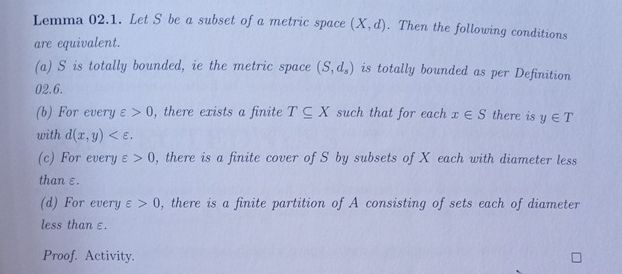
Lemma 02.1. Let S be a subset of a metric space (X, d) Then the following conditions are equivalent.
(a) S is totally bounded, ie the metric space (S, d_{s}) is totally bounded as per Definition 02.6.
(b) For every epsilon > 0 there exists a finite T subseteq X such that for each x \in S there is y \in T with d(x, y) < epsilon
(c) For every epsilon > 0 there is a finite cover of S by subsets of X each with diameter less than s
(d) For every epsilon > 0 there is a finite partition of A consisting of sets each of diameter less than e.
Proof. Activity.Lemma 02.1. Let S be a subset of a metric space (X,d). Then the Iolewing nin
are equivalent.
(a) 5 is totally bounded, ie the metric space (3,d,) is totally bounded as per Defntion
026,
(8) For every = > 0, there cists a finite TC X such that for cach = € S there is y eT
fh d(z,y) 0, there is a finite cover of S by subsets of X each with diameter less
d) For every = > 0, there is a finite partition of A consisting of sets each of diameter
ss than =.
of. Activity. o
Question:
give answer in 2 step with explanation at the end of each step and final answer at the end:
Lemma 02.1. Let S be a subset of a metric space (X, d) Then the following conditions are equivalent.
(a) S is totally bounded, ie the metric space (S, d_{s}) is totally bounded as per Definition 02.6.
(b) For every epsilon > 0 there exists a finite T subseteq X such that for each x \in S there is y \in T with d(x, y) < epsilon
(c) For every epsilon > 0 there is a finite cover of S by subsets of X each with diameter less than s
(d) For every epsilon > 0 there is a finite partition of A consisting of sets each of diameter less than e.
Proof. Activity.Lemma 02.1. Let S be a subset of a metric space (X,d). Then the Iolewing nin
are equivalent.
(a) 5 is totally bounded, ie the metric space (3,d,) is totally bounded as per Defntion
026,
(8) For every = > 0, there cists a finite TC X such that for cach = € S there is y eT
fh d(z,y) 0, there is a finite cover of S by subsets of X each with diameter less
d) For every = > 0, there is a finite partition of A consisting of sets each of diameter
ss than =.
of. Activity. o
This is AI generated Response.
Asked by: Pagal
Created at: 2025-09-05 12:33:00
Final Answer:
RenderedRaw Text
Did you like this answer?
Sure! Let's **prove the equivalence** of the conditions in Lemma 02.1 in **two main steps**, explaining each step and then giving the final conclusion.
---
### **Step 1: (a) ⇒ (b) ⇒ (c)**
#### (a) ⇒ (b):
If \( S \) is totally bounded, then for every \( \varepsilon > 0 \), there exists a **finite \(\varepsilon\)-net** in \( S \).
- This means: There is a finite subset \( T \subseteq S \) such that every \( x \in S \) is within \( \varepsilon \) of some \( y \in T \) (i.e., \( d(x, y) < \varepsilon \)).
- Since \( T \subseteq S \subseteq X \), we can also view \( T \) as a subset of \( X \).
- Therefore, **for every \( \varepsilon > 0 \), there exists a finite \( T \subseteq X \) such that for each \( x \in S \), there is \( y \in T \) with \( d(x, y) < \varepsilon \)**, which is exactly condition (b).
**Explanation:**
Total boundedness means you can "approximate" all points in \( S \) with finitely many points within any given accuracy. This gives you a finite \( \varepsilon \)-net as in (b).
---
#### (b) ⇒ (c):
Given (b), for every \( \varepsilon > 0 \), there is a finite \( T = \{y_1, \ldots, y_n\} \subseteq X \) such that for each \( x \in S \), \( d(x, y_i) < \varepsilon \) for some \( i \).
- Consider the balls \( B(y_i, \varepsilon) \) for \( i = 1, ..., n \).
- The union of these balls **covers \( S \)** (since every \( x \in S \) is close to some \( y_i \)).
- Each ball has diameter at most \( 2\varepsilon \), but we can always adjust \( \varepsilon \) by using \( \varepsilon/2 \) instead.
- **Thus:** For any \( \varepsilon > 0 \), \( S \) can be covered by finitely many subsets of \( X \) (the balls) with diameter less than \( \varepsilon \), which is (c).
**Explanation:**
Having a finite net implies you can cover the set with finitely many small balls, which is a finite cover with small diameter.
---
### **Step 2: (c) ⇒ (d) ⇒ (a)**
#### (c) ⇒ (d):
If for every \( \varepsilon > 0 \), there’s a finite cover of \( S \) by subsets of diameter less than \( \varepsilon \),
- Then you can **refine the cover into a finite partition**: assign each point in \( S \) to one of the covering sets, forming a partition.
- The resulting partition consists of finitely many sets, each of diameter less than \( \varepsilon \), which is (d).
**Explanation:**
A finite cover can always be refined to a finite partition by distributing points among the covering sets.
---
#### (d) ⇒ (a):
Suppose for every \( \varepsilon > 0 \), there is a finite partition of \( S \) into sets of diameter less than \( \varepsilon \).
- Picking one point from each partition set gives a finite \( \varepsilon \)-net for \( S \).
- Thus, \( S \) is totally bounded.
**Explanation:**
A finite partition with small diameter allows you to choose representatives forming a finite net, matching the definition of total boundedness.
---
## **Final Answer**
**All four conditions (a)-(d) are equivalent** for a subset \( S \) of a metric space \((X, d)\):
1. **(a) ⇒ (b) ⇒ (c) ⇒ (d) ⇒ (a)** (as shown above).
2. **Explanation:** Each step shows how the property in one condition guarantees the next, eventually circling back to the first, thereby proving equivalence.
Question:
(a) S is totally bounded, ie the metric space (S, d_{s}) is totally bounded as per Definition 02.6.
This is AI generated Response.
Asked by: Pagal
Created at: 2025-09-05 12:33:53
Final Answer:
RenderedRaw Text
Did you like this answer?
Certainly! Here's a clear two-step explanation with reasoning at each stage:
---
### **Step 1: Showing (a) ⇒ (b) and (b) ⇒ (c)**
**(a) ⇒ (b):**
- **Total boundedness** of \( S \) means: For every \( \varepsilon > 0 \), there exists a **finite \(\varepsilon\)-net** within \( S \).
- **Implication:** We can find a finite subset \( T \subseteq S \) such that every point \( x \in S \) is within \( \varepsilon \) of some \( y \in T \).
- **Result:** This matches condition (b): for each \( x \in S \), there exists \( y \in T \) with \( d(x, y) < \varepsilon \).
**(b) ⇒ (c):**
- Given (b), for each \( \varepsilon > 0 \), we have a finite set \( T = \{ y_1, y_2, \ldots, y_n \} \) such that every \( x \in S \) is within \( \varepsilon \) of some \( y_i \).
- **Construct a cover:** Take balls \( B(y_i, \varepsilon) \). These finitely many balls cover \( S \).
- **Diameter consideration:** Each ball has diameter at most \( 2\varepsilon \). By choosing smaller \( \varepsilon \), we can ensure the diameter of each covering set is less than \( \varepsilon \).
- **Result:** \( S \) can be covered by finitely many subsets of diameter less than \( \varepsilon \), satisfying (c).
---
### **Step 2: Showing (c) ⇒ (d) and (d) ⇒ (a)**
**(c) ⇒ (d):**
- Given that for each \( \varepsilon > 0 \), \( S \) is covered by finitely many subsets each of diameter less than \( \varepsilon \).
- **Refinement:** Partition \( S \) into these subsets, which gives a finite partition where each part has diameter less than \( \varepsilon \).
- **Result:** Condition (d) holds.
**(d) ⇒ (a):**
- If for every \( \varepsilon > 0 \), \( S \) admits a finite partition into sets of diameter less than \( \varepsilon \),
- **Choose representatives:** Pick one point from each part.
- These points form a finite \( \varepsilon \)-net for \( S \).
- **Conclusion:** \( S \) is totally bounded, satisfying (a).
---
### **Final conclusion:**
**All four conditions are equivalent.**
This means that **total boundedness** of \( S \) in \((X, d)\) can be characterized in multiple, equivalent ways as given in the lemma.
---
**Answer:**
**(a) \( S \) is totally bounded if and only if any of the conditions (b), (c), or (d) hold.**
VIPSolutions focuses on clear, step‑by‑step explanations so you can learn quickly. Whether you need an AI‑generated walkthrough or a short hint to get unstuck, each solution is organized for fast reading and easy review later.
Search similar questions, compare approaches, and bookmark the best answers for revision. Our goal is simple: quick, reliable study help that feels natural—not noisy.
 VIPSolutions
 Lemma 02.1. Let S be a subset of a metric space (X,d). Then the Iolewing nin
are equivalent.
(a) 5 is totally bounded, ie the metric space (3,d,) is totally bounded as per Defntion
026,
(8) For every = > 0, there cists a finite TC X such that for cach = € S there is y eT
fh d(z,y) 0, there is a finite cover of S by subsets of X each with diameter less
d) For every = > 0, there is a finite partition of A consisting of sets each of diameter
ss than =.
of. Activity. o
Lemma 02.1. Let S be a subset of a metric space (X,d). Then the Iolewing nin
are equivalent.
(a) 5 is totally bounded, ie the metric space (3,d,) is totally bounded as per Defntion
026,
(8) For every = > 0, there cists a finite TC X such that for cach = € S there is y eT
fh d(z,y) 0, there is a finite cover of S by subsets of X each with diameter less
d) For every = > 0, there is a finite partition of A consisting of sets each of diameter
ss than =.
of. Activity. o