 VIPSolutions
give answer in 2 step with explanation at the end of each step and final answer at the end: Assignment 1 A diploid organism has the dihybrid genotype D 2 D 2 E 3 E 2 for alleles of gene D and alleles of gene E . Genes D and E are on different chromosomes. Illustrate these two pairs of chromosomes through a mitotic and a meiotic division. Label each copy of each allele on chromosomes and sister chromatids. Label all cell components required for these processes, including the types of microtubules, centrosomes, and any other components.Assad psn ie ep sd ge dd lg oo oo a x ries td ii, ma ET ee To TL SE microtubues, centrosomes, and any othr compenents.
Question:
give answer in 2 step with explanation at the end of each step and final answer at the end:
Assignment
1
A diploid organism has the dihybrid genotype
D
2
D
2
E
3
E
2
for alleles of gene
D
and alleles of gene
E
.
Genes D and E are on different chromosomes. Illustrate these two pairs of chromosomes through a mitotic and a meiotic division. Label each copy of each allele on chromosomes and sister chromatids. Label all cell components required for these processes, including the types of microtubules, centrosomes, and any other components.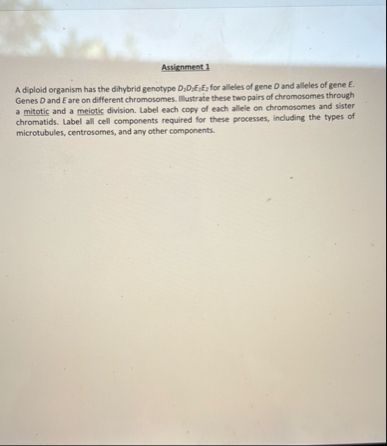 Assad psn ie ep sd ge dd lg
oo oo a x ries td
ii, ma
ET ee To TL SE
microtubues, centrosomes, and any othr compenents.
Assad psn ie ep sd ge dd lg
oo oo a x ries td
ii, ma
ET ee To TL SE
microtubues, centrosomes, and any othr compenents.
This is AI generated Response.
Asked by: Pagal
Created at: 2025-09-10 06:32:19
Asked by: Pagal
Created at: 2025-09-10 06:32:19
Final Answer:
Rendered
Raw Text
Did you like this answer?
# Assignment 1 Solution
## Step 1: **Mitosis Illustration and Explanation**
### **Explanation**
- **Genotype:** The organism is diploid (**D₂D₂ E₃E₂**), meaning it has two homologous chromosomes for each gene.
- **Genes on Different Chromosomes:** D and E are on separate chromosomes, so they assort independently.
- **Mitosis Overview:** Mitosis produces two genetically identical diploid daughter cells. Each chromosome duplicates, forming sister chromatids, which are then separated.
### **Illustration Outline**
#### **Before Mitosis (G2 phase)**
- **Chromosome pairs:**
- Chromosome 1: D₂ | D₂ (each duplicated into sister chromatids)
- Chromosome 2: E₃ | E₂ (each duplicated into sister chromatids)
- **Cell components:**
- **Centrosomes:** Two, at opposite poles
- **Microtubules:** Spindle fibers (kinetochore microtubules attach to centromeres; polar microtubules span pole-to-pole)
#### **During Metaphase**
- Chromosomes align at metaphase plate
- D₂ sister chromatids on each side, E₃ and E₂ aligned similarly
#### **During Anaphase**
- Sister chromatids are pulled apart by spindle fibers to opposite poles
#### **After Mitosis (Cytokinesis)**
- Each daughter cell gets:
- D₂ | D₂
- E₃ | E₂
- Both cells are genetically identical to parent
---
## Step 2: **Meiosis Illustration and Explanation**
### **Explanation**
- **Meiosis Overview:** Meiosis involves two divisions (Meiosis I and II) to produce four haploid gametes. Homologous chromosomes separate in Meiosis I; sister chromatids separate in Meiosis II.
### **Illustration Outline**
#### **Before Meiosis I (G2 phase)**
- Same as before mitosis: D₂ | D₂ (sister chromatids), E₃ | E₂ (sister chromatids)
#### **Meiosis I (Homologous Chromosomes Separate)**
- **Metaphase I:** Homologous pairs align at metaphase plate
- One D₂ pairs with the other D₂
- E₃ pairs with E₂
- **Anaphase I:** Homologous chromosomes move to opposite poles
- One cell gets D₂ + E₃, the other gets D₂ + E₂
#### **Meiosis II (Sister Chromatids Separate)**
- Each cell divides again
- Sister chromatids are separated
#### **Final Gametes**
- Possible combinations:
1. D₂, E₃
2. D₂, E₂
3. D₂, E₃
4. D₂, E₂
- All gametes are haploid (one copy of each gene)
---
## **Final Answer:**
### **Mitosis produces two identical diploid cells** with the genotype **D₂D₂ E₃E₂** (each cell has both D₂ alleles, and both E₃ and E₂ alleles).
### **Meiosis produces four haploid gametes**, each with the genotype **D₂E₃** or **D₂E₂**.
- All gametes have D₂ because the organism is homozygous for D₂.
- Gametes differ for the E gene (E₃ or E₂).
---
### **Diagram Key Components to Label**
- **Chromosomes and alleles:** D₂, E₃, E₂
- **Sister chromatids**
- **Centrosomes**
- **Microtubules:** Kinetochore and polar
- **Cell membrane**
*(If you need a hand-drawn or digital diagram, let me know—I can sketch how to arrange and label these components!)*
📢 Instructions:
- Ask anything relatd to above question only.
- For new Question goto :