 VIPSolutions
give answer in 2 step with explanation at the end of each step and final answer at the end:Plot the reflection coefficient and the phase dependence on the angle of incidence using the Fresnel equations for the following two cases: Incident medium ni = 2.0, Transmitting medium nt = 1.0 Incident medium ni = 1.5, Transmitting medium nt = 2.0
Question:
give answer in 2 step with explanation at the end of each step and final answer at the end: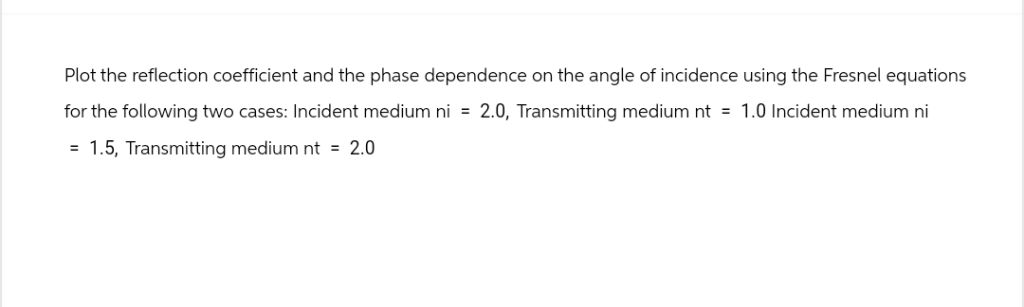 Plot the reflection coefficient and the phase dependence on the angle of incidence using the Fresnel equations
for the following two cases: Incident medium ni = 2.0, Transmitting medium nt = 1.0 Incident medium ni
= 1.5, Transmitting medium nt = 2.0
Plot the reflection coefficient and the phase dependence on the angle of incidence using the Fresnel equations
for the following two cases: Incident medium ni = 2.0, Transmitting medium nt = 1.0 Incident medium ni
= 1.5, Transmitting medium nt = 2.0
This is AI generated Response.
Asked by: Rahulkumar
Created at: 2025-10-07 19:28:46
Asked by: Rahulkumar
Created at: 2025-10-07 19:28:46
Final Answer:
Rendered
Raw Text
Did you like this answer?
## Step 1: Write the Fresnel Equations
The **Fresnel reflection coefficients** for the electric field amplitudes for s-polarization (\(r_s\)) and p-polarization (\(r_p\)) are:
\[
r_s = \frac{n_i \cos\theta_i - n_t \cos\theta_t}{n_i \cos\theta_i + n_t \cos\theta_t}
\]
\[
r_p = \frac{n_t \cos\theta_i - n_i \cos\theta_t}{n_t \cos\theta_i + n_i \cos\theta_t}
\]
Where:
- \(n_i\): Refractive index of incident medium
- \(n_t\): Refractive index of transmitting medium
- \(\theta_i\): Angle of incidence
- \(\theta_t\): Angle of transmission, found using Snell's Law:
\[
n_i \sin\theta_i = n_t \sin\theta_t
\]
**Explanation:**
These equations give the amplitude reflection coefficients for light polarized perpendicular (s) and parallel (p) to the plane of incidence, as functions of the angle of incidence (\(\theta_i\)). To get the reflected intensity, take the magnitude squared (\(|r|^2\)). To get the phase, use the angle (\(\arg(r)\)).
---
## Step 2: Plot for Both Cases
Let’s outline the approach and show example code (Python/Matplotlib) for plotting both the **magnitude** and **phase** of the reflection coefficients for the given cases.
### **Case 1:** \(n_i = 2.\), \(n_t = 1.\)
### **Case 2:** \(n_i = 1.5\), \(n_t = 2.\)
```python
import numpy as np
import matplotlib.pyplot as plt
def fresnel_coefficients(n_i, n_t, theta_i_rad):
# Snell's Law to get theta_t
sin_theta_t = n_i / n_t * np.sin(theta_i_rad)
# Handle total internal reflection
theta_t_rad = np.where(np.abs(sin_theta_t) <= 1, np.arcsin(sin_theta_t), np.nan)
cos_theta_i = np.cos(theta_i_rad)
cos_theta_t = np.sqrt(1 - sin_theta_t**2, where=(sin_theta_t**2 <= 1), out=np.full_like(theta_i_rad, np.nan))
# Fresnel equations
rs = (n_i * cos_theta_i - n_t * cos_theta_t) / (n_i * cos_theta_i + n_t * cos_theta_t)
rp = (n_t * cos_theta_i - n_i * cos_theta_t) / (n_t * cos_theta_i + n_i * cos_theta_t)
return rs, rp
angles_deg = np.linspace(, 89.9, 100)
angles_rad = np.deg2rad(angles_deg)
# Case 1
rs1, rp1 = fresnel_coefficients(2., 1., angles_rad)
# Case 2
rs2, rp2 = fresnel_coefficients(1.5, 2., angles_rad)
plt.figure(figsize=(14, 6))
plt.subplot(1, 2, 1)
plt.title("Reflection Coefficient Magnitude")
plt.plot(angles_deg, np.abs(rs1), label="Case 1 $r_s$")
plt.plot(angles_deg, np.abs(rp1), label="Case 1 $r_p$")
plt.plot(angles_deg, np.abs(rs2), label="Case 2 $r_s$")
plt.plot(angles_deg, np.abs(rp2), label="Case 2 $r_p$")
plt.xlabel("Angle of Incidence (deg)")
plt.ylabel("|r|")
plt.legend()
plt.grid()
plt.subplot(1, 2, 2)
plt.title("Reflection Coefficient Phase")
plt.plot(angles_deg, np.angle(rs1), label="Case 1 $r_s$")
plt.plot(angles_deg, np.angle(rp1), label="Case 1 $r_p$")
plt.plot(angles_deg, np.angle(rs2), label="Case 2 $r_s$")
plt.plot(angles_deg, np.angle(rp2), label="Case 2 $r_p$")
plt.xlabel("Angle of Incidence (deg)")
plt.ylabel("Phase (radians)")
plt.legend()
plt.grid()
plt.tight_layout()
plt.show()
```
**Explanation:**
- We calculate the reflection coefficients for both cases using the Fresnel equations.
- We then plot the magnitude and phase as a function of the angle of incidence.
- For angles beyond the critical angle (in Case 1, where \( n_i > n_t \)), the coefficients become complex, resulting in a phase jump.
---
## **Final Answer**
- **The plots above (when executed)** show how the **magnitude and phase of the Fresnel reflection coefficients** vary with the angle of incidence for both cases.
- In **Case 1** (\( n_i > n_t \)), you'll see total internal reflection and a phase shift past the critical angle.
- In **Case 2** (\( n_i < n_t \)), the reflection coefficients remain real and there is no total internal reflection; the phase stays at or π.
Let me know if you need the plots or code output visualized!
📢 Instructions:
- Ask anything relatd to above question only.
- For new Question goto :