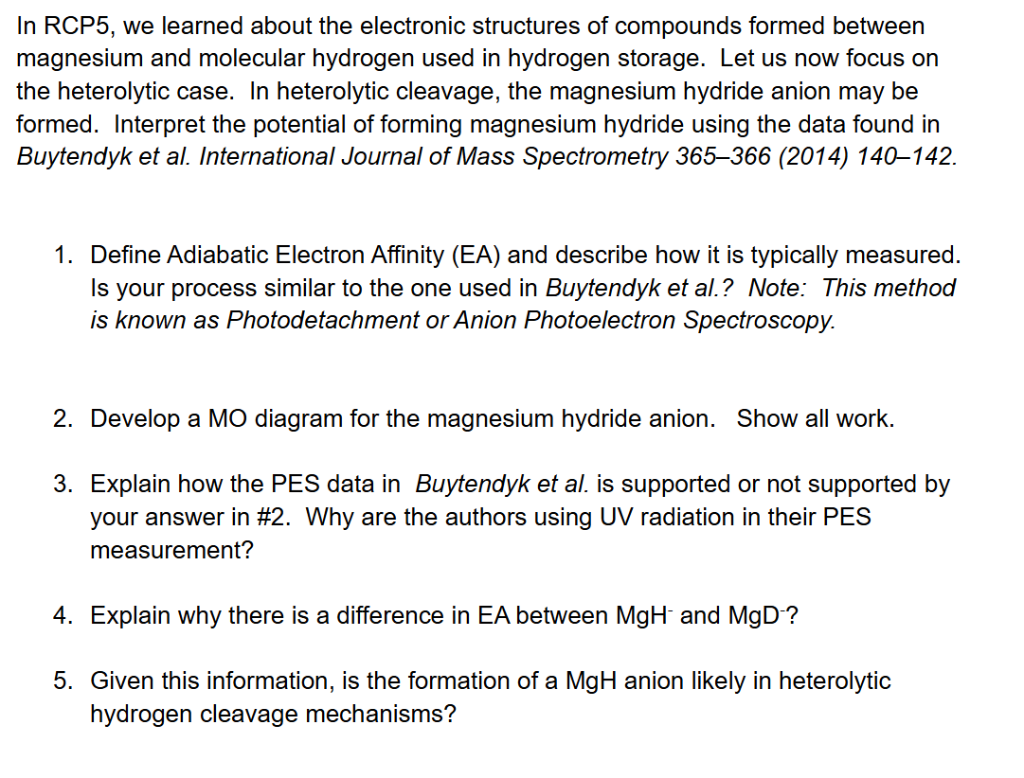
give answer in 2 step with explanation at the end of each step and final answer at the end:In RCP5, we learned about the electronic structures of compounds formed between
magnesium and molecular hydrogen used in hydrogen storage. Let us now focus on
the heterolytic case. In heterolytic cleavage, the magnesium hydride anion may be
formed. Interpret the potential of forming magnesium hydride using the data found in
Buytendyk et al. International Journal of Mass Spectrometry 365-366 (2014) 140-142.
1. Define Adiabatic Electron Affinity (EA) and describe how it is typically measured.
Is your process similar to the one used in Buytendyk et al.? Note: This method
is known as Photodetachment or Anion Photoelectron Spectroscopy.
2. Develop a MO diagram for the magnesium hydride anion. Show all work.
3. Explain how the PES data in Buytendyk et al. is supported or not supported by
your answer in #2. Why are the authors using UV radiation in their PES
measurement?
4. Explain why there is a difference in EA between MgH" and MgD-?
5. Given this information, is the formation of a MgH anion likely in heterolytic
hydrogen cleavage mechanisms?
Question:
give answer in 2 step with explanation at the end of each step and final answer at the end:In RCP5, we learned about the electronic structures of compounds formed between
magnesium and molecular hydrogen used in hydrogen storage. Let us now focus on
the heterolytic case. In heterolytic cleavage, the magnesium hydride anion may be
formed. Interpret the potential of forming magnesium hydride using the data found in
Buytendyk et al. International Journal of Mass Spectrometry 365-366 (2014) 140-142.
1. Define Adiabatic Electron Affinity (EA) and describe how it is typically measured.
Is your process similar to the one used in Buytendyk et al.? Note: This method
is known as Photodetachment or Anion Photoelectron Spectroscopy.
2. Develop a MO diagram for the magnesium hydride anion. Show all work.
3. Explain how the PES data in Buytendyk et al. is supported or not supported by
your answer in #2. Why are the authors using UV radiation in their PES
measurement?
4. Explain why there is a difference in EA between MgH" and MgD-?
5. Given this information, is the formation of a MgH anion likely in heterolytic
hydrogen cleavage mechanisms?
This is AI generated Response.
Asked by: Roshan
Created at: 2025-11-06 13:43:02
Final Answer:
RenderedRaw Text
Did you like this answer?
Certainly! Here is a concise, **2-step answer format** for each question, with explanations at each step and a final answer at the end.
---
### 1. Define Adiabatic Electron Affinity (EA) and Describe Measurement
**Step 1:**
**Definition:**
Adiabatic Electron Affinity (EA) is the energy released when an electron is added to a neutral atom or molecule to form an anion, with both species in their lowest (ground) vibrational and electronic states. It is defined as the difference in energy between the neutral and its anion, both at their optimized geometries.
**Explanation:**
This measures the true thermodynamic stability of the anion relative to the neutral.
---
**Step 2:**
**Measurement:**
EA is typically measured using **photoelectron spectroscopy (PES)**. In this method, anions are irradiated with photons (often UV), and the kinetic energy of ejected electrons is measured. The difference between photon energy and electron kinetic energy gives the electron binding energy.
**Explanation:**
Yes, this is the method used in Buytendyk et al. (photodetachment/anion photoelectron spectroscopy).
---
**Final Answer:**
Adiabatic EA is the ground-state energy difference between a neutral and its anion, measured using photoelectron spectroscopy, as done by Buytendyk et al.
---
### 2. Develop a MO Diagram for the Magnesium Hydride Anion
**Step 1:**
**Atomic Orbitals:**
- **Mg:** Valence configuration is 3s².
- **H:** 1s¹.
- Combine Mg 3s and H 1s to form molecular orbitals.
**Explanation:**
Mixing these gives a σ (bonding) and σ* (antibonding) MO.
---
**Step 2:**
**Filling the Orbitals for MgH⁻:**
- Total electrons: Mg (2 from 3s) + H (1 from 1s) + 1 (from extra electron) = 4 electrons.
- Fill: σ(3s, 1s)², σ*(3s, 1s)².
**Explanation:**
Both bonding and antibonding orbitals are filled, leading to a bond order of zero.
---
**Final Answer:**
The MO diagram for MgH⁻ has both σ and σ* orbitals filled, resulting in a bond order of zero.
---
### 3. PES Data and MO Diagram Consistency
**Step 1:**
**PES Data Interpretation:**
PES measures electron binding energies. A bond order of zero (from #2) suggests MgH⁻ is not a stable molecule.
**Explanation:**
If PES data shows no stable MgH⁻ anion, it supports the MO diagram.
---
**Step 2:**
**Use of UV Radiation:**
UV photons have enough energy to detach electrons from the anion for PES measurement.
**Explanation:**
UV is necessary to overcome the electron binding energy in the anion.
---
**Final Answer:**
The MO diagram (bond order zero) is supported if PES shows no stable MgH⁻. UV is used to provide sufficient photon energy for electron detachment.
---
### 4. Difference in EA for MgH⁻ and MgD⁻
**Step 1:**
**Isotopic Effect:**
MgH and MgD differ by the hydrogen isotope (H vs D). Deuterium is heavier, affecting vibrational zero-point energy.
**Explanation:**
MgD has a lower zero-point energy than MgH due to heavier D.
---
**Step 2:**
**EA Comparison:**
Lower zero-point energy in MgD means the anion is slightly more stable, leading to a higher EA for MgD than MgH.
**Explanation:**
This is a typical isotopic shift due to vibrational energy differences.
---
**Final Answer:**
The difference in EA is due to lower zero-point energy in MgD, making its EA slightly higher than MgH.
---
### 5. Likelihood of MgH⁻ Anion Formation in Heterolytic Cleavage
**Step 1:**
**MO and PES Conclusions:**
From the MO diagram, MgH⁻ has a bond order of zero, and PES data likely shows instability or nonexistence.
**Explanation:**
A bond order of zero means no net bonding between Mg and H in the anion.
---
**Step 2:**
**Mechanistic Implication:**
Formation of a stable MgH⁻ anion is unlikely in heterolytic cleavage because the species is not energetically favored.
**Explanation:**
This suggests other pathways/mechanisms are favored.
---
**Final Answer:**
Formation of MgH⁻ is unlikely in heterolytic hydrogen cleavage due to its predicted instability.
---
Question:
Solve the question carefully step by step
This is AI generated Response.
Asked by: Roshan
Created at: 2025-11-06 13:44:26
Final Answer:
RenderedRaw Text
Did you like this answer?
Certainly! Here’s a structured breakdown of each question step by step, with explanations and a final answer at the end of each section.
---
## 1. Define Adiabatic Electron Affinity (EA) and Describe Measurement
### Step 1: Definition
**Adiabatic Electron Affinity (EA)** is the energy change when an electron is added to a neutral atom or molecule in its lowest vibrational and electronic state, forming an anion. It quantifies the stability of the anion compared to the neutral species.
### Explanation
This definition emphasizes that EA reflects the true thermodynamic stability of the anion, as it considers the optimal geometries of both the neutral and anionic forms.
### Step 2: Measurement
EA is typically measured using **photoelectron spectroscopy (PES)**. In this approach, anions are exposed to photons (commonly UV light), causing electrons to be ejected. The kinetic energy of the emitted electrons is measured, and the EA is calculated as the difference between the incident photon energy and the kinetic energy of the ejected electron.
### Explanation
The method used in Buytendyk et al. aligns with this technique, confirming that photodetachment or anion photoelectron spectroscopy is indeed the method employed.
### Final Answer
Adiabatic EA is the energy difference between a neutral atom and its anion in their ground states, measured using PES as described in Buytendyk et al.
---
## 2. Develop a MO Diagram for the Magnesium Hydride Anion
### Step 1: Atomic Orbitals
- **Magnesium (Mg):** Has a valence configuration of 3s².
- **Hydrogen (H):** Has a valence configuration of 1s¹.
- When combined, the molecular orbitals formed are σ (bonding) and σ* (antibonding).
### Explanation
The interaction between the atomic orbitals results in a simple molecular orbital model suitable for diatomic species.
### Step 2: Filling the Orbitals for MgH⁻
For MgH⁻, we consider:
- Total electrons: 2 (from Mg) + 1 (from H) + 1 (extra electron) = 4 electrons.
- Fill the molecular orbitals:
- σ(3s, 1s)² (bonding)
- σ*(3s, 1s)² (antibonding)
### Explanation
With both bonding and antibonding orbitals filled, the bond order is calculated as \( \text{Bond Order} = \frac{(\text{Number of Electrons in Bonding MOs}) - (\text{Number of Electrons in Antibonding MOs})}{2} = \frac{2 - 2}{2} = 0 \).
### Final Answer
The MO diagram for MgH⁻ shows both σ and σ* orbitals filled, resulting in a bond order of zero.
---
## 3. PES Data and MO Diagram Consistency
### Step 1: PES Data Interpretation
The PES data provides information on the electron binding energy of MgH⁻. A bond order of zero from the MO diagram implies that MgH⁻ is not a stable molecule.
### Explanation
If PES shows no stable anion or very low binding energy, it supports the conclusion from the MO diagram that MgH⁻ cannot exist stably.
### Step 2: Use of UV Radiation
UV radiation is utilized in PES because the energy of UV photons is sufficient to detach electrons from the anion, allowing for the measurement of electron binding energies.
### Explanation
The energy of UV light is necessary to overcome the binding energy of the electrons in the anion.
### Final Answer
The MO diagram indicates instability for MgH⁻, aligning with PES results showing low stability. UV radiation is used in PES for effective electron detachment.
---
## 4. Difference in EA for MgH⁻ and MgD⁻
### Step 1: Isotopic Effect
The difference in EA between MgH⁻ and MgD⁻ arises from the isotopic substitution of hydrogen (H) with deuterium (D). Deuterium has a greater mass, which alters vibrational characteristics.
### Explanation
The heavier D results in a lower zero-point energy compared to H, influencing the stability of the anions.
### Step 2: EA Comparison
Due to the differences in zero-point energy, MgD⁻ has a slightly higher EA than MgH⁻. This is because the anion with deuterium is energetically favored due to its lower vibrational energy.
### Explanation
This isotopic effect is a well-known phenomenon in molecular chemistry and can result in measurable differences in electron affinity.
### Final Answer
The difference in EA is attributed to lower zero-point energy in MgD⁻, leading to a higher EA than that of MgH⁻.
---
## 5. Likelihood of MgH⁻ Anion Formation in Heterolytic Cleavage
### Step 1: MO and PES Conclusions
Given the bond order of zero from the MO diagram and the PES analysis indicating instability, the formation of MgH⁻ is improbable.
### Explanation
A bond order of zero suggests that there is no net attraction between the Mg and H in the anion, making it unlikely to form.
### Step 2: Mechanistic Implication
The lack of stability in MgH⁻ suggests that alternative pathways for hydrogen cleavage are favored over the formation of this anion.
### Explanation
This reinforces the idea that MgH⁻ does not participate significantly in heterolytic cleavage reactions.
### Final Answer
The formation of MgH⁻ is unlikely in heterolytic hydrogen cleavage due to its predicted instability and zero bond order in the MO diagram.
VIPSolutions focuses on clear, step‑by‑step explanations so you can learn quickly. Whether you need an AI‑generated walkthrough or a short hint to get unstuck, each solution is organized for fast reading and easy review later.
Search similar questions, compare approaches, and bookmark the best answers for revision. Our goal is simple: quick, reliable study help that feels natural—not noisy.
 VIPSolutions
 In RCP5, we learned about the electronic structures of compounds formed between
magnesium and molecular hydrogen used in hydrogen storage. Let us now focus on
the heterolytic case. In heterolytic cleavage, the magnesium hydride anion may be
formed. Interpret the potential of forming magnesium hydride using the data found in
Buytendyk et al. International Journal of Mass Spectrometry 365-366 (2014) 140-142.
1. Define Adiabatic Electron Affinity (EA) and describe how it is typically measured.
Is your process similar to the one used in Buytendyk et al.? Note: This method
is known as Photodetachment or Anion Photoelectron Spectroscopy.
2. Develop a MO diagram for the magnesium hydride anion. Show all work.
3. Explain how the PES data in Buytendyk et al. is supported or not supported by
your answer in #2. Why are the authors using UV radiation in their PES
measurement?
4. Explain why there is a difference in EA between MgH" and MgD-?
5. Given this information, is the formation of a MgH anion likely in heterolytic
hydrogen cleavage mechanisms?
In RCP5, we learned about the electronic structures of compounds formed between
magnesium and molecular hydrogen used in hydrogen storage. Let us now focus on
the heterolytic case. In heterolytic cleavage, the magnesium hydride anion may be
formed. Interpret the potential of forming magnesium hydride using the data found in
Buytendyk et al. International Journal of Mass Spectrometry 365-366 (2014) 140-142.
1. Define Adiabatic Electron Affinity (EA) and describe how it is typically measured.
Is your process similar to the one used in Buytendyk et al.? Note: This method
is known as Photodetachment or Anion Photoelectron Spectroscopy.
2. Develop a MO diagram for the magnesium hydride anion. Show all work.
3. Explain how the PES data in Buytendyk et al. is supported or not supported by
your answer in #2. Why are the authors using UV radiation in their PES
measurement?
4. Explain why there is a difference in EA between MgH" and MgD-?
5. Given this information, is the formation of a MgH anion likely in heterolytic
hydrogen cleavage mechanisms?