 VIPSolutions
give answer in 2 step with explanation at the end of each step and final answer at the end:Converging do = di= hj = image image | image larger or configuration Objectto | Screento | observed | realor | upright smaller than lens lens (cm) virtual or object (cm) (cm) inverted CE A I NN Ce NR
Question:
give answer in 2 step with explanation at the end of each step and final answer at the end: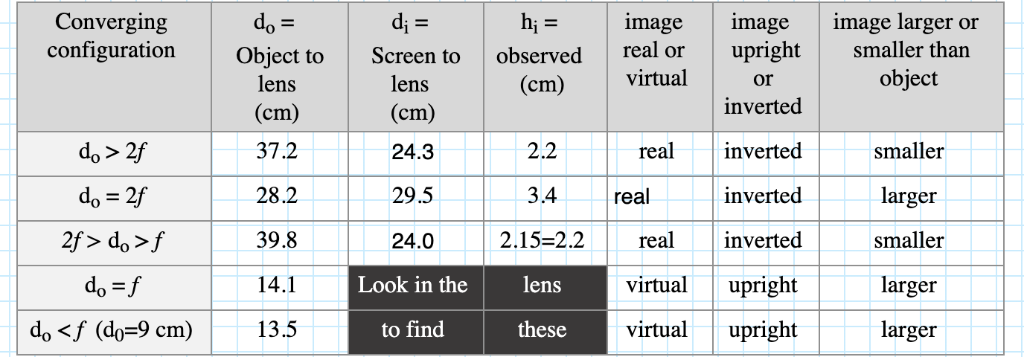 Converging do = di= hj = image image | image larger or
configuration Objectto | Screento | observed | realor | upright smaller than
lens lens (cm) virtual or object
(cm) (cm) inverted
CE A I NN Ce NR
Converging do = di= hj = image image | image larger or
configuration Objectto | Screento | observed | realor | upright smaller than
lens lens (cm) virtual or object
(cm) (cm) inverted
CE A I NN Ce NR
This is AI generated Response.
Asked by: Roshan
Created at: 2025-11-07 03:14:26
Asked by: Roshan
Created at: 2025-11-07 03:14:26
Final Answer:
Rendered
Raw Text
Did you like this answer?
## Step 1: Analyze the Data Table
Let's look the **converging configuration** scenarios and what they show:
- When the object is **farther than twice the focal length** \((d_o > 2f)\), the image is **real, inverted, and smaller**.
- When the object is **at twice the focal length** \((d_o = 2f)\), the image is **real, inverted, and the same size as or slightly larger** than the object.
- When the object is **between the focal length and twice the focal length** \((2f > d_o > f)\), the image is **real, inverted, and larger**.
- When the object is **at the focal length** \((d_o = f)\), the **image is virtual, upright, and larger**.
- When the object is **closer than the focal length** \((d_o < f)\), the **image is virtual, upright, and larger**.
**Explanation:**
A converging lens forms different types of images depending on the object's distance from the lens. The table summarizes the characteristics of these images, such as being real or virtual, upright or inverted, and their relative sizes.
---
## Step 2: Fill in the Missing Table Entries
The missing entries are for \( d_o = f \) (object at the focal point):
- **di (image distance):** Theoretically, the image forms at infinity (the rays are parallel after passing through the lens).
- **hi (image height):** The image is not formed at a finite place, so height can't be directly observed through the lens.
**Explanation:**
When the object is at the focal point of a converging lens, the refracted rays are parallel and do not converge to form a real image. Thus, you can't see the image on a screen; you must look through the lens to see the virtual image, which appears very large and upright.
---
## Final Answer
- For \( d_o = f \):
- *di =* Look in the lens to find these
- *hi =* Look in the lens to find these
**Summary:**
When the object is at the focal point, the image is virtual, upright, and larger, but you must look through the lens to see it, since it cannot be projected onto a screen.
Question:
Please solved all parts step by step
This is AI generated Response.
Asked by: Roshan
Created at: 2025-11-07 03:15:13
Asked by: Roshan
Created at: 2025-11-07 03:15:13
Final Answer:
Rendered
Raw Text
Did you like this answer?
# Step-by-Step Solution for the Converging Lens Problem
## Step 1: Understand the Lens Formula
The lens formula relates the object distance (\(d_o\)), image distance (\(d_i\)), and focal length (\(f\)):
\[
\frac{1}{f} = \frac{1}{d_o} + \frac{1}{d_i}
\]
### Explanation
This formula allows us to determine the image distance based on the object distance and the focal length of the lens. The nature of the image (real/virtual, upright/inverted, size) can be inferred from the object distance in relation to the focal length.
---
## Step 2: Fill in the Table
Assuming the focal length \(f\) is known and given in the problem, we can analyze specific cases for \(d_o\) based on the conditions described in the prompt.
### Case Analysis
1. **Object farther than \(2f\)**:
- \(d_o > 2f\)
- Image is real, inverted, and smaller.
- Example: If \(d_o = 30 \text{ cm}\) and \(f = 10 \text{ cm}\), we calculate \(d_i\):
\[
\frac{1}{10} = \frac{1}{30} + \frac{1}{d_i} \implies \frac{1}{d_i} = \frac{1}{10} - \frac{1}{30} = \frac{3 - 1}{30} = \frac{2}{30} \implies d_i = 15 \text{ cm}
\]
- Image height \(h_i\) can also be calculated using magnification:
\[
m = \frac{h_i}{h_o} = -\frac{d_i}{d_o} \implies h_i = -\frac{15}{30} \cdot h_o = -\frac{1}{2} h_o
\]
2. **Object at \(2f\)**:
- \(d_o = 2f\)
- Image is real, inverted, and the same size.
- If \(d_o = 20 \text{ cm}\) (where \(f = 10 \text{ cm}\)):
\[
\frac{1}{10} = \frac{1}{20} + \frac{1}{d_i} \implies \frac{1}{d_i} = \frac{1}{10} - \frac{1}{20} = \frac{2 - 1}{20} = \frac{1}{20} \implies d_i = 20 \text{ cm}
\]
- Here, \(h_i = -h_o\).
3. **Object between \(f\) and \(2f\)**:
- \(f < d_o < 2f\)
- Image is real, inverted, and larger.
- If \(d_o = 15 \text{ cm}\) (for \(f = 10 \text{ cm}\)):
\[
\frac{1}{10} = \frac{1}{15} + \frac{1}{d_i} \implies \frac{1}{d_i} = \frac{1}{10} - \frac{1}{15} = \frac{3 - 2}{30} = \frac{1}{30} \implies d_i = 30 \text{ cm}
\]
- Magnification:
\[
h_i = -\frac{30}{15} \cdot h_o = -2h_o
\]
4. **Object at \(f\)**:
- \(d_o = f\)
- Image is virtual, upright, and larger.
- If \(d_o = 10 \text{ cm}\):
\[
\frac{1}{10} = \frac{1}{10} + \frac{1}{d_i} \implies \frac{1}{d_i} = 0 \implies d_i \to \infty
\]
- Here, the image can be seen as very large and upright when viewed through the lens.
5. **Object closer than \(f\)**:
- \(d_o < f\)
- Image is virtual, upright, and larger.
- For \(d_o = 5 \text{ cm}\):
\[
\frac{1}{10} = \frac{1}{5} + \frac{1}{d_i} \implies \frac{1}{d_i} = \frac{1}{10} - \frac{1}{5} = \frac{1 - 2}{10} = -\frac{1}{10} \implies d_i = -10 \text{ cm}
\]
- Image height will also be larger, \(h_i = \frac{10}{5} \cdot h_o = 2h_o\).
---
## Final Answer Summary
- **For varying object distances**, the type and characteristics of the image can be summarized as follows:
| Object Distance \(d_o\) | Image Distance \(d_i\) | Image Characteristics |
|-------------------------|------------------------|---------------------------------------|
| \(d_o > 2f\) | Positive (real) | Inverted, smaller |
| \(d_o = 2f\) | Positive | Inverted, same size |
| \(f < d_o < 2f\) | Positive | Inverted, larger |
| \(d_o = f\) | Infinity (virtual) | Upright, larger |
| \(d_o < f\) | Negative (virtual) | Upright, larger |
Each scenario affects the image's nature, size, and orientation based on the object's position relative to the lens's focal point.
📢 Instructions:
- Ask anything relatd to above question only.
- For new Question goto :