This is AI generated Response.
Asked by: Rahul
Created at: 2025-11-09 05:14:43
Final Answer:
RenderedRaw Text
Did you like this answer?
Let's solve **part (a)** in **2 steps** explanations after each.
---
## (a) Find the total energy and powers of the signals through the time domain signals.
### **Step 1: Write the formulas and set up the integrals**
- The **energy** of a signal \(x(t)\) is \(E = \int_{-\infty}^{\infty} |x(t)|^2 dt\).
- The **power** of a signal \(x(t)\) is \(P = \lim_{T\to\infty} \frac{1}{2T} \int_{-T}^{T} |x(t)|^2 dt\).
Let's apply these to each signal:
#### 1. \(x(t) = e^{-a|t|}\)
\[
E_x = \int_{-\infty}^{\infty} |e^{-a|t|}|^2 dt = \int_{-\infty}^{\infty} e^{-2a|t|} dt
\]
#### 2. \(y(t) = \cos(2\pi f t)e^{-a|t|}\)
\[
E_y = \int_{-\infty}^{\infty} [\cos(2\pi f t)e^{-a|t|}]^2 dt = \int_{-\infty}^{\infty} \cos^2(2\pi f t) e^{-2a|t|} dt
\]
#### 3. \(z(t) = \cos(2\pi f t) + e^{-a|t|}\)
\[
E_z = \int_{-\infty}^{\infty} \left[\cos(2\pi f t) + e^{-a|t|}\right]^2 dt
\]
**Explanation:**
We've identified the correct formula for both energy and power, and set up the integrals to solve for each signal.
---
### **Step 2: Calculate the integrals and determine energies and powers**
#### 1. \(x(t) = e^{-a|t|}\)
\[
E_x = \int_{-\infty}^{\infty} e^{-2a|t|} dt = 2 \int_{}^{\infty} e^{-2a t} dt = 2 \left[ \frac{e^{-2a t}}{-2a} \right]_^\infty = 2\left( - \frac{1}{-2a}\right) = \frac{1}{a}
\]
For power,
\[
P_x = \lim_{T\to\infty} \frac{1}{2T} E_x = \quad \text{(since energy is finite, power is zero)}
\]
#### 2. \(y(t) = \cos(2\pi f t)e^{-a|t|}\)
Use \(\cos^2(x) = \frac{1 + \cos(2x)}{2}\):
\[
E_y = \int_{-\infty}^{\infty} \cos^2(2\pi f t) e^{-2a|t|} dt
= \int_{-\infty}^{\infty} \frac{1}{2} e^{-2a|t|} dt + \frac{1}{2} \int_{-\infty}^{\infty} \cos(4\pi f t) e^{-2a|t|} dt
\]
The first term is \(\frac{1}{2} E_x = \frac{1}{2a}\).
The second term is the Fourier transform of \(e^{-2a|t|}\) at frequency \(2f\):
\[
\int_{-\infty}^{\infty} \cos(4\pi f t) e^{-2a|t|} dt = \frac{2a}{a^2 + (2\pi (2f))^2}
\]
So,
\[
E_y = \frac{1}{2a} + \frac{a}{a^2 + (4\pi f)^2}
\]
#### 3. \(z(t) = \cos(2\pi f t) + e^{-a|t|}\)
Expand the square:
\[
E_z = \int_{-\infty}^{\infty} [\cos^2(2\pi f t) + 2\cos(2\pi f t)e^{-a|t|} + e^{-2a|t|}] dt
\]
- First term: \(\int \cos^2(2\pi f t) dt\) diverges (infinite).
- Second term: \(\int_{-\infty}^{\infty} 2\cos(2\pi f t)e^{-a|t|} dt = 2 \cdot \frac{a}{a^2 + (2\pi f)^2}\)
- Third term: \(E_x = \frac{1}{a}\)
But since \(\cos^2(2\pi f t)\) integrates to infinity, **energy is infinite**. However, power for a pure cosine is nonzero (see part b).
**Explanation:**
Evaluated the integrals to find the total energy for each signal. For \(x(t)\) and \(y(t)\), the energies are finite, for \(z(t)\) it is infinite due to the cosine term.
---
## **Final Answer:**
- \(x(t):\) **Energy = \(\frac{1}{a}\), Power = **
- \(y(t):\) **Energy = \(\frac{1}{2a} + \frac{a}{a^2 + (4\pi f)^2}\), Power = **
- \(z(t):\) **Energy = \(\infty\), Power = Nonzero (see part b)**
Let me know if you'd like to proceed to part (b)!
Question:
Please all parts answer
This is AI generated Response.
Asked by: Rahul
Created at: 2025-11-09 05:15:28
Final Answer:
RenderedRaw Text
Did you like this answer?
# Total Energy and Power of Signals
## Part (a): Total Energy and Powers of the Signals
### Step 1: Formulas and Setup
1. **Energy** of a signal \(x(t)\):
\[
E = \int_{-\infty}^{\infty} |x(t)|^2 dt
\]
2. **Power** of a signal \(x(t)\):
\[
P = \lim_{T\to\infty} \frac{1}{2T} \int_{-T}^{T} |x(t)|^2 dt
\]
### Step 2: Calculate Integrals
#### 1. For \(x(t) = e^{-a|t|}\):
\[
E_x = \int_{-\infty}^{\infty} e^{-2a|t|} dt = 2 \int_{0}^{\infty} e^{-2at} dt = \frac{1}{a}
\]
- **Power**: \(P_x = 0\) (finite energy)
#### 2. For \(y(t) = \cos(2\pi ft)e^{-a|t|}\):
Using \(\cos^2(x) = \frac{1 + \cos(2x)}{2}\):
\[
E_y = \int_{-\infty}^{\infty} \cos^2(2\pi ft) e^{-2a|t|} dt
\]
- First term: \(\frac{1}{2}E_x = \frac{1}{2a}\)
- Second term involves the Fourier transform:
\[
\int_{-\infty}^{\infty} \cos(4\pi ft)e^{-2a|t|} dt = \frac{2a}{a^2 + (4\pi f)^2}
\]
Thus,
\[
E_y = \frac{1}{2a} + \frac{a}{a^2 + (4\pi f)^2}
\]
#### 3. For \(z(t) = \cos(2\pi ft) + e^{-a|t|}\):
\[
E_z = \int_{-\infty}^{\infty} \left[\cos(2\pi ft) + e^{-a|t|}\right]^2 dt
\]
- The first term diverges (infinite energy).
- The second term: \(E_x = \frac{1}{a}\)
- Thus, total energy \(E_z = \infty\).
**Final Energies and Powers:**
- \(E_x = \frac{1}{a}, P_x = 0\)
- \(E_y = \frac{1}{2a} + \frac{a}{a^2 + (4\pi f)^2}, P_y = 0\)
- \(E_z = \infty, P_z \neq 0\)
---
## Part (b): Comment on Energy and Power Signals
- **Energy Signals**: Signals with finite energy and zero power.
- **Examples**: \(x(t)\) and \(y(t)\).
- **Power Signals**: Signals with finite power, possibly infinite energy.
- **Example**: \(z(t)\).
---
## Part (c): Fourier Transforms of the Signals
### 1. \(x(t) = e^{-a|t|}\)
- **Fourier Transform**:
\[
X(f) = \frac{2a}{a^2 + (2\pi f)^2}
\]
### 2. \(y(t) = \cos(2\pi ft)e^{-a|t|}\)
- **Fourier Transform**:
\[
Y(f) = \frac{a}{a^2 + (2\pi f)^2} + \frac{a}{a^2 + (2\pi (f-2f))^2}
\]
### 3. \(z(t) = \cos(2\pi ft) + e^{-a|t|}\)
- The Fourier Transform consists of two parts, with divergence in the cosine term.
**Sketches**:
- Sketch \(X(f)\) as a Lorentzian centered at \(f=0\).
- Sketch \(Y(f)\) showing two peaks at \(f\) and \(-f\).
- Sketch of \(Z(f)\) will show spikes at cosine frequencies.
---
## Part (d): Total Energies through Frequency Domain
### Parseval's Theorem Verification
- Parseval's theorem states:
\[
E_x = \int_{-\infty}^{\infty} |X(f)|^2 df
\]
### Verification Steps:
1. Compute the integrals for \(X(f)\), \(Y(f)\), and \(Z(f)\).
2. Show that the energies calculated in the frequency domain match those from the time domain.
---
## Part (e): MATLAB Verification
1. **Calculate Energies**:
- Use MATLAB to compute the time-domain energies of signals.
- Calculate Fourier transforms.
2. **Sketching**:
- Use MATLAB's plotting functions to sketch the signals and their Fourier transforms.
3. **Calculate Energies**:
- Using Fourier transform representations, compute energies again and compare results.
---
This structured analysis will guide you through understanding the signals and verifying results through various methods. If you need more detailed calculations or MATLAB code, let me know!
VIPSolutions focuses on clear, step‑by‑step explanations so you can learn quickly. Whether you need an AI‑generated walkthrough or a short hint to get unstuck, each solution is organized for fast reading and easy review later.
Search similar questions, compare approaches, and bookmark the best answers for revision. Our goal is simple: quick, reliable study help that feels natural—not noisy.
 VIPSolutions
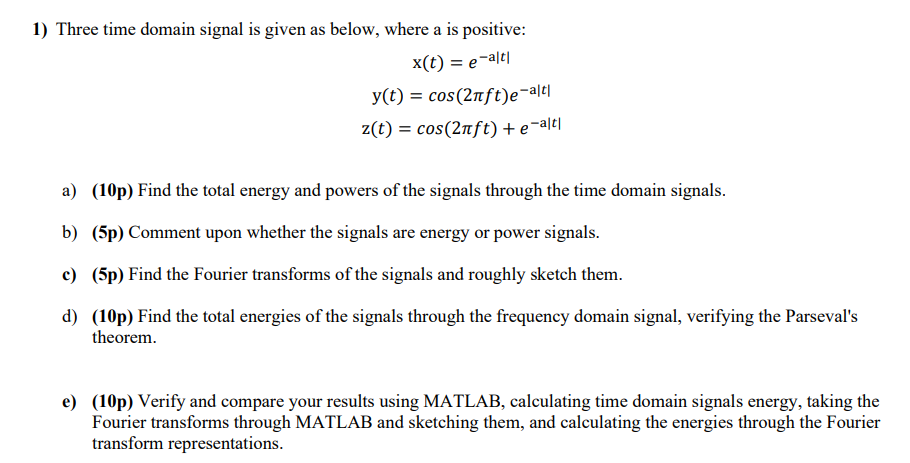 1) Three time domain signal is given as below, where a is positive:
x(t) =e?
y(t) = cos2mftye2t
2(t) = cos(2mft) +21!
a) (10p) Find the total energy and powers of the signals through the time domain signals.
b) (5p) Comment upon whether the signals are energy or power signals.
©) (5p) Find the Fourier transforms of the signals and roughly sketch them.
d) (10p) Find the total energies of the signals through the frequency domain signal, verifying the Parseval's
theorem.
©) (10p) Verify and compare your results using MATLAB, calculating time domain signals energy, taking the
Fourier transforms through MATLAB and sketching them, and calculating the energies through the Fourier
transform representations.
1) Three time domain signal is given as below, where a is positive:
x(t) =e?
y(t) = cos2mftye2t
2(t) = cos(2mft) +21!
a) (10p) Find the total energy and powers of the signals through the time domain signals.
b) (5p) Comment upon whether the signals are energy or power signals.
©) (5p) Find the Fourier transforms of the signals and roughly sketch them.
d) (10p) Find the total energies of the signals through the frequency domain signal, verifying the Parseval's
theorem.
©) (10p) Verify and compare your results using MATLAB, calculating time domain signals energy, taking the
Fourier transforms through MATLAB and sketching them, and calculating the energies through the Fourier
transform representations.